Talat Noi: Bangkok's Forgotten Urban Village With Surprising Depth
Wedged between the Chao Phraya River and Chinatown's gold shops, Talat Noi is one of Bangkok's oldest surviving neighborhoods. Its layered streets hold Portuguese-influenced shrines, century-old mechanic workshops, and some of the city's most photogenic street art, all within a compact area most tourists walk straight past.
Quick Facts
- Location
- Talat Noi, Samphanthawong District, Bangkok (between Yaowarat and the Chao Phraya River)
- Getting There
- MRT Sam Yot (10-min walk) or Chao Phraya Express Boat to Si Phraya or Marine Department Pier
- Time Needed
- 1.5 to 3 hours for a thorough walk
- Cost
- Free to explore; café and food costs vary
- Best for
- Architecture lovers, street photographers, slow travelers, and anyone curious about old Bangkok
What Is Talat Noi and Why It Matters
Talat Noi translates loosely as 'small market,' and the name understates what this neighborhood actually is: one of the oldest continuously inhabited urban pockets in Bangkok. It predates the founding of the Rattanakosin capital, originally settled by Chinese and Portuguese traders who worked the river commerce routes in the late 18th and early 19th centuries. While much of old Bangkok has been demolished or renovated beyond recognition, Talat Noi has survived through a combination of economic neglect and tight community bonds, and the result is a neighborhood that still reads like a physical archive of the city's mercantile past.
The area sits just south of Chinatown's main artery, Yaowarat Road, squeezed between a dense grid of narrow lanes and the Chao Phraya riverbank. Its defining visual characteristic is the Chinese-Portuguese shophouse, a building type with a colonnaded ground-floor walkway and upper residential floors, many of which still bear their original tiled facades and carved wooden shutters. Some are pristine. Many are beautiful in their decay, with peeling paint, monsoon-stained plaster, and ficus roots working through old brick. Neither version is wrong.
💡 Local tip
Visit on a weekday morning, ideally between 7am and 9am, when the neighborhood runs on its own rhythm: mechanics opening their workshops, aunties sweeping sidewalks, and the smell of joss sticks from small household shrines drifting into the lane.
The Street-Level Experience: What You Actually See
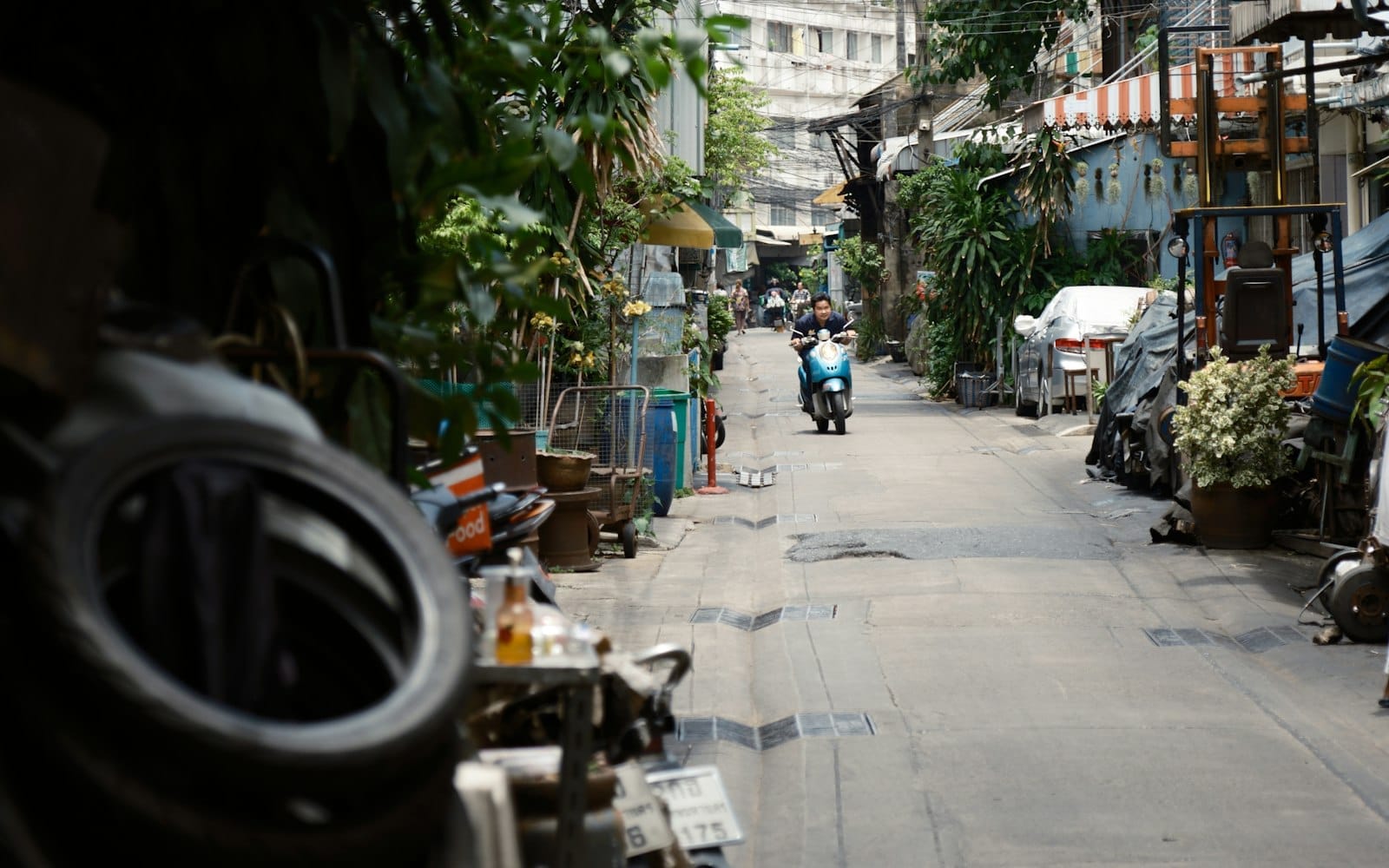
The entrance most visitors take is from Yaowarat Road, cutting south down Soi Wanit 2 or one of the narrow alleys that branch off toward the river. The contrast with Yaowarat is immediate. The gold-shop signage and constant foot traffic of Chinatown give way to something quieter and more textured. You walk on uneven paving stones past open-fronted workshops where men in oil-stained shirts sort engine parts, past stacked crates of produce outside family homes, past cats sleeping on ledges.
The street art scattered across the quarter adds another layer. Several large-scale murals have appeared over the past decade, painted on the sides of shophouses and the blank faces of older buildings. The subjects often reflect the neighborhood's history: river traders, old tools, portraits of elderly residents. These aren't purely decorative. They signal that younger creative residents have been investing in the neighborhood's identity without erasing what came before.
At the river end of the neighborhood, the lanes open onto a narrow waterfront strip. The view across the Chao Phraya here is quieter than from the main piers: long-tail boats cutting wakes through brown water, rice barges moving slowly upstream, the occasional tourist ferry in the distance. Early morning brings mist and soft light that makes this one of the better photography spots in the city for those willing to forgo the more famous views from Wat Arun.
The neighborhood's position adjacent to Chinatown means you can easily extend a visit into Yaowarat Road's famous food scene afterward, making this a natural pairing for half a day.
Tickets & tours
Hand-picked options from our booking partner. Prices are indicative; availability and final rates are confirmed when you complete your booking.
Temples of Bangkok and Grand Palace half-day guided tour
From 18 €Instant confirmationFree cancellationDamnoen Saduak floating market and Maeklong railway guided tour
From 36 €Instant confirmationFree cancellationBangkok tuk-tuk night tour with Chinatown street food meal
From 28 €Instant confirmationFree cancellationAfternoon Tea at Hyatt Regency Hotel Bangkok
From 900 €Instant confirmationFree cancellation
Key Sites Within the Neighborhood
Holy Rosary Church Area
On the western edge of the Talat Noi area, near the riverbank, sits the historic Portuguese Catholic settlement. This community was established by Portuguese traders and Catholic missionaries in the 18th century and represents a rare surviving example of Bangkok's early multicultural port culture. The church itself is painted in pale yellow, and the surrounding lanes hold small family-run shops selling kanom farang, a dense egg cake that traces its recipe directly to Portuguese influence.
Talat Noi Shrine and Community Halls
Scattered through the sois are several small Chinese community shrines and clan association halls, some dating to the 19th century. These are functional religious and social spaces, not museums. If a ceremony is underway, observe respectfully from a distance and follow the lead of locals regarding photography. The shrines typically feature red lacquered altars, offerings of fruit and incense, and the low murmur of recorded chanting. Entry to some is permitted to respectful visitors; others are private.
The Mechanic Workshops
One of Talat Noi's most distinctive features is its concentration of old-school auto and marine mechanical workshops, a trade that has operated in this area for generations. These are not tourist attractions in themselves, but they give the neighborhood its working texture: the clang of metal on metal, the smell of oil and rubber, the sight of engine blocks stacked alongside antique furniture and potted plants. This is everyday commerce in a city that has otherwise pushed much of its industrial activity to the outskirts.
How the Neighborhood Changes Through the Day
Early morning is the most rewarding time to visit. Between 6am and 9am the lanes are active with local residents going about routines that feel entirely disconnected from Bangkok's tourist circuits. Vendors sell rice porridge and Chinese pastries from carts positioned at lane intersections. The light is cool and flat, good for photography without harsh shadows on the shophouse facades.
By late morning the workshops are in full operation and the neighborhood hits a utilitarian midday rhythm. This is still a pleasant time to walk, though the heat rises sharply in the narrow lanes after about 10am. Carrying water is non-negotiable in any season, but particularly from March through May when temperatures in sheltered alleys can feel significantly hotter than the official reading.
Afternoons bring a quieter lull. Some family businesses close for a few hours. This is actually a good time to sit in one of the small cafés that have opened in renovated shophouses and observe the neighborhood from a fixed point rather than moving through it. Evenings are calm rather than dramatic here, unlike the neon-lit atmosphere of nearby Yaowarat Road.
⚠️ What to skip
Talat Noi's lanes are narrow and not consistently labeled. A downloaded offline map (Google Maps or Maps.me with offline data) is strongly recommended before you enter, as mobile data can be patchy in the older buildings.
Practical Information for Visiting
There are no entrance fees and no ticket booths. This is a living neighborhood, not a managed attraction, and it should be approached with that awareness. Walk quietly, avoid photographing people inside their homes without clear permission, and do not block narrow passages that residents and workers use as functioning thoroughfares.
Getting here on foot from the MRT Sam Yot station takes roughly 10 minutes heading west toward the river, passing through the fringes of Chinatown along the way. Alternatively, the Chao Phraya Express Boat stops at Si Phraya Pier, which places you near the riverfront end of Talat Noi. This river approach gives a completely different first impression: you arrive at the waterfront edge first and work inward, which some visitors find more atmospheric than entering from Yaowarat.
Talat Noi pairs well with a visit to Wat Traimit to the northeast and the Chinatown street food corridor along Yaowarat Road. Together these make a coherent half-day itinerary in the Samphanthawong district without significant backtracking.
Wear shoes with closed toes. The lane surfaces are uneven, and some sections have broken paving or low curbs that are easy to miss when you are looking at a mural or a building facade. Lightweight, breathable clothing is practical for most of the year given the limited airflow in the narrower sois.
ℹ️ Good to know
Several small independent cafés have opened inside renovated shophouses in recent years. These are worth a stop both for rest and because they often display historical photographs of the neighborhood, providing visual context for what you are walking through.
Who Should Skip Talat Noi
Talat Noi rewards slow, observational travel. Visitors who want clearly labeled attractions, air-conditioned comfort, or a structured narrative experience may find it unsatisfying. There are no interpretation panels, no audio guides, and no defined route. The neighborhood's appeal is largely atmospheric and architectural, which means someone expecting dramatic temple grandeur or a polished cultural attraction will likely leave underwhelmed.
Mobility is also a consideration. The surfaces are uneven throughout, and some of the more interesting lanes involve steps, narrow gaps between buildings, or sections with no pavement at all. Visitors who use wheelchairs or have significant difficulty with uneven ground will find access limited.
If your Bangkok visit is short and you are focused on major landmarks, your time is likely better spent at the Grand Palace or Wat Pho before coming here. Talat Noi fits best into an itinerary that has already covered the headline sites and is looking for something with more texture and less polish.
Insider Tips
- The most photogenic stretch of shophouses is found by walking down Soi Talat Noi itself toward the river, particularly the section where overhanging upper floors create a narrow corridor of peeling plaster and old wood. Best light is in the early morning before 9am.
- Several murals change or are added periodically. If you have visited before and think you know the route, check recent photos online before returning, as the street art landscape shifts year to year.
- The riverfront at the end of the neighborhood has a small informal sitting area where locals gather in the early morning. Sitting here quietly for 15 to 20 minutes gives a far more accurate picture of daily life in old Bangkok than any managed cultural center.
- Avoid visiting during major Chinese festivals when the lanes can become extremely crowded and some of the smaller shrines restrict access entirely. Check the lunar calendar around Chinese New Year and the Vegetarian Festival period.
Who Is Talat Noi For?
- Street photographers looking for layered, unposed urban scenes beyond the obvious Bangkok backdrops
- Architecture enthusiasts interested in Chinese-Portuguese shophouse vernacular and its survival in a modern city
- Repeat visitors to Bangkok who have already covered the major temples and want to understand how the city actually lives
- Travelers with a genuine interest in Thai-Chinese cultural history and the Portuguese legacy in Southeast Asia
- Anyone who appreciates slow, unhurried neighborhood walking as a way of experiencing a city
Nearby Attractions
Other things to see while in Chinatown (Yaowarat):
- Chinatown Street Food
Yaowarat Road and its surrounding lanes form the spine of Bangkok's most intense street food district. From char-grilled seafood to century-old noodle shops, Chinatown rewards curious eaters who arrive hungry and unhurried.
- Wat Mangkon Kamalawat
Wat Mangkon Kamalawat, known in Cantonese as Leng Buai Ia, is Bangkok's most important Chinese Mahayana Buddhist temple. Built in 1871 along Charoen Krung Road, it draws thousands of worshippers daily and reaches spiritual intensity during Chinese New Year. For visitors willing to engage with a genuinely active place of worship, it offers an experience unlike anything else in the city.
- Wat Traimit (Golden Buddha)
Wat Traimit in Bangkok's Chinatown houses the world's largest solid gold Buddha statue, a 5.5-tonne masterpiece of Sukhothai craftsmanship with a remarkable discovery story. The temple complex also holds a museum tracing the history of Bangkok's Chinese community, making it one of the most layered cultural stops in the city.
- Yaowarat Road
Yaowarat Road is the spine of Bangkok's Chinatown, a centuries-old commercial corridor lined with gold traders, roast duck shops, street food carts, and ornate Chinese shrines. It comes alive after dark when the neon signs ignite and the sidewalks fill with smoke from charcoal grills.