Water Street, Gastown: Walking Vancouver's Oldest Street
Water Street is the spine of Gastown, Vancouver's original settlement and a National Historic Site of Canada. Free to walk, lined with heritage brick buildings dating to the 1890s, and anchored by the famous Gastown Steam Clock, it rewards visitors who slow down and pay attention to the architecture rather than just the souvenir shops.
Quick Facts
- Location
- Gastown, Downtown Vancouver, BC
- Getting There
- Waterfront Station (SkyTrain, SeaBus, West Coast Express) — Water Street is a short walk east
- Time Needed
- 45 minutes to 2 hours depending on stops
- Cost
- Free (public street; individual shops and restaurants charge separately)
- Best for
- Architecture lovers, history walkers, photographers, first-time Vancouver visitors
- Official website
- gastown.org/discover-water-street
About Water Street
Water Street is a relatively short public street running through the Gastown neighbourhood in Downtown Vancouver, close to the south shore of Burrard Inlet. It was briefly known as Front Street in the city's earliest days, a name that reflected its position at the waterfront edge of the original settlement. Today it functions as Gastown's main commercial corridor, and because Gastown is itself a designated National Historic Site of Canada, the streetscape is subject to heritage protections that have kept the building facades largely intact.
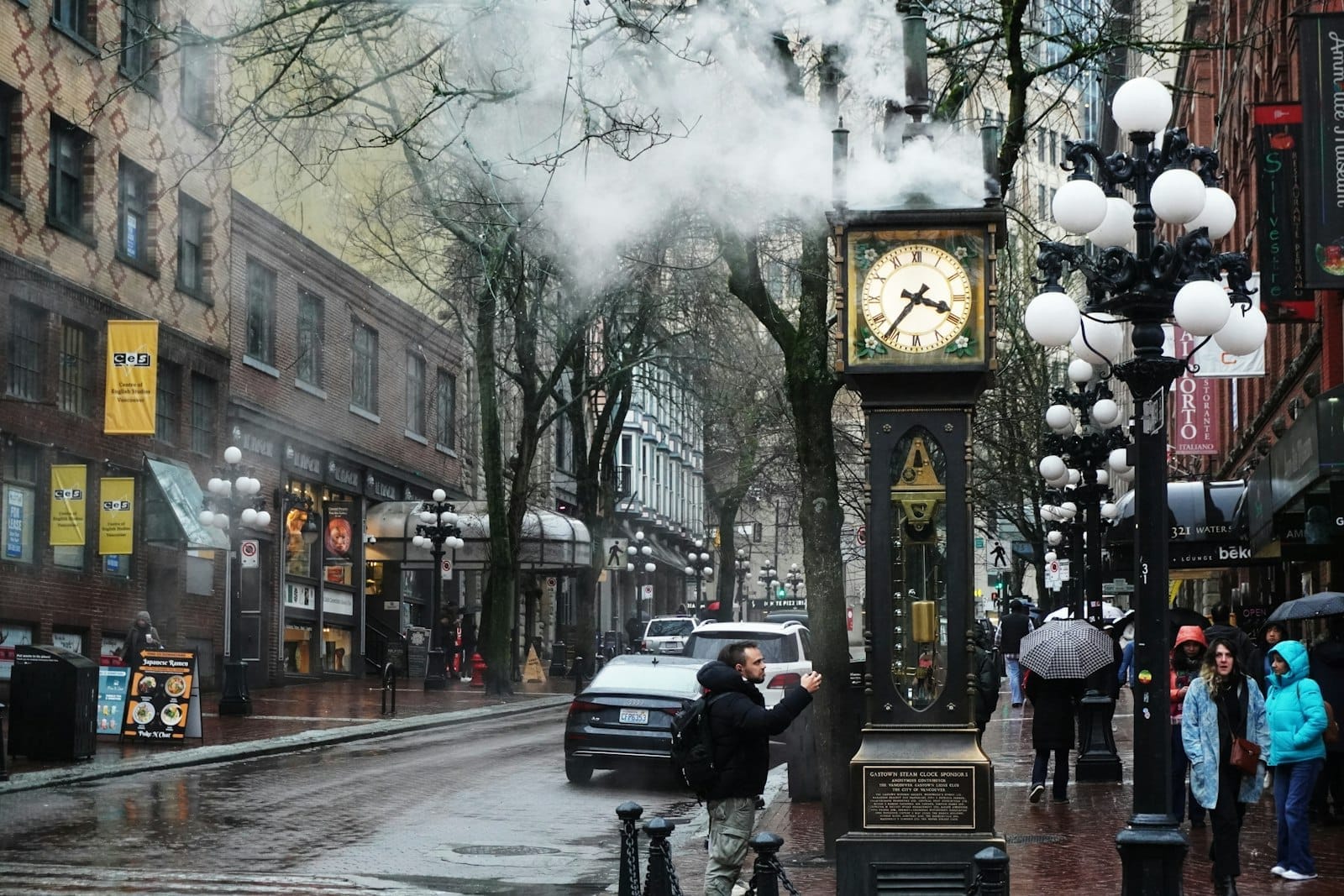
The cobblestone-style paving, the cast-iron street lamps, and the low-rise brick buildings create a visual register that is genuinely unusual in a Canadian city of Vancouver's scale. Most of what you see is not a reconstruction or a theme-park impression of the past; these are real buildings, some dating to the early 1890s. The Holland Block at 364 Water St, for example, was constructed in 1891 to 1892 and still stands in recognizable form.
ℹ️ Good to know
Water Street is a public thoroughfare with no admission fee and no formal opening hours. The street itself is accessible at any hour, though the shops and restaurants set their own times. Plan your visit around the businesses you want to enter, not the street itself.
The Steam Clock and Why Everyone Stops Here
The Gastown Steam Clock at the corner of Water Street and Cambie Street is the single most photographed object in the neighbourhood, and it draws a reliable crowd at any hour. It chimes every quarter-hour and the full hourly whistle sequence draws onlookers into a loose semicircle on the sidewalk. The mechanism is visually interesting and the sound is distinctive rather than decorative.
For context on what you are actually looking at, the Gastown Steam Clock has its own detailed page covering the history of its construction and the steam system that powers it. The short version: it is not a Victorian original but a 1977 installation designed by Raymond Saunders. That does not make it less interesting, but visitors who arrive expecting a genuine 19th-century artifact should know the difference.
Early morning is the least crowded time to photograph the clock with a clear foreground. By late morning on any summer weekend, the sidewalk around the clock is dense with tour groups, and getting a clean composition requires patience or a wide-angle lens. On rainy weekday mornings in autumn or winter, you may have the clock almost entirely to yourself.
Tickets & tours
Hand-picked options from our booking partner. Prices are indicative; availability and final rates are confirmed when you complete your booking.
Old Gastown Vancouver exploration game and tour
From 10 €Instant confirmationFree cancellation2-hour donut tour of Vancouver's downtown with Gastown
From 67 €Instant confirmationFree cancellationLegendary Gastown food tour
From 81 €Instant confirmationFree cancellationThe Lost Souls of Gastown tour
From 26 €Instant confirmationFree cancellation
The Architecture: What to Look for Beyond the Clock
The heritage buildings along Water Street are worth examining at close range. Look up at the upper floors of the brick blocks: decorative corbelling, arched windows, and recessed panel details that were standard commercial architecture in a Pacific Northwest port city at the turn of the 20th century. At street level these buildings now house boutiques, restaurants, and galleries, but the bones of the original warehouse and trading district remain visible if you look above the ground-floor signage.
The cobblestone-style surface underfoot is one of the details that sets Water Street apart from the rest of Downtown Vancouver. It also means the street is not ideal for wheeled luggage, strollers with small wheels, or anyone with mobility challenges. Curb cuts and standard paving are available on adjacent streets, and most individual businesses in the heritage buildings have ground-level or near-level entrances, though this varies by property.
Water Street sits at the edge of a broader neighbourhood worth exploring on foot. The Gastown neighbourhood extends north and south of Water Street, with additional heritage blocks on Cordova Street and Alexander Street. A full walking circuit of Gastown including Water Street typically takes 60 to 90 minutes at a relaxed pace.
How the Street Changes Through the Day
Water Street before 9am is quiet in a way that is easy to underestimate. The morning light comes in low from the east, catching the brick facades at an angle that makes the texture of the masonry apparent. Delivery vehicles park along the kerb, and the smell of roasting coffee drifts from the cafes that open early. This is when the street most closely resembles what a working port-district street might have felt like in its earlier commercial life.
By mid-morning the tour groups arrive, generally on foot from Waterfront Station to the west. The stretch between Abbott Street and Cambie Street becomes the most concentrated pedestrian zone. If you are primarily here for the architecture and the atmosphere rather than the shops, this is the stretch to walk quickly and then explore the quieter blocks further east, where the tourist density drops noticeably.
Evenings on Water Street lean toward restaurants and bars. Several of Gastown's better-regarded dining options have addresses here or just off it, and the evening crowd is noticeably different from the daytime tourist mix: local residents, people arriving for dinner, and a bar-going crowd later in the night. The cobblestones can be uneven underfoot in low light, so practical footwear matters if you are arriving for dinner and moving between venues.
Getting There and Getting Around
The most straightforward arrival is via Waterfront Station, which is served by the SkyTrain Expo and Canada Lines, the SeaBus ferry from North Vancouver, and the West Coast Express commuter rail. From the station's east exit, Water Street is visible within a two-minute walk. There is no need to consult a map for this connection.
For travelers using transit across Vancouver more broadly, the getting around Vancouver guide covers TransLink fares, zone structures, and transit card options. Fares and zone classifications are updated periodically, so verify current pricing on the TransLink website before your visit.
Parking exists in the area but is limited and paid. Walking from adjacent downtown blocks is straightforward for most visitors. Water Street itself is not a through-route for vehicles in the usual sense; the pedestrian and tourist volume on the main block near the Steam Clock makes it a slow drive at most hours.
Photography on Water Street
The photographic appeal of Water Street is real but conditional on timing. The combination of brick buildings, iron lamp posts, and the Steam Clock creates a coherent visual environment that photographs well in soft or overcast light, which Vancouver provides frequently from October through March. Harsh midday summer sun creates difficult contrast between the shadow of building overhangs and the bright cobblestones.
The most commonly overlooked composition is looking east along the street from near Abbott Street, with the brick facades receding in perspective and the North Shore mountains occasionally visible in the background on clear days. This requires clear air and is more likely in winter after a rainfall has cleared the haze than in the smoky periods of late summer.
💡 Local tip
For the clearest mountain backdrop behind the Water Street streetscape, visit on a clear winter morning after overnight rain. Summer haze and wildfire smoke (common in August) frequently obscure the mountains entirely.
Who Should Temper Their Expectations
Water Street is, at its core, a tourist-oriented commercial street with heritage dressing. The shops skew toward souvenirs, fashion boutiques, and restaurants priced for visitors. If you are looking for a street that reflects everyday Vancouver life, this is not it. The locals who come here come for dinner or drinks in the evening, not for daily shopping.
Travelers who have already spent time in comparable heritage districts in other North American cities, particularly in cities with better-preserved 19th-century commercial cores, may find Water Street pleasant but unremarkable. Its significance is partly contextual: for Vancouver, a city that has demolished large portions of its early built fabric, a functioning heritage streetscape of this completeness is genuinely unusual.
If your primary interest is contemporary Vancouver culture rather than heritage, the areas around Main Street and Mount Pleasant offer a more current cross-section of the city. Water Street and Gastown are worth an hour or two on any Vancouver itinerary, but they are not where you go to understand what contemporary Vancouver looks like.
Insider Tips
- Walk the full length of Water Street past the Steam Clock toward its eastern end, where tourist density drops and a few independent galleries and design studios occupy the heritage buildings at lower rents. The architecture on these blocks is often as interesting as the more photographed western section.
- The Steam Clock chimes on the quarter-hour, with the full whistle sequence at the top of the hour. If you want to watch the hourly display without a crowd, arrive two to three minutes early on a weekday morning rather than a weekend afternoon.
- The cobblestones are genuinely uneven in places. If you are walking the area in the evening after rain, solid-soled footwear makes a practical difference. Heels and thin-soled shoes work less well here than on standard paving.
- Adjacent Cordova Street, one block south, has several of Gastown's better independent coffee shops and is noticeably less congested than Water Street at most hours. It is a useful alternative if you want to sit and observe the neighbourhood without the tourist foot traffic.
- On clear days in winter and early spring, the view east along Water Street toward the mountains is sharper than anything you will see in summer. If your visit falls in the wetter months, this is a compensating visual reward worth seeking out.
Who Is Water Street For?
- First-time visitors to Vancouver who want a compact, walkable introduction to the city's history
- Architecture and heritage enthusiasts interested in late-19th-century Pacific Northwest commercial buildings
- Photographers looking for a streetscape with consistent visual character and heritage detail
- Travelers combining a Gastown walk with a visit to nearby Chinatown or the waterfront
- Evening diners using Water Street as a starting point for Gastown's restaurant and bar scene
Nearby Attractions
Other things to see while in Gastown:
- Gastown Steam Clock
Built in 1977 and connected to Vancouver's downtown steam-heating system, the Gastown Steam Clock at Water and Cambie Streets is one of the most photographed spots in the city. It's free, it's effectively always accessible as an outdoor landmark, and it whistles every 15 minutes. Here's how to make the most of a short stop.
- Vancouver Police Museum
Housed in the same building that once served as Vancouver's coroner's court and city morgue, the Vancouver Police Museum & Archives offers an unusually candid look at a century of law enforcement history. It's a small, genuinely absorbing museum that suits curious adults and history buffs far more than families with young children.