Gastown Steam Clock: Vancouver's Famous Whistling Landmark
Built in 1977 and connected to Vancouver's downtown steam-heating system, the Gastown Steam Clock at Water and Cambie Streets is one of the most photographed spots in the city. It's free, it's effectively always accessible as an outdoor landmark, and it whistles every 15 minutes. Here's how to make the most of a short stop.
Quick Facts
- Location
- Water Street at Cambie Street, Gastown, Vancouver, BC
- Getting There
- Waterfront Station (SkyTrain Expo, Canada Lines + SeaBus) — about a 5-minute walk east along Water Street
- Time Needed
- 10–20 minutes to see the clock; pair with a 30–60 minute walk through Gastown
- Cost
- Free — outdoor public landmark, no tickets required
- Best for
- First-time visitors, photography, a quick stop on a broader Gastown walk
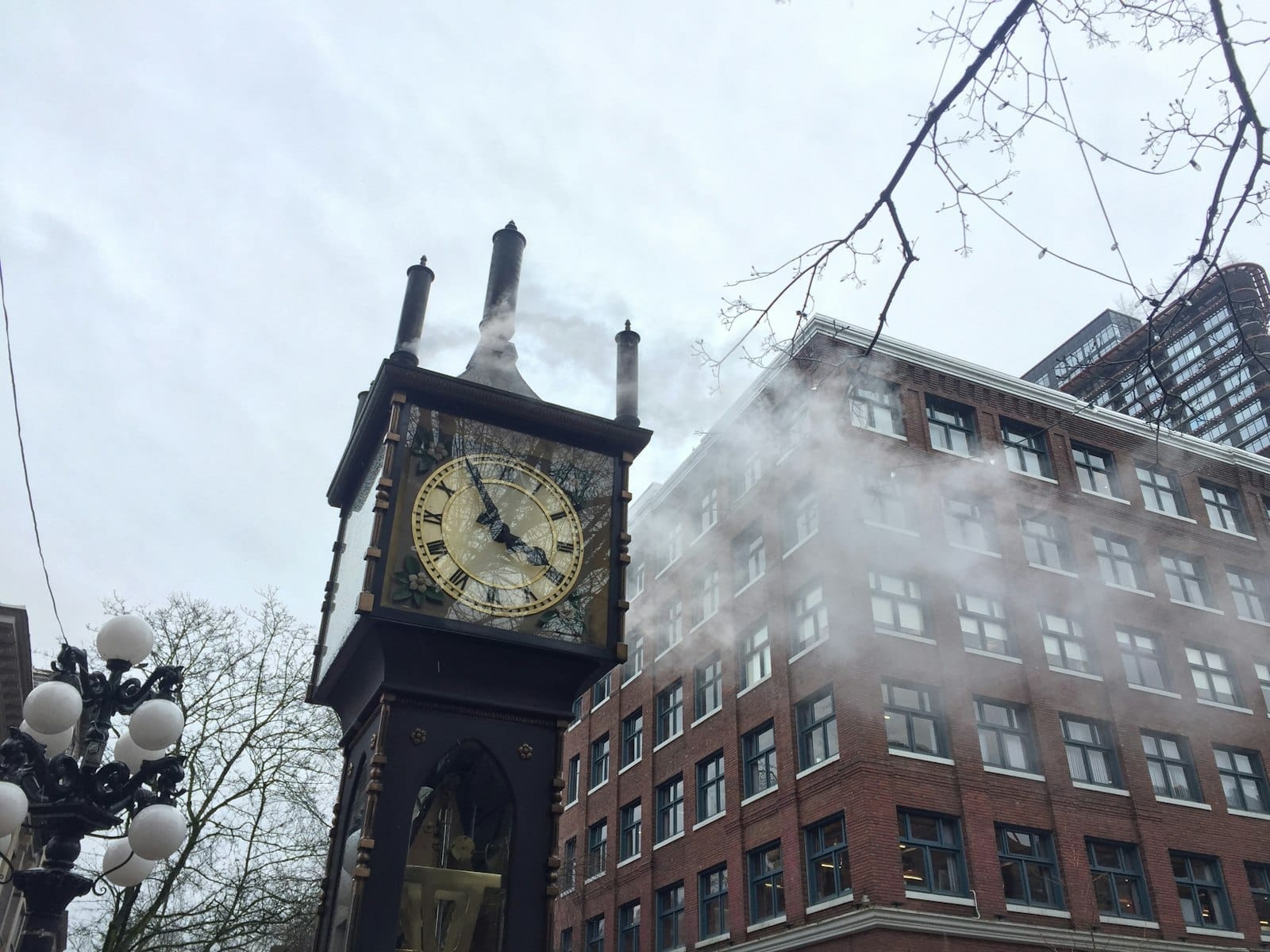
About the Gastown Steam Clock
The Gastown Steam Clock is a two-ton, ornate street clock standing at the corner of Water and Cambie Streets in Vancouver's Gastown district. Built in 1977 by Canadian horologist Raymond Saunders, with metalwork by Doug Smith, it was installed partly as a decorative landmark and partly to cover a functional steam grate that was part of Vancouver's downtown steam-heating system. That system supplies steam to drive the clock’s whistles and the visible white plumes that puff from the top at regular intervals, although the timekeeping mechanism itself is powered electrically.
Despite its Victorian appearance, the timekeeping itself is driven by an electric motor rather than purely by steam. The steam is real, but it's doing theatrical work rather than mechanical work. Every 15 minutes the clock plays Westminster-style chimes through its whistles, and on the hour the display is more pronounced, releasing a visible cloud of steam above the street. It is a genuinely unusual piece of urban engineering, even if the romantic notion of a fully steam-powered clock doesn't quite hold up to scrutiny.
ℹ️ Good to know
The clock chimes every 15 minutes using steam whistles tuned to Westminster-style tones. If you want to catch the full show, plan to arrive a few minutes before the quarter hour.
The Experience at Different Times of Day
At 8 or 9 in the morning, the corner of Water and Cambie is relatively quiet. The cobblestones of Water Street carry the sound of the whistles cleanly, and the steam catches the morning light in a way that makes for genuinely good photography without a crowd in the frame. The surrounding heritage brick buildings and the narrow street add context that midday photos often lose behind a wall of people.
By late morning and through the afternoon, especially in summer, the area fills quickly. Tour groups from nearby cruise ships docked at Canada Place often walk this route, and the clock becomes the anchor for a brief stop. The crowd around it thickens noticeably in the 10 minutes before each quarter-hour chime, with phones raised. If you arrive just after the hour, you'll often find a brief lull before the next wave assembles.
In the evening, the clock takes on a different character. The gas-lamp-style street lighting along Water Street illuminates the brass fittings, and the steam catches the glow in a way that looks nothing like the daytime experience. Winter evenings, when there's a chill and the steam disperses more dramatically into the cold air, are arguably the most atmospheric time to visit. There are fewer people, the surrounding restaurants are lit, and the scene feels more like a genuine neighborhood corner than a tourist attraction.
💡 Local tip
For photos without crowds: arrive before 9 AM in summer, or visit on a weekday evening in autumn or winter. The cold air makes the steam far more visible and photogenic.
Tickets & tours
Hand-picked options from our booking partner. Prices are indicative; availability and final rates are confirmed when you complete your booking.
Old Gastown Vancouver exploration game and tour
From 10 €Instant confirmationFree cancellation2-hour donut tour of Vancouver's downtown with Gastown
From 67 €Instant confirmationFree cancellationLegendary Gastown food tour
From 81 €Instant confirmationFree cancellationThe Lost Souls of Gastown tour
From 26 €Instant confirmationFree cancellation
Historical and Cultural Context
Gastown is the oldest part of Vancouver, named informally after 'Gassy Jack' Deighton, a saloon keeper who set up near Burrard Inlet in 1867. The neighborhood's cobblestone streets and heritage masonry buildings date from the late 19th and early 20th centuries, and the area was designated a historic district in the 1970s as part of a broader effort to prevent demolition and encourage preservation.
The Steam Clock was commissioned in 1977 as part of that revitalization effort. It was designed to draw attention to the neighborhood and give the district a distinctive landmark, and by that measure it succeeded completely. Today, Gastown's street character — the brick facades, the narrow lots, the mix of working studios, restaurants, and souvenir shops — gives the clock a more coherent backdrop than you'd expect from something that's essentially a 1970s installation. For more about the neighborhood, see the Gastown neighborhood guide.
How to Get There and Navigate the Area
Waterfront Station is the most straightforward starting point. It's served by the Expo and Canada SkyTrain lines, the SeaBus from North Vancouver, and the West Coast Express commuter rail. From the station's main exit on Cordova Street, walk east one block to Cambie Street, then one block south to Water Street. The clock is at that corner. The walk takes about five minutes.
The clock sits at the western end of Water Street's most photographed stretch. From here you can walk east along Water Street to explore the rest of Gastown — a 10-minute walk covers the whole main strip. The street is mostly flat and accessible to wheelchair users, though the cobblestones can be uneven in places. There is no indoor area, seating, or shelter associated specifically with the clock.
⚠️ What to skip
Cobblestone sidewalks around the clock can be slippery when wet, which in Vancouver's rainy season (October through March) is frequently. Wear shoes with grip if you're visiting in the wetter months.
Photography Tips
The clock is roughly four meters tall with brass fittings, a glass face, and a domed top from which the steam emerges. Shooting from across Water Street gives you the full clock with the heritage buildings behind it. Shooting from the Cambie Street sidewalk puts the clock in profile against Water Street's perspective, which can work well for wider street shots.
Steam visibility depends on temperature. On warm summer days, the plumes dissipate quickly and may be nearly invisible in photos. On cold days, the steam hangs in the air and photographs dramatically. If steam visibility matters for your shot, visit between November and March. Morning light comes from the east along Water Street and hits the clock's face directly; afternoon light comes from the west and illuminates the metalwork and dome.
Is it worth your time?
The Gastown Steam Clock is frequently cited as one of Vancouver's top attractions, and by visitor count, it genuinely is. But the experience itself is brief. You're looking at a clock on a sidewalk. It chimes, it steams, you photograph it, and you move on. That's fine — it's designed for a short stop, not a destination experience. The value comes from what's around it, not the clock itself.
If you're in Gastown for other reasons — dinner, shopping, a walk through the historic district — the clock is worth two minutes of your time regardless of your expectations. If you're traveling specifically to see it as a primary attraction, it's likely to feel anticlimactic. The neighborhood context is the real draw: the brick architecture, the independent shops, the proximity to Canada Place and the waterfront. Plan the clock as part of a broader Gastown itinerary rather than a standalone trip.
Travelers who prefer museums, galleries, or natural scenery should note that there's little depth here beyond the visual. Those with very limited time in Vancouver may find the effort-to-reward ratio low compared to, say, Stanley Park or Granville Island Public Market. But for a quick, free stop on a walking tour of downtown, it earns its place.
Insider Tips
- Arrive 3–4 minutes before the quarter hour and position yourself on the south side of Water Street for an unobstructed view of the steam release above the clock's dome.
- The clock is best photographed in winter, when cold temperatures make the steam dramatically visible. Summer shots often look like the clock is barely working.
- If the area feels overcrowded midday, walk east along Water Street for five minutes — the rest of Gastown is noticeably less packed and gives a better sense of the historic district.
- The steam-heating network that powers the clock's whistles also serves other downtown buildings. The hiss of steam is subtle when no chime is playing, but you can hear it if you stand close and the street is quiet.
- Combine this stop with the nearby Gassy Jack statue in Maple Tree Square, about a 3-minute walk east — it gives useful historical grounding for what you're seeing in the neighborhood.
Who Is Gastown Steam Clock For?
- First-time visitors to Vancouver checking off an iconic city landmark
- Photography enthusiasts, especially on cold or overcast mornings
- Travelers on a walking tour of Gastown and downtown Vancouver
- Families with children who enjoy the novelty of the steam and chimes
- Budget travelers looking for free sights in the city center
Nearby Attractions
Other things to see while in Gastown:
- Vancouver Police Museum
Housed in the same building that once served as Vancouver's coroner's court and city morgue, the Vancouver Police Museum & Archives offers an unusually candid look at a century of law enforcement history. It's a small, genuinely absorbing museum that suits curious adults and history buffs far more than families with young children.
- Water Street
Water Street is the spine of Gastown, Vancouver's original settlement and a National Historic Site of Canada. Free to walk, lined with heritage brick buildings dating to the 1890s, and anchored by the famous Gastown Steam Clock, it rewards visitors who slow down and pay attention to the architecture rather than just the souvenir shops.