Vancouver Police Museum & Archives: Crime, Consequence, and the City's Dark Past
Housed in the same building that once served as Vancouver's coroner's court and city morgue, the Vancouver Police Museum & Archives offers an unusually candid look at a century of law enforcement history. It's a small, genuinely absorbing museum that suits curious adults and history buffs far more than families with young children.
Quick Facts
- Location
- 240 E Cordova St, Vancouver, BC
- Getting There
- Waterfront Station (10–15 min walk); Bus #4 or #7 stops across the street
- Time Needed
- 1 to 1.5 hours
- Cost
- Approx. CAD $10–$12 per adult (verify current rates at official site)
- Best for
- History enthusiasts, true crime fans, curious solo travelers
- Official website
- www.vancouverpolicemuseum.ca
About the Vancouver Police Museum
The Vancouver Police Museum & Archives is a small but carefully curated museum dedicated to the history of the Vancouver Police Department and the city's relationship with crime, punishment, and public safety from the late 19th century to the present day. It opened in 1986, coinciding with the centennial of the Vancouver Police Department.
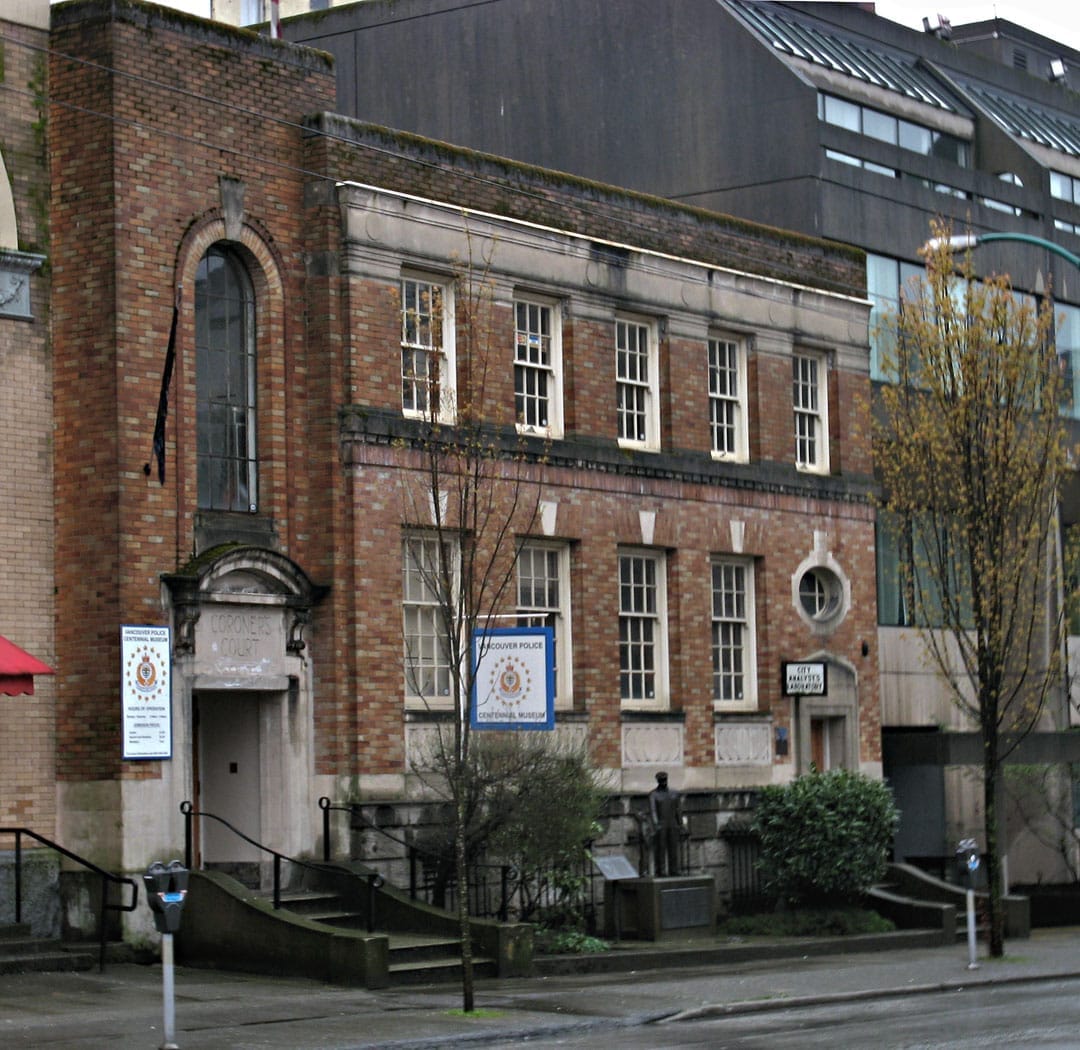
What makes the building as interesting as its contents is its history. The structure at 240 E Cordova Street was purpose-built in 1932 to house the Coroner's Court, the City Morgue, and the City Analyst's Laboratory. The forensic laboratory here was where evidence from major criminal cases was processed. Those rooms still exist, and in some cases still contain original equipment. That context gives the museum a texture that most civic history collections simply lack.
ℹ️ Good to know
Admission prices are subject to change and are not consistently listed on the official site. Check the Vancouver Police Museum website directly before visiting to confirm current rates in CAD.
The Building: A 1932 Morgue That Still Feels Like One
From the street, the building reads as solid civic architecture from the Depression era: brick, restrained, institutional. It doesn't announce itself. You walk up four steps to the front entrance, and the interior immediately signals that this is not a typical museum space. The ceilings are lower than you expect, the corridors narrower, and the floors carry that specific echo of older public buildings.
The former morgue is one of the most affecting rooms on the tour. The autopsy table is still in situ. The tiled walls, the drainage channels, the industrial lighting overhead: none of it has been over-restored or theatrically dressed up. This authenticity is the museum's strongest card. You are standing in the actual space where Vancouver's dead were examined and where coroners' inquests were held for decades. That weight is palpable in a way that replica sets in larger museums rarely achieve.
The building has 2.5 flights of stairs between the entrance and the full museum floor, with no elevator. This is a significant constraint for visitors with mobility limitations, and the museum acknowledges it directly on their website. If you have concerns about stairs or accessibility, contacting the museum ahead of your visit is strongly advised.
⚠️ What to skip
Accessibility is limited. The heritage building has 4 steps at the entrance and 2.5 flights of interior stairs. There is no elevator and restrooms are not wheelchair accessible. Contact the museum before visiting if mobility is a concern.
Tickets & tours
Hand-picked options from our booking partner. Prices are indicative; availability and final rates are confirmed when you complete your booking.
Vancouver Art Gallery Tickets
From 19 €Instant confirmationFree cancellationVancouver Stanley Park cycling tour
From 56 €Instant confirmationFree cancellationWhistler, Shannon Falls and Sky Gondola tour from Vancouver
From 135 €Instant confirmationFree cancellationVancouver City and Capilano Suspension Bridge tour with lunch
From 292 €Instant confirmationFree cancellation
What You'll See Inside
The collection spans roughly 130 years of policing in Vancouver. Exhibits include confiscated weapons, historical uniforms, forensic equipment, photographs of crime scenes, case files, and artifacts from notable investigations. The archive also holds a significant collection of records and photographs that researchers can access by appointment.
Display cases cover everything from counterfeit currency operations to the tools of early forensic science. There are exhibits on the evolution of police communications, from the call-box system that once dotted Gastown's streets to early radio dispatch. One area addresses the history of the VPD's interactions with Vancouver's Chinese community, a story that involves both discriminatory policing practices and complex social history, and the museum handles this with more candor than you might expect from an institution connected to the department itself.
The City Analyst's Lab section is particularly compelling for anyone with an interest in forensic science. The original glassware, chemical cabinets, and analytical instruments have been preserved. Staff can explain what specific pieces of equipment were used to test for poisons, adulterants, and other substances in an era before modern toxicology.
How the Experience Changes by Time of Day
The museum opens 10:00–17:00 on Thursdays through Saturdays and 12:00–17:00 on Sundays. Arriving close to opening is genuinely worthwhile here. The building is small and intimate, and the experience degrades noticeably when more than two or three groups are moving through the same corridors simultaneously. On a Saturday afternoon, particularly during summer, the morgue room can feel crowded with the kind of foot traffic that undercuts the atmosphere entirely.
Thursday and Friday mornings tend to be quieter. If you have the flexibility, a weekday morning visit gives you a near-private experience in rooms that reward slow, attentive looking. The quality of natural light through older institutional windows in the late morning is also good for reading exhibit labels and examining display cases without glare.
The museum is closed Monday through Wednesday, and on statutory holidays. Vancouver has a number of public holidays throughout the year, so checking the museum's website or calling ahead before a long-weekend visit is worth the two minutes it takes.
Getting There: Location in Gastown
The museum sits at 240 E Cordova Street, at the eastern edge of Gastown, close to where the neighborhood transitions toward the Downtown Eastside. This is one of the most historically layered parts of Vancouver. The streets outside the museum are not a tourist promenade, and the surrounding blocks reflect the social complexity that defines this part of the city. Most visitors find this context interesting rather than uncomfortable, but it's worth noting that this is not a sanitized cultural precinct.
By transit, the most direct approach is the SkyTrain Canada Line or Expo Line to Waterfront Station, followed by about a 10–15 minute walk east toward 240 E Cordova Street. That walk passes through the core of Gastown, including the cobblestone blocks near Water Street and the heritage storefronts that make this one of Vancouver's most architecturally consistent historic districts. Bus routes #4 (Powell) and #7 (Nanaimo Station) stop right across the street from the museum on E Cordova, which is the most direct transit option if you're coming from further east or west along that corridor.
Street parking exists in the surrounding blocks, but it is metered and can be competitive on weekends. There is no dedicated museum parking lot. If you're driving from outside the area, budgeting 10 minutes to find parking is reasonable on a weekday and optimistic on a Saturday.
Who This Museum Is For, and Who Might Skip It
The Vancouver Police Museum rewards visitors who come with genuine curiosity about urban history, forensic science, or the social history of law enforcement. True crime enthusiasts will find it legitimately interesting rather than commercially packaged. History-focused travelers doing a broader cultural sweep of the city can fit it naturally alongside a visit to the Dr. Sun Yat-Sen Classical Chinese Garden or the Gastown Steam Clock on the same afternoon.
It is a relatively small museum, and visitors who prefer large, immersive, technology-forward experiences may find it underwhelming. There are no interactive digital installations, no audioguide app, and no theatrical lighting effects. The appeal is almost entirely in the authenticity of the space and the quality of the physical artifacts.
Families with young children should think carefully before visiting. The morgue and crime scene photography are presented with historical straightforwardness that is not calibrated for younger audiences. For family-oriented options in Vancouver, the Science World or Vancouver Aquarium are better suited.
If you're building an itinerary around Vancouver's best cultural institutions, the best museums in Vancouver guide covers the full range from this niche specialty museum to major collecting institutions, which helps put the Police Museum in context before you commit your time.
Insider Tips
- Visit on a Thursday or Friday morning for the quietest experience. The building is small, and a group of 10 tourists in the morgue room fundamentally changes the atmosphere.
- The museum also runs occasional evening crime history tours of Gastown. These are separate ticketed events and sell out. Check the events section of the official site if you're interested in a more guided, narrative experience.
- The archives are a legitimate resource for researchers. If you're tracing family history connected to early Vancouver or have a specific investigative interest, contact the museum in advance about archival access rather than just walking in.
- There is no café or seating area inside. The Gastown blocks around E Cordova and nearby Water Street have several coffee shops and casual lunch spots within a few minutes' walk if you want to debrief over a coffee afterward.
- Photography is generally permitted in the exhibit areas, but confirm with staff on arrival, particularly in the morgue room where some specific artifacts may have different rules.
Who Is Vancouver Police Museum For?
- True crime and forensic history enthusiasts
- Urban history researchers and local history buffs
- Solo travelers interested in Vancouver's social and cultural past
- Adults seeking a genuinely unusual, non-commercial museum experience
- Travelers combining a Gastown walking itinerary with a cultural stop
Nearby Attractions
Other things to see while in Gastown:
- Gastown Steam Clock
Built in 1977 and connected to Vancouver's downtown steam-heating system, the Gastown Steam Clock at Water and Cambie Streets is one of the most photographed spots in the city. It's free, it's effectively always accessible as an outdoor landmark, and it whistles every 15 minutes. Here's how to make the most of a short stop.
- Water Street
Water Street is the spine of Gastown, Vancouver's original settlement and a National Historic Site of Canada. Free to walk, lined with heritage brick buildings dating to the 1890s, and anchored by the famous Gastown Steam Clock, it rewards visitors who slow down and pay attention to the architecture rather than just the souvenir shops.