Wat Pha Lat: The Jungle Temple Hidden on the Trail to Doi Suthep
Wat Pha Lat is an ancient, moss-draped temple tucked into the forested hillside below Doi Suthep, reachable via a shaded jungle trail. Unlike Chiang Mai's busier temple sites, it rewards visitors with solitude, dense canopy, and a genuine sense of stepping back in time.
Quick Facts
- Location
- Doi Suthep hillside, approx. 7–8 km west of Chiang Mai Old City
- Getting There
- Songthaew to Doi Suthep road, then hike the Monk's Trail; or drive/ride to the trailhead near Chiang Mai University
- Time Needed
- 1.5–2.5 hours including the trail approach
- Cost
- Free entry
- Best for
- Solo travelers, hikers, photography, quiet temple exploration
What Wat Pha Lat Actually Is
Wat Pha Lat is a working Buddhist temple complex built into a rocky stream gorge on the lower slopes of Doi Suthep mountain. The name roughly translates to 'Temple of the Slanted Rock', a reference to the dramatic boulders the monks used as natural foundations centuries ago. The temple is active, meaning monks live and practice here, and the atmosphere carries the quiet weight of a genuinely sacred site rather than a tourist showpiece.
Most visitors reach the temple via the Monk's Trail, a forested footpath that climbs steadily from the back of Chiang Mai University's campus. The trail takes roughly 30 to 50 minutes depending on pace, gaining around 180–200 metres in elevation through dense jungle. The temple itself sits partway up the mountain, well below Wat Phra That Doi Suthep, so it functions as a natural waypoint for hikers heading to the summit or as a standalone destination for those who prefer a shorter outing.
💡 Local tip
The Monk's Trail trailhead is located behind Chiang Mai University, near the Nimman side. Look for the signs pointing toward Wat Pha Lat and Doi Suthep. The path is well-maintained but can be slippery after rain, so closed-toe shoes with grip are strongly recommended.
The Walk In: Monk's Trail Through the Jungle
The approach through the Monk's Trail is as much the experience as the temple itself. Within minutes of leaving the trailhead, the sounds of the city drop away almost entirely, replaced by cicadas, birdsong, and the occasional creek crossing on narrow wooden bridges. The canopy is thick enough that even midday heat becomes manageable under the shade.
The trail is uneven in places, with exposed roots and stone steps worn smooth by decades of monks walking to the university below. It is signed well enough not to get lost, but not so heavily developed that it feels like a theme park walk. You share the path with monks in orange robes, local joggers, university students, and the occasional pack of serious hikers heading all the way to the Doi Suthep summit.
In the early morning, mist lingers between the trees and the light filters green and gold through the upper canopy. This is the best window for both atmosphere and temperature. By late morning the trail becomes noticeably warmer and footfall increases. Afternoons are quieter again but the golden-hour light on the mossy temple structures is exceptional for photography.
⚠️ What to skip
During the burning season (roughly February to April), haze and smoke from agricultural fires can settle on the hillside and reduce visibility significantly. The jungle walk remains pleasant but the panoramic views are often lost. Check air quality (AQI) before heading up.
Tickets & tours
Live prices and dates from our booking partner. If you book, we may earn a commission at no extra cost to you.
Half-day private van tour to Doi Suthep and Wat Pha Lat
From 79 €Instant confirmationFree cancellationDoi Suthep and Wat Pha Lat temples hiking tour
From 16 €Instant confirmationFree cancellationHalf-day tour to admire elephants and enjoy Thai nature
From 48 €Instant confirmationFree cancellationPrivate van with driver for 1 day, Pha Chor and Doi Inthanon
From 151 €Instant confirmationFree cancellation
Arriving at the Temple: What You See
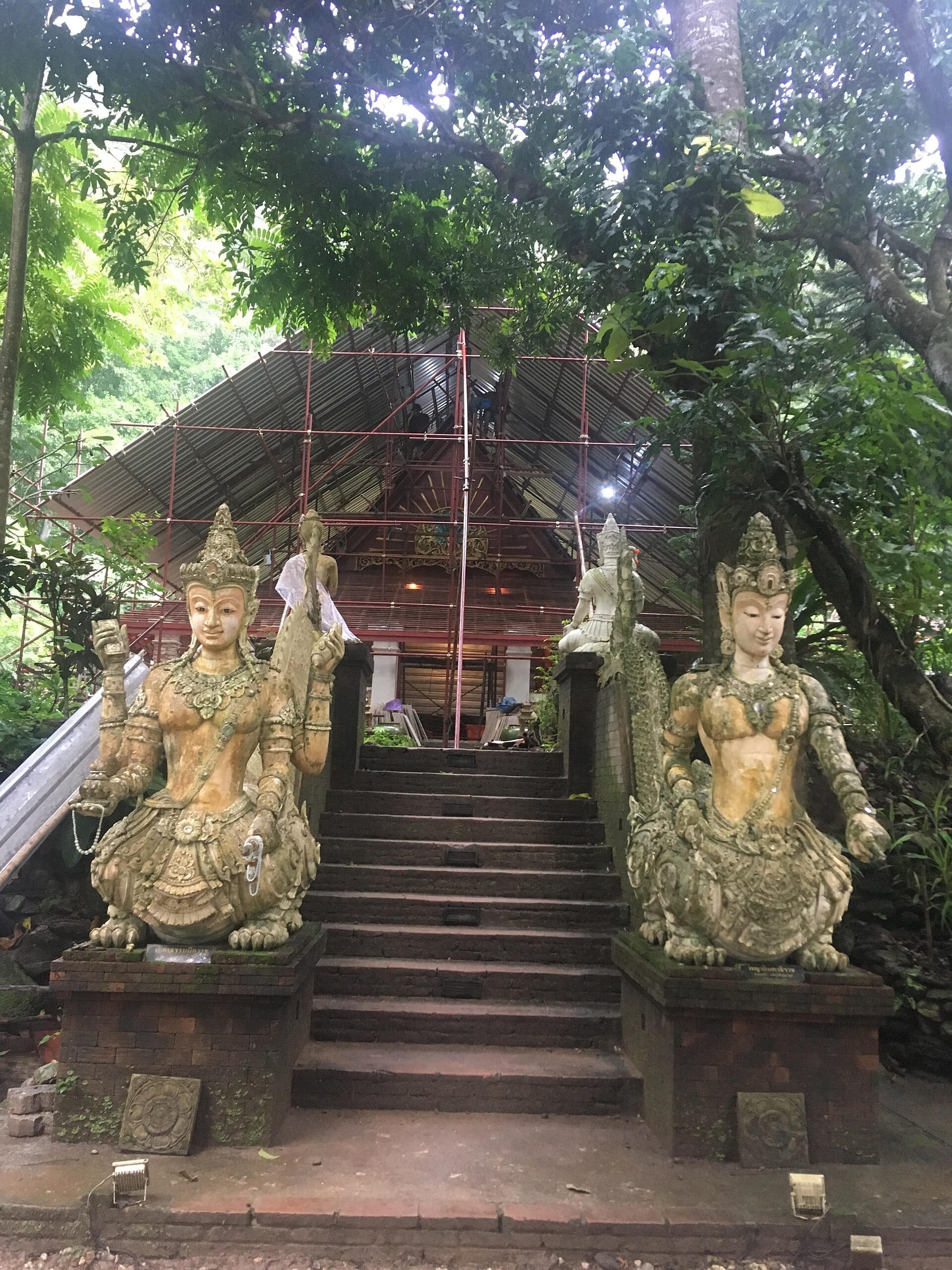
The first indication you have arrived is the sound of a stream, almost always running, threading through the boulders below the main terrace. The temple structures appear gradually rather than all at once, tucked between tree trunks and behind weathered stone walls. A Naga balustrade, the serpent guardian common to Lanna Buddhist temples, frames the main staircase, but here it is coated in thick green moss, softening it completely.
The complex includes several chedis (stupas), a small ordination hall, living quarters for monks, and a cascade of stone terraces that step down toward the stream. The temple dates to the 14th century in origin, though elements have been added and restored across different periods. One of the most photographed spots is a small wooden bridge over the stream alongside a moss-covered shrine, especially striking when the stream is running fast after rain.
Unlike many of Chiang Mai's central temples, there is no formal entrance, no ticket booth, and no tour group infrastructure. Visitor numbers on any given weekday morning are modest. The temple has a contemplative quality that the more famous sites in the Old City rarely match, not because it is secret, but because reaching it on foot naturally filters the crowd.
For context on how this compares to the broader landscape of Chiang Mai's sacred sites, the Chiang Mai temples guide gives a useful overview of what distinguishes Lanna-style temple architecture from the central Thai tradition.
Cultural and Historical Context
The temple's origins are connected to the founding legend of Wat Phra That Doi Suthep. According to the 14th-century story, a monk named Sumanathera brought a sacred relic from Sukhothai to Chiang Mai. The relic miraculously duplicated itself, and one piece was eventually placed on the back of a white elephant that wandered up Doi Suthep mountain, choosing the summit as the site for what became Doi Suthep temple. Wat Pha Lat is said to mark a resting point along that original procession route, giving it direct historical and spiritual continuity with one of Thailand's most revered temple sites.
This lineage matters in practical terms: the Monk's Trail between Wat Pha Lat and the Doi Suthep summit follows what may be one of the oldest maintained footpaths in northern Thailand, still walked daily by monks from the community below. The temple is not a ruin or a heritage display; it is a living site where the rhythm of monastic life continues.
Wat Pha Lat sits within the broader Doi Suthep area, which also includes Bhuphing Palace and the hilltop village of Doi Pui Hmong Village. A single day on the mountain can combine all three with proper planning.
Photography at Wat Pha Lat
The temple is one of the most photogenic locations in the Chiang Mai area, and it rewards patience. The interplay of light, moss, stone, and water changes throughout the day. Early morning arrivals, before 8 am, catch the softest diffused light and occasional mist. The Naga staircase and stream crossing are the most iconic frames, but the real character of the place comes through in the details: incense ash on a stone ledge, a monk's sandals outside a doorway, the way the roots of a bodhi tree have grown over and around a centuries-old retaining wall.
A wide-angle lens suits the temple's cramped, layered terraces well. A longer focal length helps isolate details without physically entering restricted areas. As with any active temple in Thailand, photograph with discretion, avoid shooting monks without implicit permission, and dress modestly. Shoulders and knees should be covered.
For broader advice on capturing Chiang Mai's temples and landscapes, the Chiang Mai photography guide covers light conditions, cultural etiquette, and the best locations by season.
Practical Walkthrough: Getting There and Timing Your Visit
The most straightforward approach is to take a red songthaew (shared taxi truck) from the Chiang Mai University or Nimman area toward the Monk's Trail trailhead. Alternatively, most visitors riding a scooter can park near the university perimeter and walk to the trailhead in under five minutes. GPS works reliably for locating the trail entrance.
The trail itself is around 1.4–1.5 km one way to Wat Pha Lat. Allow 30 to 50 minutes uphill and slightly less coming back down. If you plan to continue to Wat Phra That Doi Suthep, the full hike from the trailhead to the summit adds roughly another 1–1.5 hours of uphill walking from Wat Pha Lat. This full route is a genuinely satisfying half-day outing.
Wat Pha Lat has no formal opening hours listed, but as an active monastery the temple is accessible during daylight hours. There is no entrance fee if you arrive by road, but a small fee may be charged at the main Monk’s Trail trailhead — verify on arrival. Water and snacks are not available on site, so bring your own. The trail itself has no facilities until you reach the Doi Suthep car park at the top.
ℹ️ Good to know
Accessibility note: The Monk's Trail involves significant elevation gain on uneven terrain with roots, steps, and narrow sections. It is not suitable for wheelchairs or strollers, and is challenging for anyone with limited mobility. Those unable to manage the hike can still reach Wat Phra That Doi Suthep by road.
If you are planning a full day on Doi Suthep mountain, the dedicated Doi Suthep area guide outlines how to combine Wat Pha Lat with the summit temple and other nearby sites efficiently.
Who Should Skip This
Wat Pha Lat is not the right choice for everyone. If you have limited time and want to see the most iconic landmark on the mountain, go directly to Wat Phra That Doi Suthep by road. If you are visiting during a heavy rain period, the trail becomes muddy and significantly harder to navigate safely. Visitors with knee or joint issues should think carefully before committing to the elevation gain.
The temple is also not a good fit for those who find unmarked, quiet spaces underwhelming. There is no audio guide, no informational signage in English beyond basic directional markers, and no commercial infrastructure around the site. The experience is almost entirely what you bring to it in terms of curiosity and attentiveness.
Insider Tips
- Arrive before 7:30 am on a weekday to have the temple almost entirely to yourself. Weekend mornings bring noticeably more foot traffic from local hikers.
- The stream running through the complex is most dramatic from June through October, when rainfall keeps it running fast. In the dry season it slows to a trickle and some of the waterfall features stop entirely.
- If you continue past Wat Pha Lat toward Doi Suthep, the trail eventually emerges at the main road near the Doi Suthep car park, where songthaews wait to take passengers back to the city. This one-way hike format avoids retracing your steps.
- Carry at least one litre of water per person. The jungle shade keeps temperatures moderate, but the climb is steady and there is nowhere to refill until the Doi Suthep summit area.
- Remove shoes before entering any of the temple buildings and keep voices low. Monks may be in the middle of morning chanting or afternoon prayers, and this is a place of active religious observance, not just a scenic stop.
Who Is Wat Pha Lat (Jungle Temple) For?
- Hikers who want a cultural payoff at the end of a jungle trail
- Photographers seeking moss, stone, and atmospheric light away from crowds
- Travelers combining the walk with a full Doi Suthep day trip
- Anyone wanting a temple experience that feels genuinely removed from the tourism circuit
- Early risers who want to be in the forest before the heat builds
Nearby Attractions
Other things to see while in Doi Suthep & Mountain Area:
- Bhuphing Palace (Bhubing Palace)
Perched on the slopes of Doi Buak Ha in Doi Suthep-Pui National Park at around 1,000–1,200 metres elevation, Bhuphing Palace is the Thai royal family's official winter residence in the north. When the royals are not in residence, the palace grounds open to visitors who come for the manicured formal gardens, cool mountain air, and sweeping valley views across Chiang Mai.
- Chiang Mai Night Safari
Chiang Mai Night Safari is Thailand's largest night zoo, where open-air tram rides carry visitors through illuminated savannah and forest zones after dark. It's a family-oriented attraction with genuine nocturnal animal encounters, though the experience varies significantly depending on when you go and which zones you prioritize.
- Chiang Mai Zoo
Spread across forested hillside terrain at the base of Doi Suthep, Chiang Mai Zoo is one of northern Thailand's most visited family attractions. Home to giant pandas, big cats, reptiles, and hundreds of species, it offers a full day of wildlife encounters in a setting that feels closer to a nature park than a concrete enclosure.
- Doi Pui Hmong Village
Perched at over 1,200 meters on the slopes above Chiang Mai, Doi Pui Hmong Village offers a window into northern Thailand's Hmong hilltribe communities, complete with a small opium history museum, traditional textile vendors, and cool mountain air. It sits just beyond Wat Phra That Doi Suthep, making it a logical extension of any mountain day trip.
Planning a trip? Discover personalized activities with the Nomado app.