Vancouver Art Gallery: What to Expect Before You Go
The Vancouver Art Gallery is British Columbia's largest art museum, housed in a neoclassical courthouse at the heart of downtown Vancouver. With a permanent collection that includes one of the world's most significant holdings of Emily Carr's work, plus rotating international exhibitions, it draws serious art lovers and curious first-timers alike.
Quick Facts
- Location
- 750 Hornby Street, Downtown Vancouver, BC
- Getting There
- Vancouver City Centre or Burrard SkyTrain stations (Expo/Millennium Line), both within easy walking distance
- Time Needed
- 2 to 3 hours for a thorough visit; 1 hour if you focus on a single exhibition
- Cost
- Paid admission; verify current CAD pricing at vanartgallery.bc.ca before visiting
- Best for
- Art lovers, rainy-day itineraries, Emily Carr enthusiasts, architecture admirers
- Official website
- www.vanartgallery.bc.ca
About the Vancouver Art Gallery
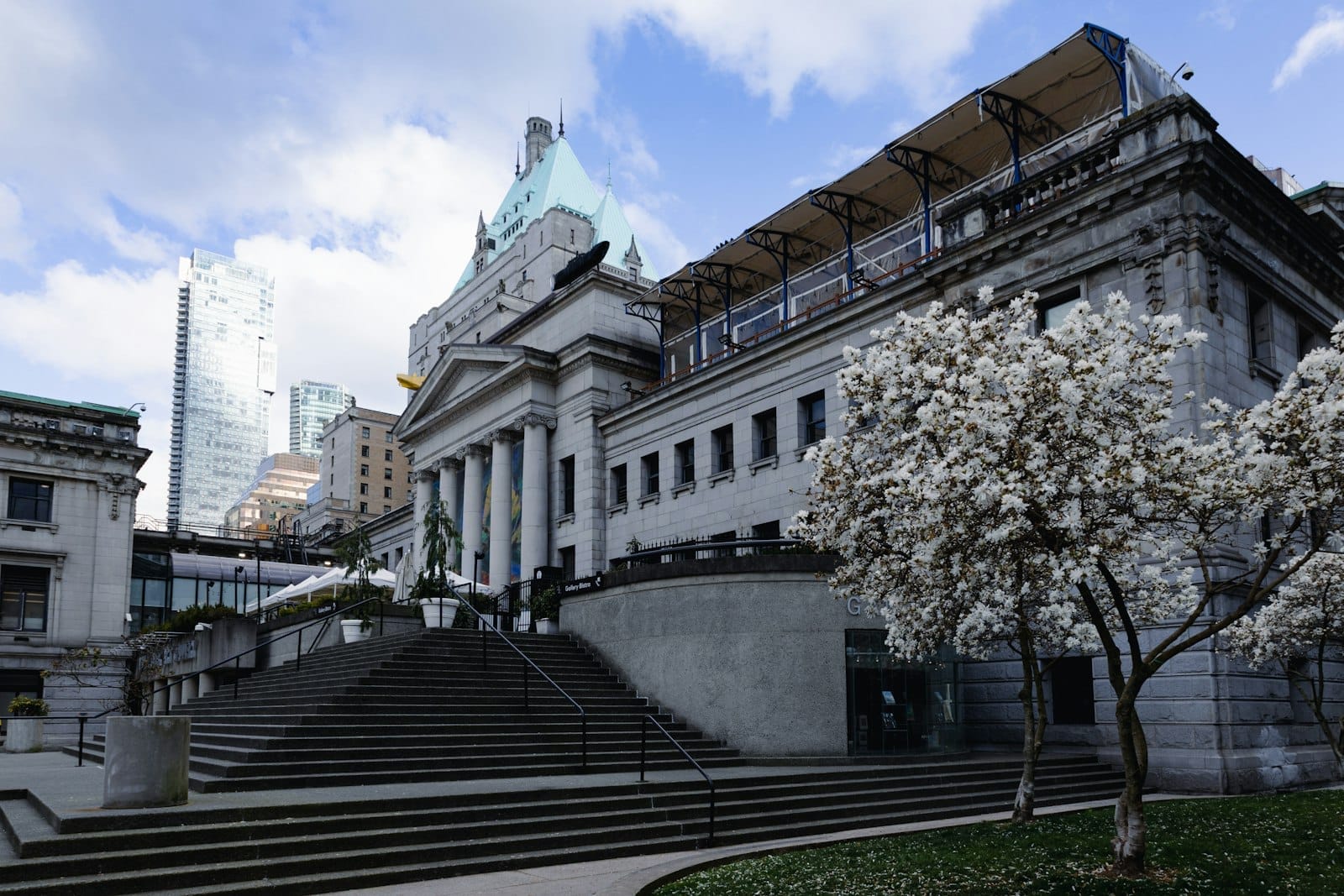
The Vancouver Art Gallery is British Columbia's largest public art museum and one of the most significant cultural institutions in western Canada. Founded in 1931, it occupies a neoclassical courthouse designed by Francis Rattenbury and George William Grant, the same architect behind Victoria's famous Empress Hotel and Parliament Buildings. The building itself, at 15,300 square metres (165,000 sq ft), is a landmark in its own right: four columned facades of stone, capped with a copper-green dome, anchoring the north end of Robson Square in the middle of downtown Vancouver.
The permanent collection spans historical and contemporary Canadian art, with particular depth in British Columbia artists. The gallery holds one of the world's most important collections of work by Emily Carr, the painter whose early 20th-century canvases of coastal forests and First Nations villages became foundational to Canadian artistic identity. If you have any interest in Carr, this is a primary destination, not a secondary one.
Alongside the permanent holdings, the gallery runs a rotating program of major international exhibitions that have included retrospectives and thematic shows drawing from institutions worldwide. The caliber of these visiting shows varies, so it is worth checking the current schedule at the gallery's official site before you plan around a specific show. Admission prices cover both permanent and temporary galleries.
The Building: A Courthouse Repurposed
Before the art, the architecture. The Vancouver Art Gallery's home was the old Provincial Courthouse, completed in 1906 and later expanded. Francis Rattenbury's design draws from Beaux-Arts classicism: wide stone steps leading to a colonnaded entrance, symmetrical proportions, and interior rotundas with natural light filtering through upper skylights. These features were designed to project authority and civic permanence, and they still do, though now the authority on display is cultural rather than legal.
When you step inside, the ceilings are higher than you expect. The main galleries are arranged across multiple floors, connected by a central staircase. The natural light that floods the upper-floor galleries in the morning creates a noticeably different atmosphere from the more controlled lighting in basement and lower-level spaces. Mornings are the best time to be in the upper Emily Carr galleries if you want to see those forest greens without competing with overhead tungsten.
ℹ️ Good to know
The gallery's exterior steps on the Robson Street side double as an informal public gathering space. On summer days, it is not unusual to find people sitting on those steps eating lunch or watching the foot traffic on Robson Square below.
Tickets & tours
Hand-picked options from our booking partner. Prices are indicative; availability and final rates are confirmed when you complete your booking.
Vancouver Art Gallery Tickets
From 19 €Instant confirmationFree cancellationFull-day tour to Victoria and Butchart Gardens from Vancouver
From 163 €Instant confirmationFree cancellationVancouver street art and craft beer tour
From 39 €Instant confirmationFree cancellationSightseeing tour of Victoria and Butchart Gardens from Vancouver
From 140 €Instant confirmationFree cancellation
What You Will See Inside
Emily Carr Collection
The gallery's Emily Carr holdings are the reason many visitors make the trip specifically to this building rather than any other museum in Vancouver. Carr's paintings, often large-format oils and watercolours, depict the rainforest and coastline of British Columbia with an expressionist intensity that is difficult to appreciate in reproduction. Standing in front of a canvas like 'Big Raven' or one of her forest studies, the scale and texture read entirely differently from what you see in a book. The trees are not decorative. They are dense, spiraling, almost animate.
The collection draws from different periods of Carr's work, allowing you to trace the evolution of her style from more representational early pieces toward the swirling, atmospheric works of her later career. The gallery provides contextual notes that help explain her relationship with the Group of Seven and with the Indigenous communities whose art significantly influenced her visual language. These notes are worth reading slowly.
Rotating International Exhibitions
The Vancouver Art Gallery regularly partners with major international institutions to bring large-scale curated exhibitions to Vancouver. These can range from historical surveys of European modernism to contemporary installation work. The quality and interest level of these shows depend entirely on what is running during your visit. Check the official website in advance rather than assuming any particular exhibition will be on during your trip.
When a major travelling exhibition is in town, the gallery can get crowded, particularly on weekend afternoons. If you are visiting during a high-profile show, weekday mornings are significantly quieter, and the difference in experience is real.
Contemporary Canadian Art
Beyond Carr, the permanent collection includes works by other significant Canadian artists across media including photography, sculpture, and video installation. The gallery's commitment to contemporary BC and Canadian voices makes it meaningfully different from a general art museum. If you are building a broader understanding of Canadian visual culture, pairing this visit with a stop at the Bill Reid Gallery of Northwest Coast Art a few blocks away gives you a more complete picture of the artistic traditions that have shaped this region.
How Crowds and Time of Day Shape the Experience
Weekday mornings, particularly Tuesday through Thursday, are the quietest periods inside the Vancouver Art Gallery. The upper floors are often nearly empty by 10am, and you can spend fifteen minutes with a single painting without anyone else in the room. By noon, school groups begin to arrive, and the ground-floor atrium becomes noticeably louder.
Saturday and Sunday afternoons are the busiest periods. The combination of tourists, local families, and visitors drawn by ticketed exhibitions can make the more popular galleries feel compressed. If you are visiting on a weekend, arriving at opening time makes a measurable difference. The gallery's café area also fills up quickly on weekend afternoons if you are planning to use it.
💡 Local tip
Many Vancouver residents visit the gallery during rainy winter months when outdoor options shrink. If you are traveling between October and March, this is one of the city's most reliable and rewarding indoor destinations, but expect higher local attendance on grey weekends.
Getting There and Finding Your Way Around Downtown
The gallery is located at 750 Hornby Street, between Robson and Smythe Streets in the heart of downtown Vancouver. Vancouver City Centre SkyTrain station (Expo and Millennium Lines) is the closest rapid transit stop, roughly a five-minute walk north along Granville Street. Burrard Station is slightly farther, about eight minutes on foot, but the walk is straightforward and flat.
Multiple bus routes run along Granville and Robson Streets, making the gallery easily accessible from most parts of the city without a transfer. If you are arriving by car, there is underground paid parking at Robson Square directly adjacent to the gallery, though rates in this part of downtown are not cheap and spaces fill during events. Transit is the practical choice for most visitors.
The gallery sits within easy walking distance of several other downtown attractions. Robson Street runs immediately beside it, and Canada Place, the waterfront, and Coal Harbour are all reachable on foot in under twenty minutes. Planning the gallery as part of a broader downtown walking day is straightforward.
What to Know Before You Go
Admission is charged for adults, with reduced rates typically available for seniors, youth, and students. The gallery also offers free admission on certain evenings, which historically have been on Tuesday nights, though this should be confirmed on the official website before you plan your visit around it. Booking tickets in advance online is recommended during major exhibitions to avoid queuing.
Photography policies inside the gallery vary by exhibition. The permanent collection galleries generally permit photography without flash, but some travelling exhibitions prohibit it entirely due to loan agreements. Signs are posted clearly at gallery entrances, but it is worth asking staff if you are unsure before you start shooting.
The gallery is fully accessible. Elevators connect all floors, and step-free entrances are available. For specific accessibility needs including assistive devices, audio guides, or sensory-friendly visiting options, the gallery's visitor information page has current details.
⚠️ What to skip
Opening hours and admission pricing at the Vancouver Art Gallery change periodically, including seasonal adjustments. Always verify current hours and ticket prices at vanartgallery.bc.ca before your visit rather than relying on third-party sources.
Who Should Consider Skipping This
Travelers with very limited time in Vancouver who are prioritizing outdoor experiences or neighborhood exploration may find the gallery a less efficient use of two to three hours than alternatives like Stanley Park or Granville Island. If contemporary and historical Canadian art is not among your interests, the permanent collection alone may not justify the admission cost for a short visit. The gallery's strongest appeal is to people with a genuine interest in Canadian art history, particularly Emily Carr, or those who want to catch a specific ticketed exhibition.
Families with very young children can find the gallery challenging to navigate, as most spaces require quiet and careful movement around artwork. The Science World and Vancouver Aquarium are generally more engaging for children under eight.
Insider Tips
- The rooftop terrace, when accessible during specific events or programs, offers an unusual view of Robson Square and the downtown skyline. Check the gallery's events calendar for openings or late-night programming that includes rooftop access.
- The museum shop on the ground floor carries a notably good selection of books on Canadian art, Emily Carr monographs, and design-focused publications. Even if you skip the galleries, it is worth a browse if you are nearby.
- If you are visiting for the Emily Carr collection specifically, head to the upper floors first. By mid-morning, tour groups tend to move upward from the ground level, so reversing the typical bottom-to-top route keeps you ahead of the crowds.
- Tuesday evenings have historically offered free or reduced admission for Vancouver residents. Confirm this on the official site before planning around it, as the policy has changed in the past.
- The Robson Square ice rink directly outside operates seasonally in winter. Combining a gallery visit with skating on the same afternoon makes for an efficient use of time in the same block.
Who Is Vancouver Art Gallery For?
- Art enthusiasts wanting to engage seriously with Emily Carr's work in one of the world's best collections of her paintings
- Travelers visiting Vancouver in rainy season who want a substantial indoor cultural experience
- Architecture admirers interested in Francis Rattenbury's neoclassical courthouse design
- Those following a broader Canadian art and culture itinerary through the city
- Visitors with a half-day to spare in downtown Vancouver who want depth over breadth
Nearby Attractions
Other things to see while in Downtown Vancouver:
- BC Place
BC Place is Vancouver's premier indoor stadium and event venue, sitting on the north side of False Creek on the southeastern edge of downtown. From BC Lions football to Whitecaps soccer, international concerts, and trade expos, this retractable-roof arena is the city's largest indoor gathering space. Here is what it is actually like to visit, and how to make the most of your time there.
- Bill Reid Gallery of Northwest Coast Art
Opened in 2008, the Bill Reid Gallery of Northwest Coast Art is Canada's only public gallery dedicated entirely to Indigenous art of the Northwest Coast. Tucked into a quiet courtyard in downtown Vancouver, it offers an intimate, carefully curated encounter with Haida and other Northwest Coast artistic traditions.
- Canada Place
Canada Place anchors Vancouver's downtown waterfront with its sail-shaped roof, working cruise terminal, and free public promenade overlooking Burrard Inlet. Whether you're passing through or planning your first visit, here's what actually makes it worth your time.
- Coal Harbour
Coal Harbour is a free-to-explore waterfront neighbourhood on Burrard Inlet, stretching between Canada Place and the edge of Stanley Park. It combines a paved seawall, marina views, mountain backdrops, and one of the most photographed skylines in western Canada.