Twelve Apostles: What to Know Before You Visit Victoria's Most Famous Coastline
The Twelve Apostles are a series of limestone sea stacks rising from the Southern Ocean along the Great Ocean Road, about 275 km southwest of Melbourne. The formations are the product of millions of years of wave erosion, and the cliffs continue to change. Here is everything a traveller needs to make the most of the journey.
Quick Facts
- Location
- Great Ocean Road and Booringa Road, Princetown VIC 3269 — approximately 7 km east of Port Campbell
- Getting There
- By car via the Great Ocean Road (no public transport to the site); most visitors drive from Melbourne or join an organised day tour
- Time Needed
- 1.5 to 2.5 hours at the site; allow a full day or overnight trip from Melbourne
- Cost
- Entry is currently free; a booking is required to access the site — confirm fees and availability at the official website before visiting
- Best for
- Coastal scenery, geology, sunrise and sunset photography, road trips
- Official website
- www.twelveapostles.org.au
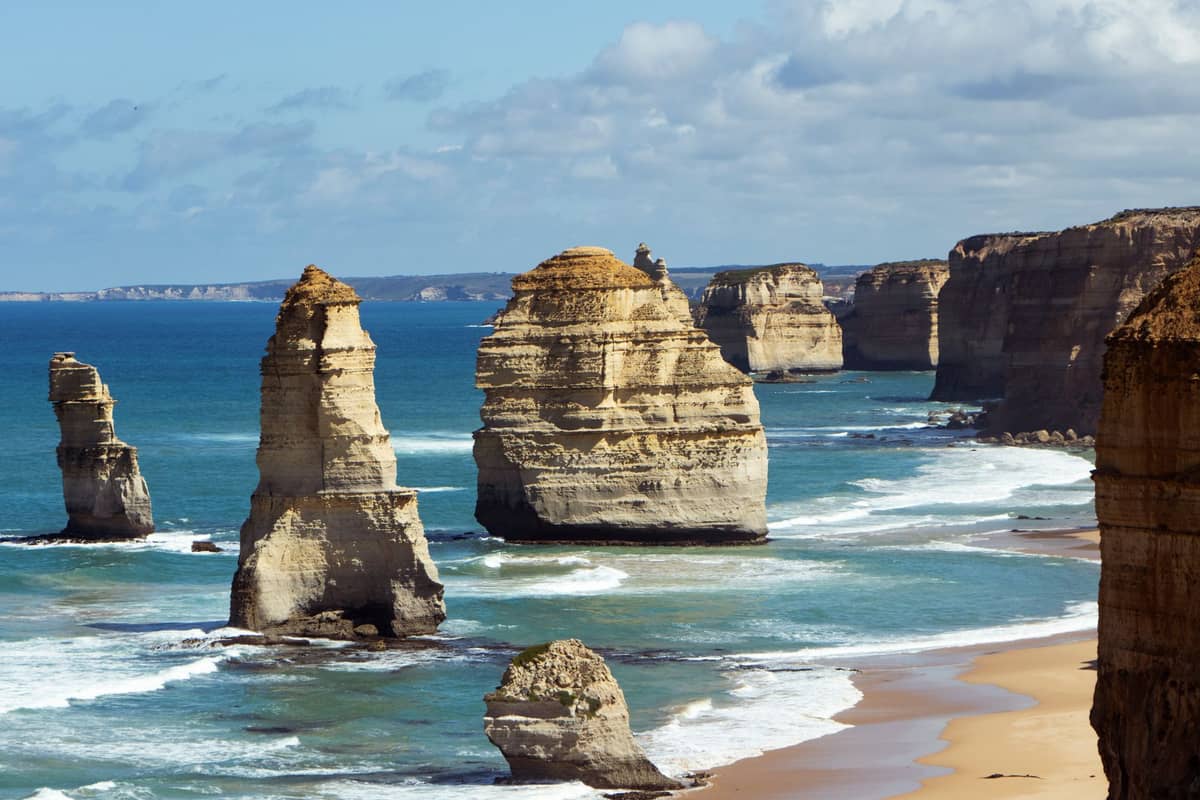
What the Twelve Apostles Actually Are
The Twelve Apostles are a collection of isolated limestone sea stacks standing off the cliffs of Port Campbell National Park, along Victoria's Great Ocean Road. They are the product of a slow geological process: seawater carved caves into the headlands, caves became arches, arches eventually collapsed, and what remained were freestanding pillars of rock in the churning Southern Ocean. The process continues today.
A small clarification worth making before you go: the name is misleading. There were never twelve stacks. Parks Victoria records that there were nine before a stack collapsed in July 2005, and another fell in 2009. The number of formations visible from the main viewing platforms depends on how you count them. The name predates any precise count, and it stuck. This is not a reason to feel disappointed at the site, but it is worth knowing so the geography does not confuse you on arrival.
ℹ️ Good to know
Visitor bookings are required to access the Keerray Woorroong Visitor Centre. Visitor bookings are required to access the Keerray Woorroong Visitor Centre. During daylight saving, the car park is open 6:00 am to 9:00 pm daily; during standard time, it is open 7:00 am to 6:00 pm. The visitor centre operates 8:00 am to 8:00 pm during daylight saving and 9:00 am to 5:00 pm during standard time. Confirm your booking slot and seasonal hours at twelveapostles.org.au before you leave Melbourne. Confirm your booking slot at twelveapostles.org.au before you leave Melbourne.
How the Experience Unfolds on the Ground
From the car park, an underground tunnel leads beneath the Great Ocean Road and delivers you to the clifftop viewing platforms on the ocean side. The tunnel itself is a short walk, but the transition is dramatic: one moment you are in a car park surrounded by eucalypts; a few steps later you emerge on the edge of a cliff with the entire Southern Ocean spread before you.
The clifftops are wide and the paths are paved, so you can move comfortably between several distinct vantage points. Each one frames the stacks differently. The western platform typically shows the largest grouping of stacks; the eastern platform offers a view across a longer stretch of cliff face, showing the layered ochre and cream of the limestone wall. Take time at both rather than stopping only at the first spot you reach.
The Southern Ocean is not quiet. Wind at the cliff edge is consistent and can be strong, particularly in winter and early spring. Waves hit the base of the stacks with enough force to send spray visible even from platform height. On calmer mornings, the sea turns a deep teal and the contrast with the warm-toned rock is at its most vivid. On overcast days, the mood shifts entirely: the ocean goes grey-green and the cliffs look severe, which makes for a different but equally compelling scene.
Tickets & tours
Live prices and dates from our booking partner. If you book, we may earn a commission at no extra cost to you.
Great Ocean Road reverse itinerary tour from Melbourne
From 77 €Instant confirmationFree cancellationGreat Ocean Road bus tour with a forest walk
From 90 €Instant confirmationFree cancellationYarra Valley Bus Wine Tour including lunch with a glass of wine and chocolate
From 107 €Instant confirmationFree cancellationHidden bars of Melbourne guided tour
From 115 €Instant confirmationFree cancellation
Best Time to Visit: Sunrise, Sunset, and Everything Between
Sunset is the most photographed moment at the Twelve Apostles. The western-facing cliffs catch the late afternoon light in a way that turns the limestone a deep amber, while the ocean behind the stacks holds its blue tone. Crowds reflect this: the platforms in the hour before sunset tend to fill quickly, particularly in summer. If you are arriving for sunset, build in extra time for car park access and allow at least 30 minutes on the platform before the light peaks.
Sunrise is underused by most visitors, partly because it requires either staying nearby overnight or leaving Melbourne extremely early. During daylight saving, the car park opens at 6:00 am, which aligns well with summer sunrise times. In the early morning, you will often have the platform largely to yourself. The eastern light comes over the cliff behind you, creating softer shadows across the stacks and catching the seafoam in the water below. It is the preferred time for photographers who want the scene without a crowd in every frame.
Midday visits are honest: the light is flat, the car park is at its busiest, and the stacks look less dramatic. If your schedule allows no flexibility, midday is still worth the stop, but lower your photographic expectations. The site is worth experiencing regardless of time of day purely for the scale of the landscape.
💡 Local tip
If you are staying in Port Campbell the night before, set an alarm for sunrise. The short drive to the site in the early morning is one of the most rewarding experiences the Great Ocean Road offers, and you will have the cliffs largely to yourself.
Getting There from Melbourne
The Twelve Apostles are roughly 275 km from Melbourne by road, following the Great Ocean Road from Torquay westward through Lorne, Apollo Bay, and Port Campbell. The full scenic route takes approximately four to five hours of driving without stops, and most visitors treat the road itself as part of the itinerary rather than just a means of access.
There is no public transport to the Twelve Apostles. Visitors without a car have two realistic options: join an organised day tour from Melbourne (coach tours depart regularly and include a stop at the stacks), or hire a car for a self-drive trip that allows you to control timing. Tour schedules vary, and self-driving gives you the flexibility to arrive at sunrise or stay for sunset. Self-driving gives you the flexibility to arrive at sunrise or stay for sunset.
An alternative to a single long day is to break the trip across two days, overnighting in Port Campbell or nearby. This also gives you time to stop at other significant formations along the way, such as Loch Ard Gorge, which is only a few kilometres from the Twelve Apostles and is considerably less crowded despite being equally striking.
For planning advice on the full route, including suggested stops and driving times, see the Great Ocean Road day trip guide.
Geology, History, and Cultural Context
The limestone that forms the stacks was deposited when the area lay beneath a shallow sea. These rocks have been exposed to coastal erosion. The cliffs retreat over time, meaning the stacks visible today are temporary in geological terms. The collapses of 2005 and 2009 were not unusual events; they were a visible acceleration of a continuous process.
The formations were previously known as the Sow and Piglets, before becoming known as the Twelve Apostles. The site is now one of Australia's best-known natural attractions.
The visitor centre at the site is named the Keerray Woorroong Visitor Centre. The Great Ocean Road corridor passes through Country belonging to several Aboriginal groups; the area around Port Campbell has deep cultural significance that predates European settlement. The Great Ocean Road corridor passes through Country belonging to several Aboriginal groups; the area around Port Campbell is part of Country with deep cultural significance that predates European settlement by tens of thousands of years.
Practical Details: Accessibility, What to Bring, and Honest Limitations
The viewing platforms are accessible by wheelchair. The site includes accessible parking spaces, wheelchair-accessible paths from the car park to the main platforms, rest areas, accessible toilets, and a Changing Places facility for visitors with higher support needs. This is one of the more comprehensively accessible natural attractions in Victoria.
Wind at the cliff edge is the main physical factor to account for. Even in summer, temperatures at the coast can drop quickly in the afternoon, and wind chill makes conditions feel colder than the air temperature suggests. A light jacket is sensible regardless of season. In winter, full weatherproofing is advisable. The paths are exposed: there is no shelter between the tunnel exit and the viewing platforms.
Photography works best with a wide-angle lens for landscape captures and a longer focal length for isolating individual stacks against the water. A polarising filter reduces glare from the ocean surface at midday. For smartphone shooters, the early morning or late afternoon light does most of the compositional work for you.
⚠️ What to skip
Do not attempt to climb down the cliffs to the beach. Do not attempt to climb down the cliffs to the beach. The cliffs are unstable and actively eroding; follow all signs and stay within designated visitor areas.
An honest note for travellers with limited time: the Twelve Apostles are the most famous stop on the Great Ocean Road, but they are not necessarily the most moving. Loch Ard Gorge, a short drive away, offers a narrower and more intimate gorge experience with a compelling shipwreck history. Many visitors who know both consider them equally worthwhile, just for different reasons. If your trip allows only one Great Ocean Road stop, the Twelve Apostles are the logical choice for scale and context. But if you have two hours at the stacks and no time for anything else, consider splitting that time between the two sites instead.
Who This Attraction Suits, and Who Might Reconsider
The Twelve Apostles reward travellers who are genuinely drawn to coastal geology, big landscape photography, or the romance of a long scenic drive. They fit naturally into a day trip from Melbourne, though an overnight stop closer to the site transforms the experience significantly.
Travellers who find large crowds and organised tour-group dynamics uncomfortable should be aware that the platforms can feel congested during peak hours, particularly in summer around sunset. The experience is not ruined by the crowds, but it is not a solitary encounter with nature either. Managing your arrival time is the single most effective way to improve the experience.
Visitors expecting a long hike or active engagement with the landscape may find the platform format slightly passive. The viewing area is compact. You walk out, you look, you move between two or three vantage points, and then you return through the tunnel. The impact is immediate and visual rather than earned through effort. That is not a flaw, but it is worth calibrating expectations, especially if you have driven four-plus hours specifically for this stop.
Insider Tips
- Book your visitor arrival slot before you leave Melbourne. The booking system manages car park access and without a confirmed time you risk arrival delays, especially in peak season.
- Loch Ard Gorge is nearby and northwest of the Twelve Apostles. If you have flexibility, combine both sites in a single stop rather than treating them as separate detours.
- The helicopter flights that operate from near the car park offer a perspective on the stacks that no ground-level viewpoint can match. If aerial photography or a short scenic flight appeals to you, this is one of the more worthwhile places in Australia to consider it.
- Check sunrise and sunset times for your visit date before you leave. In midsummer, sunrise is around 6:00 am and the car park opens at 6:00 am during daylight saving. In winter, sunrise is later and the light at the site tends to stay softer for longer into the morning.
- Wear layers and carry a windproof outer shell even in summer. The cliff edge is exposed and afternoon sea breezes come in fast. Visitors in t-shirts at midday are often visibly cold by 4:00 pm.
Who Is Twelve Apostles For?
- Road trippers doing the full Great Ocean Road route
- Photographers chasing golden-hour coastal light
- Travellers interested in active coastal geology and erosion
- Families with older children who can manage short, paved cliff walks
- Visitors on a long weekend who can overnight near Port Campbell for a sunrise visit
Nearby Attractions
Combine your visit with:
- 1000 Steps Kokoda Track Memorial Walk
The Kokoda Track Memorial Walk, known locally as the 1000 Steps, climbs through fern-filled forest in the Dandenong Ranges east of Melbourne. Free to visit and reached by train, it combines a genuine physical workout with quiet moments of WWII commemoration.
- Albert Park Lake
Albert Park Lake is a vast freshwater reserve just minutes from Melbourne's CBD, offering a 4.7km walking and cycling path around calm water, sports ovals, and open parkland. Free to enter and accessible by tram, it rewards early morning walkers, cycling families, and anyone wanting to understand how Melbourne uses its open spaces.
- Bells Beach
Bells Beach, in Wadawurrung country and also known by its Traditional Owner name Djarrak, is a 48-hectare coastal reserve near Torquay that holds the distinction of being the world's first declared surfing reserve. With its sheer sandstone cliffs, deep bowl-shaped break, and annual Rip Curl Pro competition, it draws surfers and non-surfers alike for one of Victoria's most dramatic coastal experiences.
- Brighton Beach Bathing Boxes
Lined up along Dendy Street Beach in Brighton, Melbourne's 96 privately owned bathing boxes are one of Victoria's most recognisable sights. Free to view from the public beach, they reward visitors who time their arrival with the morning light or an empty tide. Here is what you actually need to know before making the trip.
Planning a trip? Discover personalized activities with the Nomado app.