Loch Ard Gorge: Cliffs, Shipwrecks, and Raw Coastal Drama on the Great Ocean Road
Loch Ard Gorge is a sculpted limestone inlet within Port Campbell National Park, carved by the Southern Ocean over millennia. Named for a ship wrecked here in 1878, it combines geological spectacle with one of Australia's most haunting maritime stories. Entry is free, and The lookout trails are open, but beach access steps are currently closed due to geological instability.
Quick Facts
- Location
- Post Office Road, Port Campbell National Park, Victoria 3269 (approx. 285 km southwest of Melbourne)
- Getting There
- No public transport to the site; self-drive or organised tour via the Great Ocean Road is required. No public transport to the site; self-drive or organised tour is required. Follow the signs from the Great Ocean Road to the car park.
- Time Needed
- Allow 1 to 3 hours for the trails; combine with the Twelve Apostles for a half-day.; combine with the Twelve Apostles (3 km away) for a half-day
- Cost
- Free public access; no ticket or booking required
- Best for
- Coastal scenery, photography, history and geology, road trip stops
What Loch Ard Gorge Actually Is
Loch Ard Gorge is a narrow sea inlet cut into the limestone cliffs of Port Campbell National Park, roughly 285 kilometres southwest of Melbourne along the Great Ocean Road. The gorge takes its name from the iron-hulled clipper ship Loch Ard, which foundered near Mutton Bird Island on 1 June 1878. Of the 54 people aboard, only two survived: an apprentice officer named Tom Pearce and a passenger named Eva Carmichael, both in their late teens. Pearce reached the gorge's beach, found Carmichael clinging to wreckage, and pulled her ashore. The story is engraved into the place, and the names given to features around the gorge, including Burial Cave and Mutton Bird Island, reflect that tragedy.
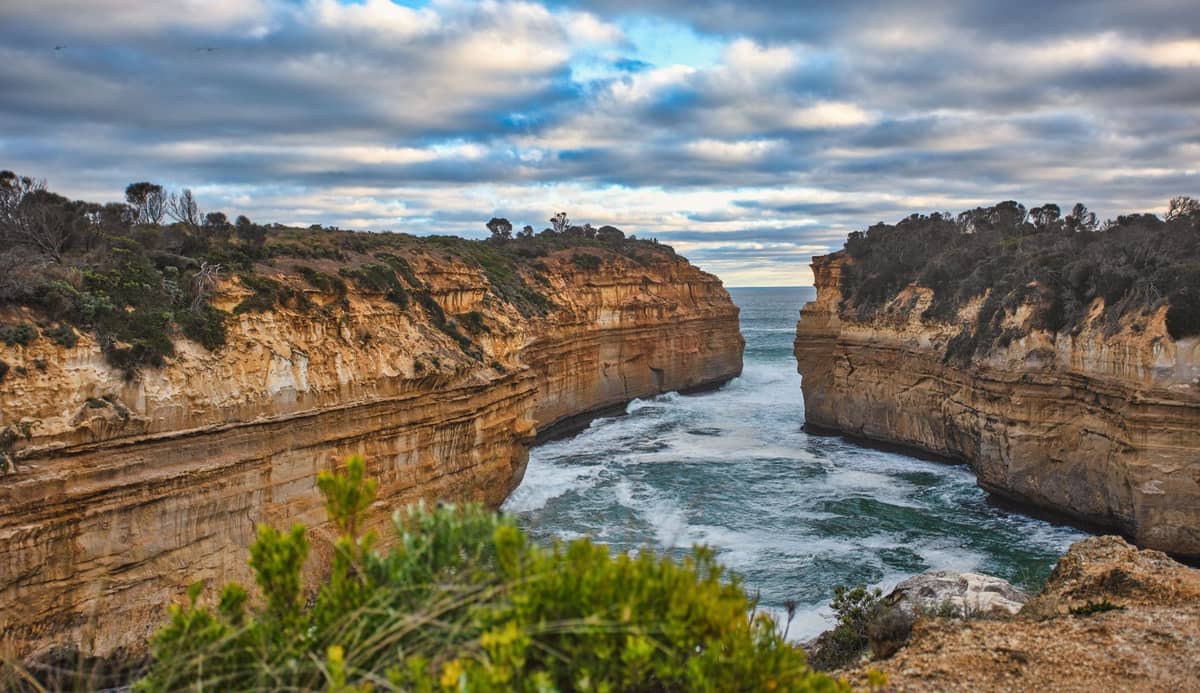
Geologically, this stretch of coast is formed from Eocene-age limestone, laid down around 25 to 40 million years ago when the region was a shallow sea. The Southern Ocean has relentlessly undercut, collapsed, and reshaped these cliffs, producing arches, blowholes, and gorges. Loch Ard is one of the most dramatic of these formations: a near-enclosed amphitheatre of pale ochre rock with a small crescent of sand at its base. The colour of the walls shifts throughout the day, from bone-white in flat midday light to warm amber at dusk.
⚠️ What to skip
Beach Access Currently Closed: As of the time of writing, the steps leading down to Loch Ard beach are closed due to geological instability and will remain shut until remediation is complete. Check the Great Ocean Road Coast and Parks Authority website before visiting if beach access is a priority for you.
The Lookout Trails: What You Will See and How to Walk Them
Several walking trails leave from the car parks, including the Geology Walk and Loch Ard Wreck Lookout. The designated accessible parking space at the main car park provides good access to those two trails, though path surfaces and gradients vary.
The Loch Ard Lookout delivers the defining view: looking straight into the gorge's throat, with the sea framed between sheer walls. The light is most photogenic in the late afternoon, when the sun angles in from the northwest and the cliff faces glow rather than appear flat. Early morning visits are quieter, but the light falls differently and the gorge can sit in shadow longer. If you are driving the Great Ocean Road from east to west (the standard direction from Melbourne), arriving at Loch Ard in the early-to-mid afternoon and staying until the light softens tends to be the most rewarding sequence.
The Geology Trail includes interpretive panels explaining how the limestone formations developed, making it genuinely informative rather than just scenic. The distinction between the gorge walls' rock layers, visible as horizontal bands of varying density, is easier to read here than at larger formations like the Twelve Apostles. If you have any interest in coastal landforms, this trail adds considerable depth to the visit.
Tickets & tours
Live prices and dates from our booking partner. If you book, we may earn a commission at no extra cost to you.
Sovereign Hill, Botanical Gardens and Melbourne Skydeck Bus Tour
From 116 €Instant confirmationFree cancellationGreat Ocean Road reverse itinerary tour from Melbourne
From 77 €Instant confirmationFree cancellationGreat Ocean Road bus tour with a forest walk
From 90 €Instant confirmationFree cancellationYarra Valley Bus Wine Tour including lunch with a glass of wine and chocolate
From 107 €Instant confirmationFree cancellation
How the Place Feels at Different Times of Day
Mid-morning, typically 10am to noon, is when tour coaches begin arriving. The car park fills quickly, and the main lookout becomes crowded. Conversations in multiple languages overlap with the constant sound of the Southern Ocean, which never quiets regardless of wind conditions. The smell at the lookout is clean salt air with an occasional note of kelp when the swell is running hard.
By contrast, arriving before 9am or after 4pm shifts the experience considerably. The car park is sparse, the lookout platforms are uncrowded, and the scale of the cliffs becomes easier to absorb without people constantly framing your view. In the late afternoon, the wind typically picks up along this coast, carrying spray and making the air visibly hazy at the gorge mouth. Bring a wind layer regardless of what the weather app says, because coastal conditions here are independent of Melbourne forecasts.
On overcast days the gorge has a different character entirely: the limestone reads as grey-white, the ocean turns dark green-grey, and the drama is more elemental than scenic. It is not a lesser experience, just a starker one. Rain makes the paths slippery and reduces visibility at the gorge mouth, which is a legitimate reason to reconsider if the forecast is poor.
The Shipwreck Story and Why It Matters Here
The Loch Ard was a three-masted clipper carrying immigrants and general cargo from England to Melbourne. The ship had been at sea for nearly three months when it struck the reef in pre-dawn darkness, in fog. The surviving passengers and crew who reached lifeboats were almost immediately capsized by the swell. The gorge's beach is where Tom Pearce found footing after swimming through surf that killed most of his shipmates.
The Port Campbell Visitor Information Centre in town displays artefacts from local wrecks, including the Loch Ard. Pairing the gorge visit with the display provides additional context for the wreck; the gorge itself has interpretive panels referencing the story. If the historical dimension interests you, pairing the gorge visit with the museum provides proper context. The gorge itself has interpretive panels referencing the wreck, but they are brief.
This stretch of Victorian coastline is sometimes called the Shipwreck Coast for good reason: more than 80 vessels were lost between Cape Otway and Port Fairy in the nineteenth century. The Great Ocean Road was partly built to provide better access to the area following recurring maritime disasters. Understanding that context makes the gorge feel less like a scenic stop and more like a place with genuine weight.
Practical Walkthrough: Getting There and Making the Most of It
Loch Ard Gorge sits approximately 3 kilometres east of Port Campbell township. There is no scheduled public transport to the site. Most visitors arrive by self-drive or as part of an organised tour departing Melbourne. The drive from Melbourne takes roughly three to three and a half hours without stops, typically via the Princes Freeway to Colac and then south, or via the Great Ocean Road itself from Torquay, which adds significant time but is the scenic route.
If you are taking an organised tour, Great Ocean Road day tours from Melbourne typically include both Loch Ard Gorge and the Twelve Apostles as adjacent stops. This is a reasonable way to cover the area if you are not renting a car, though tour schedules often visit at peak midday hours when crowds are heaviest.
The car park at Loch Ard Gorge is free and has accessible spaces. There are no toilets on site. Port Campbell town has cafes and a general store. There is no food or drink at the gorge itself; Port Campbell town has cafes and a general store. If you are planning a full day along this section of coast, the Great Ocean Road day trip guide covers sequencing the stops, driving times, and where to eat along the route.
💡 Local tip
Combine Loch Ard Gorge with the Twelve Apostles lookout, Combine Loch Ard Gorge with the Twelve Apostles lookout, approximately 6 km east along the Great Ocean Road. Both are free and both car parks are signed from the road. Doing them consecutively takes about two to three hours in total.. Both are free and both car parks are signed from the Great Ocean Road. Doing them consecutively, with Loch Ard first, takes about two to three hours in total.
Photography: What Works and What Doesn't
The gorge is one of the more technically interesting photography subjects on the Great Ocean Road because of its enclosed geometry. A wide-angle lens captures the full sweep of the cliff walls from the main lookout platform, while a telephoto compresses the sea at the gorge entrance into something more abstract. The limestone's colour range, from cream through orange to deep ochre in raking light, rewards shooting in raw format if you want latitude in post-processing.
Long-exposure shots of the sea through the gorge entrance work well in low light, particularly at dusk. Bring a tripod and be prepared for wind movement affecting stability. At peak tourist hours, getting a clean shot without other visitors in frame requires patience or clever framing from the side lookout positions rather than the central platform. Drone use is restricted in Port Campbell National Park; check current regulations with the Great Ocean Road Coast and Parks Authority before bringing one.
Who This Attraction Suits and Who Might Not Need It
Loch Ard Gorge rewards visitors who are genuinely interested in geology, maritime history, or coastal landscape photography. The combination of a specific human story and an extraordinary physical setting gives it more depth than a purely scenic stop.
Travellers who are primarily visiting the Twelve Apostles and pressed for time sometimes skip Loch Ard Gorge on the basis that it is 'more of the same.' That is a reasonable call if your schedule is tight, but it misses the point: the gorge is a more intimate and historically specific site than the open-coast drama of the Apostles. The two are complementary, not repetitive.
Visitors with limited mobility should note that the beach is not currently accessible due to the step closure, and the lookout trails, while graded as accessible, do have some surface variation. Families with young children will find the lookout trails manageable, but the cliff edges are unfenced in places and supervision is essential. Anyone expecting a beach swimming experience will be disappointed regardless of the step closure: the gorge is not a swimming beach, and the Southern Ocean swell makes the water dangerous.
Insider Tips
- Arrive before 9am or after 4pm to avoid the peak coach-tour window. The gorge is open at all hours and the light is often more interesting at the edges of the day than at noon.
- The side lookout positions along the trail give better cliff-face angles than the central platform, which most visitors crowd around. Walk the full trail length before settling on a shooting position.
- Port Campbell town has a Visitor Information Centre display of local shipwreck artefacts, including material from the Loch Ard. It provides context for the story featured in the on-site panels.
- Check the Great Ocean Road Coast and Parks Authority website for the current status of beach access before visiting if getting down to the sand is important to your plans. The remediation timeline is not publicly fixed.
- The wind along this coast is persistent and often cold regardless of air temperature. A compact windproof layer in your bag costs nothing and prevents the experience from being cut short.
Who Is Loch Ard Gorge For?
- Road trippers driving the Great Ocean Road who want a site with both scenery and historical substance
- Landscape and coastal photographers looking for enclosed cliff geometry rather than open-sea panoramas
- Visitors with an interest in Australian maritime history and nineteenth-century immigration
- Geology enthusiasts who want to read limestone cliff formations up close with interpretive support
- Couples or small groups who prefer quieter, more atmospheric stops to crowded main attractions
Nearby Attractions
Combine your visit with:
- 1000 Steps Kokoda Track Memorial Walk
The Kokoda Track Memorial Walk, known locally as the 1000 Steps, climbs through fern-filled forest in the Dandenong Ranges east of Melbourne. Free to visit and reached by train, it combines a genuine physical workout with quiet moments of WWII commemoration.
- Albert Park Lake
Albert Park Lake is a vast freshwater reserve just minutes from Melbourne's CBD, offering a 4.7km walking and cycling path around calm water, sports ovals, and open parkland. Free to enter and accessible by tram, it rewards early morning walkers, cycling families, and anyone wanting to understand how Melbourne uses its open spaces.
- Bells Beach
Bells Beach, in Wadawurrung country and also known by its Traditional Owner name Djarrak, is a 48-hectare coastal reserve near Torquay that holds the distinction of being the world's first declared surfing reserve. With its sheer sandstone cliffs, deep bowl-shaped break, and annual Rip Curl Pro competition, it draws surfers and non-surfers alike for one of Victoria's most dramatic coastal experiences.
- Brighton Beach Bathing Boxes
Lined up along Dendy Street Beach in Brighton, Melbourne's 96 privately owned bathing boxes are one of Victoria's most recognisable sights. Free to view from the public beach, they reward visitors who time their arrival with the morning light or an empty tide. Here is what you actually need to know before making the trip.
Planning a trip? Discover personalized activities with the Nomado app.