Transamerica Pyramid: San Francisco's Most Recognizable Skyline Icon
The Transamerica Pyramid at 600 Montgomery Street is San Francisco's most photographed skyscraper and a defining feature of the city's Financial District skyline. While there is no public observation deck, the surrounding Transamerica Pyramid Center offers a free redwood park and close-up architecture worth any visitor's time.
Quick Facts
- Location
- 600 Montgomery Street, Financial District, San Francisco, CA 94111
- Getting There
- Multiple Muni bus lines on Columbus Ave and Market Street; walkable from Embarcadero BART/Muni station
- Time Needed
- 30–60 minutes for exterior, grounds, and photography
- Cost
- Free (public grounds and redwood park); no observation deck tickets available
- Best for
- Architecture lovers, photographers, first-time visitors, self-guided walkers
- Official website
- http://thepyramidcenter.com
What the Transamerica Pyramid Actually Is
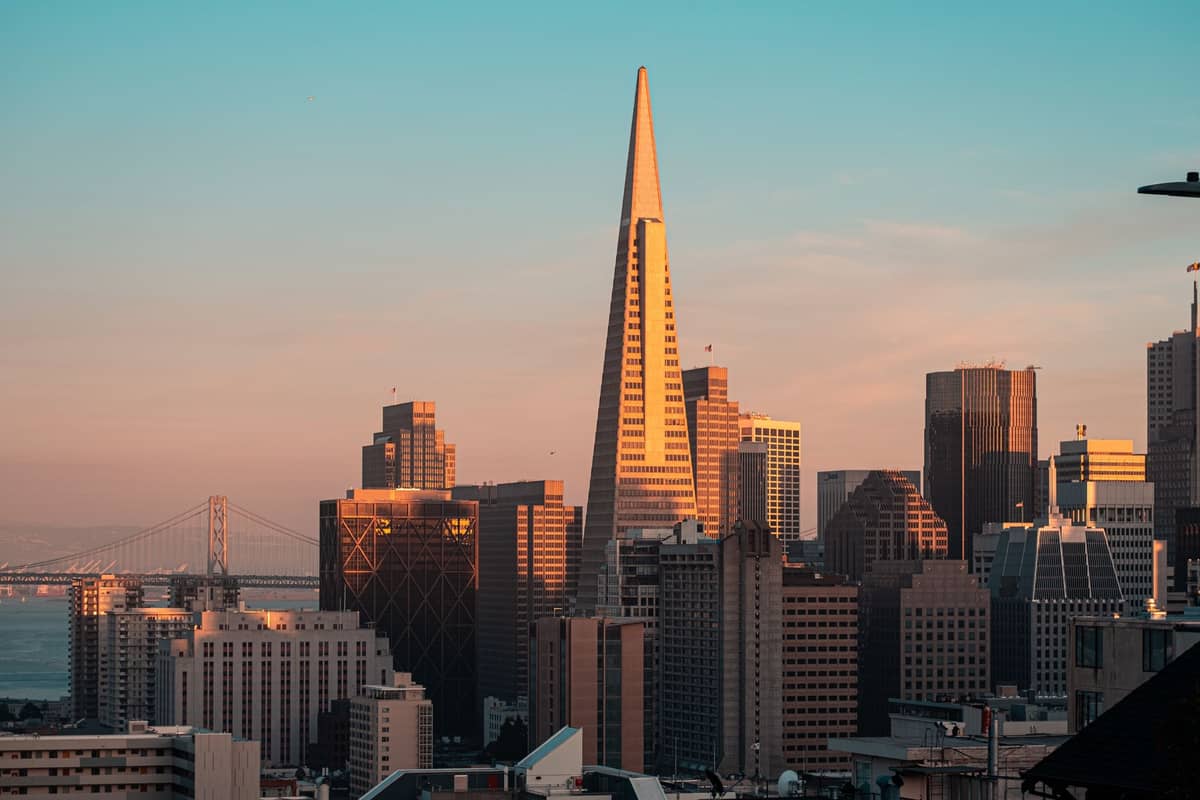
The Transamerica Pyramid is a 48-story, 260-meter (853-foot) office skyscraper completed in 1972 and designed by architect William Pereira. It served as the corporate headquarters of the Transamerica Corporation and remains one of the most structurally distinctive high-rises built in the United States during the postwar era. Today the building is the centerpiece of the larger Transamerica Pyramid Center, a redeveloped campus that includes ground-level public amenities and a small urban redwood park.
One critical point for visitors to understand before making the trip: there is no public observation deck. The upper floors are commercial office space and are not accessible to the general public. What draws people here is the exterior architecture itself, the street-level experience, and the rare opportunity to stand beneath a building that genuinely looks unlike anything else in the downtown skyline.
ℹ️ Good to know
Public hours for the Transamerica Pyramid Center indoor spaces are Tuesday to Saturday 11:00–18:00 and Sunday 12:00–17:00. The Redwood Park surrounding the base is open seven days a week from sunrise to sunset, free of charge. Verify current hours at thepyramidcenter.com before visiting.
The Architecture: Why This Building Matters
When Pereira's design was first unveiled in the late 1960s, San Franciscans were not enthusiastic. Criticism was sharp and public. Opponents called it a misfit on the skyline, an act of architectural arrogance imposed on a low-rise, pedestrian-scaled neighborhood at the edge of North Beach and Chinatown. The city had never seen a tapered quartz aluminum cladding and a pointed spire quite like this one, and for many, that was not a compliment.
What changed the public's mind was time and familiarity. The pyramid form, rather than competing with the bay and hills, complements them. Unlike a flat-topped rectangular tower, the tapering profile reduces the building's bulk at street level and allows more light to reach the surrounding blocks. The two thin "wings" that extend from either side of the upper floors house elevator shafts and stairwells rather than rentable office space, a structural decision that gives the spire its clean, uncluttered silhouette.
The building sits at the foot of Columbus Avenue, the diagonal street that cuts from the Financial District up through North Beach. This placement means the Pyramid terminates a long street view from the north, making it visible as you walk south along Columbus from City Lights or Washington Square. That framing is one of the best free photographic compositions in the city.
Tickets & tours
Live prices and dates from our booking partner. If you book, we may earn a commission at no extra cost to you.
Sonoma and Napa Valley wine tour from San Francisco
From 127 €Instant confirmationFree cancellationGo City | San Francisco Explorer Pass
From 76 €Instant confirmationFree cancellationMuir Woods and Sausalito guided tour with transportation
From 82 €Instant confirmationFree cancellationSan Francisco CityPASS
From 77 €Instant confirmationFree cancellation
The Redwood Park: A Quiet Surprise at the Base
Tucked along the eastern side of the complex is a small grove of coast redwood trees, planted as part of the original development. The grove is modest in size but unexpectedly serene for a downtown Financial District block. During weekday lunch hours, office workers occupy the benches and eat quietly while the trees filter the midday light. On weekends, the park empties considerably, and it becomes one of the calmer public green spaces in the downtown core.
The redwoods themselves are not ancient, but they are substantial for urban plantings and create a genuine microclimate difference: slightly cooler, notably quieter, with the soft filtered light that coastal redwood canopy produces. If you arrive expecting a manicured tourist plaza, the grove may surprise you with its understated character.
💡 Local tip
The redwood park is most atmospheric on overcast mornings, when diffuse light softens the tower above and the grove feels genuinely secluded. On clear midday visits, the light is harsher and the nearby streets fill with foot traffic.
How the Experience Changes by Time of Day
Early morning, before 8:00, the Financial District is still waking up. Montgomery Street carries delivery vehicles and early commuters, and the pyramid catches low eastern light on its aluminum cladding in a way that shifts the color from white to pale gold. At this hour the base of the building is nearly empty, and you can photograph the spire from directly below with almost no pedestrian interference.
Midday on weekdays brings the area to its peak density. The sidewalks along Montgomery fill with office workers, and the nearby blocks toward the Embarcadero and Chinatown move quickly. Photography becomes more challenging, though the energy of the district reflects the building's working identity as a functioning commercial tower, not a museum piece.
Late afternoon, roughly 16:00 to 17:30, is often the most rewarding time for photography. The western sun hits the Kearny and Washington Street angles and the spire becomes dramatically backlit when viewed from the east. San Francisco's marine layer frequently drifts in during the late afternoon during summer months (June through August), which can create a moody, diffuse backdrop behind the tower. September and October tend to offer the clearest skies and warmest temperatures for an extended outdoor visit.
Getting There and Getting Around the Area
The Transamerica Pyramid is reachable on foot from several downtown starting points. The Embarcadero BART and Muni station is roughly a 10 to 12 minute walk heading northwest along Clay or Sacramento Street. Multiple Muni bus lines serve Columbus Avenue and the surrounding blocks. The California Street cable car line passes several blocks to the south, connecting Nob Hill to the Financial District waterfront corridor.
The building is also well positioned within a self-guided walking circuit. From here you can walk north along Columbus into City Lights Bookstore and Washington Square Park in under 15 minutes, or continue east to the Ferry Building Marketplace along the Embarcadero in about 20 minutes on foot.
For visitors planning a broader Financial District and waterfront loop, combining the Transamerica Pyramid with a visit to the Embarcadero and Coit Tower makes for an efficient half-day. The San Francisco walking tours guide outlines several self-guided routes that pass through this corridor.
💡 Local tip
Street parking in the Financial District is extremely limited and expensive. Do not drive here specifically to see the pyramid. Transit and walking are both faster and cheaper on most days of the week.
Photography and Viewing Angles
The pyramid is photographed from all directions, but a few angles stand out. Looking south along Columbus Avenue with the spire framing the street ahead is the most classic composition and requires nothing more than standing on the sidewalk a few blocks north. The intersection of Columbus and Kearny offers a wider view that captures the base and the wing structures against the surrounding Financial District mid-rises.
For a more unusual perspective, the upper reaches of nearby hills such as Nob Hill or Telegraph Hill provide elevated views that place the Pyramid within the broader downtown skyline rather than isolating it. From Coit Tower, the Transamerica spire is visible as part of a sweep of towers against the bay, which offers a stronger sense of how the building relates to the surrounding urban fabric.
If skyline views from a distance are a priority, the best viewpoints in San Francisco include several vantage points from the East Bay waterfront where the pyramid appears prominently in classic bay-and-skyline shots.
Is It Worth Your Time?
As a standalone destination, the Transamerica Pyramid rewards visitors who come with realistic expectations. This is primarily an exterior architectural experience, not a large interactive attraction. There is no public observation deck and no ticketed access to the upper floors, though a small lobby visitor center offers virtual observation monitors and building information on weekdays.
Visitors expecting Chicago-style architecture tours or New York-style observation deck access will be disappointed. The building is a private commercial office tower and functions as one. But for anyone with an interest in modernist architecture, urban photography, or the history of San Francisco's skyline, standing beneath the Pyramid and looking straight up the tapering walls toward the 260-meter apex is a genuinely striking moment. It is the kind of building that looks better the closer you get to it.
⚠️ What to skip
If you are visiting specifically to access an upper-floor observation level: this is not possible. The Transamerica Pyramid has no public observation deck and the upper floors are commercial office space. Plan your visit around the exterior, the grounds, the redwood park, and the small lobby visitor center.
Insider Tips
- Walk north on Columbus Avenue from about two blocks away and shoot the pyramid framing the end of the street. This is the view that appears on most postcards and requires no special vantage point, just the sidewalk.
- Visit on a Tuesday or Wednesday morning before 9:00 if you want near-empty streets for photography. Weekday lunchtimes and weekends after 11:00 bring heavier foot traffic to the surrounding blocks.
- The redwood park on the eastern side of the complex is easy to miss if you arrive from Montgomery Street. Walk around to the Merchant Street or Hotaling Place side to find the grove.
- September and October deliver the clearest skies and best light conditions for outdoor photography in San Francisco. Summer fog can obscure the upper spire during morning and late afternoon hours, particularly in June and July.
- Combine the Transamerica Pyramid with Coit Tower and Washington Square Park for a 2-to-3 hour self-guided walk that covers three of North Beach and the Financial District's most photographed landmarks without any transit.
Who Is Transamerica Pyramid For?
- Architecture enthusiasts interested in postwar American commercial design
- Photographers building a comprehensive San Francisco skyline portfolio
- First-time visitors doing a self-guided Financial District and North Beach walking loop
- Travelers looking for free, low-effort sights that anchor a broader neighborhood walk
- Anyone combining a morning in Chinatown or North Beach with a downtown stroll
Nearby Attractions
Combine your visit with:
- 16th Avenue Tiled Steps
The 16th Avenue Tiled Steps Project is a community-made mosaic staircase of 163 steps stretching through San Francisco's Golden Gate Heights neighborhood (a sub-area of the Inner Sunset), depicting a journey from the ocean floor to the night sky. It's free, photogenic, and connects to one of the city's best lesser-known hilltop viewpoints.
- Angel Island State Park
Angel Island State Park sits in the middle of San Francisco Bay, offering miles of hiking trails, layers of military and immigration history, and 360-degree views of the city skyline, Marin headlands, and beyond. Getting there requires a ferry, which is part of the appeal — the island feels removed from city life, even though San Francisco is visible the entire time.
- Asian Art Museum of San Francisco
One of the largest Asian art collections in the Western world, housed in a transformed Beaux-Arts landmark at Civic Center. From ancient Chinese bronzes to contemporary Southeast Asian installations, the museum rewards careful visitors who know what to look for.
- UC Berkeley Campus
The University of California, Berkeley sits on a hillside above San Francisco Bay, offering free access to striking Beaux-Arts architecture, landmark museums, and open green spaces. A short BART ride from San Francisco, it rewards curious visitors with history, intellectual energy, and some of the best campus scenery in the country.
Planning a trip? Discover personalized activities with the Nomado app.