Train World Brussels: Inside Belgium's National Railway Museum
Train World is the official railway museum of Belgium's National Railway Company (SNCB/NMBS), opened in 2015 next to Schaerbeek station in Brussels. It houses a remarkable collection of historic locomotives and rolling stock inside a beautifully restored 19th-century station hall, offering one of the most atmospheric museum experiences in the Belgian capital.
Quick Facts
- Location
- Place Princesse Élisabeth 5, 1030 Schaerbeek, Brussels
- Getting There
- Schaerbeek railway station (SNCB), directly adjacent
- Time Needed
- 2 to 3 hours; allow more with children
- Cost
- Typical recent pricing: adults around €12, reduced tickets around €9–11, children and family tickets lower; under 4 free (check website for current rates).
- Best for
- Families, history enthusiasts, architecture lovers, rainy-day visits
- Official website
- www.trainworld.be
What Train World Actually Is
Train World is the official railway museum of Belgium's National Railway Company (SNCB/NMBS), located in the Schaerbeek district of Brussels. It opened in 2015 inside and alongside the historic Schaerbeek station building, a late 19th-century structure that gives the museum an architectural backbone most purpose-built institutions simply cannot replicate. This is not a collection of static exhibits behind ropes. The locomotives are enormous, lit with dramatic intent, and placed close enough to touch the rivets.
Belgium has a legitimate claim to railway history. The first continental European steam passenger railway line ran between Brussels and Mechelen in 1835, just five years after the world’s first public railway opened in England. Train World uses that founding moment as its narrative spine, tracing the evolution of Belgian rail from steam-powered origins through electrification and into the high-speed Eurostar era. The scope is national, but the storytelling is human-scale.
ℹ️ Good to know
Last admission is at 15:30, while the museum stays open until 17:00. If you arrive after 15:00, you may feel rushed. Aim to arrive before 14:00 for a relaxed visit.
The Experience: What You See and Feel Inside
The entrance leads through the restored station concourse, where original tilework and cast-iron columns frame the transition from street to exhibition. The smell is the first thing visitors notice: a faint combination of machine oil, aged timber, and the particular staleness of enclosed metal spaces. It is not unpleasant. It is specific, and it signals immediately that this is a place where real objects have been preserved.
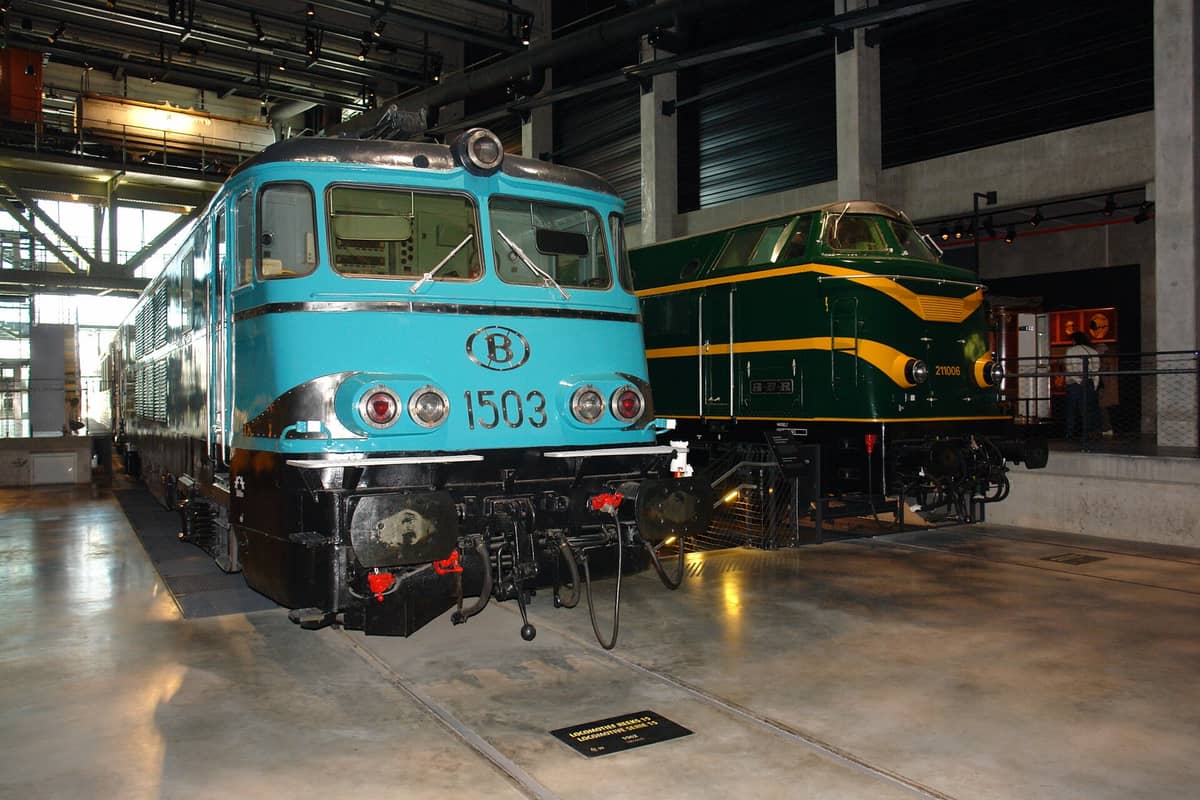
The centrepiece of the main hall is a collection of full-size locomotives, some dating to the late 1800s. The sheer scale of these machines in an enclosed space creates a quiet tension. The largest steam engines dwarf visitors standing beside them, and the museum's lighting design works carefully to emphasise form and shadow, making the machines look less like museum pieces and more like sleeping things. Children tend to go silent for a moment before the questions begin.
Beyond the locomotives, the exhibition covers the social history of rail travel, including original railway compartment interiors, a reconstructed station waiting room, luggage and ticketing artefacts, and displays on the human labour behind the network. There is a strong thread running through the displays about what the railway meant to Belgian working life, not just as infrastructure, but as employer, connector, and social institution.
Tickets & tours
Hand-picked options from our booking partner. Prices are indicative; availability and final rates are confirmed when you complete your booking.
Brussels self-guided audio tour with Train World ticket
From 28 €Instant confirmationBrussels' landmarks audio guide and Autoworld entry ticket
From 33 €Instant confirmationPass to Brussels Choco-Story, Belgian Beer World, and bus tour
From 74 €Instant confirmationBelgian Beer World entry and Brussels' landmarks audio guide
From 39 €Instant confirmation
Time of Day and Crowd Patterns
Train World draws a mix of school groups, families, and solo visitors with a genuine interest in transport history. Weekday mornings, particularly Tuesday through Thursday, tend to bring school parties, which means the main hall can be loud between roughly 10:00 and 12:30. If you prefer a quieter atmosphere, arriving just after lunch on a weekday, or on a Sunday morning, typically offers more space.
Weekend afternoons are the busiest periods overall. Saturday between 13:00 and 16:00 sees the highest family footfall. The museum is fully indoors, which makes it a practical choice on rainy Brussels days regardless of crowds.
💡 Local tip
For the calmest visit with the best light for photography, aim for a Tuesday or Wednesday around 13:00. The morning school groups have usually left, and the afternoon families have not yet arrived.
Getting There: Schaerbeek Station and Transit Options
The museum's location is one of its genuine practical advantages. Train World sits directly beside Schaerbeek railway station, served by regular SNCB intercity and local trains from Brussels-Central, Brussels-Nord, and Brussels-Midi. The journey from Brussels-Central takes around 10 minutes. If you are already travelling by Belgian rail, arriving at Schaerbeek is seamless: the museum entrance is visible from the platform.
STIB bus and tram connections also serve the Schaerbeek area, linking it to central Brussels neighbourhoods. Check the STIB journey planner for current line numbers and stops near Place Princesse Élisabeth, as services are subject to revision. The area around the station is straightforward to navigate on foot once you arrive.
If you are combining Train World with other Brussels museums, consider pairing it with the Autoworld museum at the Cinquantenaire, which offers a complementary perspective on Belgian transport history, or with the Museum of Natural Sciences for a full day of family-friendly exhibits across the city.
Practical Information: Tickets, Hours, and Access
Train World is open Tuesday to Sunday, including most public holidays, from 10:00 to 17:00. It is closed on Mondays and on major holidays such as Christmas Day and New Year’s Day. The ticket office and doors close at 15:30, which is an earlier cutoff than many visitors expect.
- Adults (18+): around €12 (check current price online)
- Children 6–17: around €9–11 (check current price online)
- Children 4–5: typically a reduced child rate (consult current tariffs)
- Children under 4: free (ticket collected at entrance)
- Seniors 65+: reduced rate compared with adults (see latest prices; conditions may vary between online and cash desk).
- Family ticket (2 adults + children under 18): around €36–40 depending on offer; check current family rates.
- Visitor with disability (without companion): reduced rate (verify current amount on the official website).
- Visitor with disability + companion: combined discounted rate (check current pricing structure online).
The disability pricing structure is notably thoughtful: a visitor with a disability and their companion benefit from a combined discounted rate that is close to the price of a single adult ticket. School groups pay a reduced price per pupil. For specific accessibility requirements beyond pricing, the museum recommends contacting them directly, as the official site does not publish detailed physical accessibility specifications.
Train World fits naturally into a broader Brussels museum itinerary. For a full overview of the city's best collections, see the best museums in Brussels guide, or if you are visiting with children, the Brussels with kids guide covers practical logistics and child-friendly sequencing.
Photography Inside Train World
The main hall offers genuinely striking photography opportunities. The combination of industrial scale, moody directional lighting, and the texture of aged metal produces images that work well even with a smartphone. Wide-angle shots from the far end of the hall capture the full length of multiple locomotives in perspective. Close-up details, wheel assemblies, coupling mechanisms, cab windows, reward patience and a steady hand in the lower light areas.
Avoid using flash, which flattens the dramatic shadows that make these spaces visually interesting. The reconstructed interior spaces, including the vintage waiting room, photograph best in the quieter afternoon hours when visitor density drops. Tripods are unlikely to be practical given the foot traffic, but a raised ISO and image stabilisation handle the conditions well.
Is Train World Worth Your Time?
Train World earns its reputation. It is not an attraction that coasts on subject matter alone. The curation is careful, the architecture of the building adds genuine atmosphere, and the scale of the collection justifies the ticket price. It consistently receives high marks from visitors who did not expect to find it compelling, which is often the more reliable signal.
That said, it is worth being honest about limitations. The Schaerbeek location feels peripheral to some visitors who are concentrating their time around the centre and the Grand-Place area. The journey is short by train, but it requires an intentional detour. If your Brussels itinerary is very compressed, Train World competes for time with major attractions closer to the city core. For anyone with a half-day to spare, particularly on a grey Belgian afternoon, it is among the more rewarding ways to spend it.
Visitors who are indifferent to railway history and primarily motivated by checking off landmarks may find the experience less compelling. The museum rewards curiosity and slowing down rather than moving quickly through a space. Those expecting interactive digital experiences may find the emphasis on physical objects and historical narrative more traditional than they anticipated.
⚠️ What to skip
The museum is closed every Monday and on certain public holidays. Always check the official website at trainworld.be before making the journey, especially during school holiday periods when hours or closures may differ.
Insider Tips
- Take the SNCB train directly to Schaerbeek station rather than trying to reach the museum by bus from the centre. The train takes around 10 minutes from Brussels-Nord or Brussels-Central, and you step off the platform practically at the entrance.
- The senior discount (reduced rate for ages 65+) may have specific conditions depending on whether you buy online or at the cash desk. If you are booking tickets in advance digitally for a group that includes seniors, check the latest conditions and be prepared for a brief stop at the desk on arrival if needed.
- The reconstructed vintage railway compartment interiors are easy to walk past quickly. Slow down here. The detail work in these small spaces, original upholstery patterns, luggage racks, window hardware, is some of the most tactile history in the entire museum.
- If you are visiting with young children, note that the museum cafe provides a useful reset point roughly halfway through the visit. The main hall's open floor plan means noise carries, so children who need a break from stimulation benefit from a short detour.
- For context before you visit, Belgium's railway history connects directly to its industrial and colonial history. The museum addresses some of this complexity in its displays, which gives adult visitors a richer experience than a straightforward celebration of engineering would offer.
Who Is Train World For?
- Families with children aged 5 and above who respond to large-scale physical objects and hands-on history
- Architecture enthusiasts interested in 19th-century Belgian station design and industrial heritage buildings
- Travellers on rainy days looking for a full half-day indoor experience outside the standard city-centre circuit
- Transport history buffs and anyone interested in Belgium's foundational role in continental European railways
- Budget-conscious visitors travelling by rail who can reach Schaerbeek station directly without additional transport costs
Nearby Attractions
Combine your visit with:
- AfricaMuseum Tervuren
Set in a grand neoclassical palace 14 km east of Brussels, the AfricaMuseum is one of Europe's largest museums dedicated to Central Africa. Reopened in 2018 after a five-year renovation, it now confronts its own colonial past head-on while housing world-class natural history, ethnographic, and art collections.
- Basilica of the Sacred Heart (Koekelberg)
The National Basilica of the Sacred Heart in Koekelberg is one of the largest Art Deco religious buildings in the world, its green copper dome rising 89 metres above Brussels. Entry to the basilica is free; a paid climb to the dome platform delivers one of the city's most underrated panoramas.
- Cantillon Brewery (Brasserie Cantillon)
Cantillon Brewery (Brasserie Cantillon) is one of the few remaining traditional lambic breweries in Brussels, doubling as the Brussels Museum of the Gueuze since 1978. Located a short walk from Gare du Midi in Anderlecht, it is a working industrial site and a serious destination for anyone wanting to understand why Belgian beer culture earned UNESCO recognition.
- Comic Strip Route (Mural Trail)
Brussels' Parcours BD is a free, self-guided trail of more than sixty large-scale comic murals painted on building walls across the city. Created in 1991, it turns the streets themselves into an open-air gallery celebrating Belgium's most distinctive art form. No ticket required, no opening hours to check.