Torre di Mariano II: Oristano's Medieval Tower in the Heart of Piazza Roma
Rising about 28 metres above Piazza Roma, the Torre di Mariano II is one of the most visible survivors of Oristano's medieval city walls. Built in 1290 by Judge Mariano II de Bas-Serra, it anchors the historic centre and rewards any visitor who pauses long enough to read its stones. Entry to the exterior is free.
Quick Facts
- Location
- Piazza Roma, centro storico, 09170 Oristano, Sardinia
- Getting There
- 10–15-minute walk from Oristano train station; central pedestrian square with restricted vehicle access
- Time Needed
- 15–30 minutes for the exterior; longer if combined with a walk around the historic centre
- Cost
- Free (exterior only; interiors currently closed to visitors)
- Best for
- History enthusiasts, architecture lovers, slow travellers exploring Oristano on foot
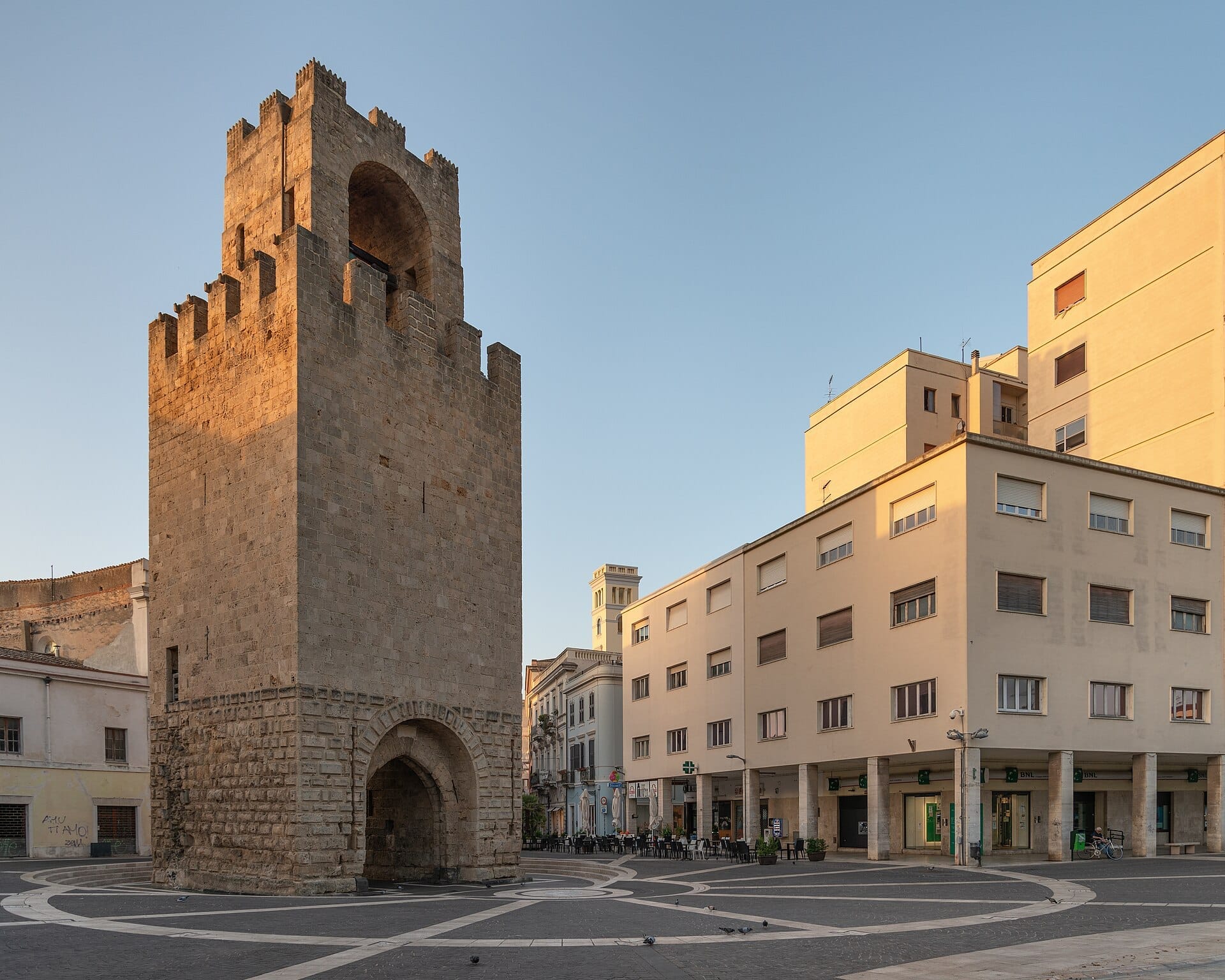
What Is the Torre di Mariano II?
The Torre di Mariano II, also known as the Torre di San Cristoforo, stands alone in the centre of Piazza Roma as the last major gate tower of Oristano's medieval fortifications. At roughly 28 metres tall, it is composed of a main sandstone body rising about 19 metres, topped by a smaller merloned turret of around 10 metres. That upper section carries a bronze bell dated to 1430, attributed to a founder named Bernardo Guardi, whose authorship is traditionally attributed in local historiography.
The tower was built in 1290 on the orders of Judge Mariano II de Bas-Serra, ruler of the Giudicato of Arborea, the medieval Sardinian kingdom that at its height controlled much of the island and resisted Aragonese expansion for decades. An inscription recording the construction date was removed over the centuries and is now preserved in the Antiquarium Arborense museum, a short walk from the square.
ℹ️ Good to know
The interior of the tower is currently closed to the public. All visits are exterior only. For information on organised guided tours of Oristano's monuments, contact: Tel. +39 0783 791262 or visiteguidate@fondazioneoristano.it.
Historical Context: The Giudicato of Arborea and Its Fortifications
To understand why this tower matters, it helps to know what it was part of. Between the 9th and 15th centuries, Sardinia was divided into four independent kingdoms called Giudicati. Oristano was the capital of the Giudicato of Arborea, and by the late 13th century the city was protected by a circuit of walls with multiple gate towers. The Torre di Mariano II served as the northern gate, the Porta Ponti (also referred to historically as Porta Manna), controlling the main road toward Sassari and the northern part of the island.
Mariano II ruled Arborea from roughly 1250 to 1297 and was a significant political figure in Sardinian history, instrumental in consolidating Arborean power before the Aragonese invasion of the early 14th century. His daughter-in-law, Eleanor of Arborea (Eleonora d'Arborea), later became one of Sardinia's most celebrated historical figures, known for the Carta de Logu, a legal code that remained in force until 1827. Walking through the square today, you pass within a few hundred metres of the civic statue dedicated to Eleanor, making this corner of Oristano something of an open-air archive of the Arborean era.
The tower is one of only two surviving gate towers from Oristano's original medieval walls; the other, the smaller Torre Portixedda, stands a few streets away. Together they give a partial but still legible sense of how the fortified city was organised. For broader context on Sardinia's extraordinary density of historic monuments, the guide to Sardinia's ancient and medieval sites is a useful companion.
Tickets & tours
Hand-picked options from our booking partner. Prices are indicative; availability and final rates are confirmed when you complete your booking.
Balai Bay snorkeling experience from Porto Torres
From 42 €Instant confirmationFree cancellationAsinara island e-bike rental from Porto Torres
From 48 €Instant confirmationFree cancellationDiscover the Products of Beekeeping in Oristano
From 92 €Instant confirmationFree cancellationGuided Kayaking Excursion in Porto Torres
From 49 €Instant confirmationFree cancellation
The Experience: What It Feels Like to Visit
Piazza Roma is a working civic square, not a tourist set piece. Locals cross it on the way to the bar, the post office, and the shops that ring the perimeter. The tower rises from the paving stones with no fence, no barrier, and no admission booth, which gives the whole encounter an unusual directness. You can stand close enough to press your hand against the rough limestone and trace the individual cut blocks, some visibly weathered, others re-pointed at different periods.
In the morning, the light comes low from the east and catches the texture of the upper merlons. The square is quiet, occupied mainly by pensioners on benches and the occasional delivery van threading through the pedestrian zone. By midday in summer, the tower throws a useful shadow across the south side of the square, and the piazza fills with students and office workers on lunch breaks. Late afternoon, roughly an hour before sunset, is photographically the strongest moment: the warm orange-pink light strikes the west face of the tower directly, and the surrounding buildings recede into shade.
The bell in the upper turret is visible from below if you step back far enough toward the south side of the square. It does not ring on a public schedule as far as current records indicate, but its presence gives the upper tier a functional, non-decorative quality that distinguishes this tower from purely ornamental survivors.
💡 Local tip
For the cleanest photographs, position yourself at the southeast corner of Piazza Roma in the late afternoon. From there you capture the full height of the tower with the merloned turret in profile and minimal visual clutter from surrounding buildings.
Architecture: Reading the Tower's Construction
The tower is built in a style typical of late 13th-century Sardinian military architecture, drawing on the Pisan and Genoese traditions that were influential in the island's western and northern territories at the time. The base is square in plan and constructed from local limestone, with walls of considerable thickness that taper slightly as they ascend. The transition between the main body and the merloned turret is articulated by a corbelled cornice, a detail that recurs on contemporary Sardinian defensive structures.
The original gate arch, which would have spanned the road through the tower's base, is no longer passable. The tower now sits as a free-standing monument, the road having been redirected around it as the city changed over centuries. This isolation in the square is actually a relatively recent urban condition; for most of its history, the tower was embedded in the wall circuit and experienced as a threshold rather than a landmark.
Practical Walkthrough: Getting There and Around
Oristano train station is served by Trenitalia regional services from Cagliari (approximately 1 hour) and from Sassari (approximately 2 hours). From the station, Piazza Roma is a straightforward 10–15-minute walk through the town centre, along streets such as Via Vittorio Veneto, Via Giuseppe Mazzini and Via Figoli. The route passes through a compact historic centre that rewards slow walking.
If you arrive by car, limited parking is available on the eastern side of the historic centre near Via Mazzini; the central squares are pedestrianised. Oristano makes an efficient base for exploring the wider region, including the Tharros archaeological site on the Sinis Peninsula about 20 kilometres to the west, and the Stagno di Cabras lagoon, one of the most significant wetland habitats in the western Mediterranean.
The piazza itself is fully accessible from street level and has no steps or barriers at the perimeter. The tower exterior can be viewed and photographed by anyone without restriction. Since the interior is closed, there is no accessibility question for internal spaces at present.
⚠️ What to skip
The interior of the Torre di Mariano II has been closed to the public for a considerable period. Do not assume access will be available. Check with the Fondazione Oristano (visiteguidate@fondazioneoristano.it) before planning a visit that depends on internal access.
Combining the Tower with the Rest of Oristano
The Torre di Mariano II is most rewarding when it is one point on a longer walk rather than a standalone destination. The Antiquarium Arborense museum, which holds the original construction inscription from the tower along with a substantial collection of Nuragic, Phoenician, and Roman artefacts from the Oristano area, is located a short distance from Piazza Roma and is the logical companion visit. The civic statue of Eleanor of Arborea stands nearby, connecting the visual and historical threads of the Arborean period.
The second surviving medieval tower, Torre Portixedda, is walkable from Piazza Roma in under five minutes. Together, these two towers and the Antiquarium Arborense constitute a coherent half-day itinerary for anyone interested in medieval Sardinia. For a broader picture of the area's attractions, the day trips from Cagliari guide covers the Oristano region in the context of what is reachable from the island's capital.
Oristano is also a gateway to the Sinis Peninsula, where the landscape shifts from the quiet provincial city to a coastline of shallow lagoons, Phoenician ruins, and beaches composed of quartz sand so fine it resembles ground glass. Renting a car for the afternoon extends the day considerably.
Who This Is For — and Who Might Skip It
The Torre di Mariano II is not a destination that will satisfy visitors looking for an immersive or interactive experience. The interior is closed, there is no interpretive signage of real depth in the square, and the tower does not dominate its surroundings with the theatrical quality of, say, a coastal castle or a hilltop fortress. What it offers is something quieter: a well-preserved medieval structure of genuine historical significance, standing in a living Italian piazza, free to visit, and best understood by those who come with some context already in hand.
Travellers doing a rapid coastal circuit of Sardinia with the beach as the primary goal are unlikely to find the detour worthwhile. However, for anyone with an interest in medieval Italian history, in the specific history of Sardinia's pre-Aragonese period, or in the texture of a non-touristy Sardinian town, the tower and the square it occupies offer something that the island's more photographed attractions do not: ordinariness, in the best sense.
Insider Tips
- The Antiquarium Arborense holds the original foundation inscription of the tower, removed from the structure centuries ago. Visiting the museum first gives you the historical framing that the square itself does not provide.
- Late afternoon on a weekday is the least crowded and most photogenic time. The square sees peak foot traffic during the Saturday morning market and on weekday lunch hours.
- The nearby Caffe Veneto and other bars on Piazza Roma are local institutions. Sitting with a coffee and watching the square is its own experience and costs almost nothing.
- If you ask at the Fondazione Oristano about guided tours (visiteguidate@fondazioneoristano.it), occasional organised visits to the tower and other monuments in the historic centre are arranged, sometimes including restricted-access areas not open to individual visitors.
- The second surviving gate tower, Torre Portixedda, is less visually striking but structurally older in parts. Seeing both in the same walk takes under 20 minutes and gives a clearer sense of the original fortification system.
Who Is Torre di Mariano II (Oristano) For?
- Travellers with an interest in medieval Sardinian history and the Giudicato of Arborea
- Architecture enthusiasts drawn to late 13th-century defensive building techniques
- Slow travellers using Oristano as a base for the Sinis Peninsula who want to understand the town they are sleeping in
- Photographers looking for an uncluttered medieval tower in a real working piazza rather than a tourist precinct
- Anyone combining a visit to the Antiquarium Arborense with a walk around the historic centre
Nearby Attractions
Other things to see while in Oristano & the Sinis Peninsula:
- Giants of Mont'e Prama (Cabras Museum)
The Giants of Mont'e Prama are Nuragic stone statues discovered near Cabras in 1974 — carved warriors, archers, and boxers currently dated to roughly 900–750 BCE. Displayed at the Civic Archaeological Museum “Giovanni Marongiu” in Cabras (with additional sculptures in Cagliari), they represent one of the most significant archaeological finds in the entire Mediterranean world.
- Lago Omodeo
Lago Omodeo is the largest artificial reservoir in Sardinia, formed by damming the Tirso River and stretching almost 30 km² across the central-western interior of the island. Its layered history, from a record-breaking 1924 dam to a torpedo attack in 1941 to a 100-metre replacement inaugurated in 1997, makes it far more than a scenic viewpoint. Entry is free, access requires a car, and the reward is a landscape that most coastal-focused visitors never see.
- Nuraghe Losa
Standing on the basalt plateau of Abbasanta in central-western Sardinia, Nuraghe Losa is a remarkably well-preserved trilobed nuraghe dating back to the 14th century BC. With its massive central tower, three surrounding bastions, and a sprawling village complex covering 3.5 hectares, this is one of the most complete and legible Nuragic sites on the island — and one of the few that rewards visitors who take the time to climb inside.
- Pozzo Sacro di Santa Cristina
The Pozzo Sacro di Santa Cristina, near Paulilatino in the Oristano province, is one of the best-preserved sacred wells of the Nuragic civilization, dating to around the 11th century BC. Its keyhole-shaped staircase descends into the earth with architectural precision that still puzzles researchers. This is not a site you pass through quickly — it rewards slow attention.