Topkapı Palace Harem: Inside the Ottoman Empire's Most Secretive Quarters
The Topkapı Palace Harem is one of Istanbul's most architecturally intricate and historically loaded spaces. The standard palace ticket now includes access beyond the main palace courts into a labyrinth of tiled chambers, royal apartments, and courtyard gardens where Ottoman sultans, their mothers, wives, and hundreds of palace servants lived — largely hidden from the outside world for over three centuries.
Quick Facts
- Location
- Topkapı Palace, Cankurtaran, Fatih, Istanbul — behind Hagia Sophia
- Getting There
- Tram T1 to Gülhane or Sultanahmet stops; 5-10 min walk to palace entrance
- Time Needed
- 1 to 1.5 hours for the Harem alone; 3-4 hours for the full palace
- Cost
- Since January 2024, the Harem is included in the standard Topkapı Palace ticket (2,750 TL combined). No separate Harem ticket is needed. The Istanbul Museum Pass covers the main palace but not the Harem. Verify current rates at muze.gen.tr before visiting.
- Best for
- Ottoman history, Islamic architecture, cultural depth, photography
- Official website
- muze.gen.tr/muze-detay/topkapi
What the Harem Actually Is
The Topkapı Palace Harem is not a single room or even a wing — it is a city within a palace. Comprising more than 300 rooms across multiple levels, courtyards, hamams, and corridors, the Harem was the private residential compound of the Ottoman sultan and everyone under his household authority. At its peak during the 16th and 17th centuries, it housed the sultan's mother (the Valide Sultan, the most powerful woman in the empire), his concubines, wives, daughters, and a large staff of eunuchs who managed security and administration.
The Harem section of Topkapı Palace dates primarily from the late 16th century, when the complex was substantially expanded under Murad III. Topkapı itself was begun in 1459 under Mehmed II — the sultan who had conquered Constantinople just six years earlier — and served as the administrative and residential heart of the Ottoman Empire until the mid-19th century. The palace became a museum in 1924, shortly after the founding of the Turkish Republic. The Harem was opened gradually to the public in the mid-20th century after a period of restricted access and study.
ℹ️ Good to know
The Harem entrance is located beneath the Tower of Justice on the western side of the Second Court, not the main palace entrance. Buy your Harem ticket at the designated booth near this entrance, as it is separate from the general Topkapı admission ticket.
First Impressions: Entering the Complex
Visitors enter the Harem through the Carriage Gate (Arabalı Kapı), a narrow stone passage that immediately signals a change in scale. The transition from the broad, open Second Court of the palace into the Harem corridors is abrupt. Ceilings lower. Corridors narrow. The light shifts from open sky to the filtered glow coming through high, latticed windows. Within the first few steps, you understand why this space carried such psychological weight — its architecture was designed to control movement and visibility.
The smell inside is cool stone and faint must, occasionally cut by the scent of the garden courtyards when windows align with the breeze. In summer, the interior is noticeably cooler than the outer palace grounds, which makes the Harem an unexpectedly pleasant refuge on hot afternoons. In winter, the tile surfaces feel cold and the chambers take on a more austere character — the ornamentation stands out more sharply without the softening effect of warm light.
Tickets & tours
Hand-picked options from our booking partner. Prices are indicative; availability and final rates are confirmed when you complete your booking.
Topkapi Palace and Harem skip-the-line tickets with options
From 60 €Instant confirmationTopkapi Palace & Harem Fast Track Ticket and Guided Tour
From 62 €Instant confirmationFree cancellationTopkapi Palace and Basilica Cistern fast-track ticket
From 99 €Instant confirmationFree cancellationHagia Sophia, Topkapi Palace and Basilica Cistern Istanbul tour
From 144 €Instant confirmationFree cancellation
The Rooms Worth Slowing Down For
Only a portion of the Harem's 300-plus rooms are accessible to visitors at any given time. Restoration work is ongoing, and the route shifts accordingly, so the exact sequence of rooms you walk through may differ from published guides. The sections that are consistently open include the quarters of the Valide Sultan, the Imperial Hall (Hünkar Sofası), the apartments of Murad III, and the Cage (Kafes) — the gilded-but-confining area where princes lived until they were called to the throne.
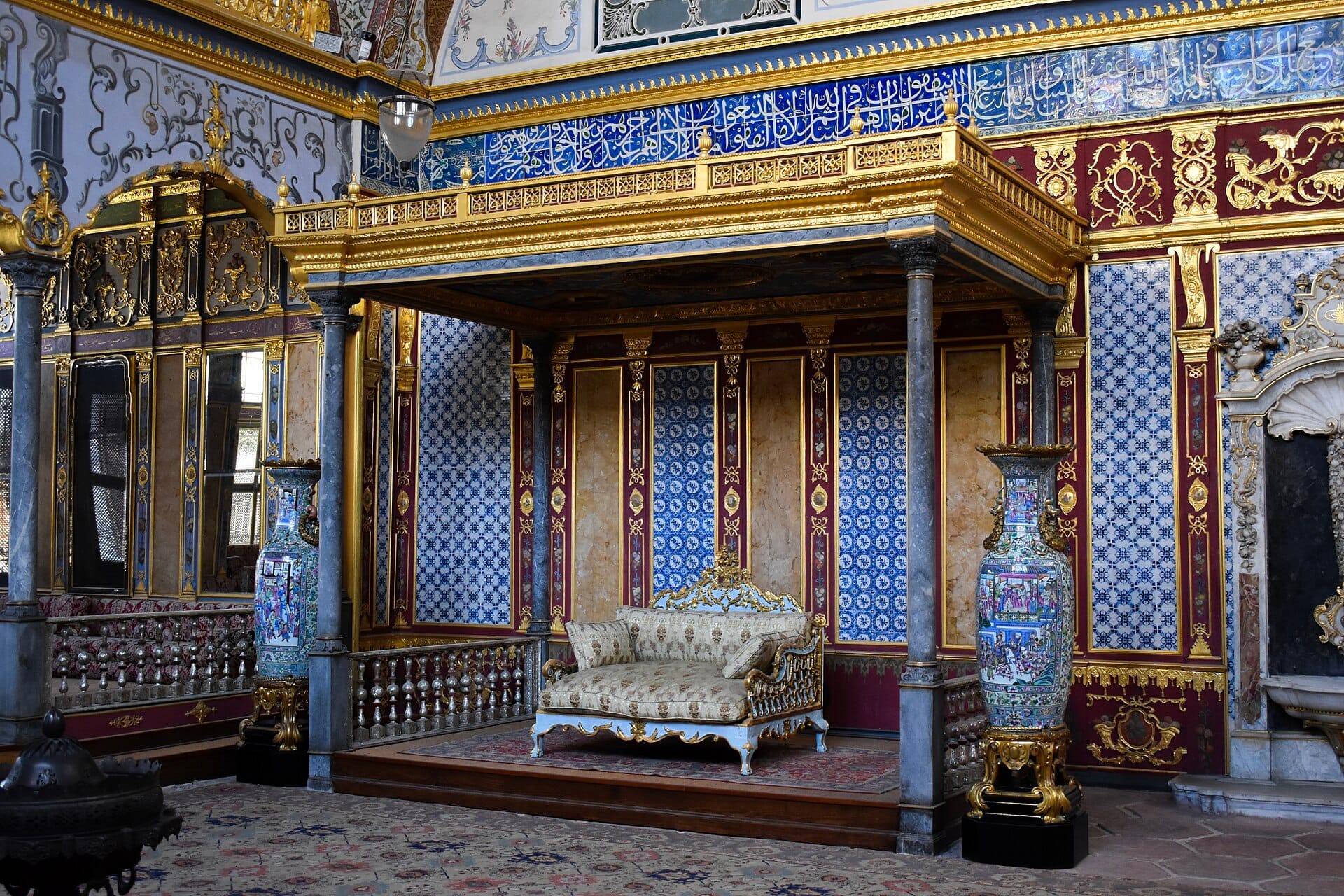
The Imperial Hall is the visual centerpiece. It is a large domed reception room where the sultan received his household on formal occasions. The proportions are unexpected — unexpectedly grand in a palace otherwise organized around intimate, private spaces. The dome rises above a room lined with 17th-century Iznik tiles and European-influenced painted panels added in later centuries, a layering of styles that reflects the Ottoman court's evolving tastes over 400 years.
The apartments of Murad III are the most architecturally coherent. Designed in the late 16th century, the rooms feature a fountain set into the wall (a detail meant to mask conversation from eavesdroppers), tilework in deep cobalt and turquoise, and carved stucco ceilings. The juxtaposition of the fountain's practical purpose — acoustic privacy — and its extraordinary craftsmanship says something pointed about life in the Harem: beauty and control were never fully separated.
💡 Local tip
Stand in Murad III's apartments and look at the tilework at floor level as well as eye level. The lower panels often show different motifs from those at eye height, and the transition between them is easy to miss when crowds are pressing through.
How Time of Day Shapes the Visit
The Harem is most crowded between 10:30 AM and 1:30 PM, when tour groups from the main palace flow through after completing the outer courts. During peak season (April through October), corridors can become seriously congested, which makes it harder to pause and examine tilework or architectural details without blocking foot traffic.
Arriving when the palace opens at 9:00 AM gives you roughly 45 minutes to an hour ahead of the main crowd surge. The early light through latticed windows hits the Iznik tiles at low angles, emphasizing texture and color in ways that midday flat light does not. Afternoon visits after 3:00 PM are also quieter, though you should allow adequate time before the 6:00 PM closing — official hours are 9:00 AM to 6:00 PM — as the Harem route is longer than it looks on maps.
⚠️ What to skip
Opening hours and ticket prices at Topkapı Palace change seasonally and are updated regularly by the Ministry of Culture and Tourism. Always verify current information at muze.gen.tr or the official museum ticket booth before your visit. The Harem ticket is not included in the Istanbul Museum Pass, which only covers the main palace areas.
Photography Inside the Harem
Photography is permitted throughout most of the Harem without flash. The interiors are dim in many sections, so a phone camera will struggle without night mode or the ability to stabilize on a surface. A small mirrorless camera with a fast wide-angle lens handles the conditions well. The courtyard of the Valide Sultan is the most photogenic outdoor space in the complex — a contained garden with a fountain at its center, surrounded by tiled arcades that frame the space cleanly.
The Imperial Hall is frequently the most photographed room, but the composition is tricky given its size and the number of people in it. Better shots come from the quieter connecting rooms, where arched doorways create layered framing and light from adjacent windows creates natural contrast. Look also at the ceilings: the painted vault in the Twin Kiosk section is one of the more photographically underexploited details in the whole palace.
Practical Walkthrough: Getting There and Getting In
Topkapı Palace sits at the eastern tip of the historic peninsula in Sultanahmet. The easiest route is the T1 tram from Eminönü or Kabataş to either the Sultanahmet or Gülhane stop, followed by a walk uphill through Gülhane Park or along the palace walls. For broader context on navigating the historic peninsula, the Istanbul Historic Peninsula guide covers the main access points and walking routes between major sites.
Buy your general Topkapı Palace admission at the main gate (the Imperial Gate). The Harem ticket is sold separately at a dedicated booth near the Harem entrance in the Second Court, not at the main ticket office. During busy periods, there can be a short queue for the Harem ticket even if you already hold the palace ticket. The Harem operates on timed entry during peak season — ask at the booth when the next entry slot is available.
The Harem is not fully accessible for wheelchair users due to uneven cobblestones, stepped thresholds between rooms, and narrow corridors. Some outdoor courtyard sections are manageable, but the interior route involves level changes that cannot be avoided. The Topkapı Palace main complex has similar accessibility constraints throughout the historic courts.
Is It Worth the Extra Ticket?
The Harem divides visitors. Travelers with a strong interest in Ottoman history, architectural detail, or court culture will find it one of the most rewarding hours they spend in Istanbul. The combination of tilework, spatial sequencing, and historical weight is not replicated anywhere else in the city. If you have spent time reading about the role of the Valide Sultan or the politics of harem life, walking through these rooms with that knowledge is a genuinely affecting experience.
Visitors looking primarily for panoramic views, broad open spaces, or the kind of spectacle associated with Istanbul's great exterior sights will get more from spending that time on the palace terraces or walking to the Hagia Sophia. The Harem rewards patience and attention; it does not deliver immediate visual impact in the way that a great dome or courtyard does.
The route can also feel incomplete. Because restoration is permanent and ongoing, some of the most storied sections of the Harem — including certain concubine quarters and the baths — are periodically closed. Visitors sometimes emerge having expected more rooms than were available, which is a reasonable frustration worth factoring into expectations.
Insider Tips
- Combine your Harem visit with the adjacent Imperial Treasury in the same morning. Both reward careful looking over a long stay, and doing them back-to-back before crowds peak is far more satisfying than rushing either.
- The courtyard of the Valide Sultan is often the least crowded outdoor space in the entire Harem route. Pause here rather than pressing forward — most visitors move through quickly without sitting with the space.
- Audio guides for the Harem are available at the entrance and add substantial context to rooms that otherwise have minimal English signage. The labeling inside the Harem is less thorough than in the outer palace courts.
- If a room is roped off when you pass it, check again on your way back. Guards sometimes open sections after the initial rush moves through, particularly in the late morning.
- Wear comfortable, flat shoes. The Harem floor surfaces alternate between marble, uneven stone paving, and worn thresholds. In wet weather, some outdoor courtyard sections become slippery.
Who Is Topkapı Palace Harem For?
- Ottoman and Byzantine history enthusiasts who want architectural and cultural depth beyond the headline sights
- Architecture and decorative arts travelers with particular interest in Iznik tilework and 16th-century interior design
- Photographers seeking interior detail shots rather than wide exterior compositions
- Couples and mga solo traveler who move at their own pace and are willing to slow down for detail
- Visitors on a second trip to Istanbul who have already seen the major exterior sights and want something more layered
Nearby Attractions
Other things to see while in Sultanahmet:
- Basilica Cistern
Built by Emperor Justinian I in 532 AD, the Basilica Cistern is one of Istanbul's most extraordinary ancient structures. Descend beneath Sultanahmet's streets into a vast, column-filled underground reservoir that once supplied water to the Byzantine imperial palace. Few places in the world feel quite like it.
- Blue Mosque (Sultan Ahmed Mosque)
The Sultan Ahmed Mosque, known universally as the Blue Mosque, is one of Istanbul's most recognizable landmarks. Built between 1609 and 1616, it remains an active place of worship that welcomes non-Muslim visitors outside prayer times. This guide covers everything you need to plan a smooth, respectful visit.
- Gülhane Park
Gülhane Park sits directly beside Topkapı Palace in Sultanahmet, occupying land that served as the Ottoman court's private outer garden for centuries. Open daily, free to enter, and containing one of Istanbul's oldest surviving monuments, it rewards visitors who take more than a passing glance.
- Hagia Irene
Hagia Irene (Aya İrini Müzesi) is the oldest surviving church structure in Istanbul, predating even Hagia Sophia. Sitting quietly inside the first courtyard of Topkapı Palace, it offers a rare encounter with raw Byzantine architecture — unrestored, unadorned, and old.