Thean Hou Temple: Kuala Lumpur's Grand Chinese Shrine Above the City
Perched on a hill in Seputeh, Thean Hou Temple is one of the largest and most ornate Chinese temples in Southeast Asia. Dedicated to the sea goddess Mazu, it draws worshippers, curious travelers, and photographers year-round, with its six-tiered structure offering sweeping views over Kuala Lumpur's skyline.
Quick Facts
- Location
- Robson Hill, Seputeh, Kuala Lumpur
- Getting There
- Hang Tuah Monorail Station, then 10-min taxi or Grab
- Time Needed
- 1 to 2 hours
- Cost
- Free entry to temple grounds
- Best for
- Architecture lovers, photographers, cultural visitors, festival-goers
What Is Thean Hou Temple?
Thean Hou Temple, formally known as the Temple of the Heavenly Mother, sits on Robson Hill in the Seputeh district, about three kilometers south of Kuala Lumpur's city center. Built by the Hainanese community and managed by the Selangor and Federal Territory Hainan Association, the temple was officially opened in 1989 after nearly a decade of construction. At six stories tall and occupying roughly 1.67 hectares, it is among the largest Chinese temples in Southeast Asia.
The temple is dedicated primarily to Tian Hou, the Taoist sea goddess Mazu, who is venerated by Hainanese and Hokkien communities across Malaysia, Singapore, and Taiwan. Two secondary deities share the main hall: Guan Yin, the Buddhist goddess of mercy, and Shui Wei Sheng Niang, the goddess of the waterfront. The three deities together make this a temple that blends Taoist and Buddhist traditions under one ornate roof, which explains the broad mix of visitors you will find here on any given morning.
ℹ️ Good to know
Entry to the main temple floors and gardens is free. Some commercial areas on the lower levels, including souvenir stalls and a healthcare hall, occupy paid-use spaces but visiting them is entirely optional.
The Architecture: What You Are Actually Looking At
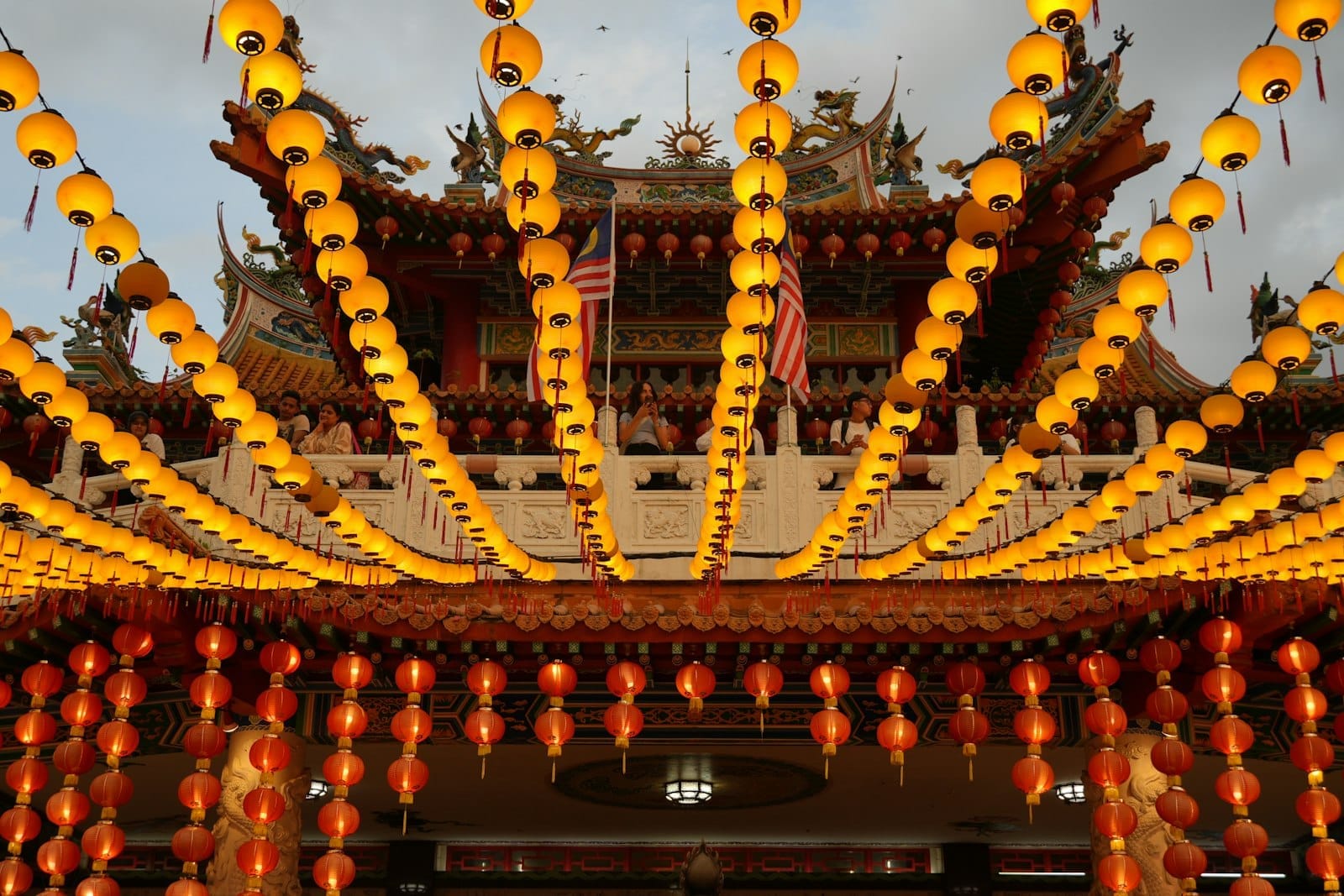
From the street, the temple reads like a layered wedding cake of red columns, upswept rooflines, and golden dragons coiling across every visible surface. The design follows classical southern Chinese temple architecture, with heavy influence from the Fujian style, though the sheer scale pushes it well beyond a traditional neighborhood shrine. Eight large tortoises, symbolizing longevity, flank the forecourt at the base, and the approach staircase is lined with statues and lantern poles that glow orange and red after dark.
The main prayer hall occupies the fourth floor. The ceiling is painted in concentric circles of red and gold, and the altar is heavily gilded, lit by dozens of candles and incense coils that hang from above like smoldering chandeliers. The smell of sandalwood and burnt joss paper is constant here, thick enough that it clings to clothing. On the third floor, a series of smaller shrines and a wishing well draw visitors who come specifically to consult the resident fortune tellers or collect their kau cim fortune sticks.
The upper floors open onto outdoor observation terraces with carved stone balustrades. From here, particularly from the top tier, you get an unobstructed view across Kuala Lumpur's skyline, with the Petronas Twin Towers clearly visible to the northeast and KL Tower rising to the north. The elevated position, roughly 100 meters above the surrounding residential streets, gives the entire complex a sense of remove from the city that makes the view feel earned.
For a comparable skyline perspective with different character, the open-air deck at Menara Kuala Lumpur (KL Tower) offers a higher vantage point, but Thean Hou's foreground of dragons and red rooftiles makes for a uniquely photogenic frame that no observation tower can replicate.
Tickets & tours
Hand-picked options from our booking partner. Prices are indicative; availability and final rates are confirmed when you complete your booking.
Petronas Twin Towers and Kuala Lumpur Tower observation deck tickets
From 34 €Private Taman Negara day trip from Kuala Lumpur with lunch
From 85 €Instant confirmationFree cancellationKuala Lumpur city and Batu Caves tour
From 41 €Instant confirmationFree cancellationKuala Lumpur city exploration private half-day tour
From 42 €Instant confirmationFree cancellation
How the Experience Changes by Time of Day
Early mornings, roughly 7am to 9am, belong to the worshippers. Older residents from nearby Seputeh and Pantai Dalam make their way up the hill with fresh flowers, incense bundles, and offerings of fruit. The atmosphere is quiet and genuinely devotional. The smell of incense is at its strongest at this hour, the coils lit fresh for the day, and the light through the colored roof panels casts amber and rose tones across the stone floors. This is the version of the temple most guides do not mention, and it is the most authentic.
By mid-morning, tour groups and individual visitors begin arriving. The forecourt fills with people photographing the dragons and posing in front of the main altar backdrop. It is not overwhelmingly crowded on regular days, but during public holidays and especially during Chinese New Year and the Wesak Day celebration, the crowd density changes completely. Lanterns are strung across every available surface during the Lunar New Year period, and wedding photoshoots take place almost every weekend morning.
Late afternoon, around 4pm to 6pm, offers a second quiet window. The tour groups have largely left, the light is warm and directional, and the city below starts to light up as dusk approaches. Staying for sunset and the first hour of evening illumination is worth the extra time. The temple's exterior flood lights turn the entire structure gold and red against the darkening sky, and the city lights behind it make for exceptional photography.
💡 Local tip
Arrive before 8:30am on weekdays for the most peaceful visit. If you come during Chinese New Year or Wesak Day, expect large crowds but a genuinely spectacular atmosphere. The temple's illuminated night display runs year-round and is best seen from the lower forecourt or the access road below.
Cultural Significance and Festival Calendar
The Hainanese community in Malaysia has deep roots in the country's colonial history. Hainanese migrants, many of whom worked as cooks, sailors, and coffee shop owners during the British era, established cultural and religious associations throughout the peninsula. The Selangor Hainan Association's decision to build a landmark temple in the capital was a statement of permanence and community identity. The result, after years of fundraising and construction, is one of the most photographed structures in Kuala Lumpur.
The temple's festival calendar is dense. Chinese New Year transforms the complex with thousands of red lanterns, lion dance performances, and round-the-clock visits from devotees. Wesak Day, which commemorates the Buddha's birth, enlightenment, and passing, draws enormous crowds for candlelight processions. The birthday of Tian Hou, celebrated on the twenty-third day of the third lunar month, is the temple's most important annual event, when elaborate ceremonies and cultural performances take place over several days. The Mid-Autumn Festival fills the forecourt with mooncake stalls and lantern displays.
If your trip to KL coincides with any of these dates, the best time to visit Kuala Lumpur guide breaks down which festivals are worth planning around and which transform popular sites into overcrowded experiences.
Getting There and Getting Around
Thean Hou Temple is not walkable from the city center. The most reliable approach is a Grab or taxi from the KL Sentral transport hub, which takes roughly ten minutes and costs between RM8 and RM15 depending on traffic. The nearest monorail station is Hang Tuah, about 2 kilometers away, which leaves a stretch that is steep and poorly shaded on foot. Most visitors arrive by private car or ride-hailing app.
Parking is available on-site, free and relatively generous in capacity on ordinary days. During major festivals, parking fills quickly and traffic on the surrounding streets backs up significantly. On festival days, the temple recommends arriving by public transit or catching a Grab from a nearby hub to avoid the congestion.
Thean Hou Temple pairs naturally with a visit to the Islamic Arts Museum Malaysia and Masjid Negara, both of which are roughly fifteen minutes by Grab in the direction of the city center. Combining the three gives you a meaningful survey of KL's religious architecture in a single half-day.
Photography and Practicalities
The temple is almost entirely photogenic, but a few specifics matter. The main altar is intensely lit with artificial light and warm incense haze, which makes phone cameras struggle without manual exposure adjustment. A wide-angle lens is useful for capturing the full sweep of the prayer hall ceiling. The exterior dragons along the staircases photograph best in soft morning light or under the warm evening flood lights, as harsh midday sun creates deep shadow in the carved detail.
Dress modestly. The temple is an active place of worship, not a cultural theme park. Shorts and sleeveless tops are technically not prohibited but will draw glances from older worshippers. Shoulders and knees covered is a reasonable standard. Remove shoes before entering the main prayer hall. Photography is generally permitted throughout, but point your camera away when devotees are in private prayer.
⚠️ What to skip
The upper observation terraces have no air conditioning and limited shade. On a hot afternoon, the stone surfaces and metal railings become extremely hot to the touch. Bring water and a hat if you plan to spend time on the upper levels.
Honest Assessment: Who This Is For and Who Might Pass
Thean Hou Temple is genuinely impressive. The scale, the detail, and the hilltop position combine to produce an experience that is hard to find elsewhere in Kuala Lumpur. It is not, however, an ancient site. It was completed in 1989, and that relative modernity is visible in the concrete construction beneath the ornamental layers. Travelers seeking the weathered antiquity of a centuries-old place of worship will find the aesthetic slightly theatrical by comparison.
For photographers, architecture enthusiasts, and travelers curious about Chinese Malaysian religious culture, the temple offers real depth. Families with children handle it well, as the accessible floors, clear sightlines, and visual spectacle hold attention easily. Solo travelers comfortable walking slowly and observing quietly will find the morning hours particularly rewarding.
Travelers with very limited time in KL who are choosing between this and the Batu Caves should know that Batu Caves offers a different kind of scale and drama, and is easier to reach by rail. The two are not in competition, but if you can only fit one temple visit into your itinerary, your interest in Hindu versus Chinese Taoist-Buddhist traditions is the clearest deciding factor.
Insider Tips
- The fortune teller stations on the third floor operate during temple hours and charge a small fee. Even if you are skeptical, watching the ritual of shaking the kau cim cylinder and interpreting the stick that falls out is a genuinely interesting cultural observation.
- The lower levels of the temple house a hall of traditional Chinese medicine practitioners and a souvenir market. The market sells items at fixed prices, which is unusual and welcome compared to the negotiation-heavy markets elsewhere in KL.
- Wedding photoshoots take place almost every Saturday and Sunday morning. Arriving early (before 8am) means you will have the forecourt largely to yourself. By 9:30am, bridal parties and their photographers often occupy the most scenic spots near the main entrance.
- The view from the access road just below the main forecourt, before you enter the gates, frames the entire tiered structure in one shot with the city behind it. This is often a better architectural photograph than anything taken from inside the complex.
- During Chinese New Year, the temple sells numbered lanterns that visitors can hang in designated areas. Purchasing one is a small way to participate in the tradition rather than just observe it, and the lanterns are included in the broader decorative display for weeks afterward.
Who Is Thean Hou Temple For?
- Architecture and design enthusiasts drawn to classical southern Chinese temple construction
- Photographers looking for dramatic foreground subjects with the KL skyline behind
- Travelers interested in Chinese Malaysian cultural and religious traditions
- Festival visitors during Chinese New Year, Wesak Day, or the Tian Hou birthday celebrations
- Families with children who want a visually engaging cultural site that is free to enter
Nearby Attractions
Combine your visit with:
- Batu Caves
Batu Caves is a series of ancient limestone caverns set inside a 400-million-year-old hill, crowned by a 43-metre golden statue of Lord Murugan and reached by 272 rainbow-coloured steps. It is the most significant Hindu shrine outside India and one of Southeast Asia's most photographed natural landmarks. Whether you come for the temple rituals, the cave ecology, or simply the spectacle, the site rewards visitors who time their arrival carefully.
- Istana Budaya
Istana Budaya is Malaysia's premier performing arts venue, staging everything from grand theatrical productions to classical concerts and traditional dance. Beyond the performances, the building itself is a striking piece of contemporary Malaysian architecture worth seeing up close.
- Kepong Metropolitan Park
Kepong Metropolitan Park is one of Kuala Lumpur's largest and least-touristed green spaces, built around a large lake with forest-edged trails, cycling paths, and open lawns. It draws locals for morning jogs and weekend picnics rather than international visitors, which makes it genuinely worth exploring.
- Little India (Brickfields)
Brickfields is Kuala Lumpur's officially designated Little India, a compact neighbourhood packed with Tamil temples, textile traders, flower-garland sellers, and some of the city's best South Indian vegetarian cooking. It rewards slow walking and curious noses more than any checklist approach.