The Parthenon Nashville: Inside the World's Only Full-Scale Replica
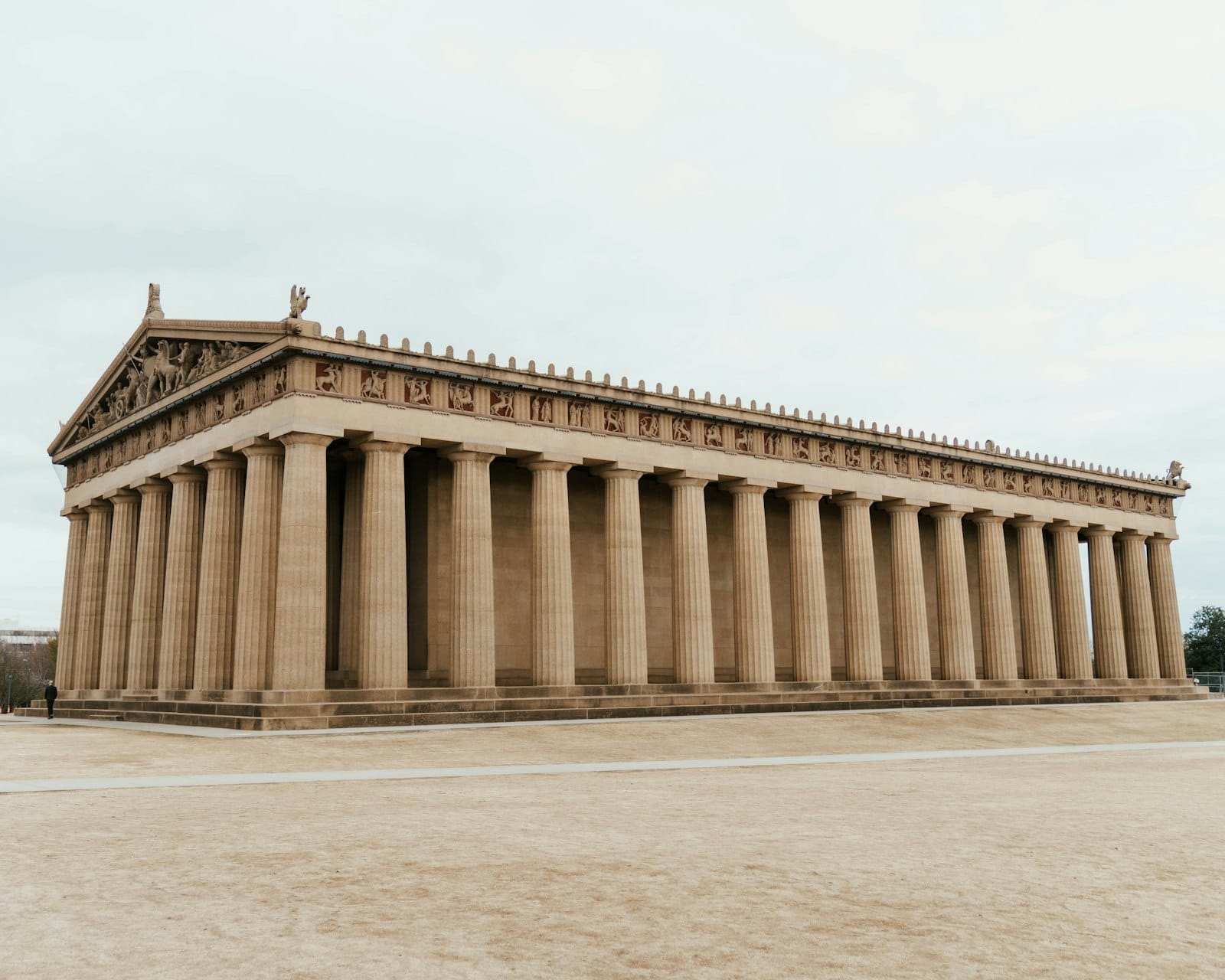
Standing inside Centennial Park in Nashville, Tennessee, The Parthenon is a full-scale replica of the ancient Greek temple in Athens, complete with a 42-foot gilded statue of Athena. Originally built for the 1897 Tennessee Centennial Exposition, it now functions as an art museum and one of the most architecturally striking landmarks in the American South.
Quick Facts
- Location
- 2500 West End Ave, Nashville, TN 37203 — inside Centennial Park
- Getting There
- WeGo bus routes serve West End Ave; rideshare drop-off at park entrance
- Time Needed
- 1 to 2 hours for interior; 30 minutes for exterior and park grounds
- Cost
- Adults $15, Seniors (62+) $10, Youth (4–17) $10, Under 4 free; SNAP/EBT and active-duty military discounts available
- Best for
- Architecture enthusiasts, families, history and classics lovers, photographers
- Official website
- www.nashvilleparthenon.com
What Is Nashville's Parthenon, Exactly?
The Parthenon is a full-scale, architecturally precise replica of the ancient Parthenon on the Acropolis in Athens, Greece. Located inside Centennial Park on West End Avenue in Nashville, it was originally constructed in 1897 as the centerpiece of the Tennessee Centennial Exposition, celebrating the state's 100th anniversary of statehood. The original structure was built from plaster, wood, and brick. The permanent concrete version standing today was completed in 1931, and the interior has since been refined significantly, including the addition of a 42-foot gilded statue of Athena Parthenos that was dedicated in 1990.
Nashville's unofficial nickname as 'the Athens of the South' predates the Parthenon replica by decades, rooted in the city's early investment in higher education and classical architecture. The Parthenon made that nickname literal. Today it functions as an art museum managed by the Metropolitan Government of Nashville and Davidson County, housing a permanent collection of 63 American paintings alongside temporary exhibitions.
⚠️ What to skip
IMPORTANT: The Parthenon is closed for HVAC renovations from March 1 through June 2026. The building exterior remains accessible, and a merchandise stand operates Fridays through Tuesdays during the temporary closure (weather permitting). Check nashvilleparthenon.com for updated reopening dates before visiting.
The Architecture: What You're Actually Looking At
From a distance across Centennial Park's reflecting lawn, the Parthenon looks almost impossibly out of place, a full Greek temple rising from a flat Tennessee park. Get closer and the scale registers: the colonnade of Doric columns stretches 228 feet in length, matching the Athenian original. The concrete was cast to replicate the deliberate optical corrections of the ancient structure, including the subtle upward curve of the stylobate, the slight inward lean of the columns, and the barely-perceptible swelling of each column shaft (a technique called entasis).
The pediment sculptures are recreations of the original 5th-century BCE carvings attributed to the workshop of Pheidias, depicting the birth of Athena on the east pediment and the contest between Athena and Poseidon on the west. Nashville sculptor Alan LeQuire created the current cast reproductions. These details reward slow, close observation that most visitors skip by walking straight to the entrance.
The bronze entrance doors are among the largest in the world at roughly 7.5 tons each. They open with unexpected ease, and that mechanical precision is one of those small, satisfying surprises of the visit.
Tickets & tours
Live prices and dates from our booking partner. If you book, we may earn a commission at no extra cost to you.
Old Town trolley tour of Nashville
From 54 €Instant confirmationFree cancellationDowntown walking tour of Nashville
From 21 €Instant confirmationFree cancellationNashville Downtown Underground Donut Tour
From 46 €Instant confirmationFree cancellationNashville City Center audio-guided walking tour
From 9 €Instant confirmation
The Athena Statue: The Reason Most People Come
Nothing prepares you for the interior scale. The main hall is tall and relatively austere, lit by directional lighting that makes the 42-foot gilded Athena Parthenos statue the unambiguous focal point. Sculpted by Nashville artist Alan LeQuire and completed in 1990, it is the largest indoor sculpture in the Western Hemisphere. The figure stands on a raised plinth, gold-leafed across the exposed skin and robes, holding a smaller winged Nike figure in her right hand. On her left arm rests a shield, and a coiled serpent rests at her feet.
The statue is a scholarly reconstruction of what the ancient chryselephantine original by Pheidias is believed to have looked like, based on ancient descriptions, surviving miniature replicas, and archaeological evidence from the Athenian original (which no longer exists). LeQuire's version took 12 years to complete. The gold leaf was reapplied during a 2002 restoration. Up close, the craftsmanship in the drapery folds, the facial expression, and the intricate helmet crest is extraordinary. Plan to spend at least 10 to 15 minutes here.
💡 Local tip
Photography tip: The statue is best photographed from the rear of the hall, using a wide-angle lens or phone in landscape mode. Mid-morning light (when the building is open) gives better illumination than the limited ambient light at opening time. Tripods are generally not permitted inside.
The Art Museum Galleries
Below the main hall, the lower level houses the Parthenon's permanent collection: 63 American paintings donated by James M. Cowan in 1931, spanning the 19th and early 20th centuries. The works include landscapes, portraits, and genre scenes by artists of the Hudson River School and their contemporaries. It is a modest collection by major museum standards, but it is thoughtfully displayed and largely uncrowded, which means you can actually look at paintings without jostling.
Rotating temporary exhibitions occupy additional gallery space on the lower level. These vary considerably in subject and quality, so checking the current schedule on the official website before visiting is worth the 30 seconds it takes.
If the permanent collection is not your primary interest, budget about 20 minutes for the galleries and save the rest of your time for the Athena hall and the exterior.
The Surrounding Park: How the Visit Actually Flows
Centennial Park is a 132-acre public park that surrounds the Parthenon. The approach from the West End Avenue entrance takes you across a wide lawn with a clear sightline to the temple, which is intentional and produces the most photogenic angle. Early mornings, particularly on weekdays, the park is occupied mainly by joggers and dog walkers, and the Parthenon sits in near-solitude. By late morning, school groups begin arriving, and by early afternoon on weekends, the lawn fills with picnickers, families, and visitors posing for photos on the steps.
The park has a seasonal lake with paddle boats, walking paths, a band shell, and mature trees that provide shade critical for summer visits. Nashville summers push 87 to 90°F with high humidity, and the walk from the parking area to the building in July can be genuinely uncomfortable without a hat and water. Spring visits in April and May, when temperatures sit between 61 and 79°F, are considerably more pleasant. For more on timing your Nashville trip around the weather, see the best time to visit Nashville guide.
Getting There and Practical Logistics
The Parthenon is located at 2500 West End Ave, Nashville, TN 37203, inside Centennial Park. Driving is straightforward: the park has free parking lots accessible from West End Avenue, though weekend afternoons see these fill up. Street parking exists along the surrounding blocks. WeGo Public Transit operates bus routes along West End Avenue; check current WeGo schedules for routes and timetables. Rideshare drop-off at the West End entrance works well and is the simplest option if you are coming from downtown.
The Parthenon sits in the Midtown Nashville area, roughly 2 miles west of downtown Nashville. It pairs naturally with a walk through Vanderbilt University's campus, which borders the park to the south, or a visit to the nearby Centennial Park grounds for an extended afternoon.
Admission is purchased on-site at the Ticket Counter or Museum Store. There is currently no advance online ticketing listed on the official site, so budget a few minutes for the queue on busy weekend days. The building exterior is physically accessible; confirm specific interior accessibility details directly with the venue, as the official site does not elaborate beyond general exterior access statements.
Honest Assessment: Is It Worth Your Time?
For travelers primarily interested in live music, honky tonks, or Nashville's culinary scene, the Parthenon can feel like an obligatory detour rather than a genuine draw. The art museum component is solid but not exceptional, and if you have been to major classical museums, the permanent collection will feel modest.
That said, the Athena statue is genuinely one of the more arresting single objects in any American museum, and the exterior of the building is architecturally remarkable in a way that photographs do not fully communicate. If you are putting together a broader Nashville itinerary, the Parthenon works well as part of a culture-focused afternoon that might also include the Frist Art Museum or a walk through Music Row. For families, the combination of the striking architecture, the Athena statue, and the park grounds tends to hold children's attention better than many indoor-only museums.
Visitors who should reconsider: anyone visiting Nashville for 2 days or fewer who is primarily here for the music scene. The time is better spent at the Country Music Hall of Fame or Ryman Auditorium. The Parthenon rewards visitors with a genuine interest in classical history, American 19th-century art, or architectural detail.
Insider Tips
- Come on a weekday morning before 11:00 AM to have the Athena hall almost entirely to yourself. Weekend afternoons bring school groups and tour buses that make it difficult to stand still and absorb the statue.
- Walk the full perimeter of the exterior before entering. The rear and side elevations are just as detailed as the front facade and are almost always unoccupied by other visitors.
- The outdoor reflecting lawn to the north of the building is the best photography position, especially in late afternoon when the low sun hits the west pediment directly. Morning light favors the east-facing main entrance.
- During the 2026 HVAC closure, the exterior visit is still worthwhile and the pop-up shop runs Friday through Tuesday. Confirm the main building's reopening date on nashvilleparthenon.com before planning an interior visit.
- Admission includes access to both the Athena hall and the lower gallery exhibitions. The lower level is noticeably cooler in summer and provides a good midday break from the heat if you are spending time in Centennial Park.
Who Is The Parthenon For?
- Architecture and classical history enthusiasts who want to understand what the original Athenian Parthenon looked like at human scale
- Families with school-age children who respond well to large, visually dramatic spaces and interactive historical context
- Photographers seeking dramatic, photogenic subjects beyond Nashville's music venues
- Travelers on a budget who want a substantive cultural experience under $15
- Anyone combining a broader Nashville culture day with nearby Midtown attractions
Nearby Attractions
Other things to see while in Belle Meade & West Nashville:
- Belle Meade Historic Site & Winery
Belle Meade Historic Site & Winery sits on 30 acres in west Nashville, preserving a Greek Revival mansion that once anchored one of America's most celebrated Thoroughbred breeding farms. Guided tours cover the full arc of the site's history, including the lives of the enslaved people who built and ran it, followed by wine tastings in a setting that is equal parts educational and scenic.
- The Bluebird Cafe
Since 1982, the Bluebird Cafe has operated as a 90-seat listening room in Nashville's Green Hills neighborhood, roughly 10 miles south of downtown. It's where professional songwriters perform in the round, face to face with the audience, in a format that has no equivalent on Broadway.
- Centennial Park
A 132-acre public park listed on the National Register of Historic Places, Centennial Park sits approximately two miles west of downtown Nashville across from Vanderbilt University. It is free to enter, open daily until 11 PM, and home to the only full-scale replica of the ancient Parthenon in the world.
- Cheekwood Estate & Gardens
Cheekwood Estate & Gardens combines a National Register-listed 1930s mansion, 55 acres of cultivated gardens, a 1.5-mile woodland sculpture trail, and a serious art museum under one admission. Located about 8.5 miles southwest of downtown Nashville in the Belle Meade area, it rewards slow exploration across multiple seasons.
Planning a trip? Discover personalized activities with the Nomado app.