Telouet Kasbah: A Crumbling Palace of Power Deep in the Atlas
Perched at nearly 1,800 metres in the High Atlas, Telouet Kasbah is the half-ruined palace of Thami El Glaoui, the most powerful and controversial warlord in 20th-century Morocco. It is architecturally astonishing, historically complex, and feels quietly forgotten by time.
Quick Facts
- Location
- Telouet village, High Atlas Mountains, approx. 135 km from Marrakech
- Getting There
- Private car or day-tour from Marrakech via N9 (Tizi n'Tichka pass), then a secondary road to Telouet
- Time Needed
- 2 to 3 hours on site; allow a full day from Marrakech
- Cost
- Small entrance fee on site (approx. MAD 20–50 reported; verify locally)
- Best for
- History lovers, architecture enthusiasts, Atlas road-trip travellers
What Is Telouet Kasbah?
Telouet Kasbah, also known as the Kasbah du Pacha El Glaoui or Palais du Glaoui, is the former mountain fortress-palace of Thami El Glaoui, who served as Pasha of Marrakech during the French Protectorate era in the first half of the 20th century. Built in the early 20th century and expanded over decades, it sits at an elevation of roughly 1,780–1,800 metres in the village of Telouet, overlooking the high plateau south of the Tizi n'Tichka pass.
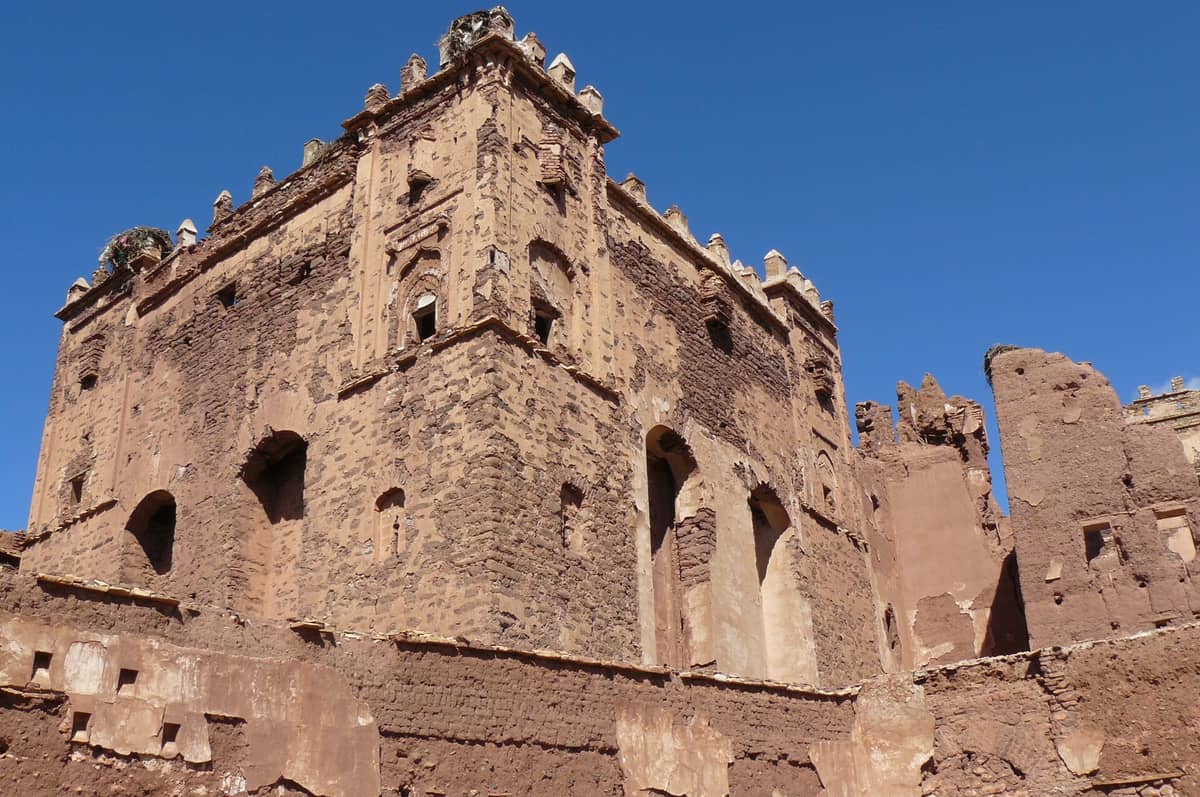
The site is not a manicured tourist attraction. Large sections are structurally unstable and officially closed to visitors. What remains accessible is simultaneously breathtaking and melancholy: elaborate zellige tilework and carved stucco ceilings in a handful of reception rooms, contrasted with crumbling mud-brick towers and roofless corridors open to the mountain sky. That contrast is the point. This is not a palace that has been restored for tourism; it is a palace that history walked away from.
ℹ️ Good to know
Telouet Kasbah is most commonly visited as part of a day trip from Marrakech, often combined with the Ait Benhaddou ksar. The two sites are roughly 40 km apart via a scenic mountain road and complement each other well historically.
The History Behind the Walls
To understand Telouet, you have to understand El Glaoui. Thami El Glaoui rose to power in the early 1900s as a chieftain of the Glaoua Berber tribe, which controlled the main trade route over the High Atlas. When French forces arrived in Morocco, El Glaoui became their most powerful local ally, governing Marrakech and much of the south with near-absolute authority for decades. He was a figure of extraordinary personal wealth, political cunning, and deep moral contradiction.
The kasbah was his mountain seat of power, and he built it on an extraordinary scale. Craftsmen from Fes and Marrakech were brought in to execute the interiors, which in the finished reception rooms still show the full vocabulary of Moroccan palatial design: honeycomb muqarnas ceilings, hand-painted plasterwork, and floors covered in geometric zellige. The scale of ambition is evident even in the ruin.
El Glaoui died in January 1956, shortly before Morocco's formal independence that March, and the palace was gradually abandoned. No family member maintained it. No government programme restored it. The site deteriorated for decades, and today it occupies an ambiguous legal and administrative status. For context on how Marrakech's own palaces fared under different historical circumstances, the Bahia Palace in the medina offers a useful comparison: similar craftsmanship, similar era of construction, but a radically different fate.
Tickets & tours
Live prices and dates from our booking partner. If you book, we may earn a commission at no extra cost to you.
Full-day tour Marrakech to Kasbah Telouet and Kasbah Ait Ben Hadou
From 40 €Instant confirmationFree cancellationPrivate tour to Ouarzazate and Kasbah Ait Ben Haddou
From 229 €Instant confirmationFree cancellationPrivate day trip to the Ancient Kasbah of Ait Benhaddou
From 125 €Instant confirmationFree cancellationCinema and Kasbah Day in Ouarzazate, private tour from Marrakech
From 124 €Instant confirmationFree cancellation
What You Actually See on a Visit
Arriving at Telouet, the kasbah dominates the small village. The outer walls are massive, built of pisé (rammed earth), and the towers that once served as watchtowers now lean at alarming angles. A local guardian or caretaker typically collects the entrance fee at the gate, and the accessible portion of the site begins with a series of interior courtyard spaces.
The highlight of any visit is the set of formal reception rooms near the main hall. These rooms were finished to a high standard and have survived reasonably well. The ceilings in particular are exceptional: hand-painted wood and carved plaster in patterns that would not look out of place in any royal medina palace. Painted tiles line the lower walls. The workmanship is comparable to the finest interiors in Marrakech, which makes the surrounding decay all the more striking.
Beyond those rooms, the kasbah opens into sections that are partially open to the elements. Roofless corridors, collapsed staircases, and rooms where the ceiling has given way to open sky create a strange, photogenic landscape. The lack of barriers or safety railings is both part of the experience and a genuine hazard. Visitors should watch footing carefully; the floors are uneven throughout, and some sections have loose masonry.
⚠️ What to skip
Telouet Kasbah has no safety barriers in many sections. The site is in active deterioration. Wear sturdy footwear with grip, stay on clearly used paths, and do not climb walls or enter sections that appear structurally compromised. Mobility-impaired visitors will find the site very difficult to navigate.
Getting There from Marrakech
The journey to Telouet is an attraction in itself. The route follows the N9 highway south from Marrakech, climbing through the High Atlas to the Tizi n'Tichka pass at around 2,260 metres before dropping toward the signed turn-off for Telouet on the P1506/P31. From the main road, this paved mountain road leads roughly 30–40 km to the village. Total driving time from Marrakech is typically two to two and a half hours each way.
There is no public bus service to Telouet village. The practical options are renting a car, hiring a grand taxi for the day from Marrakech, or booking a guided day tour. Many tour operators in Marrakech combine Telouet with Ait Benhaddou, the UNESCO-listed ksar on the other side of the mountains. That combination makes for a long but rewarding day of roughly ten hours. If you prefer a self-guided road trip approach, the Atlas driving conditions are generally good but require care in winter months when snow can affect the pass.
For planning context on how to structure a multi-day trip that incorporates sites like this, the day trips from Marrakech guide covers the logistics in detail, including how to combine the Tizi n'Tichka route with overnight options.
Time of Day and Seasonal Considerations
Morning visits, arriving before 10:00, offer the best light inside the decorated rooms and the fewest other visitors. The site rarely gets crowded in the way that medina attractions do, but tour groups from Marrakech tend to arrive mid-morning and again after lunch. If you are visiting independently, arriving early in the morning gives you an almost private experience of the interior.
At midday in summer, the site is exposed and the altitude does not provide as much cooling as you might expect. Temperatures at 1,789 metres are noticeably lower than Marrakech, but direct sun on the open courtyard sections is intense. Carry water; there are minimal facilities on site. In winter and early spring, the road to Telouet can be affected by snow on the Tizi n'Tichka pass, which can occasionally close temporarily. Checking road conditions before departure in the November to March period is sensible.
The late afternoon light, around 16:00 to 17:00 in warmer months, turns the pisé walls a deep amber and produces strong shadows across the towers. For photography, this hour is distinctly better than midday. Reported opening hours from traveller accounts are typically 08:00 to 18:00, but hours have not been confirmed through an official source and should be verified locally before planning a tight itinerary around last entry.
Architecture and Craftsmanship Up Close
The architectural vocabulary of Telouet Kasbah is classic Moroccan palatial design, executed by artisans brought from the imperial cities. The zellige tilework on the lower walls of the reception rooms uses the same geometric tessellation found in Marrakech's finest monuments, with star and polygon patterns in terracotta, cobalt, and white. The carved plaster above is in arabesques and calligraphic bands. The cedar wood ceilings carry painted geometric compositions.
Visitors with an interest in this tradition will find it useful to have already seen comparable interiors in Marrakech before visiting Telouet, because the contrast between a maintained building and a deteriorating one sharpens the eye considerably. The Ben Youssef Madrasa and the Bahia Palace are the most instructive comparisons, both in terms of craft quality and scale. For a broader architectural overview, the Marrakech Islamic architecture guide provides historical context for reading the decorative language you encounter at Telouet.
The exterior mud-brick construction, common to Berber kasbahs across the Atlas and Draa valley, is structurally different from the ornate interiors. Pisé walls are remarkably durable in dry conditions but deteriorate rapidly once rooflines fail and water penetrates. The contrast between the surviving decorated rooms and the collapsed outer sections is not aesthetic; it is the direct result of differential maintenance over the past seventy years.
Who Should Visit, and Who Should Think Twice
Telouet Kasbah rewards visitors who arrive with curiosity about Moroccan history and some tolerance for rough conditions. The site is not polished. Signage is minimal or absent. The caretaker on site may or may not speak your language. Facilities are basic. If you need a visitor centre, audio guide, and comfortable pathways, this is not the right day trip for you.
For those who engage with a place on its own terms, Telouet is one of the most atmospheric sites accessible from Marrakech. The combination of extraordinary craftsmanship, complex history, mountain setting, and unrestored condition creates something that no polished tourist site can replicate. The fact that it is slightly inconvenient to reach keeps it quiet.
Visitors with mobility impairments should approach with caution. The uneven stone floors, narrow doorways, and absence of adapted facilities make significant portions of the site inaccessible in practice. Families with young children should supervise closely given the open drops and loose masonry in the outer sections.
Insider Tips
- The caretaker who collects the entrance fee often knows the site well and may offer to walk you through sections not immediately obvious. A small additional tip is appropriate if they guide you to the upper terrace level, which offers a panoramic view over the village and surrounding Atlas landscape.
- Combine Telouet with the drive over Tizi n'Tichka pass rather than treating the kasbah as an isolated stop. The pass itself, at around 2,260 metres, has vendors selling minerals, fossils, and Berber crafts and offers dramatic views in both directions.
- The decorated reception rooms are best photographed in the first hour after opening, when soft morning light enters through high windows without direct sun causing harsh contrast. Bring a wide-angle lens or use your phone's ultra-wide mode; the rooms are not large.
- If you are driving independently, the secondary road (P1506/P31) from the N9 to Telouet is paved but narrow with steep drops on sections and runs for roughly 30–40 km. Allow more time than mapping apps suggest, especially if sharing the road with loaded trucks or tour buses.
- Ask locally about the condition of the road and site before visiting in winter (December to February). Snow on Tizi n'Tichka can occasionally close the pass for short periods, and while the road to Telouet itself is lower, ice on the descent can occur.
Who Is Telouet Kasbah For?
- History and politics enthusiasts wanting to understand Morocco's colonial-era complexity beyond the standard medina narrative
- Architecture travellers who want to see traditional Moroccan craftsmanship in an unrestored, unmediated context
- Photographers looking for dramatic contrasts between ornate interiors and decaying mud-brick ruins in mountain light
- Road-trip travellers crossing the Atlas via Tizi n'Tichka who want a substantive cultural stop rather than just scenery
- Experienced independent travellers comfortable navigating sites without infrastructure or English-language signage
Nearby Attractions
Combine your visit with:
- Agafay Desert
Just 30 to 40 kilometres southwest of Marrakech, the Agafay Desert is a rocky plateau of roughly 300 to 400 square kilometres that delivers dramatic open-sky landscapes without a multi-day Sahara expedition. It is not the sand-dune desert many visitors picture, but that distinction is part of its appeal: a raw, mineral terrain framed by the snow-capped peaks of the High Atlas, accessible within an hour of the city.
- Aït Benhaddou
Rising from the southern slopes of the High Atlas, the Ksar of Aït Benhaddou is a UNESCO World Heritage Site and one of Morocco's most architecturally striking places. Built from pisé earth and palm wood, this fortified village has stood at the crossroads of trans-Saharan trade for centuries — and remains partly inhabited today.
- Anima Garden
Set along the Ourika road 27 km south of Marrakech, Anima Garden is a three-hectare art-and-nature space created by Austrian artist André Heller. Sculptures, water features, and carefully curated plantings coexist in a setting that feels both otherworldly and deeply rooted in Moroccan landscape. It rewards slow exploration and offers a genuine contrast to the pace of the medina.
- Essaouira
Essaouira is a UNESCO-listed fortified coastal city on Morocco's Atlantic coast, roughly 2.5 to 3 hours from Marrakech by road. Its 18th-century medina, ocean-facing ramparts, and salt-aired souks offer a complete change of pace from the heat and intensity of the inland city. Entry to the medina is free.
Planning a trip? Discover personalized activities with the Nomado app.