Sustipan: Split's Clifftop Retreat with a Thousand Years of History
Sustipan is a small peninsula jutting into Split harbor that delivers some of the city's best sunset views, complete silence during off-hours, and layers of history stretching from a medieval Benedictine monastery to a 19th-century cemetery. Entry is free, the walk from the old town takes about ten minutes, and it remains a quiet escape close to the city center.
Quick Facts
- Location
- Sustipanski Put, Split 21000 — southwestern cape of Split harbor, past ACI Marina
- Getting There
- 10-minute walk west from Diocletian's Palace along the waterfront
- Time Needed
- 30–60 minutes; longer if you linger for sunset
- Cost
- Free — open public park, no ticket required
- Best for
- Sunset views, quiet walks, photography, picnics, history seekers
What Sustipan Actually Is
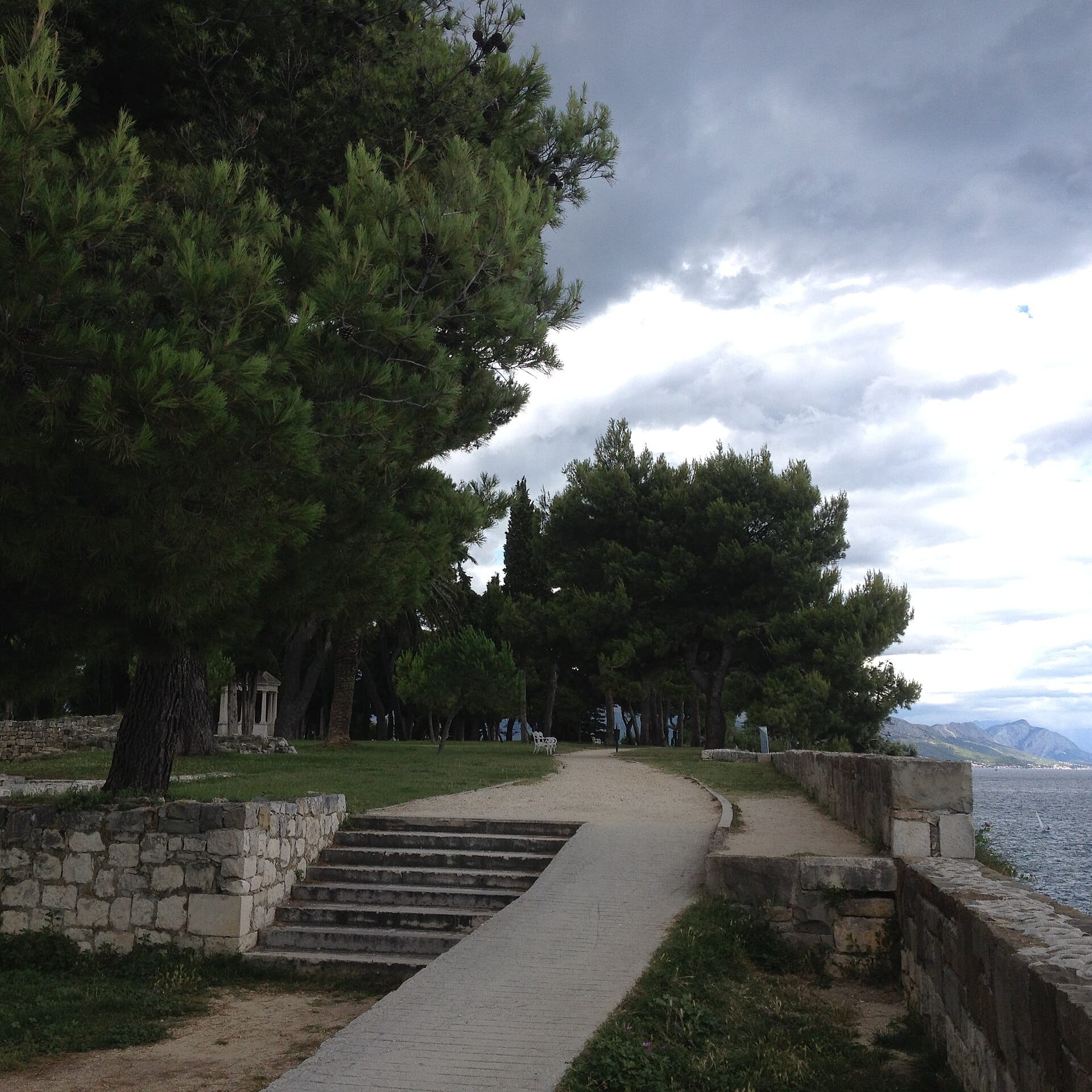
Sustipan is a compact peninsula at the far southwestern edge of Split's harbor, separated from the rest of the city by the ACI Marina. The name translates literally as 'Saint Stephen' in Croatian, a reference to the Benedictine monastery that once stood here. Today it is a public park: a plateau of pine and cypress trees perched above the Adriatic, edged by low cliffs, and furnished with stone benches that face open water. There is no entrance fee, no ticket booth, and no guided tour infrastructure. It is simply there, open to anyone who walks the coastal path from town.
What makes Sustipan unusual is the combination of accessibility and atmosphere. The park sits roughly ten minutes on foot from Diocletian's Palace, yet most day-trippers never reach it. The path follows the western waterfront past the marina, and the moment you round the final curve and enter the tree canopy, the noise of the city drops away almost completely. That contrast is the attraction.
💡 Local tip
Walk the coastal path rather than cutting inland. The route along the harbor edge past ACI Marina is flat, well-paved, and gives you views of the marina and offshore islands all the way to the peninsula tip.
The Sensory Experience: Morning, Afternoon, and Sunset
Early morning is the most underrated time to visit. The pine trees hold the night's coolness well into mid-morning in summer, and the limestone paths are almost entirely empty before 9am. You can hear gulls, the distant slap of rigging from sailboats in the marina, and occasionally a fishing boat engine idling around the headland. The sea below the cliffs is clear enough to see the rocky bottom, and the light at this hour turns the water a deep aquamarine that looks almost painted.
By midday in July and August, the park fills with local families and couples seeking shade. The pine canopy does a reasonable job of blocking direct sun, and the slight sea breeze that moves across the peninsula makes it considerably cooler than the reflective stone streets of the old town. This is when you will notice people spreading out on the grass for picnics, children clambering on the lower rocks, and groups gathering around the Classicist gloriette at the center of the plateau.
Sunset is when Sustipan justifies any modest detour. The peninsula faces west, which means the sun descends directly over the open Adriatic from this vantage point. On clear evenings in summer, the sky moves through amber and pink before the silhouettes of distant islands appear in sharp relief against the darkening horizon. Photographers typically position themselves along the southern cliff edge. Come at least thirty minutes before sunset to secure a bench, as this is the one time of day when the park genuinely fills up.
⚠️ What to skip
The cliff edges have benches and low stone walls but no continuous barrier. Keep children close to the edges, and note that the rock surfaces become slippery when wet. The terrain is uneven throughout — not suitable for wheelchairs or strollers.
Tickets & tours
Hand-picked options from our booking partner. Prices are indicative; availability and final rates are confirmed when you complete your booking.
Blue Cave and Hvar 5 islands tour from Split
From 145 €Instant confirmationFree cancellationKrka national park tour from Split
From 27 €Instant confirmationFree cancellationAll-inclusive Blue Lagoon tour from Split with three islands visit
From 68 €Instant confirmationFree cancellationGuided kayaking tour with snorkeling stops from Split
From 50 €Instant confirmationFree cancellation
A Millennium of History on One Small Headland
The recorded history of Sustipan begins in 1020, when a Benedictine monastery dedicated to St. Stephen was first documented here. Archaeological evidence suggests the site was occupied even earlier: the monastery was built on the foundations of a three-naved Early Christian basilica, itself likely constructed on Roman-era remains. The peninsula's natural defensibility made it attractive to monastic communities, and the shallow ruins beneath the current park surface represent at least three distinct phases of construction spanning late antiquity through the medieval period.
According to local historical tradition, Sustipan served as a refuge for the last Croatian king, Stjepan II. Whether as a place of contemplation or sanctuary, the association between the peninsula and that name, Stjepan, became permanent enough to survive the monastery's later disappearance.
In the 19th century, the headland took on a very different function. Split established its first formal municipal cemetery here, and the park that exists today was once full of graves. The cemetery operated until the communist-era authorities demolished it in the 20th century. Most of the gravestones and burial infrastructure were removed, but two things survived: the small Classicist gloriette that stands at the center of the park, and a handful of carved stone grave markers now incorporated into the landscape. That gloriette, with its neoclassical columns and open rotunda, was almost certainly part of the cemetery's ceremonial architecture rather than an ornamental garden feature.
The layered history here connects directly to the wider story of Split itself. For a deeper look at the Roman foundations that underpin the entire city, the Diocletian's Palace complex and the palace cellars offer excavated archaeology at scale — a useful companion visit for anyone interested in the early Christian and Roman layers beneath Sustipan's surface.
The Gloriette and What Remains
The Classicist gloriette is the park's most photogenic surviving structure. It is a small open-air rotunda built in the neoclassical style, with stone columns supporting a low dome, positioned at roughly the center of the plateau. It is not large — you can walk around it in under a minute — but it carries considerable weight as the only above-ground remnant of the cemetery period. In summer evenings it becomes the backdrop for informal gatherings, and the municipality has occasionally used the park for the outdoor cultural event series known as Sustipanske Noći, a summer-night program that brings live performances to the headland.
A small number of original gravestones are still visible at the edges of the park, some incorporated into low walls or left as freestanding markers. They are easy to miss on a casual walk but worth seeking out: the inscriptions and decorative carvings offer a glimpse into 19th-century Split's civic identity, including names and dates from a period when the city was part of the Habsburg Empire.
Getting There and Navigating the Park
The walk from the old town takes approximately ten minutes at a relaxed pace. Leave the Riva promenade heading west, pass the ferry terminal area, and continue along the coastal path past ACI Marina. The path is flat, well-maintained, and clearly signed. Once you pass the marina entrance, you will see the tree canopy of Sustipan rising ahead on the small headland. There is no formal entrance gate, just a path that leads up into the park.
If you are combining this with a broader exploration of Marjan HillMarjan area, Sustipan sits at the base of the Marjan Hill park, which extends westward from this point. The two areas connect, and a longer walk can take you up through Marjan's forest trails with sea views on both sides of the peninsula.
The park has no facilities: no cafe, no toilets, no water fountain. Bring water in summer, particularly if you plan to visit midday. Mobile signal is generally reliable, and the path is well-lit enough for early evening visits in summer, though it gets quite dark after sunset. Flat shoes or trainers are sufficient for the park itself; hiking footwear is only needed if you continue further into Marjan's trail network.
ℹ️ Good to know
Dogs are not supposed to enter the park, though this rule is not consistently enforced. If you have dog allergies or concerns, this is worth knowing before you visit.
Photography and Practical Notes
The two best photography positions are the southern cliff edge, which faces open water and works well for wide-angle sea shots and sunset compositions, and the area immediately around the gloriette, where the columns frame views of the tree canopy and sky. For island silhouette photography at golden hour, bring a telephoto or longer lens — the offshore islands sit far enough away that a wide lens renders them as thin dark lines rather than recognizable forms.
The pine trees create interesting dappled light conditions in the midmorning that suit environmental portrait and lifestyle photography. The pale limestone benches and paths contrast well against the dark green canopy. There is no entrance fee to recover, so this is one of the more risk-free photography visits in Split: if the light is wrong, you have lost only the ten-minute walk.
Travelers building a full day around this part of the city might also consider the Meštrović Gallery, which sits along the road between the old town and Marjan. The gallery is one of Croatia's most significant sculpture collections and pairs naturally with the historical-cultural thread of a Sustipan visit. For a broader picture of what to prioritize in the city, the full guide to things to do in Split provides useful context.
Honest Assessment: What Sustipan Is and Is Not
Sustipan is not a major archaeological site, and visitors who arrive expecting visible ruins, interpretive signage, or museum-quality presentation will be disappointed. The monastery is gone. The cemetery is gone. What remains is a park with strong atmosphere, a single preserved structure, and a few scattered grave markers that most visitors walk past without noticing.
What it genuinely offers is something different: a place to step outside the density and noise of Split's old town and experience the city from a quiet, elevated perspective. In peak summer when the Riva and Diocletian's Palace are crowded with tour groups, Sustipan stays relatively calm. That relative calm is its actual value proposition, not the architecture or the history, though both add depth for those who seek it.
Travelers who dislike green, unstructured spaces with no food or shopping options nearby, or those with mobility limitations, should probably skip it. The terrain is uneven, there are no facilities, and the 'sight' itself is subtle. But for anyone who wants twenty minutes of quiet with a genuinely beautiful view, it is worth every step of the ten-minute walk.
Insider Tips
- Visit on a weekday morning in summer to have the benches almost entirely to yourself. Weekend evenings from June through August draw larger crowds for sunset, sometimes including organized events.
- The gloriette makes a good landmark to navigate by inside the park, but the best cliff-edge views are actually on the southern side, slightly away from the rotunda. Follow the path past the gloriette and look for the gap in the low stone wall.
- The scattered gravestones at the park's edges are easy to overlook. Walk the full perimeter of the plateau rather than just the central path and you will find inscribed markers from the 19th-century cemetery that most visitors miss entirely.
- If you are visiting in summer and want to time a sunset visit, check the actual local sunset time for the date — in mid-July the sun sets around 8:20pm local time, and the best light lasts about 20 minutes after that. Arrive by 8pm to get a bench on the cliff edge.
- The path from Sustipan connects directly into the lower trails of Marjan Hill. Bring water and you can extend a short park visit into a proper half-day walk through the forest with multiple viewpoints over the harbor and islands.
Who Is Sustipan For?
- Travelers who need a break from the palace crowds and want genuine quiet within walking distance of the center
- Photographers targeting sunset compositions over open water with island silhouettes
- History enthusiasts interested in early medieval and Benedictine heritage beyond the Roman-era sites
- Couples looking for a low-key, scenic evening walk that does not require reservations or entrance fees
- Anyone extending a visit into the Marjan Hill trail network who wants a natural starting point
Nearby Attractions
Other things to see while in Marjan Hill & Peninsula:
- Marjan Hill & Forest Park
Marjan Forest Park (Park šuma Marjan) is a protected peninsula of pine, Mediterranean scrub, and limestone cliffs rising 178 metres above Split's western edge. Free to enter and open around the clock, it offers panoramic viewpoints, quiet hiking trails, small rocky beaches, and medieval chapels — all within walking distance of Diocletian's Palace.
- Meštrović Gallery
Perched on the southern slopes of Marjan Hill, the Meštrović Gallery occupies the neoclassical villa Ivan Meštrović designed as his home, studio, and legacy. With nearly 200 sculptures in marble, bronze, and wood, plus a terraced Mediterranean garden overlooking the Adriatic, it rewards visitors who make the short walk from the Riva.
- Poljud Stadium
Designed by Croatian architect Boris Magaš and opened in 1979, Poljud Stadium is the home of HNK Hajduk Split and one of the most architecturally distinctive sports venues in southeastern Europe. Its sweeping seashell-shaped roof, officially protected cultural heritage status, and passionate local fan culture make it a serious point of interest even for visitors with no particular interest in football.