Poljud Stadium: Split's Football Cathedral and Architectural Icon
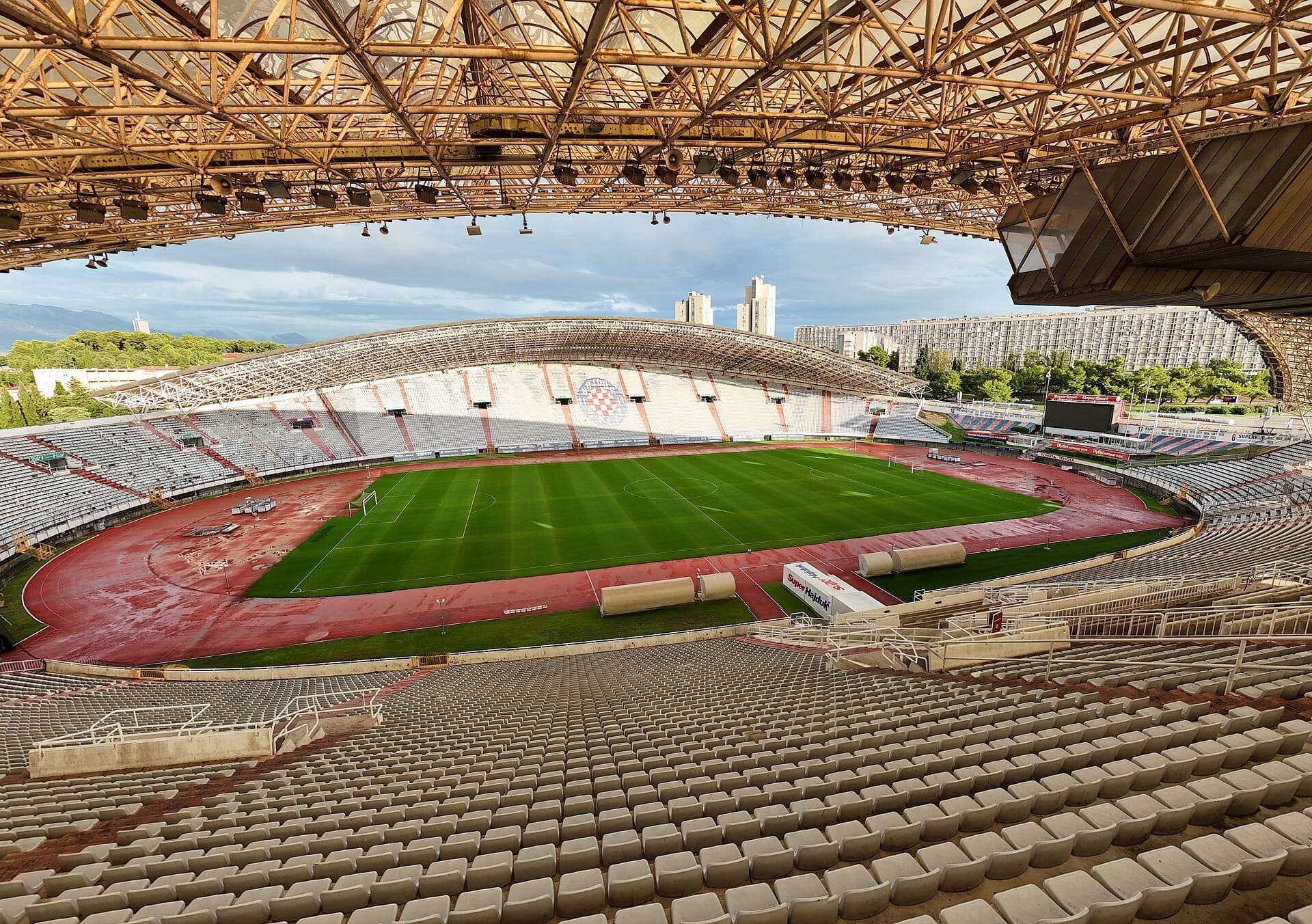
Designed by Croatian architect Boris Magaš and opened in 1979, Poljud Stadium is the home of HNK Hajduk Split and one of the most architecturally distinctive sports venues in southeastern Europe. Its sweeping seashell-shaped roof, officially protected cultural heritage status, and passionate local fan culture make it a serious point of interest even for visitors with no particular interest in football.
Quick Facts
- Location
- Poljud neighbourhood, northern Split peninsula
- Getting There
- City bus lines serve the Poljud area; walkable from Riva in roughly 20-25 minutes
- Time Needed
- 1-2 hours for exterior and surroundings; longer on match days
- Cost
- Exterior free to view; guided tours and match tickets vary — verify current pricing at hajduk.hr
- Best for
- Architecture lovers, football fans, sports history enthusiasts
- Official website
- hajduk.hr/eng/club/stadium
What Poljud Stadium Actually Is
Poljud Stadium, officially the Gradski stadion u Poljudu (City Stadium in Poljud), sits on the northern edge of the Split peninsula in the Poljud neighbourhood, roughly two kilometres from the city's waterfront. It opened on 26 September 1979, built to host the Mediterranean Games of that year, and has served as the home ground of HNK Hajduk Split ever since.
What separates this from a standard football stadium is the architecture. Boris Magaš, a celebrated Croatian architect, designed a structure whose roof arc spans about 205–206 metres in a continuous shell-like curve, covering both main stands without internal support columns. The form was not decorative flourish: it was a structural solution that also gave the stadium its defining visual identity. In November 2015, the Croatian government formally recognized it as cultural heritage, placing it in the same category of protection as historic buildings and monuments.
ℹ️ Good to know
Current capacity is around 35,000 seats. The stadium originally held 55,000, later expanded to 62,000 standing, before seating installation in the 1990s reduced the figure to its current level. Verify tour availability and any visitor access details directly with HNK Hajduk Split at hajduk.hr before your visit.
The Architecture Up Close
The roof is the first thing that registers. From the approach roads and from the waterfront on clear days, the white curve of the western stand rises above the surrounding low-rise neighbourhood like the edge of a giant shell half-buried in the ground. The comparison is not a cliché in this context: Magaš drew directly on the natural forms of the Adriatic coast, and the resemblance to a scallop shell or mussel viewed from the side is genuinely precise.
Up close, the structural logic becomes clear. The roof is a reinforced concrete canopy tensioned across steel supports, creating an overhang that shelters the entire seating bowl without posts interrupting sightlines. The western stands alone cover roughly 11,000 square metres of usable space within the structure, housing gyms, a swimming pool, a sauna, club offices, and restaurant facilities. The eastern stands add another roughly 9,000 square metres of business areas. This is not a stadium with a few concession stands bolted on: the building functions as a genuine multi-purpose sports complex.
The hundreds of floodlights installed around the roof perimeter have been cited as among the best stadium lighting systems in the world, a practical detail that matters when you see the ground illuminated for an evening match. The playing surface measures 105 by 68 metres and is surrounded by eight running tracks, a configuration that reflects the stadium's origins as a Mediterranean Games venue rather than a purpose-built football ground.
Tickets & tours
Hand-picked options from our booking partner. Prices are indicative; availability and final rates are confirmed when you complete your booking.
Blue Cave and Hvar 5 islands tour from Split
From 145 €Instant confirmationFree cancellationKrka national park tour from Split
From 27 €Instant confirmationFree cancellationAll-inclusive Blue Lagoon tour from Split with three islands visit
From 68 €Instant confirmationFree cancellationGuided kayaking tour with snorkeling stops from Split
From 50 €Instant confirmationFree cancellation
Hajduk Split and Why the Club Matters
To understand Poljud is to understand Hajduk Split, and to understand Hajduk is to understand something specific about Split's identity. Founded in Prague in 1911 by Croatian students, the club has operated through the Austro-Hungarian period, the Kingdom of Yugoslavia, socialist Yugoslavia, the Croatian War of Independence, and the post-war years of Croatian football. Through each period it has carried a particular symbolic weight for the city and the wider Dalmatian region.
The fan group known as Torcida, founded in 1950, is considered the oldest organized football supporters group in Europe. On match days, the Torcida occupies the northern end of the stadium in numbers that create noise levels the seashell roof does nothing to dampen. For non-football visitors, this is worth noting: a Hajduk home fixture transforms the entire Poljud neighbourhood, not just the stadium interior. Bars, side streets, and the approach paths fill hours before kickoff.
If you are planning your trip around a Hajduk match, cross-reference the fixture schedule with the Hajduk Split match guide for practical advice on ticketing, approach routes, and what to expect inside the stadium on a live match day.
Visiting Without a Match: What You Actually See
On non-match days, the stadium sits quietly in its residential and light-industrial neighbourhood. The exterior can be viewed for free from the surrounding streets, and the scale of the structure is genuinely impressive at ground level in a way that photographs do not capture. The curve of the roof against the sky, the raw concrete and steel of the support structure, the sheer physical size of the building relative to the surrounding houses: this reads as significant architecture, not just a large shed.
Guided tours of the interior have been offered historically, though current availability should be confirmed directly with HNK Hajduk Split. A tour typically covers the pitch-side areas, changing rooms, and the press facilities, giving access to spaces that are otherwise closed. Early mornings on non-match days tend to offer the quietest conditions for exterior photography: light arrives from the east, hitting the curved western stand directly, and foot traffic is minimal.
💡 Local tip
For exterior photography, position yourself on the approach from the south for the best view of the full roof arc. Late afternoon light catches the concrete surface well, though the stadium faces east-west, so morning light on the western stand is crisper.
The neighbourhood itself, Poljud, is not a tourist district. There are no souvenir shops or themed cafes clustered around the gates. What you find instead is a genuine local area: a few bars frequented by residents, a beach at Poljud Cove a short walk away, and the sense that you are in a part of the city where the majority of visitors do not reach. This is worth noting if you are travelling with children or anyone who expects the infrastructure of a managed tourist attraction: facilities are limited unless a match or organised event is underway.
Getting There and Combining with Other Visits
The stadium is on the northern side of the Split peninsula, roughly 1.5–2 kilometres from the old town. Walking from the Riva waterfront takes around 20-25 minutes along a straightforward route heading northwest. City buses also serve the Poljud area. There is no metro in Split: the bus network and walking are the primary options.
Combining a visit to Poljud with Marjan Hill makes geographical sense: the hill rises immediately to the west of the stadium neighbourhood, and a visit to both in a single half-day is practical. The Meštrović Gallery on the Marjan slopes is another natural pairing for visitors with an interest in Croatian design and culture.
If you are spending more time in Split and want a framework for the day, the Split walking tour guide covers a logical route from the old town toward the western end of the peninsula that passes near the Poljud area.
Honest Assessment: Is It Worth the Trip?
If you have a strong interest in sports architecture, the answer is straightforwardly yes. There are very few stadiums anywhere in the world with Poljud's combination of structural ambition, cultural heritage status, and living history. The building is not preserved behind glass: it is actively used, which means the concrete shows its age in places, and the facilities reflect successive eras of renovation rather than a single coherent interior aesthetic. That is part of what makes it honest architecture rather than a showcase.
If you have no particular interest in football or architecture, the calculation is different. The exterior is worth the walk if you are already heading toward Marjan Hill, but it does not reward a dedicated half-day trip on its own without a match or guided tour to structure the visit. Visitors who came expecting a polished tourist attraction with multilingual interpretation and ticketed exhibits should recalibrate expectations: this is a working stadium in a residential neighbourhood, and the experience is proportionally more rewarding the more context you bring to it.
⚠️ What to skip
On major match days, the area around Poljud fills quickly and public transport becomes crowded. If you are visiting Split primarily for culture and sightseeing rather than football, check the Hajduk fixture schedule in advance to plan your movements accordingly.
Insider Tips
- The best unobstructed view of the full roof profile is from the junction of Ulica Stjepana Radića and the northern approach road, looking south toward the stadium: the entire arc is visible in a single frame.
- If you want to experience the atmosphere without buying a match ticket, the bars and side streets around the stadium fill 90 minutes before kickoff and offer a genuine window into local football culture at no cost.
- The Poljud Cove beach is a short walk from the stadium and almost entirely unknown to visitors arriving from the old town. Worth combining into any visit to the area.
- Hajduk Split merchandise is sold at the club shop: current location and hours should be confirmed at hajduk.hr, but it is a more authentic souvenir stop than anything in the tourist-facing old town shops.
- The stadium looks significantly different at night when the 630 floodlights are active. If an evening event coincides with your stay, even a brief walk past the illuminated exterior is worth the detour.
Who Is Poljud Stadium For?
- Architecture and design enthusiasts interested in late-20th-century structural innovation
- Football supporters wanting to see a historically significant European club ground
- Travellers combining a half-day in the Marjan and Poljud area away from the old town crowds
- Sports history researchers: Hajduk Split and Torcida carry real historical depth beyond the Croatian league context
- Photographers looking for strong geometric and structural subjects outside the standard Split skyline
Nearby Attractions
Other things to see while in Marjan Hill & Peninsula:
- Marjan Hill & Forest Park
Marjan Forest Park (Park šuma Marjan) is a protected peninsula of pine, Mediterranean scrub, and limestone cliffs rising 178 metres above Split's western edge. Free to enter and open around the clock, it offers panoramic viewpoints, quiet hiking trails, small rocky beaches, and medieval chapels — all within walking distance of Diocletian's Palace.
- Meštrović Gallery
Perched on the southern slopes of Marjan Hill, the Meštrović Gallery occupies the neoclassical villa Ivan Meštrović designed as his home, studio, and legacy. With nearly 200 sculptures in marble, bronze, and wood, plus a terraced Mediterranean garden overlooking the Adriatic, it rewards visitors who make the short walk from the Riva.
- Sustipan
Sustipan is a small peninsula jutting into Split harbor that delivers some of the city's best sunset views, complete silence during off-hours, and layers of history stretching from a medieval Benedictine monastery to a 19th-century cemetery. Entry is free, the walk from the old town takes about ten minutes, and it remains a quiet escape close to the city center.