Strand IJburg (IJburg Beach): Amsterdam's Sandy Escape on the Water
Strand IJburg stretches along the edge of Strandeiland, one of Amsterdam's artificial islands east of the centre. It's the city's most accessible beach, free to enter, supervised from May through September, and genuinely useful for a half-day out of the city without leaving it.
Quick Facts
- Location
- Pampuslaan 503, Strandeiland, IJburg, Amsterdam
- Getting There
- Tram towards IJburg; check GVB for current routes and stops
- Time Needed
- 2–5 hours depending on season and activity
- Cost
- Free admission; food and rentals extra
- Best for
- Families, local summer days, anyone needing open water without leaving Amsterdam
What Strand IJburg Actually Is
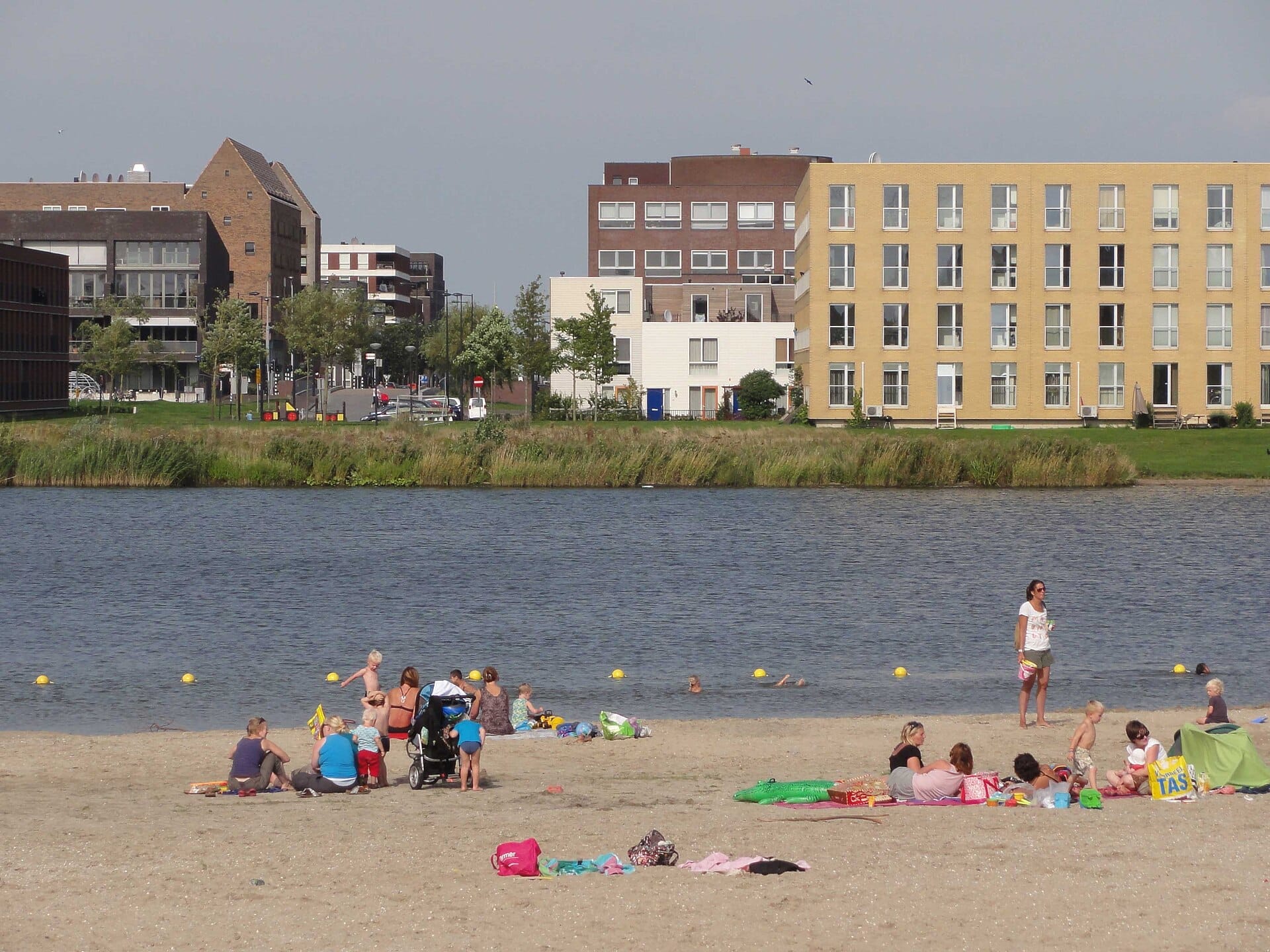
Strand IJburg is a major Amsterdam city beach, a stretch of sandy shoreline on Strandeiland, the largest island in the IJburg archipelago. IJburg itself is a remarkable piece of Dutch urban planning: a series of artificial islands reclaimed from the IJmeer lake east of Amsterdam, designed from scratch in the late 1990s and built out incrementally into the 21st century. The beach sits at the southern edge of Strandeiland, facing open water and oriented to catch afternoon sun.
For a city whose historic centre is famously short on open green space and almost entirely without sand, Strand IJburg serves a real function. It is not a destination beach in the Mediterranean sense. The water is lake water, calm and generally shallow near the shore, without tides or surf. On a warm weekday in July, it draws a mix of families with young children, people working remotely on towels, and groups of teenagers who have cycled out from the Oost district. On summer weekends it gets genuinely crowded by mid-afternoon.
💡 Local tip
The beach is supervised from 1 May to 30 September, and the toilets are open during that same supervised period. Outside those dates, the beach is technically accessible but unserviced. Arrive before noon on weekends in July and August if you want a good spot.
The Setting: Artificial Islands and Open Water
Standing on the beach, you look out over the IJmeer toward the horizon. On a clear day you can see the flat outline of the Markermeer in the distance and occasionally freight or recreational vessels crossing the water. The sky feels enormous here in a way it doesn't in the Canal Ring or Jordaan. Amsterdam's built environment is almost entirely out of sight; you hear wind off the water rather than trams.
Strandeiland itself is still being developed. Parts of the island behind the beach are construction zones for new housing, which means the surroundings can feel unfinished compared to a classic beach resort. That roughness is also part of what keeps it local. Visitors who come expecting a polished seaside experience will be mildly surprised. Visitors who come expecting a functional city escape with water, sand, and space will find exactly that.
The wider IJburg area is worth understanding as a neighbourhood. It belongs to the category of newer Amsterdam districts built on reclaimed land, sharing a structural logic with places like Java Island and KNSM Island to the west, though IJburg is considerably more residential and suburban in character. The artificial landscape gives the whole area a particular quality of light, especially in the late afternoon when the sun hits the water at low angles.
Tickets & tours
Live prices and dates from our booking partner. If you book, we may earn a commission at no extra cost to you.
Gray Line Canal Cruise with snackbox & Heineken Experience
From 48 €Instant confirmationFree cancellationAmsterdam evening canal cruise
From 18 €Instant confirmationFree cancellationJewish Museum and Portuguese Synagogue entrance ticket
From 20 €Instant confirmationFree cancellationAdmission ticket for Artis Royal Zoo and Micropia
From 39 €Instant confirmationFree cancellation
How the Experience Changes Through the Day
Morning arrivals, particularly on weekdays, find the beach quiet. The water is often glassy before any wind picks up. The sand is cool underfoot and unoccupied enough that you can hear birds calling from the reed margins at the island's edges. This is the best time for a walk along the full length of the shore, to get a clear sense of the space before it fills.
By midday in summer, the beach concession area comes to life. Food and drink are available on site, and the beach concierge post opens. This is also when families with young children start to dominate the shallows. The water temperature in the IJmeer typically reaches its warmest in July and August, making it genuinely comfortable for swimming during those months, though it stays cooler than coastal sea water would.
Late afternoon on a sunny day is the most atmospheric time. The crowd has usually peaked and begun to thin slightly, light comes in at an angle, and the lake takes on a coppery tone. It is also when the wind tends to strengthen, which is useful context for anyone who plans to bring young children: pack an extra layer for late afternoon even in summer, as the exposed shoreline can feel several degrees cooler than the city centre once the wind picks up.
⚠️ What to skip
Amsterdam's oceanic climate means summer days can shift quickly. Even in July, an overcast afternoon is common. The beach experience is entirely weather-dependent; always check the forecast before making a dedicated trip.
Practical Walkthrough: Getting There and What to Bring
The address is Pampuslaan 503, Amsterdam. The beach sits in Amsterdam Oost, reachable by tram on the IJburg line; check GVB's current route map for the most up-to-date stop information, as IJburg continues to expand and service patterns may change. The journey from Amsterdam Centraal by public transit typically takes around 15 to 25 minutes, depending on waiting times and the exact stop for Strandeiland. Cycling is a practical option for much of the year; the route follows dedicated bike infrastructure through Oost and across the bridges to the islands.
If you are organising a full day in the eastern part of the city, combining Strand IJburg with a visit to Amsterdamse Bos or a walk through Oosterpark makes geographic sense, though Amsterdamse Bos is on the opposite side of the city and would require more planning.
What to bring: a towel, sunscreen, cash or card for food (verify on-site payment options in advance), and footwear you don't mind getting sandy. The beach surface is genuine sand, not gravel, so bare feet are comfortable. A windbreak or lightweight jacket is worth packing even in summer. Bicycle locks are useful if cycling; the area has bike parking near the beach access points.
Accessibility: a beach wheelchair can be borrowed from the beach concierge, which is a meaningful practical detail for visitors who need it. The access path from the tram stop to the beach is flat, consistent with the general flatness of artificial-island terrain.
Swimming, Activities, and the Water Itself
The IJmeer is a freshwater lake, not the sea. Water quality is generally monitored, but conditions can change; it is worth checking current water quality advisories through the city's official channels before swimming, particularly after heavy rainfall, which can occasionally affect lake water quality temporarily.
Swimming in the shallows is the primary draw for families. The lake bottom near the shore is sandy and the drop-off is gradual, making it suitable for children who are not strong swimmers. There is no surf to navigate. On windy days, small wavelets develop but nothing that would be described as challenging even for casual swimmers.
Beyond swimming, the beach draws people who bring paddleboards, kayaks, and other non-motorised watercraft. The open water of the IJmeer gives paddlers significant space. Kitesurfing is practiced in parts of the wider IJmeer area, though the Strandeiland beach itself is primarily a swimming and relaxation space rather than a watersports hub.
Honest Assessment: Who This Beach Is For
Strand IJburg is most useful to people already based in Amsterdam who want a few hours near open water without spending half a day travelling. For international visitors with limited time, the question is whether it fits their priorities. If your schedule includes the Rijksmuseum, the Anne Frank House, and the canal district, a dedicated trip to IJburg may not be the highest-value use of a short stay.
That said, Amsterdam in July or August can be warm enough that a beach afternoon feels genuinely appealing as a contrast to museum-heavy days. It pairs well with a broader interest in contemporary Amsterdam: the artificial islands are a real expression of Dutch land reclamation engineering, and visiting IJburg gives a sense of the city's ongoing urban expansion that you won't get from the historic centre alone. For context on Amsterdam's architectural range, see the Amsterdam architecture guide.
Visitors who find city beaches underwhelming in general, who prefer coastal sea swimming, or who are travelling outside the May–September window will not find Strand IJburg worth the journey. The beach outside the supervised season is unserviced and the draw reduces considerably. In autumn and winter, the exposed lakeshore is cold and windswept, with a bleak quality that some people find striking but most will find simply cold.
ℹ️ Good to know
Strand IJburg is free to enter. Food, drink, and any equipment rentals are separate costs. Toilets are open during the supervised season (1 May to 30 September).
Insider Tips
- Arrive before 10am on summer weekend mornings if you want a quiet stretch of sand and calm water. By noon on a sunny Saturday in July, the beach is noticeably packed.
- The beach concierge can lend you a beach wheelchair at no charge. If you or someone in your group needs one, contact the concierge point when you arrive rather than assuming one will be available without asking.
- Cycling to Strand IJburg from the city centre takes roughly 30 to 40 minutes depending on your start point and allows you to see the transition from old Amsterdam to the newer artificial-island districts in a single continuous journey.
- The late afternoon light on the IJmeer is notably good for photography. Position yourself facing west toward the city for skyline shots with the lake in the foreground, particularly in the hour before sunset.
- Water temperature in the IJmeer peaks in July and August. If you are specifically coming to swim rather than just sit by the water, those two months give the most comfortable conditions.
Who Is Strand IJburg (IJburg Beach) For?
- Families with young children looking for calm, shallow water and a full day of outdoor space
- Amsterdam residents and longer-stay visitors who want open water without leaving the city
- Cyclists wanting a destination ride that passes through newer parts of the city
- Visitors interested in Dutch land reclamation and contemporary urban planning
- Anyone on a warm Amsterdam summer day who needs space, sky, and fresh air
Nearby Attractions
Combine your visit with:
- Amsterdam Dance Event (ADE)
Every October, Amsterdam transforms into the global capital of electronic music for five days. Amsterdam Dance Event brings together more than 1,000 shows across nearly 200 venues, from intimate club nights to warehouse raves, alongside a major industry conference that shapes the direction of dance music worldwide.
- Amsterdamse Bos (Amsterdam Forest)
Covering nearly 1,000 hectares on Amsterdam's southwestern edge, Amsterdamse Bos is a man-made forest park three times the size of New York's Central Park. Free to enter and open year-round, it offers cycling paths, a rowing lake, wildlife meadows, and genuine breathing room that the city centre simply cannot provide.
- Dappermarkt
Running along Dapperstraat in Amsterdam-East since 1910, Dappermarkt is a street market with around 200 stalls selling everything from fresh produce and spices to fabrics and secondhand clothing. Free to enter, open Monday through Saturday, and drawing locals from across the city, it offers a sharply different experience from the tourist-facing markets in the centre.
- Haarlem
Just under 20 km west of Amsterdam, Haarlem is the capital of North Holland and one of the Netherlands' oldest cities, granted city rights in 1245. A compact historic centre, the landmark Grote Kerk, the Frans Hals Museum, and a lively market square make it one of the most rewarding half-day escapes from the capital.
Planning a trip? Discover personalized activities with the Nomado app.