Milano Centrale Station: Italy's Most Spectacular Railway Terminal
Inaugurated in 1931, Milano Centrale is far more than a transit hub. With a facade stretching over 200 metres, soaring glass-and-steel vaults covering 24 tracks, and a monumental interior that blends Art Deco with Fascist-era grandeur, it rewards anyone who takes the time to look up. Whether you're passing through or arriving for the first time, this station sets the tone for Milan.
Quick Facts
- Location
- Piazza Duca d'Aosta 1, 20124 Milano
- Getting There
- Metro M2 (green line) and M3 (yellow line) — both stop directly below the station
- Time Needed
- 30–60 minutes to explore architecture; transit use only takes as long as your connection requires
- Cost
- Free to enter the station building; train and bus tickets priced separately by operator
- Best for
- Architecture lovers, first-time arrivals, photography, and travellers connecting to airports or other Italian cities
- Official website
- www.milanocentrale.it
What Milano Centrale Actually Is
Stazione di Milano Centrale is Italy's second-busiest railway station and one of the largest in the country. Completed in 1931 under Mussolini's government and designed by architect Ulisse Stacchini, it replaced an earlier 1864 station that had outgrown the city's needs. What went up instead was something closer to a palace than a platform: a structure that used sheer scale and ornamental excess to project power.
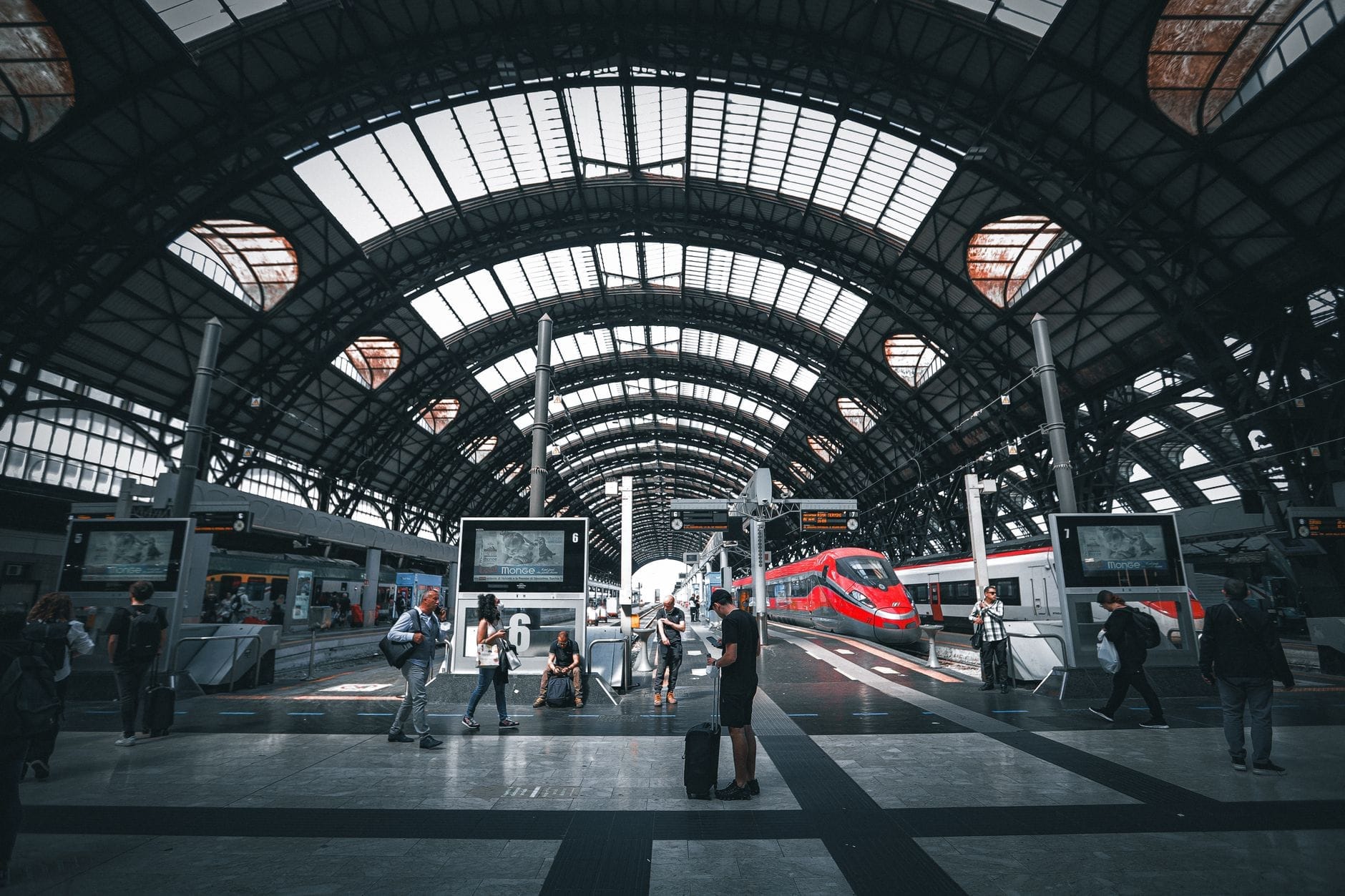
The facade runs approximately 201 metres wide. The roof vaults above the platforms climb to around 72 metres at their peak, wrapping 24 tracks in curved glass-and-steel arches that filter daylight into the concourse below. The style is a collision of Art Deco, Assyrian revival motifs, and Fascist monumental classicism — an uneasy mix that somehow produces a result that is genuinely impressive in person.
Most visitors to Milan pass through here without pausing. That is understandable: the station is large and can feel disorienting on first approach. But spending even half an hour looking at what is actually around you rewards attention in ways that most of the city's paid attractions do not.
💡 Local tip
If you arrive by train and have luggage, the left-luggage office (deposito bagagli) usually operates from 06:00 to 23:00, giving you flexibility to explore before checking in. It is located on the ground floor near the main concourse.
The Architecture: What to Look For
Start outside, on Piazza Duca d'Aosta. The approach from the square gives you the full width of the facade — a long horizontal mass of stone interrupted by a central triumphal arch and flanked by relief sculptures of horses, eagles, and allegorical figures. The stone has a pale, worn quality that reads differently depending on the light. On an overcast morning it looks heavy and severe; on a bright afternoon in April or May, it turns almost golden.
Inside, the Gran Salone delle Carrozze (the main ticketing and concourse hall) is where the architecture pays off most visibly. The ceiling height is extraordinary, and the walls carry decorative programmes that mix Lombardic ornamental detail with the angular geometry of 1920s Art Deco. Look at the capitals on the columns and the frieze work above the arched windows. This kind of labour-intensive stone carving stopped being economical decades ago, which makes the quantity of it here feel slightly unreal.
The platforms themselves, accessed from the upper level, are covered by three great arched roofs built from steel and glass. Standing at the far end of a platform when an intercity train is pulling out, with the roof funnelling light down across the tracks, is one of those incidental moments of urban beauty that Milan rewards.
For architectural context across the city, the Milan architecture guide covers how the station fits within the broader history of the city's built environment, from medieval towers to postwar rationalism.
Tickets & tours
Hand-picked options from our booking partner. Prices are indicative; availability and final rates are confirmed when you complete your booking.
Milano highlights 2 hours private tour by vintage car
From 300 €Instant confirmationFree cancellationMilano highlights 3 hours private tour by vintage car
From 400 €Instant confirmationFree cancellationMilano highlights 30 minutes private tour by vintage car
From 80 €Instant confirmationFree cancellationMilano highlights 1 hour private tour by vintage car
From 200 €Instant confirmationFree cancellation
How the Station Changes Through the Day
Early morning, between 06:30 and 08:00, the station has a different quality from most other hours. The commuter crowd moves with purpose, the coffee bars along the concourse are full, and the light comes in low through the platform roofs. The smell is a standard European railway mix: diesel, espresso, and floor cleaner, plus bread from the bakery kiosks that open early.
Midday is the most photogenic time. The high sun hits the glass vaults at an angle that scatters diffuse light across the platforms. The main hall is busy but not chaotic, and the interplay of daylight and the station's interior scale is at its clearest. Tourist arrivals and departures cluster around midday on weekends, so expect queues at ticket machines.
Evening rush hour, from around 17:30 to 19:30 on weekdays, is the most intense period. The concourse fills quickly and navigation with luggage becomes slow and occasionally frustrating. If you can avoid arriving or departing during this window, the experience is considerably calmer.
⚠️ What to skip
Pickpocketing is reported in and around Milano Centrale, particularly in the main concourse and on the square outside. Keep bags closed and in front of you. The station's size means it also attracts street solicitors near the main entrance — a firm 'no' is usually sufficient.
Practical Walkthrough: Getting In, Around, and Out
The station has three main levels. The underground level connects directly to Metro lines M2 and M3 via lifts and escalators. The ground floor contains the main concourse, ticketing offices, shops, the left-luggage service, and food and drink options. The upper level, reached by escalators or lifts near the centre of the building, leads to the platforms.
For travellers with reduced mobility, accessible lifts connect each level and are generally well-maintained. The Sala Blu assistance service for passengers with disabilities is located next to Track 4 and can arrange boarding help, wheelchair assistance, and platform escorts. It is advisable to contact Sala Blu in advance for long-distance or international journeys.
Airport connections depart from outside the station on the ground level. A shuttle bus to Linate Airport (LIN) runs approximately every 30 minutes and takes around 20 minutes. Malpensa services to Malpensa Airport (MXP) are operated by Malpensa Express trains and Malpensa Shuttle coaches departing from or near the station. Coach services to Bergamo's Orio al Serio Airport (BGY) also use the external bus bays on the south side of the piazza.
For a full breakdown of which airport connection suits your itinerary, the Milan airports guide covers all three options with journey times, costs, and practical advice.
Food, Shops, and Services Inside the Station
Milano Centrale has a reasonable selection of food options for a railway station, though the quality varies. The coffee bars on the ground floor serve standard Italian espresso and cornetti at bar prices — this is normal Italian bar culture, so standing at the counter is both socially accepted and faster. The sit-down restaurant options in the station tend to charge a significant premium and are not worth the cost when central Milan's cafes are 10 minutes away.
The station has a tourist information office with useful hours: Monday to Saturday 09:00–18:30, and Sunday 09:00–12:30 then 13:30–17:00. Staff can assist with maps, transit questions, and basic hotel inquiries. Restrooms are available from 06:00 to 01:00 and require a small coin fee at the turnstile, so carry change.
The retail offering in the station is functional rather than interesting: pharmacies, a supermarket, newsstands, and a few fashion chain outlets. Do not plan any serious shopping here. The real city is outside.
Is Milano Centrale Worth Your Time as a Destination?
The station rewards those who arrive curious about architecture and urban infrastructure, not those looking for a conventional sightseeing experience. There is no entry ticket, no audio guide, and no organised tour. What there is: one of the finest examples of early 20th-century civic monumentalism in Italy, available to anyone willing to walk slowly through a working railway station.
Travellers primarily interested in art museums, fashion shopping, or canal-side dining will not miss anything by treating this as pure transit infrastructure. But if you arrive by train and have 30 minutes before your next appointment, walking through the main hall and up to the platform level to look at the roof vaults costs you nothing and is well worth doing.
If you want to plan the time around your arrival at the station, the Milan 3-day itinerary organises the city's main sights in a logical sequence that starts from the centre and radiates outward.
ℹ️ Good to know
Photography note: The platform level is the most dramatic setting for wide-angle shots of the roof vaults. Morning light from the east side of the building is the most useful. Flash photography is pointless at this scale — use natural light and a higher ISO setting. Tripods are not practical in a working station.
Who Should Skip a Deliberate Visit
If architectural history and the aesthetics of railway infrastructure do not interest you, there is little reason to add Milano Centrale to your itinerary as a standalone destination. It is not a museum, there are no guided experiences, and the surrounding Piazza Duca d'Aosta is a functional traffic roundabout rather than a pleasant square. Anyone expecting a picturesque Italian piazza on arrival will find the approach from the station underwhelming.
Families with very young children may also find the station overwhelming rather than interesting: the scale is large, the crowds can be dense, and there is nothing specifically designed to engage children. For a family-friendly alternative nearby, the Museo Nazionale della Scienza e della Tecnologia Leonardo da Vinci is reachable by metro and offers dedicated exhibits for younger visitors.
Insider Tips
- The best unobstructed view of the facade is from the centre of Piazza Duca d'Aosta, stepping back far enough to see the full width. Most people walk straight in without ever turning around to look at what they just entered.
- Track 21 (Binario 21) in the basement has significant and difficult historical meaning: during World War II, Jewish deportees were loaded onto trains from here, directly below the station's public concourse. It is now a Holocaust memorial space called Memoriale della Shoah, with separate opening hours and a small admission fee. It is a sobering counterpoint to the station's grandiose exterior.
- If you need a quiet place to sit with luggage before a train, the upper mezzanine level above the main concourse is less crowded than the ground floor waiting areas and has better sightlines over the hall.
- The Malpensa Express departs from Tracks 1–4 on the north side of the station. Allow extra walking time from the main concourse, especially with luggage, as the platforms are at the far end of the building.
- Currency exchange kiosks inside the station offer notably poor rates. Use an ATM from a major Italian bank, or exchange currency at a bank branch outside the station before your journey.
Who Is Milano Centrale Station For?
- Architecture and design enthusiasts who appreciate early 20th-century monumental civic buildings
- First-time visitors to Milan arriving by train who want to understand the city's sense of scale from the moment they step off
- Photographers looking for industrial-scale interior spaces with dramatic natural light
- Travellers in transit connecting to airports or onward Italian cities, who want to use waiting time productively
- History-minded visitors who want to combine the station visit with the Memoriale della Shoah at Binario 21
Nearby Attractions
Combine your visit with:
- Abbazia di Chiaravalle
Founded in 1135 by Saint Bernard of Clairvaux, the Abbazia di Chiaravalle is one of the earliest examples of Gothic architecture in northern Italy. Tucked into the agricultural parkland south of Milan, it remains an active Cistercian monastery and offers a rare counterpoint to the city's more trafficked landmarks.
- Idroscalo di Milano
Built in the late 1920s as a seaplane runway, the Idroscalo di Milano is now a sprawling park wrapping a roughly 0.8 km² artificial lake on Milan's eastern fringe. Entry to the park is free, the perimeter path stretches over 6 km, and the facilities range from open-air swimming pools to kayaking and concert venues. It is the closest thing Milan has to a beach resort within city reach.
- Pirelli HangarBicocca
Housed in a converted locomotive factory in Milan's Bicocca district, Pirelli HangarBicocca is one of Europe's largest single-storey exhibition spaces. Entry is free, shows are ambitious, and the permanent installation by Anselm Kiefer alone justifies the trip across town.
- Rotonda della Besana
Built between 1695 and 1732 as a burial ground for the Ospedale Maggiore, the Rotonda della Besana is a late-Baroque complex of striking architectural beauty. Today it functions as a free public garden and culture centre, with a children's museum inside the central church. Few places in Milan carry this much layered history so quietly.