St Michan's Church & Crypts: Dublin's Underground History
Founded around 1095, St Michan's Church is the oldest surviving parish church on Dublin's north side. Its vaulted medieval crypts hold naturally mummified remains and connect visitors to centuries of Irish history, from the 1798 Rebellion to the early days of the city itself.
Quick Facts
- Location
- Church Street Lower, Arran Quay, Dublin 7
- Getting There
- Luas Red Line: Four Courts stop (short walk); North Quays bus routes also nearby
- Time Needed
- 45–90 minutes (church + crypt tour)
- Cost
- Church entry free; crypt tour approx. €7 adults with reduced student/child rates (verify on site)
- Best for
- History lovers, architecture enthusiasts, curious travellers seeking the unusual
- Official website
- christchurchcathedral.ie/about/parishes/st-michans-church
What St Michan's Actually Is
St Michan's Church sits on Church Street Lower in Dublin 7, just a few minutes' walk from the north bank of the Liffey. It is a Church of Ireland (Anglican) parish church, and its founding dates to around 1095, making it the oldest surviving parish church on Dublin's north side. The building you see today is largely the result of a 1685 to 1686 reconstruction, though fragments and foundations from the medieval structure remain. The church's Irish name, Cill Michin, translates as the Church of Michan, referring to a Norse saint to whom the original chapel was dedicated.
Most visitors come for the crypts, and understandably so. But the church itself deserves time. Its interior is compact and sober in the way of many Church of Ireland buildings: plain whitewashed walls, dark wooden box pews, and a 1724 pipe organ that still serves the congregation. That organ is widely noted as one of the finest surviving 18th-century instruments in Ireland, and according to local tradition, Handel may have played on this instrument during early performances of his work. Whether or not that story is fully verified, the organ's presence gives the building a living, functional quality that many historic churches lack.
ℹ️ Good to know
The church itself is free to enter. The crypt tour is a separate, paid guided experience. Tour schedules change seasonally and have shifted repeatedly in recent years, so check with the parish or arrive early and ask on site before planning your day around a specific time slot.
The Crypts: What You Will Find Below
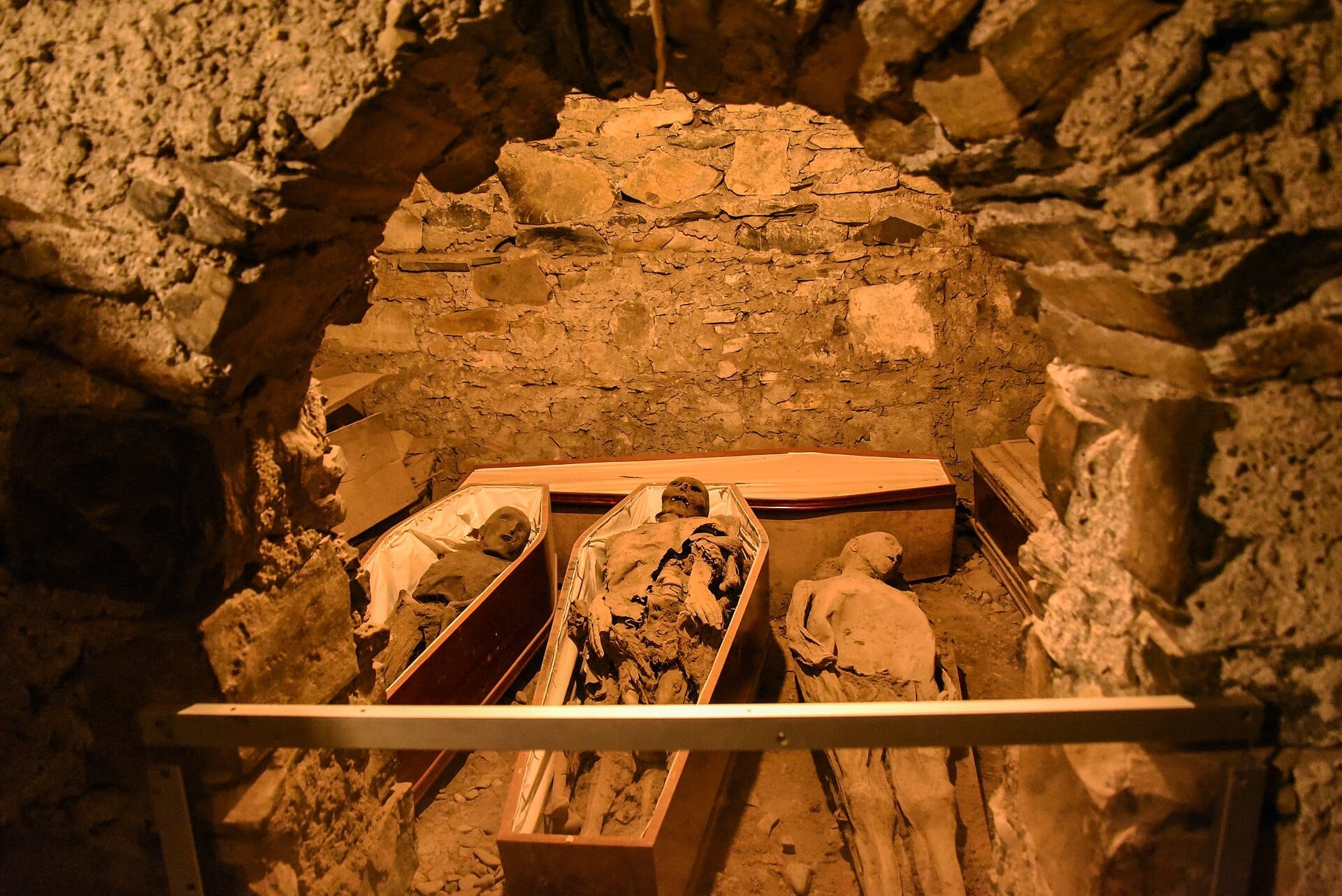
Descending into St Michan's crypts is a genuinely unusual experience, even for visitors who have toured many historic sites. The entrance is through a low doorway and down narrow stone steps into a series of vaulted limestone chambers. The air is noticeably cooler and drier than the church above, and there is a particular stillness to the place. The ceiling is close overhead in places, and the walls are rough-cut stone. It is not a space that feels staged or theatrical. It simply feels old.
The crypts were used primarily from the 17th through the 19th centuries. What makes them remarkable is the condition of some of the remains. The combination of limestone walls, low humidity, and methane-rich subsoil from a former marshland is thought to have created conditions that slowed decomposition and, in some cases, resulted in natural mummification. Several bodies have partially preserved skin and tissue, and a few of the wooden coffins have also survived in unusual condition.
Among the figures interred here are the Sheares brothers, leaders connected to the 1798 Irish Rebellion, and the crypts also hold what is traditionally identified as a Crusader knight, indicated by crossed legs on a stone effigy. The guide will walk you through the chambers and explain what is known, and what is speculated, about the individuals here. The tour is short, typically around 20 to 25 minutes, and feels appropriately measured rather than sensationalised.
⚠️ What to skip
The crypts are not wheelchair accessible. Access requires descending narrow stone steps and walking on uneven ground in confined spaces. The ceilings are low in sections. This is also not a comfortable experience if you have significant claustrophobia. Young children should be supervised carefully, and it is worth considering whether the content is suitable before bringing small children.
Tickets & tours
Hand-picked options from our booking partner. Prices are indicative; availability and final rates are confirmed when you complete your booking.
Dublin Christ Church Cathedral entrance ticket and self-guided tour
From 12 €Instant confirmationFree cancellationGiant's Causeway, Dark Hedges, and Belfast Tour from Dublin
From 85 €Instant confirmationFree cancellationDublin self-guided audio tour
From 10 €Instant confirmationBird of Prey, Cliffs of Moher and Aillwee Cave from Dublin
From 201 €Instant confirmationFree cancellation
The Church Interior: Architecture and Atmosphere
When you enter the church, the first thing you notice is how quiet it is. Church Street is not a major tourist corridor, so even in peak summer months, St Michan's draws a trickle of deliberate visitors rather than a crowd. The interior is small enough that you can take in the whole space from the entrance. The box pews date largely from the 17th and 18th centuries, and the carved wood has the particular warmth of old oak that has darkened with age.
The 1724 organ sits in the west gallery and is considered the architectural centrepiece of the interior. It is still played during services, which is relatively rare for an instrument of this age. The penal oak carving on the pews, and particularly the fine craftsmanship in the organ case, reflect the prosperity of the parish in the early 18th century, when this part of Dublin was a well-established commercial neighbourhood rather than a peripheral district.
For visitors interested in the broader history of Dublin's northside, St Michan's sits in a quarter that rewards slow walking. The Four Courts is a few minutes to the south on Inns Quay, and the Smithfield area lies immediately to the north and west. This whole stretch of the city has a different texture to the south-side tourist core: less polished, more workaday, with layers of history that are not always clearly signposted.
Visiting: Practical Walkthrough
The tour schedule currently tends to operate Monday to Thursday in two main blocks, roughly 10:00–12:00 and 14:00–16:00, with last tours near the end of each block, but times have changed repeatedly in recent years and were disrupted following a 2024 fire, so treat any timetable as indicative only and confirm directly with the parish on the day.
Tickets for the crypt tour are purchased on site, not in advance. The guide-led format means you join the next available group rather than booking a slot, which keeps the process simple but does mean waiting if a tour has just started. Arriving near the beginning of a session block is the most reliable way to avoid a wait. Payment is made to the guide directly, and the fee is minimal, typically around €7 for adults with reduced rates for students, children and seniors, though these figures should be confirmed on arrival.
Getting here is straightforward. The Luas Red Line stops at Four Courts, which is roughly a five-minute walk away along the quays. If you are coming from the city centre on foot, cross the Liffey via the Four Courts area and head north on Church Street. If you have been exploring Smithfield, the church is an easy extension of that walk, roughly ten minutes from Smithfield Square heading south-east.
Time of Day and What It Changes
Morning visits, particularly on weekdays, tend to be the quietest. The neighbourhood around Church Street sees commuter traffic in the early hours but settles into a fairly local rhythm by mid-morning. The light in the church interior comes primarily from the clear-glazed windows on the south side, so morning visits have a softer, more indirect quality. By midday in summer, the direct light cuts across the pews at a lower angle and makes the wood grain and carved details more visible.
The crypts, of course, are underground and artificially lit regardless of the time of day. What varies is the group size: earlier sessions tend to be smaller, which gives the guide room to spend more time on individual questions. If you are the kind of visitor who wants space to ask things and look properly rather than shuffle through, arriving as the first session of the morning opens is the best approach.
Historical and Cultural Context
The original church on this site was founded around 1095, during the Norse-influenced early medieval period of Dublin's development. The River Liffey's north bank was less developed than the Viking core around Christ Church and Wood Quay to the south, but the area around Church Street had its own significance as a crossing point and settlement area. The church sat within a community that would remain largely Scandinavian in origin for some generations after the Anglo-Norman arrival in the 12th century.
The rebuilding in 1685 to 1686 placed St Michan's firmly within the Protestant Ascendancy landscape of the city, and its history through the 18th and 19th centuries tracks the fortunes of Dublin's northside in that period. The presence of 1798 Rebellion figures in the crypts connects the church directly to one of the pivotal moments in Irish history, and visitors who want to understand that period more fully may also find the Kilmainham Gaol a meaningful complement to this visit.
Those with an interest in Georgian Dublin and the city's architectural legacy will find that St Michan's fits into a wider story told well by the Georgian Dublin architecture guide. The church predates the Georgian period, but its 18th-century organ and interior fittings are very much of that era.
Photography and What to Bring
Photography inside the church is generally permitted, and the carved organ case, box pews, and high windows make for visually interesting material in good light. A wide-angle lens or a phone camera in portrait mode handles the interior dimensions well. Flash photography in the crypts is typically restricted, and the guide will clarify on the tour. The low ambient lighting in the vaults means phone cameras will struggle without steady hands or a small tripod, if that is permitted.
Wear flat shoes with some grip, particularly if you plan to visit the crypts. The steps down are worn stone and can be slippery. A light layer is useful even in summer, as the temperature underground is noticeably cooler than the street. The graveyard outside is also worth a slow walk: the 18th and 19th-century headstones carry inscriptions that add texture to the history explained in the crypt tour.
Insider Tips
- Arrive at the opening of a session block rather than partway through. The guide will not restart the tour, and you could wait 30 to 40 minutes for the next group to form.
- The graveyard is freely accessible and often overlooked. Spend ten minutes there before or after the tour. Several stones carry legible inscriptions from the 18th century and connect to the family names mentioned in the crypts.
- The tour is entirely in English and involves a significant amount of verbal explanation in close quarters. If you are travelling with anyone who has hearing difficulties, try to position yourself near the guide from the start, as the acoustics in the vault are poor.
- St Michan's combines well with a walk along the north quays. The Four Courts building immediately to the south is architecturally significant, and Smithfield Square with its food and drink options is a short walk north if you want to eat before or after.
- If the church door appears locked on arrival, check whether a tour is already in progress in the crypts. The guide sometimes locks the entrance briefly when leading a group below. Wait a few minutes and try again before assuming it is closed for the day.
Who Is St Michan's Church & Crypts For?
- History and archaeology enthusiasts who want to engage with Dublin's pre-tourist-trail layers
- Visitors who have already covered the main south-side attractions and want something less visited
- Travellers interested in the 1798 Rebellion and Irish political history
- Architecture and ecclesiastical heritage visitors, particularly those interested in 17th and 18th-century church interiors
- Adults and older teenagers comfortable with the unsettling subject matter of preserved human remains
Nearby Attractions
Other things to see while in Smithfield & The Liberties:
- Christ Church Cathedral
Christ Church Cathedral has anchored Dublin's skyline for nearly a thousand years, predating the city's most famous landmarks by centuries. This guide covers what you actually see inside, when to go, how to get there, and whether the admission fee is worth it.
- Dublinia Viking and Medieval Museum
Dublinia brings over a thousand years of Dublin's earliest history to life through immersive reconstructions of Viking longships, medieval streetscapes, and hands-on archaeology exhibits. Housed in the 19th-century Gothic Revival Synod Hall beside Christ Church Cathedral, it rewards curious visitors of almost any age.
- Guinness Open Gate Brewery
Tucked inside the St. James's Gate complex on James's Street, the Guinness Open Gate Brewery is a working experimental taproom where Guinness brewers test recipes that never make it to supermarket shelves. No queues, no theatrics, just serious beer in a real brewery setting.
- Guinness Storehouse
The Guinness Storehouse takes you through seven floors of brewing history at St James's Gate, the birthplace of one of the world's most recognisable drinks. The experience ends at the rooftop Gravity Bar with a complimentary pint and views across the Dublin skyline. It draws more visitors than any other paid attraction in Ireland, and whether that's a recommendation or a caution depends entirely on what you're after.