Spruce Street Suspension Bridge: San Diego's Free-Swaying Canyon Crossing
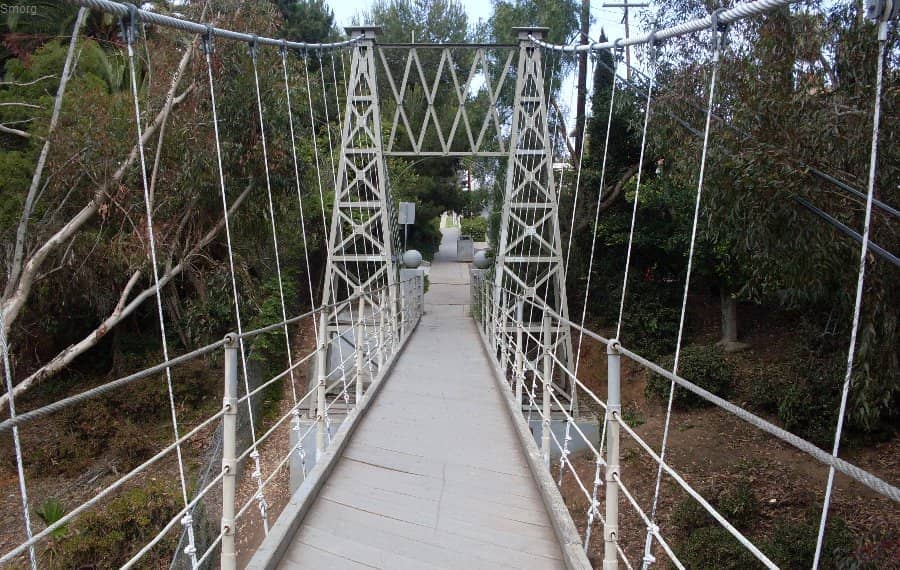
Built in 1912 and stretching 375 feet across a wooded canyon in Bankers Hill, the Spruce Street Suspension Bridge is one of San Diego's most unusual free attractions. It sways underfoot, threads through eucalyptus canopy, and offers canyon views that feel nothing like the city surrounding it. Open daily from 6 AM to 10 PM, no ticket required.
Quick Facts
- Location
- Spruce Street between Front Street and Brant Street, Bankers Hill, San Diego, CA 92103
- Getting There
- No direct trolley stop; take MTS Bus 3 or 11 to nearby stops on 1st Ave, then walk. Rideshare drops off on Spruce St.
- Time Needed
- 15–30 minutes for the bridge itself; 45–75 minutes if you explore the canyon trail below
- Cost
- Free — no ticket, no reservation required
- Best for
- Curious walkers, architecture lovers, photographers, and anyone who wants a genuine San Diego surprise without spending a dollar
- Official website
- www.sprucestreetbridge.org
What Is the Spruce Street Suspension Bridge?
The Spruce Street Suspension Bridge is a 375-foot pedestrian suspension bridge spanning a densely vegetated canyon in San Diego's Bankers Hill neighborhood. Built in 1912, it connects Spruce Street's eastern end near Front Street to its western terminus near Brant Street, carrying foot traffic above a ravine that drops roughly 70 feet below the roadway. The City of San Diego designated it Historic Landmark #116 on January 7, 1977, recognizing its age and its singular role in the city's urban fabric.
Locally, the bridge goes by the nickname the Wiggly Bridge, which tells you most of what you need to know before you step onto it. The wooden deck flexes and sways noticeably with each step, especially when multiple people cross at once. Cables extend from two anchor towers, and the whole structure moves in a way that surprises nearly every first-time visitor who expected something more rigid. That tactile quality, more than any view or historical detail, is what makes the crossing memorable.
💡 Local tip
Arrive on a weekday morning between 7 AM and 9 AM for the calmest experience. Foot traffic is minimal, the canyon is quiet except for birdsong, and the soft morning light filters through the eucalyptus canopy in a way that afternoon sun cannot replicate.
The Bridge at Different Times of Day
Early mornings are the most atmospheric window for a visit. The canyon below holds cool, damp air long after sunrise, and the smell of eucalyptus and soil rises up through the deck planks. Joggers from nearby Bankers Hill cross quickly; dog walkers pause midway to look down at the tree canopy below. The bridge barely moves during a solo crossing at this hour, making it easier to actually observe the structure rather than simply react to it.
By midday on weekends, the mood shifts. Groups of two to four people cross simultaneously, which amplifies the swaying. Children tend to bounce deliberately to increase the movement. The social energy picks up, but so does the wait — on busy weekend afternoons, a short queue sometimes forms at each end, since the bridge feels most comfortable with fewer than ten people on it at once. Sunset brings another surge of visitors, particularly photographers drawn to the warm light hitting the canyon walls to the west.
The bridge closes at 10 PM. Evening crossings before that cutoff, especially on clear nights, offer an unusually quiet version of the experience: city sounds fade, the canyon below darkens into shadow, and the overhead cables catch whatever ambient light reaches them from the street.
History and Construction
When the bridge was completed in 1912, Bankers Hill was a residential neighborhood developing rapidly above the canyons that cut through western San Diego. The ravine the bridge crosses — part of the network of arroyos running toward Mission Valley and San Diego Bay — presented a real obstacle for pedestrians trying to move through the neighborhood. A suspension bridge was chosen over a conventional concrete span, likely for cost reasons and because the canyon's soft edges made deep footings more practical at the anchor points than at midspan.
More than a century later, that pragmatic engineering decision is precisely what gives the bridge its character. The design, though functional, produced something that doesn't resemble a typical urban bridge. Its length of 375 feet is significant for a pedestrian structure of its era, and the fact that it has survived with its essential suspension mechanics largely intact says something about the quality of its original construction and the attentiveness of subsequent maintenance.
The bridge's Historic Landmark designation places it in the same civic category as structures like the Spreckels Organ Pavilion in Balboa Park — acknowledged by the city as part of the built heritage worth preserving, not simply as a curiosity.
The Crossing: What You'll Actually Experience
The approach from the east, off Front Street, gives you the best first look at the bridge's profile. You see the cables descending from two modest wooden towers and the deck disappearing into the tree canopy ahead. The planks underfoot are wooden, with gaps between them wide enough to see the canyon floor below — which is either thrilling or uncomfortable depending on your tolerance for heights.
The movement is the defining feature. Even a single person walking at a normal pace generates a rhythmic sway, and the cables creak faintly in response. Handrails run the full length on both sides, and they are essential: grip them, look down through the planks at the green canopy below, and you get a moment that is genuinely unlike anything else available for free in San Diego. Midspan, the view in both directions along the canyon is the best the bridge offers.
The crossing itself takes under two minutes at a normal pace. Most people slow down, stop midway, look out, and then continue. The full round trip — east end to west end and back — takes roughly five to eight minutes. If you descend the canyon trail from either end, you can extend the visit considerably, walking below the bridge and looking up at it through the trees. That perspective, from the canyon floor, reveals the structure's height and span in a way the deck crossing alone does not.
⚠️ What to skip
The gap between deck planks is noticeable. If you have a significant fear of heights or feel unsettled by moving surfaces underfoot, this bridge will be uncomfortable rather than enjoyable. It is not an attraction that rewards pushing through anxiety.
Getting There and Practical Details
The bridge is in Bankers Hill, a walkable residential neighborhood directly north of downtown San Diego and just west of Balboa Park. If you are already in Balboa Park, the bridge is roughly a 15-minute walk west. From downtown, the walk takes about 20 to 25 minutes heading north on Fourth or Fifth Avenue.
MTS Bus 3 runs along Fourth Avenue and stops within a few blocks of the eastern bridge access. Rideshare drop-off works well on Spruce Street itself. If you're combining this with a visit to Balboa Park, the bridge makes a logical extension of an afternoon walk west through Hillcrest or Bankers Hill.
Street parking is available on Spruce Street and nearby blocks in Bankers Hill, generally free. The neighborhood is residential and relatively low-traffic on weekdays. No facilities exist at the bridge itself — no restrooms, no water, no information kiosk. Bring water, especially in summer when afternoon temperatures in this inland-adjacent neighborhood can reach the low-to-mid 80s Fahrenheit.
The bridge is open daily from 6:00 AM to 10:00 PM, every day of the year, with no seasonal variation in hours. Admission is free. No reservation is required. Accessibility is limited — the approach involves sidewalks and short, uneven paths at each end, and the bridge deck itself is not ADA-compliant in any meaningful sense given its suspension design.
Photography Tips
The best photographs of the bridge come from below, not from on it. Descend to the canyon floor via the trails at either end, walk under the span, and shoot upward toward the cables and deck with the tree canopy framing the structure. Morning light works better from the east end; late afternoon light hits the western side of the canyon more directly.
From the deck itself, looking straight down through the planks creates a dramatic vertical shot with the canyon floor receding below. A wide-angle lens captures the full sweep of the cables and towers. If you want a longer-range walk combining multiple photogenic locations, the best viewpoints in San Diego guide covers several spots that pair well with a Bankers Hill morning.
The Bottom Line: Who Should and Shouldn't Visit
The Spruce Street Suspension Bridge delivers something specific: a short, free, physically unusual experience in a residential neighborhood that most tourists skip entirely. If that combination appeals to you, it will meet expectations. If you are expecting a dramatic scenic overlook or an immersive historical experience with signage and context, you will be underwhelmed. The bridge is a bridge. The history is real but lightly presented on-site. The view is good but not panoramic.
It fits well into a broader neighborhood exploration rather than standing as a solo destination that justifies a long drive. Pair it with a walk through Bankers Hill, a stop at a local café, or a visit to Presidio Park to the northwest, and the whole outing becomes worthwhile. On its own, it's fifteen minutes — and fifteen very good minutes, but still.
People with a genuine fear of heights, discomfort with moving surfaces, or mobility limitations will not enjoy the crossing. For everyone else, it's one of the more distinctive free things San Diego has to offer.
Insider Tips
- Cross in the direction of traffic flow rather than stopping in the middle during a crowd surge — the swaying is most intense when people are moving in opposite directions simultaneously. Wait for a gap and cross cleanly.
- The canyon trail below the bridge is accessible from both ends and largely unknown to casual visitors. Descend on the east side, walk under the structure, and look up. The bridge appears far more impressive from below than from on it.
- Combine the bridge with the small residential streets of Bankers Hill for a genuinely unhurried hour. The neighborhood sits directly above the canyon and has a number of early 20th-century homes that reflect the same era as the bridge.
- Bring a wide-angle phone lens attachment if you're serious about photography. The full cable span is hard to capture with a standard phone camera from on the bridge — you need width or elevation.
- Weekday mornings between 7 and 9 AM offer the rarest experience: a near-empty bridge with only ambient city sound and the creak of cables. Weekend afternoons after noon are the most crowded window, particularly in summer.
Who Is Spruce Street Suspension Bridge For?
- Walkers and urban explorers who want something off the standard tourist circuit
- Architecture and engineering enthusiasts interested in early 20th-century pedestrian infrastructure
- Photographers looking for unexpected compositions in a canyon setting
- Budget travelers and anyone building a free-things-to-do itinerary in San Diego
- Families with older children who will appreciate the physical sensation of crossing a moving bridge
Nearby Attractions
Combine your visit with:
- Anza-Borrego Desert State Park
Anza-Borrego Desert State Park stretches across more than 600,000 acres of Colorado Desert in eastern San Diego County, making it one of the largest state parks in the United States. From spring wildflower carpets to ancient slot canyons and some of the darkest skies in Southern California, it rewards visitors who plan carefully and respect the terrain.
- Border Field State Park
Border Field State Park occupies the southwestern corner of the continental United States, where Pacific surf meets the U.S.–Mexico border fence. It offers coastal wetlands, a historic marble boundary monument, and views toward Friendship Park — the U.S.-side gathering space has been closed since 2020, so confirm current access before you go.
- Cedar Creek Falls
Cedar Creek Falls is a backcountry waterfall deep inside Cleveland National Forest, reached by a strenuous 6-mile round-trip hike from Ramona. A mandatory day-use permit keeps crowds manageable, but you'll earn every step of the descent into this rugged gorge. This guide covers the permit process, trail conditions, safety warnings, and what to realistically expect.
- Chicano Park
Chicano Park is a National Historic Landmark tucked beneath the San Diego–Coronado Bridge in Barrio Logan, where more than 80 monumental murals cover the concrete pillars of a freeway overpass. Free to enter and open daily, it is one of the most culturally layered outdoor spaces in the American Southwest.