Presidio Park: San Diego's Founding Ground, Above the Noise of Old Town
Perched on a hillside above Old Town San Diego, Presidio Park marks the site of the original Spanish presidio established in 1769, making it the birthplace of European California. Free to enter and largely overlooked by casual tourists, the park rewards those willing to make the short climb with panoramic views, manicured grounds, and a window into the city's deepest roots.
Quick Facts
- Location
- 2727 Presidio Dr, San Diego, CA 92110 — hilltop above Old Town San Diego
- Getting There
- MTS Bus routes serve Old Town Transit Center; the park is a short uphill walk from there
- Time Needed
- 1 to 2 hours for a thorough visit; 30 minutes if you just want the overlook
- Cost
- Free park entry. Junípero Serra Museum has a separate admission fee — verify current pricing at sandiegohistory.org
- Best for
- History enthusiasts, picnickers, photographers, and anyone wanting a quiet escape from Old Town crowds
- Official website
- www.sandiego.gov/park-and-recreation/parks/regional/presidio
What Presidio Park Actually Is
Presidio Park is a 40-plus-acre public hilltop park operated by the City of San Diego, sitting directly above the historic district of Old Town. The park is open daily from sunrise to 10:00 p.m. and charges no general admission. What makes it worth knowing about is not its facilities, which are simple, but its location and its historical weight.
The ground beneath the lawns here is where Spanish colonizers established the San Diego Presidio in 1769, the military fort and mission complex that became the first permanent European settlement in what is now California. That founding moment eventually gave rise to the city of over 1.4 million people visible in the distance from the park's overlooks. If you are visiting Old Town San Diego and wondering which hill looms above the adobe buildings and taco shops, this is it.
ℹ️ Good to know
Park hours: Open daily from sunrise to 10:00 p.m. Free to enter. The Junípero Serra Museum within the park has separate hours and admission — check the San Diego History Center website before visiting.
The Grounds: What You See When You Arrive
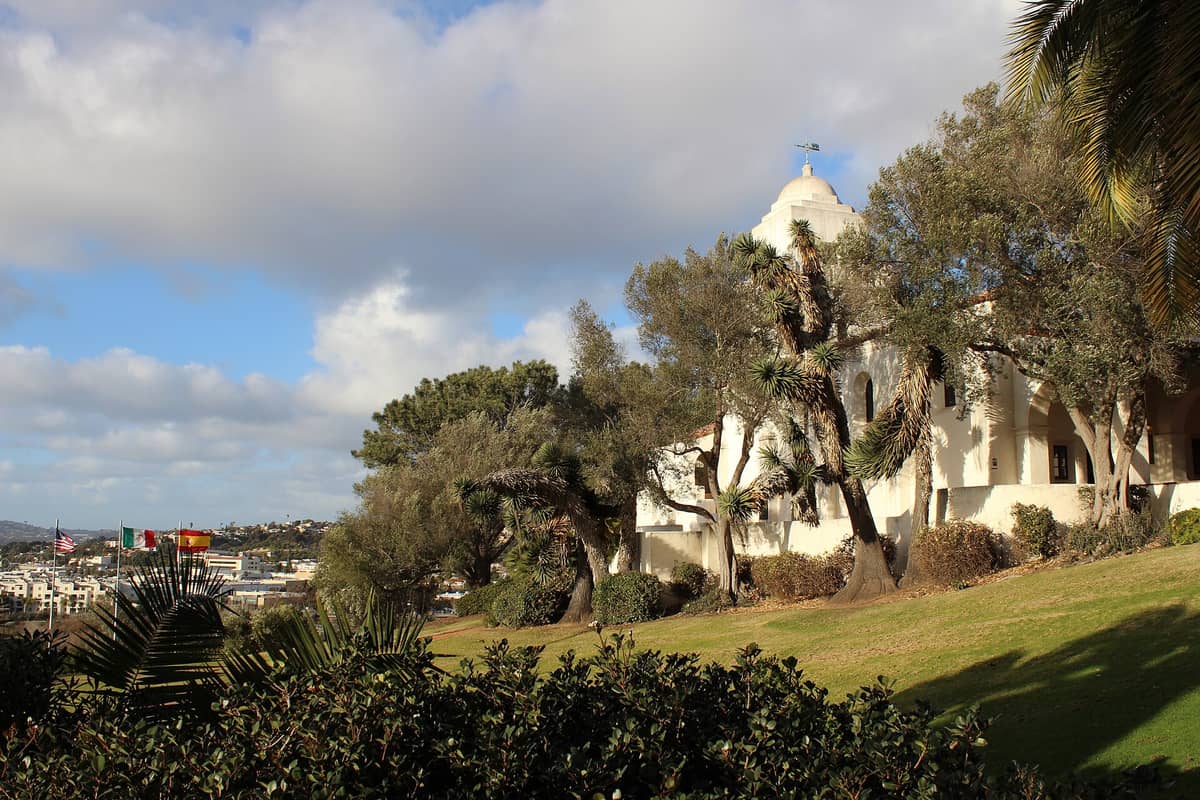
The park is landscaped rather than wild. Wide, grassy slopes roll across the hilltop, dotted with old pepper trees and palms that provide shade in summer. The smell in mid-morning, once the marine layer burns off, is cut grass and warm eucalyptus, a combination distinctly Southern Californian. Stone pathways connect the main areas, and several benches face west toward Mission Valley and the distant coast.
At the crest of the hill stands the Junípero Serra Museum, a white stucco building with a red-tile roof completed in 1929 and designed by architect William Templeton Johnson in a Spanish Colonial Revival style. The tower is visible from much of Old Town below and serves as the park's visual anchor. The building houses exhibits on the Spanish colonial and Mexican periods operated by the San Diego History Center. Note that the museum has a separate admission fee from park entry, and current pricing should be confirmed directly with the History Center before you go.
Scattered through the park are low archaeological remnants and interpretive markers indicating where the original presidio walls and structures once stood. These are not dramatic ruins; most are low outlines in the earth rather than standing walls. Travelers expecting something like a reconstructed fort will be underwhelmed. What remains is more of a commemorative landscape than an architectural site.
Time of Day: How the Experience Changes
Early morning, before 9:00 a.m., the park is genuinely quiet. Local dog walkers and joggers make up most of the crowd. The marine layer that defines San Diego mornings from June through August often sits low over Mission Valley from up here, which produces soft, diffuse light and cooler temperatures. If you are a photographer, this is the window: the museum tower catches early light well, and the valley below disappears into white mist in a way that makes the hilltop feel isolated from the city.
Midday brings families with children, particularly on weekends, and the occasional school group. The park is large enough that it never feels congested, but the shaded spots under the pepper trees become prime real estate. Bring water if you are visiting between May and October — the hilltop traps heat in the afternoon and there are no concession stands.
Late afternoon, roughly 4:00 to 6:00 p.m., offers the best combination of light quality and crowd levels. The western-facing slopes catch warm golden light, and the views toward the coast become clearer as the afternoon haze settles. This is also when the sounds from Old Town below, music from restaurants and occasional tour groups, carry up the hill in a faint but pleasant way.
💡 Local tip
Parking is available near the base of the hill off Presidio Drive at no charge. Street parking along Jackson Street is also typically available. If you are arriving by public transit, Old Town Transit Center is served by multiple MTS bus lines and is walkable to the park entrance.
The History: Why This Hill Matters
In July 1769, a Spanish expedition led by Gaspar de Portolá established a military garrison on this hill, and Franciscan friar Junípero Serra founded Mission San Diego de Alcalá here shortly after. That mission later relocated east to its current site, which you can still visit at Mission Basilica San Diego de Alcalá, but the presidio itself remained on this hill as the administrative and military center of Alta California for decades.
By the mid-19th century, after California became part of the United States, the presidio had crumbled entirely. The site was essentially forgotten until journalist and civic advocate George Marston purchased the land in the early 20th century and donated it to the City of San Diego for preservation. The museum building was constructed in 1929 to coincide with the 160th anniversary of the founding, and the park was formally established around it.
Understanding this history changes how you experience the park. The quiet lawns and stone paths sit on top of what was once the most strategically important military position in Spanish California. If you want the broader colonial history context before or after your visit, the Old Town San Diego State Historic Park directly below fills in the Mexican period that followed.
Accessibility and Practical Limitations
⚠️ What to skip
Presidio Park has a documented accessibility problem. The hilltop terrain is uneven, and the Junípero Serra Museum and presidio site are not currently ADA-accessible, with steps and unpaved paths posing significant barriers. ADA improvements have been discussed but were not fully completed as of recent reporting. Visitors with mobility limitations should verify current conditions with the City of San Diego before making the trip.
The walk from street level to the upper park areas involves a moderate uphill climb. It is not strenuous for most adults in reasonable fitness, but it is not flat. Strollers can manage the paved sections, but the steeper footpaths near the museum building require some effort. Comfortable, closed-toe shoes are adequate for the paved paths; trail shoes are better if you plan to explore the grassy slopes.
There are no food or drink vendors in the park. The nearest cafes and restaurants are in Old Town below, a 10 to 15 minute walk. Plan accordingly, especially if visiting with children or during summer heat.
Photography and Views
The views from Presidio Park are among the more underrated in the city. From the western slope, you can see across Mission Valley toward the coast on clear days, with the Pacific visible as a thin silver line. The park does not appear on most photography location lists for San Diego, which makes it less crowded than comparable viewpoints. For dedicated viewpoint seekers, the Mount Soledad Veterans Memorial offers more expansive 360-degree panoramas, but Presidio Park has a character that is harder to find: a historic landscape with city views and almost no tourist infrastructure in the frame.
The Junípero Serra Museum building itself is photogenic in the late afternoon, when the white stucco reflects warm light against the green hillside. Wide-angle lenses work well here for combining the building, the landscaping, and the valley below in a single frame. The bell tower is the most commonly photographed element and is at its best in the first and last two hours of daylight.
Pairing Presidio Park with the Rest of Old Town
Most visitors to this part of San Diego spend their time in Old Town's restaurant strip and historic park at street level, and never make it up the hill. That is understandable, but it misses a meaningful layer. A practical approach is to visit Presidio Park first, in the morning when it is cool and the light is good, and then descend to Old Town for lunch and a walk through the Old Town San Diego State Historic Park in the late morning or early afternoon.
If you are working through a broader San Diego itinerary, Presidio Park fits naturally into a half-day that also includes Mission Basilica San Diego de Alcalá a few miles east, which continues the Spanish colonial history thread. Both sites together give a reasonably complete picture of 18th-century San Diego without requiring more than a half-day and minimal expense.
For those building a longer San Diego visit, the 3-day San Diego itinerary can help you position Presidio Park efficiently alongside the city's other major sites.
Insider Tips
- The park's best photo window is the 30 minutes before and after sunrise on clear days — the museum tower catches pink light before the rest of the hill warms up, and Mission Valley below is often still in shadow.
- Free street parking on Presidio Drive is almost always available on weekday mornings, and it can be easier than competing for limited spaces and paid lots in Old Town below. If you drive, park here first and walk down to Old Town rather than fighting for parking at street level.
- The event sites within the park — specifically The Arbor and Inspiration Point — can be reserved for private events through the City of San Diego Permit Center. If you arrive on a weekend afternoon and find one area closed off, that is likely the reason.
- The archaeological outlines of the original presidio walls are easy to miss because they look like low decorative borders. Look for the interpretive signage near the museum building; it maps out what each low stone boundary represents historically.
- San Diego's June Gloom (the coastal marine layer common from late May through early July) actually works in your favor at Presidio Park. The hilltop clears faster than the valley below, so you sometimes get a sunlit park while Mission Valley is still fogged in — an unusual and striking visual.
Who Is Presidio Park For?
- History travelers who want to stand on the actual founding site of European California rather than a reconstruction
- Photographers looking for underused San Diego viewpoints without crowds or competing tripods
- Families wanting a free, low-key outdoor space away from the commercial energy of Old Town below
- Morning walkers and joggers based in Old Town or Mission Valley who want a short but meaningful hillside route
- Anyone building a Spanish colonial history day trip pairing Old Town with the Mission Basilica
Nearby Attractions
Other things to see while in Old Town San Diego:
- Old Town San Diego State Historic Park
Old Town San Diego State Historic Park preserves the original Euro-American settlement of San Diego in a compact, walkable historic core. Entry is free, the museums and visitor center are generally open daily during posted hours, and the mix of restored adobe buildings, period museums, and working artisan shops rewards a leisurely two-hour visit.