Mission Basilica San Diego de Alcalá: California's First Mission
Founded in 1769 by Franciscan friar Junípero Serra, Mission Basilica San Diego de Alcalá is the oldest of California's 21 Spanish missions and an active Catholic parish designated a minor basilica. The whitewashed adobe walls, bell tower, and peaceful gardens offer a surprisingly intimate window into colonial California history, just a short trolley ride from downtown San Diego.
Quick Facts
- Location
- 10818 San Diego Mission Road, San Diego, CA 92108
- Getting There
- San Diego Trolley – Mission San Diego stop, then a short walk north on San Diego Mission Road
- Time Needed
- 1 to 1.5 hours for a thorough self-guided visit
- Cost
- Adults $8 | Seniors/Students $5 | Children $3 | Mass attendance free
- Best for
- History lovers, architecture enthusiasts, Catholic heritage travelers, and families seeking a calm, educational stop
- Official website
- www.missionsandiego.org
What You're Actually Visiting
Mission Basilica San Diego de Alcalá is not a reconstruction of what once was. It is a living Catholic parish that doubles as a historic site, and that tension between the sacred and the scholarly gives the visit a quality you don't find in a typical museum. Mass is still celebrated here. The bells still ring. The priests still walk the corridors. For a traveler, that sense of unbroken continuity is more affecting than most exhibits.
The current church and buildings are not the originals. The mission was founded on July 16, 1769, by Franciscan friar Junípero Serra, making it the first of California's 21 Spanish missions. The original site sat closer to the coast, near present-day Old Town. After conflicts with the local Kumeyaay people and a search for better farmland and water, the mission was relocated to its current site in Mission Valley in 1774, about six miles inland from the original presidio area. The adobe buildings you see today reflect extensive rebuilding that followed an 1812 earthquake and periods of secularization and neglect throughout the 19th century. The church was restored and rededicated in 1931.
In 1976, Pope Paul VI elevated the mission church to the status of a minor basilica, which is why it carries the formal title Mission Basilica San Diego de Alcalá. For context on how this site fits into the broader story of early California, the nearby Old Town San Diego State Historic Park preserves the area where the original mission settlement stood and where much of the city's Spanish and Mexican colonial history played out.
The Approach and First Impressions
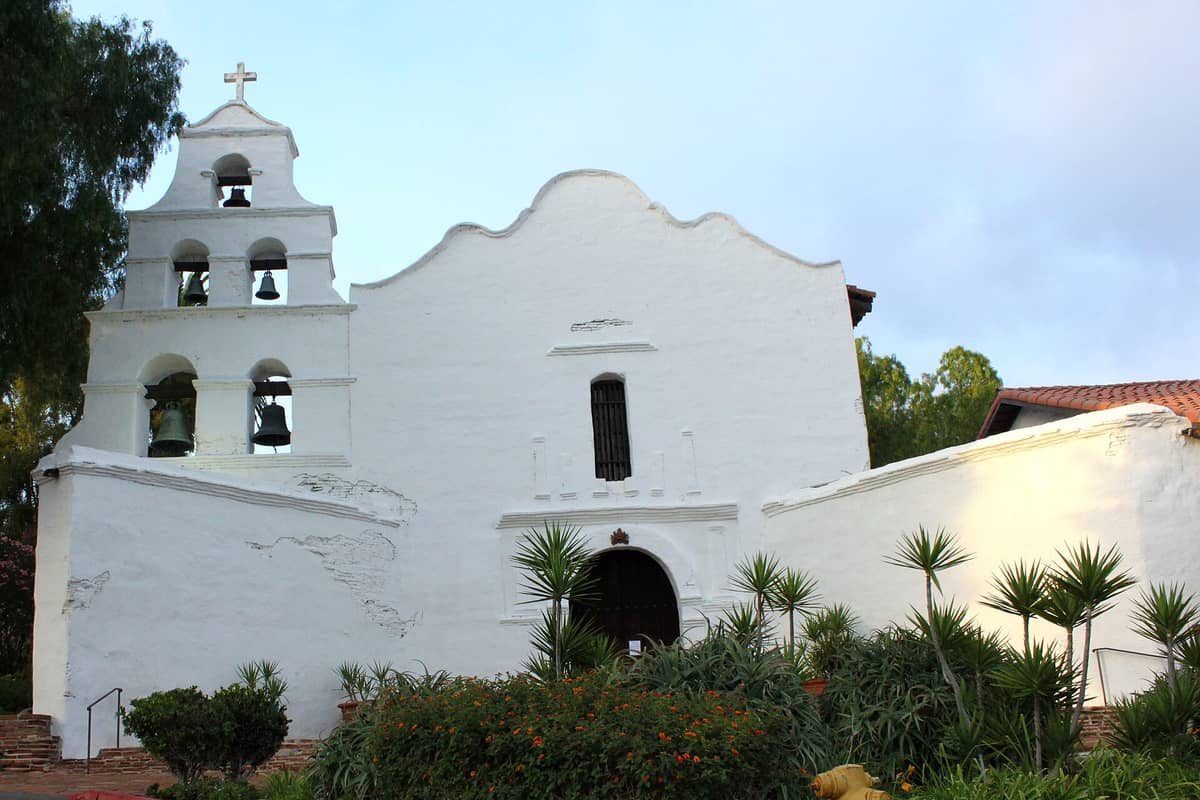
Arriving by trolley keeps expectations properly calibrated. You step off at the Mission San Diego stop and walk less than half a block north on Rancho Mission Road, then turn right onto San Diego Mission Road. The surrounding landscape is unremarkably suburban, which makes the moment you round the corner and see the white facade all the more abrupt. The church rises against the sky with a simplicity that reads as elegance: a single bell tower, five bells at different heights, and a plain whitewashed front pierced by a small rose window. There are no ornate details competing for attention.
The mission sits on a quiet, sloped property. In the morning, the light falls directly on the facade and the bells catch sharp shadows. By early afternoon the grounds have warmed considerably, and the garden areas become slightly hazy with reflected heat from the adobe and tile. Visiting on a weekday morning before noon puts you there ahead of school groups and the lunch-hour crowd, and the Visitor Center sees far less congestion before 11am.
💡 Local tip
The trolley is the most stress-free way to get here. Parking exists on-site, but the lot is small and fills quickly when school field trips are scheduled. Check the official website for group visit dates if you want to avoid crowds.
Inside the Church and Visitor Rooms
The interior of the basilica is modest by the standards of European Catholic churches, and that restraint is exactly the point. The nave is cool, dim, and quiet even when a handful of visitors are moving through. The walls are thick adobe, which keeps the temperature noticeably lower than outside, a practical feature that also gives the space an atmosphere of genuine solitude. The altar is simple painted wood, the pews old and worn smooth. There is no grandeur here, and it would be dishonest to oversell the interior as architecturally stunning. Its power is in its age and its ongoing use.
The self-guided tour, which begins at the Visitor Center on the left side of the entrance complex, takes you through several rooms that display original artifacts, period documents, replica vestments, and explanatory panels on the mission system, the life of Junípero Serra, and the Kumeyaay people who inhabited this region long before Spanish contact. The treatment of the Kumeyaay perspective has improved in recent years, with some acknowledgment of the coercive nature of the mission system alongside its religious narrative.
One room contains the burial site of Father Luis Jayme, a Franciscan friar killed during a Kumeyaay uprising in 1775. His remains are interred beneath the sanctuary floor, and the marker is surprisingly understated. It is the kind of detail that repays a slow read of the interpretive signage rather than a quick walk-through.
The Garden and Grounds
The walled garden behind the church is where many visitors slow down. It is a compact, well-maintained space with drought-tolerant California plantings, a small fountain, and old olive trees. The trees are particularly striking: gnarled, silver-leafed, and almost certainly among the oldest living things on the property. Olive cultivation was a practical necessity for early California missions, and several mission sites in the state retain their original groves.
The garden is best in morning light, when the temperature is comfortable and the sound from the surrounding streets fades into the background. It is a genuinely peaceful space, not just by San Diego standards but on its own terms. Photographers will find the combination of adobe textures, terracotta tile, and filtered garden light productive. A wide-angle lens captures the full sweep of the bell tower against the sky; a longer focal length picks out the bells themselves and the carved stone details around the church entrance.
ℹ️ Good to know
No admission fee is charged for attending Mass. If your visit coincides with a scheduled service, the church interior may be inaccessible for the self-guided tour during that period. Check the official site for Mass times before planning your arrival.
Historical Weight and Honest Context
The mission system in California is a subject of ongoing historical and cultural debate. The 21 missions, including this one, were the primary instruments of Spanish colonial expansion into Alta California and involved the forced conversion, labor, and displacement of Indigenous peoples. Visitor numbers at mission sites have declined over decades as public awareness of this history has grown, and some travelers choose not to visit on principle.
For those who do visit, the Visitor Center here does not entirely sidestep the complexity, though it does not explore it with the depth that a dedicated history museum might. If you want a fuller picture of pre-mission San Diego, the Kumeyaay cultural heritage warrants independent research beyond what the mission's own interpretive materials provide.
The mission is also one component of a larger early California historical landscape. Presidio Park, located nearby in Mission Hills, marks the site of the original Spanish fort and is worth combining with a mission visit for a more complete picture of colonial-era San Diego.
Practical Walkthrough: What to Expect Step by Step
Admission is paid at the Visitor Center, where you also pick up a self-guided tour map. The tour route is well-signed and takes you through the exhibit rooms first, then into the church sanctuary, and finally out to the garden. The full loop takes between 45 minutes and 90 minutes depending on how much time you spend reading the interpretive panels, which are detailed enough to reward genuine attention.
- Open daily 9:00am to 4:00pm. Last entry is at 4:00pm.
- Adults $8 | Seniors and Students $5 | Children $3.
- By trolley: San Diego Trolley to Mission San Diego stop, walk north on Rancho Mission Road, then right onto San Diego Mission Road.
- By car: I-8 east to Mission Gorge Road exit, follow to Twain Avenue, which becomes San Diego Mission Road. On-site parking is limited.
- Visitors with accessibility needs are advised to call the Visitor Center at +1 (619) 281-8449 in advance, as accessibility details are not fully documented online.
- Wear comfortable walking shoes. The garden path is paved but uneven in places.
- There is a small gift shop at the Visitor Center selling religious items, books on California mission history, and locally produced goods.
⚠️ What to skip
Hours may vary on Catholic holidays and during special events. Confirm via the official site at missionsandiego.org before your visit, particularly if traveling on or around major feast days.
Who Should Skip This
Travelers looking for grand-scale religious architecture will find the basilica's interior comparatively bare. Those expecting something on the visual scale of Mission Santa Barbara or a European cathedral will be underwhelmed. Similarly, visitors with very limited time in San Diego who are focused on the waterfront, beaches, or Balboa Park may find the detour into Mission Valley difficult to justify given the logistics. The mission is also not the right choice for very young children with short attention spans, as there are no interactive exhibits and the experience is primarily text-and-artifact based.
If your interest in San Diego history is primarily coastal and maritime, the Maritime Museum of San Diego on the Embarcadero offers a more hands-on experience and broader visitor infrastructure for families.
Insider Tips
- Weekday mornings before 11am are significantly quieter than weekend afternoons. School groups typically arrive mid-morning on weekdays in spring, so arrive at opening or after 1pm to avoid them.
- The bells are rung at specific times, including before Mass. If you are on the grounds when they ring, position yourself near the tower rather than inside the church for the full sonic effect — the resonance outdoors is impressive.
- The small cemetery adjacent to the church contains graves dating back centuries. Take a slow walk through if the garden is crowded; fewer visitors stop here and it offers a more reflective experience than the main tour route.
- Combine this visit with Presidio Park, about six miles west. The park marks the original Spanish fort site and includes the Junipero Serra Museum. Together, the two sites give a fuller picture of early colonial San Diego than either does alone.
- The mission gift shop stocks a well-curated selection of books on California mission history and Franciscan heritage. Several are out of print or hard to find elsewhere, making this a worthwhile stop for anyone researching the region's history.
Who Is Mission Basilica San Diego de Alcalá For?
- History and colonial architecture enthusiasts who want to understand San Diego's origins beyond the beach narrative
- Catholic heritage travelers for whom the basilica designation and active parish status add spiritual meaning to the visit
- Photographers seeking adobe textures, bell tower silhouettes, and walled garden compositions with minimal crowds in the early morning
- Travelers on a budget: at $8 for adults, this is one of the most affordable structured historical experiences in San Diego
- Older children and teenagers studying California history who will engage with the interpretive panels on the mission system and Indigenous peoples
Nearby Attractions
Combine your visit with:
- Anza-Borrego Desert State Park
Anza-Borrego Desert State Park stretches across more than 600,000 acres of Colorado Desert in eastern San Diego County, making it one of the largest state parks in the United States. From spring wildflower carpets to ancient slot canyons and some of the darkest skies in Southern California, it rewards visitors who plan carefully and respect the terrain.
- Border Field State Park
Border Field State Park occupies the southwestern corner of the continental United States, where Pacific surf meets the U.S.–Mexico border fence. It offers coastal wetlands, a historic marble boundary monument, and views toward Friendship Park — the U.S.-side gathering space has been closed since 2020, so confirm current access before you go.
- Cedar Creek Falls
Cedar Creek Falls is a backcountry waterfall deep inside Cleveland National Forest, reached by a strenuous 6-mile round-trip hike from Ramona. A mandatory day-use permit keeps crowds manageable, but you'll earn every step of the descent into this rugged gorge. This guide covers the permit process, trail conditions, safety warnings, and what to realistically expect.
- Chicano Park
Chicano Park is a National Historic Landmark tucked beneath the San Diego–Coronado Bridge in Barrio Logan, where more than 80 monumental murals cover the concrete pillars of a freeway overpass. Free to enter and open daily, it is one of the most culturally layered outdoor spaces in the American Southwest.