Mt. Soledad National Veterans Memorial: La Jolla's Hilltop Tribute with 360° Views
Perched at one of La Jolla's highest points, Mt. Soledad National Veterans Memorial combines a striking 29-foot concrete cross, more than 5,000 granite plaques honoring American veterans, and panoramic views stretching from the Pacific Ocean to downtown San Diego. Admission is always free, and the site is open daily from early morning until 10 p.m.
Quick Facts
- Location
- 6905 La Jolla Scenic Drive S., La Jolla, CA 92037
- Getting There
- No direct MTS route to the summit; most visitors drive or use rideshare (Uber/Lyft). Free on-site parking available.
- Time Needed
- 45–90 minutes for a thorough visit; 20 minutes if you are only here for the view
- Cost
- Always free — no tickets, no reservations required
- Best for
- Veterans and military families, photographers, couples at sunset, history enthusiasts
- Official website
- www.soledadmemorial.org
What Is Mt. Soledad National Veterans Memorial?
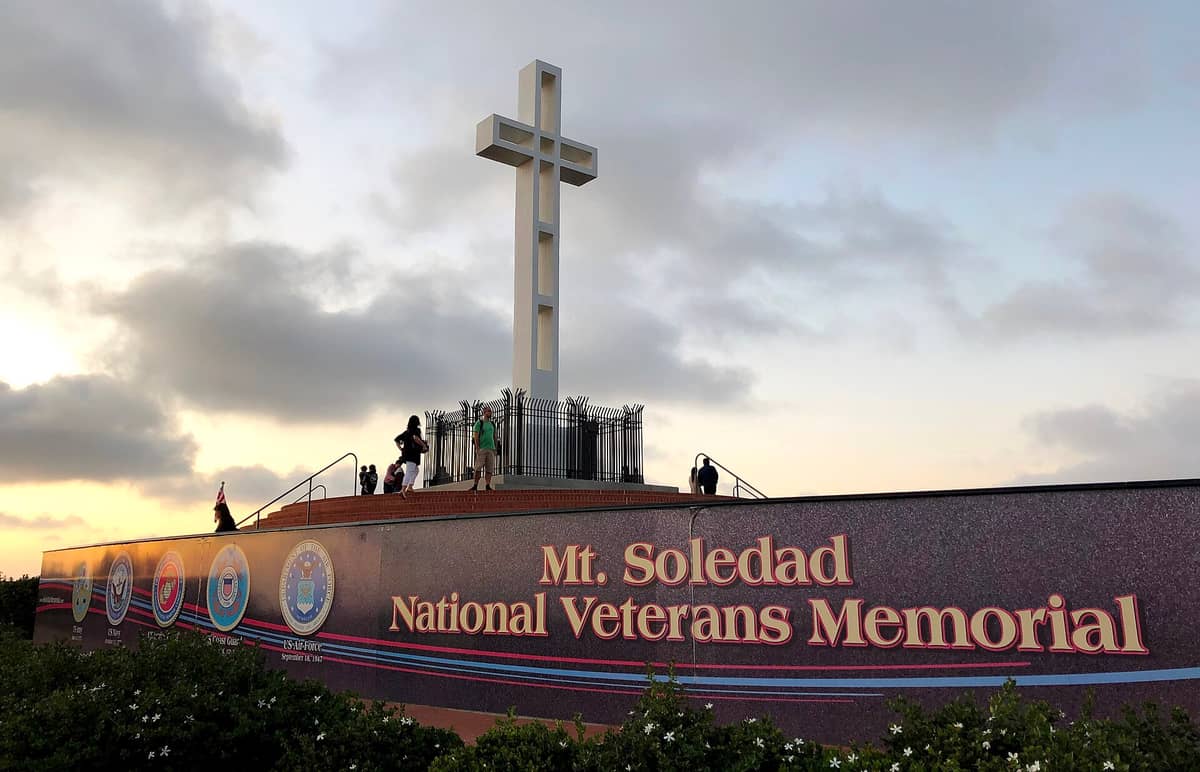
Mt. Soledad National Veterans Memorial sits near the summit of Mount Soledad in La Jolla at an elevation that places it above most of San Diego's coastal ridgeline. The site centers on a 29-foot white concrete cross mounted on a 10-foot circular platform, a landmark visible from large stretches of the city and from offshore. Around the cross, eleven curved granite walls display more than 5,000 individual memorial plaques honoring American veterans from every branch of service and every major conflict of the 20th and 21st centuries.
This is not a traditional war memorial focused on statistics and dates. It is personal at a human scale. Each granite plaque typically includes a photograph, dates of service, rank, and a brief inscription chosen by the veteran's family. Walking the walls, you pass portraits of sailors, Marines, Army soldiers, airmen, and Coast Guard personnel from World War II, Korea, Vietnam, the Gulf War, Iraq, and Afghanistan. The cumulative effect is quieter and more affecting than most grand memorial architecture.
ℹ️ Good to know
The memorial is open daily from 7:00 a.m. to 10:00 p.m., year-round, with no seasonal closure. There is no fenced entrance, no ticketing, and no admission fee. Free parking is available on-site.
A Brief History: From Easter Cross to National Memorial
A cross has stood on Mount Soledad since 1913, when a wooden structure was erected to mark Easter services. Two replacements followed before the current reinforced concrete cross was dedicated in 1954. For decades it served primarily as a geographic landmark and local gathering point, visible against the sky from La Jolla's streets and beaches below.
The transformation into a veterans memorial began gradually. Six memorial walls were added in 2000, and five additional walls were installed in 2012, bringing the total to fourteen curved walls surrounding the cross. The designation as a National Veterans Memorial followed years of legal battles over the cross on public land, a constitutional dispute that drew national attention. Congress eventually transferred the site to the Mount Soledad Memorial Association, which operates it today. Whatever one's view of those proceedings, the result is a site that has grown steadily more meaningful as a tribute to individual servicemembers.
The memorial's layered history connects to broader La Jolla, a coastal community that also contains the La Jolla Cove and Birch Aquarium at Scripps, but Soledad stands apart from those attractions in tone and purpose.
What You Actually See: The Memorial Walls and the Cross
You approach the memorial along La Jolla Scenic Drive, a winding road that climbs through residential streets before opening onto the flat summit plaza. The cross is visible before you park, its white form catching light against whatever sky the day offers. The plaza is open and unenclosed, which gives the site a relaxed, unhurried feel rather than the formal gravity of a fenced institution.
The eleven curved granite walls are arranged concentrically around the base of the cross. Each wall panel holds multiple plaques, and it takes real time to walk all of them properly. The plaques vary considerably in their level of detail. Some are spare, listing only name, rank, and dates. Others include photographs that show young faces from the 1940s or 1960s alongside the equipment and uniforms of their era. The granite is cool to the touch even on warm afternoons, and the slight curve of each wall creates a sheltered, semi-private quality as you read.
The cross itself is a clean mid-century form, abstract in its simplicity. Its history is complicated, but as an object it reads clearly against the sky, especially in morning light when shadows define its proportions. Families sometimes gather at its base for photographs; at quieter hours it stands largely alone.
The Views: What You Can See from the Summit
The panorama from Mt. Soledad is among the most complete in San Diego. On a clear day, which is most days from late spring through autumn, the view spans roughly 360 degrees. To the west and northwest, the Pacific Ocean stretches to the horizon. To the south, downtown San Diego's skyline is visible, and on very clear days you can pick out the Coronado Bridge and the bay. To the north, the coastline runs through Torrey Pines, Del Mar, and into the distance. Inland, the view opens toward Mission Valley and the hills beyond.
Morning visits, particularly in summer, often begin under a marine layer that burns off by mid-morning. If you arrive at 7:30 a.m. during June or July, the cross may be shrouded in low cloud and the ocean invisible. By 10 a.m. the same view can be crystalline. In autumn and winter, when San Diego's air is at its clearest, early mornings offer the sharpest visibility, and the light is softer and more directional for photography.
Sunset draws a consistent crowd. The western-facing orientation means that the last hour before dark is genuinely photogenic, with the cross silhouetted against a colored sky and the ocean catching the light. Expect to share the plaza with other photographers and couples at that hour. If solitude matters to you, the hour after sunrise on a weekday is far quieter.
💡 Local tip
Photography tip: For the best cross silhouette shot, position yourself on the western edge of the plaza about 30 minutes before sunset. A wide-angle lens captures both the cross and the ocean horizon in a single frame.
Practical Details: Getting There, Parking, and Accessibility
Mount Soledad's summit is not served by a direct MTS bus route, which makes this one of the few major San Diego viewpoints that genuinely requires a car or rideshare. The drive from La Jolla Village takes roughly five to ten minutes depending on traffic. From Pacific Beach or Mission Bay it is about fifteen minutes; from downtown, plan for twenty to twenty-five minutes. Uber and Lyft both operate in La Jolla, and the drop-off at the parking lot is straightforward.
Parking at the summit is free and typically adequate outside of peak weekend afternoons. On busy summer weekends, the small lot can fill by early afternoon, but turnover is generally quick since most visits last under an hour. Arriving before 10 a.m. or after 5 p.m. on weekends avoids the tightest congestion.
The site is described by the memorial association as readily accessible. The plaza is paved and at a single level, with no stairs required to view the walls and walk the full perimeter of the memorial. There is no fenced entrance and no gatehouse, which also means there is nothing formally preventing visits outside posted hours, though the official open hours are 7:00 a.m. to 10:00 p.m. daily.
If you are planning a broader La Jolla itinerary, the memorial pairs naturally with a walk down to La Jolla Cove afterward, about a ten-minute drive downhill. For a fuller day in the area, the La Jolla neighborhood guide covers the full range of coastal and cultural options.
Weather, Seasons, and When to Go
San Diego's Mediterranean climate means the memorial is genuinely pleasant to visit for most of the year. Summer highs near the coast typically reach the low to mid-70s Fahrenheit, and the summit of Mount Soledad is often a few degrees cooler and windier than the streets below. Bring a light layer even on warm days, particularly for morning and evening visits.
The rainy season runs roughly from November through March, with February typically the wettest month. Rain at the summit is not dangerous, but low cloud and poor visibility can reduce the view significantly. Winter mornings after a rain, however, can offer extraordinary clarity, with the entire coastal panorama sharp and washed clean. September and October are consistently excellent: clear air, warm temperatures, and smaller crowds than summer.
⚠️ What to skip
Summer marine layer warning: From June through early August, a dense marine layer often covers the coast until 10–11 a.m. If the view is your primary reason for visiting, avoid early morning arrivals during this period or check the forecast before driving up.
Who This Memorial Is For, and Who Might Skip It
Visitors with a connection to military service, whether veterans themselves, active-duty personnel, or family members of servicemembers, will find this site moving in a way that is difficult to replicate at larger, more abstract memorials. The individual plaques make it possible to search for a specific person or simply to spend time with the faces and names of people whose service spanned a century of American history.
Travelers who are primarily interested in views and photography will also find the trip worthwhile, particularly around sunset. The panorama is competitive with any hilltop viewpoint in the city.
If you are looking for a broad overview of San Diego's best elevated viewpoints, the best views in San Diego guide covers Soledad alongside other hilltop and waterfront options.
Visitors looking for interactive exhibits, shaded interiors, or family-oriented programming will find the memorial limited. There are no audio guides, no visitor center, and no permanent interpretive displays beyond the plaques themselves. Young children may find the experience difficult to engage with. Similarly, travelers whose primary interest is La Jolla's marine life and coastal trails might reasonably prioritize other sites and catch Soledad only if time allows.
For travelers building a full San Diego itinerary, the 3-day San Diego itinerary suggests how to balance a Soledad visit with other city highlights without backtracking.
Insider Tips
- The plaques on the memorial walls can be searched online through the Mt. Soledad Memorial Association's database before your visit. If you are researching a specific veteran, finding their wall and panel number in advance saves considerable time on-site.
- Weekday mornings between 8 and 10 a.m. offer the most peaceful experience. Weekend afternoons, especially in summer, bring consistent foot traffic and competition for parking.
- The 10-foot circular platform supporting the cross serves as a natural central landmark. Walk the full circle of walls in both directions rather than retracing your steps; the curved layout means you see each plaque from a different angle on the return pass.
- Wind at the summit can be significantly stronger than in La Jolla Village below, particularly in winter and spring. A light jacket is worth carrying even if the temperature lower down feels warm.
- New plaques are added to the memorial walls on an ongoing basis. If you are a family member interested in honoring a veteran, the Mt. Soledad Memorial Association accepts plaque applications; details and eligibility information are on the official site at soledadmemorial.org.
Who Is Mount Soledad Veterans Memorial For?
- Veterans, active-duty military, and their families seeking a personal and reflective tribute
- Photographers and couples looking for a panoramic sunset vantage point
- History enthusiasts interested in 20th-century American military history at a human scale
- Travelers combining a La Jolla afternoon with a quick but memorable elevated viewpoint
- Budget visitors: the experience is entirely free with no booking required
Nearby Attractions
Other things to see while in La Jolla:
- Birch Aquarium at Scripps
Perched on a bluff above the Pacific as part of UC San Diego's Scripps Institution of Oceanography, Birch Aquarium at Scripps is where serious marine research meets public exploration. It's smaller than big-name aquariums, but the depth of scientific context — and the view from the tide pool plaza — makes it stand out.
- Children's Pool
Children's Pool is a small, sheltered cove in La Jolla where a concrete breakwater built in 1931 now hosts one of San Diego's most accessible harbor seal colonies. Free to visit year-round for shoreline viewing, the beach itself closes each winter for seal pupping season, making timing essential.
- La Jolla Cove
La Jolla Cove is a small, protected ocean inlet framed by sandstone bluffs and home to one of Southern California's most accessible marine ecosystems. Free to enter and open year-round, it draws swimmers, snorkelers, wildlife watchers, and cliff walkers in equal measure.
- La Jolla Shores
La Jolla Shores is a one-mile stretch of sandy, sheltered coastline in La Jolla, San Diego, offering calm waves for swimmers, easy water entry for scuba divers, tide pool exploration, and a grassy park for picnics. Free to access year-round, it draws everyone from families with toddlers to certified divers heading out to the La Jolla Underwater Park.