Children's Pool, La Jolla: The Beach That Belongs to the Seals
Children's Pool is a small, sheltered cove in La Jolla where a concrete breakwater built in 1931 now hosts one of San Diego's most accessible harbor seal colonies. Free to visit year-round for shoreline viewing, the beach itself closes each winter for seal pupping season, making timing essential.
Quick Facts
- Location
- 850 Coast Blvd, La Jolla, San Diego, CA
- Getting There
- San Diego MTS bus routes serve La Jolla; check sdmts.com for current routes. Street parking on Coast Blvd is metered and competitive.
- Time Needed
- 30–60 minutes for the seawall walk and seal viewing; longer if combining with La Jolla Cove
- Cost
- Free (no admission fee). Beach sand closed to public access Dec 15–May 15 annually for seal pupping season.
- Best for
- Wildlife watchers, families, photographers, coastal walkers
- Official website
- www.sandiego.gov/lifeguards/beaches/pool
What Children's Pool Actually Is
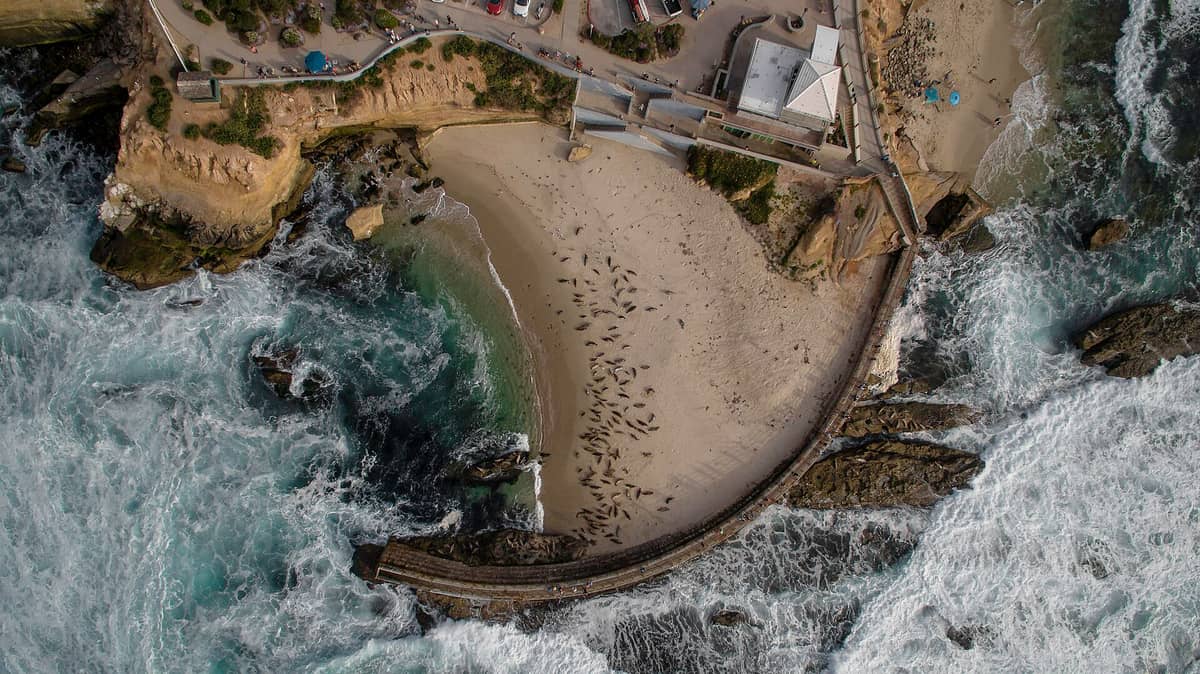
Children's Pool is a small, crescent-shaped beach on the northern edge of La Jolla, sheltered from the open Pacific by a concrete breakwater completed on April 4, 1931. The structure is approximately 300 feet long, curving in a shallow arc of about 178 feet, and was funded by philanthropist Ellen Browning Scripps with the explicit goal of giving local children a calm, wave-free place to swim. The engineering worked. What nobody planned for was that harbor seals would find the protected cove equally appealing.
Decades later, the seals have made the beach their own. The City of San Diego formally closes the sandy beach to public access each year from December 15 through May 15 to protect the seal pupping season. Outside that window, the beach can be accessed, though the seals rarely leave regardless of the season. The bluff-top path and the breakwater seawall remain open year-round, putting visitors within clear sightlines of the colony at any time of year.
ℹ️ Good to know
Beach closure: The sandy beach at Children’s Pool is closed to the public from December 15 through May 15 each year for harbor seal pupping season. The seawall, bluff path, and street-level viewpoints remain accessible year-round.
The History Behind the Breakwater
Ellen Browning Scripps was already well into her philanthropic legacy in La Jolla when she funded the Children's Pool project in the late 1920s. The breakwater was designed to calm the surf along a naturally exposed stretch of coast, and its completion in 1931 created a protected pocket of sand that drew swimmers and waders for decades. The site is now part of the La Jolla Park Coastal Historic District, recognized for its architectural and cultural significance.
The shift from children's swimming spot to seal habitat happened gradually. Harbor seals began hauling out on the sand in increasing numbers during the latter decades of the 20th century. By the 1990s, their presence had become a flashpoint in local debates about wildlife protection versus public beach access, a controversy that surfaced in lawsuits, city council votes, and ongoing negotiations between conservation advocates and swimmers. The annual closure policy that stands today reflects the legal and community compromises that followed.
For full context on La Jolla's coastal character and how this site fits into the broader neighborhood, the La Jolla neighborhood guide covers the area's geography, access, and nearby attractions in detail.
What You See at the Seawall
The most reliable place to watch seals is from the breakwater seawall itself. Visitors walk out along the concrete wall and look directly down at the beach below, often with thirty to sixty harbor seals visible at once, arranged across the sand in loose clusters. The seals move slowly, scratching, rolling, and occasionally vocalizing with low grunts. The smell is noticeable, a dense marine odor that intensifies in warmer weather, and the sounds carry clearly across the water.
The bluff path running east from the seawall along Coast Boulevard provides elevated views across the whole cove. From here you can see the full arc of the breakwater, the protected beach below, and the open ocean beyond. On clear days the view extends along the cliffs toward La Jolla Cove. Morning light hits the cove from the east, which is favorable for photography before around 10 a.m. By midday the light flattens. Late afternoon brings warm directional light from the west.
La Jolla Cove, about a five-minute walk north along Coast Boulevard, offers a complementary experience with snorkelers, sea lions, and the protected waters of the La Jolla Underwater Park. The La Jolla Cove guide explains what to expect and whether it is worth pairing with a Children's Pool visit.
How the Experience Changes by Time of Day
Early morning, before 9 a.m., is when Children's Pool is at its quietest. Foot traffic on the seawall is minimal, the seals are typically resting in large numbers on the sand, and the light is soft and angled. This is the best window for photographers who want unobstructed sightlines without other visitors in frame.
By late morning, especially on weekends and during summer, the seawall fills with visitors, families with children, and tour groups. The narrow walkway can become congested enough that moving past other people requires patience. If crowds bother you, a weekday visit before 10 a.m. is noticeably calmer.
Midday visits are entirely workable but bring the thinnest light for photography and the warmest temperatures on the exposed concrete. Sunscreen is practical here, as there is no shade on the seawall or the bluff path. Evenings can be pleasant when the foot traffic drops and the setting sun casts amber light across the cove, though the seals are no less active at dusk than at any other hour.
💡 Local tip
Photography tip: Arrive before 9 a.m. on a weekday for the best light and fewest people. A telephoto lens is useful for frame-filling shots of individual seals from the seawall. From the bluff, a wide-angle captures the full cove and breakwater arc.
Practical Walkthrough: Getting There and Moving Around
The site sits at 850 Coast Blvd in La Jolla, at the base of a short stairway that leads down from the street to the seawall access point. Metered street parking runs along Coast Boulevard and the adjoining blocks. Spaces fill quickly on weekday mornings and are nearly impossible to find on summer weekend afternoons. Arriving before 9 a.m. or after 4 p.m. significantly improves your parking odds.
San Diego MTS bus routes connect central San Diego to La Jolla Village; check the current MTS route map at sdmts.com before your visit, as routes and schedules change. From La Jolla Village, Children's Pool is a walkable distance along the coast. Rideshare drop-off works well given the lack of dedicated parking, and Uber and Lyft both operate across La Jolla.
The seawall path is paved and mostly flat, though the entry stairs from Coast Boulevard require some step navigation. The bluff path running east is a wide, unpaved trail that is manageable for most visitors but can be uneven in spots. Strollers can handle the bluff path with care but not the seawall, which is a narrow raised walkway with low barriers. Visitors with significant mobility limitations may find the street-level viewpoints along Coast Boulevard adequate for seal watching without descending.
If you are building a half-day coastal itinerary, the best coastal walks and hikes near San Diego guide offers options that pair well with a Children's Pool visit.
Wildlife Etiquette and What to Expect from the Seals
Harbor seals at Children’s Pool are wild animals protected under the Marine Mammal Protection Act. Federal law prohibits harassing, feeding, or approaching marine mammals in ways that alter their behavior. On the seawall, visitors are separated from the beach below by the wall itself, which naturally maintains a respectful distance. During the open-beach months (May 16 through December 14), signs and city lifeguards remind visitors not to approach resting seals on the sand.
The seals are largely indifferent to human presence on the seawall, provided visitors move quietly and avoid sudden loud noises. Dogs are not permitted on the beach or seawall area, which helps maintain a stable environment for the colony. Pups born during pupping season are typically visible on the sand from the bluff path even when the beach is officially closed.
⚠️ What to skip
Do not approach seals on the sand during the open-beach months. The Marine Mammal Protection Act prohibits harassment of wild marine mammals. Stay on the seawall or bluff path. Dogs are not permitted in the beach access area.
Is Children's Pool Worth Your Time?
For wildlife enthusiasts, photographers, and families with children curious about marine animals, Children's Pool delivers a genuinely close and easy encounter with wild harbor seals. There is no ticket, no queue, and no manufactured experience. The seals are simply there, doing seal things, a few feet below the seawall. That directness is the whole appeal.
Those expecting a traditional swimming beach will be disappointed. The sand is unavailable for half the year and shared with seals the rest of it. The water in the cove is not clean in the way that a public swimming beach would be maintained, given the permanent resident colony. Children's Pool is not a beach for swimming; it is a wildlife viewing site that happens to have sand.
If the wildlife angle interests you more broadly, whale watching from San Diego is a natural extension of a coastal wildlife day. Alternatively, the Birch Aquarium at Scripps in nearby La Jolla provides context on the marine ecosystems you are looking at from the seawall.
Insider Tips
- The breakwater seawall is narrow. On busy days, foot traffic moves in two directions and can slow to a crawl near the midpoint. If you want space, wait at the entry for a gap in the crowd rather than fighting through.
- During pupping season (December through May), pups are often visible from the bluff path even though the beach itself is closed. Bring binoculars if you want detail at this distance.
- The smell on the seawall is genuinely strong in warm weather due to the permanent seal colony. This is normal and worth knowing in advance, especially if you are visiting with young children who may find it overwhelming.
- Combine the visit with a walk north to La Jolla Cove. The coastal path between the two sites takes about five minutes and connects two very different wildlife experiences in a single short outing.
- Street parking on Coast Boulevard fills fastest between 10 a.m. and 3 p.m. on weekends. The surrounding residential blocks may have available spots a few blocks inland, though check posted signs carefully for permit restrictions.
Who Is Children's Pool For?
- Wildlife photographers looking for close, natural seal encounters without tours or fees
- Families with young children who want an engaging, free outdoor experience
- Coastal walkers combining several La Jolla shoreline stops in one outing
- Visitors interested in San Diego's conservation debates and natural history
- Travelers who want a genuine encounter with wild marine mammals without visiting an aquarium
Nearby Attractions
Other things to see while in La Jolla:
- Birch Aquarium at Scripps
Perched on a bluff above the Pacific as part of UC San Diego's Scripps Institution of Oceanography, Birch Aquarium at Scripps is where serious marine research meets public exploration. It's smaller than big-name aquariums, but the depth of scientific context — and the view from the tide pool plaza — makes it stand out.
- La Jolla Cove
La Jolla Cove is a small, protected ocean inlet framed by sandstone bluffs and home to one of Southern California's most accessible marine ecosystems. Free to enter and open year-round, it draws swimmers, snorkelers, wildlife watchers, and cliff walkers in equal measure.
- La Jolla Shores
La Jolla Shores is a one-mile stretch of sandy, sheltered coastline in La Jolla, San Diego, offering calm waves for swimmers, easy water entry for scuba divers, tide pool exploration, and a grassy park for picnics. Free to access year-round, it draws everyone from families with toddlers to certified divers heading out to the La Jolla Underwater Park.
- Mount Soledad Veterans Memorial
Perched at one of La Jolla's highest points, Mt. Soledad National Veterans Memorial combines a striking 29-foot concrete cross, more than 5,000 granite plaques honoring American veterans, and panoramic views stretching from the Pacific Ocean to downtown San Diego. Admission is always free, and the site is open daily from early morning until 10 p.m.