Spanish Village Art Center: Balboa Park's Living Artist Colony
Built in 1935 for a World's Fair and reimagined as a permanent artist community, Spanish Village Art Center brings together working studios, open galleries, and colorful courtyards in the heart of Balboa Park. Admission is free, studios are open daily, and you can watch artists at work — making it one of the most authentic creative experiences in San Diego.
Quick Facts
- Location
- 1770 Village Place, Balboa Park, San Diego, CA 92101
- Getting There
- MTS Bus routes serve Balboa Park; short walk from the Zoo parking area via internal park paths
- Time Needed
- 45 minutes to 2 hours depending on studio browsing
- Cost
- Free entry; individual artworks vary by studio
- Best for
- Art lovers, families, and slow travelers who want more than a museum hall
- Official website
- spanishvillageartcenter.com
What Spanish Village Art Center Actually Is
Spanish Village Art Center is not a gallery in the conventional sense. There are no long corridors of framed work under climate-controlled lighting and hushed air. Instead, it is a compound of 37 small studios arranged around open-air courtyards and shaded arcades, where artists show up, unlock their doors, and work in front of visitors throughout the day. Potters throw clay on wheels. Glass artists shape molten material with rods. Painters mix colors on palettes visible from the doorway. The whole place operates somewhere between a marketplace, an open studio event, and a neighborhood.
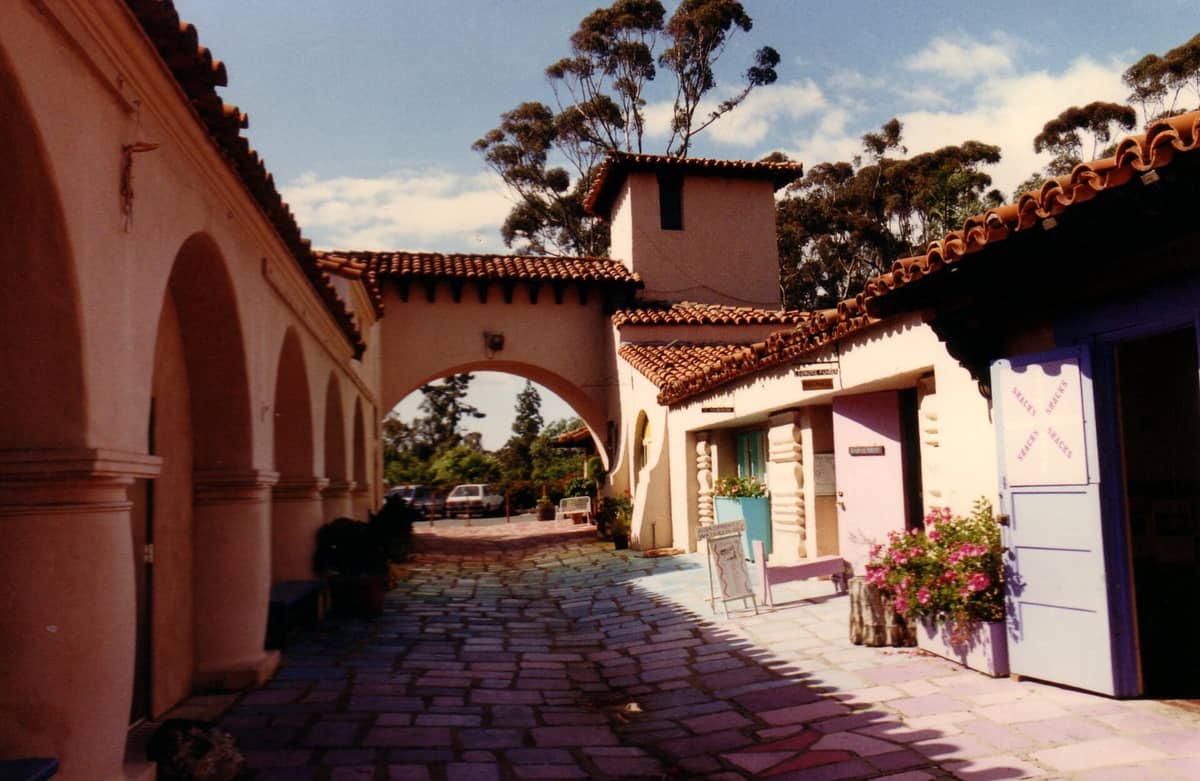
What you see from the path leading in is a row of low terracotta-tiled buildings with painted wooden doors, wrought-iron details, and flower planters along whitewashed walls. The courtyard tiles are worn smooth in the center from decades of foot traffic. In the middle of the main courtyard, a small fountain anchors the space. It looks, by design, like a village square in rural Andalusia, which was exactly the point when it was constructed.
ℹ️ Good to know
Studios are typically open daily 11:00 am to 4:00 pm, year-round, except Thanksgiving, Christmas, and New Year's Day. Arriving before 1:00 pm generally means more artists are actively working rather than packing up.
The History Behind the Architecture
The complex was constructed in 1935 for the California Pacific International Exposition, Balboa Park's second major World's Fair of the twentieth century. The organizers wanted to evoke the colonial Spanish heritage of the region, so they commissioned a cluster of small adobe-style buildings designed to resemble a traditional Spanish village. It was theatrical scenery, essentially, built at full scale.
After the exposition closed, the buildings sat idle briefly before reopening in 1937 as a permanent home for local working artists. That transition from fair pavilion to functional studio colony was unusual enough that the place carved out a genuine identity. The disruption came during World War II, when the U.S. Army requisitioned the site and used the studios as barracks and administrative offices. Artists reclaimed it around 1947, and most of the original 1930s structures remain standing today.
The architectural style is classified loosely as Spanish Colonial Revival, consistent with the broader aesthetic of Balboa Park. The buildings are low-slung, the rooflines are gentle, and the whole compound is scaled for pedestrians rather than vehicles. It sits east of the San Diego Zoo entrance within the park, separated from the main museum corridor by a stretch of landscaped paths. That slight distance is part of what keeps the atmosphere calmer than the Prado area on busy weekends.
The Art Center is one of several cultural institutions that make Balboa Park worth spending a full day exploring. The park's museum row and green spaces form a dense network that rewards visitors who slow down rather than rush from attraction to attraction.
Moving Through the Studios: What to Expect
The entrance path opens into the main courtyard without fanfare or a ticket gate. You simply walk in. Studios line the perimeter, each one a single room roughly the size of a large garage, with the front door or a wide window serving as the viewing point. Some artists leave the door wide open and actively invite conversation. Others are visibly focused on their work and a quiet nod is the appropriate acknowledgment. A brief scan of the courtyard will show you which studios are active before you commit to a closer look.
The range of media on display at any given time is broad: oil and watercolor painting, photography, ceramics, jewelry, stained glass, woodcarving, and textile work are all typically represented. Because studios rotate on leases and not all artists work every day, the specific lineup changes. Weekdays tend to have fewer studios occupied than weekends, when the center draws its largest crowds and many artists show up knowing foot traffic will be higher.
Children tend to respond well to the ceramics and glasswork studios where physical transformation is visible. Watching a flat disk of clay become a bowl, or a molten gather of glass become a paperweight, holds attention in a way that hanging paintings often do not. Parents should be aware that the studios are small and some contain hot equipment or fragile work; watching from the doorway rather than entering freely is the standard approach.
💡 Local tip
Sunday mornings are the most reliable time to find the highest number of studios open and artists present. Saturday afternoons bring more visitors overall, which creates a livelier but more crowded courtyard atmosphere.
How the Place Changes Throughout the Day
At 11:00 am when the studios unlock, the courtyards are quiet. The light at that hour comes in low and warm through the arched openings between buildings, catching the tile work and the potted geraniums in a way that the midday glare tends to flatten. This is the best time for photography, both of the architecture and of artists at work before their spaces fill with browsers.
By early afternoon the courtyard fills with the ambient sound of the park: distant zoo announcements, the rumble of tour trams passing nearby, and conversations from visitors sitting on the benches near the fountain. The studios closest to the main entrance see the most foot traffic throughout the day, while those at the far end of the compound tend to stay quieter. If you want an unhurried conversation with an artist, those back-corner studios are where it tends to happen.
After 3:00 pm some studios begin closing early, particularly on weekdays. Arriving in the final 45 minutes before the 4:00 pm closing time means accepting that parts of the center may already be shuttered. The outdoor courtyard itself remains accessible and pleasant in the late afternoon light even when fewer studios are active.
Practical Details for Visiting
Getting to Spanish Village Art Center requires getting to Balboa Park first. MTS bus route 7 connects downtown San Diego to the park, though the specific stops and schedules should be confirmed with the San Diego MTS trip planner before your visit, as they can change. Driving visitors can use the various parking lots scattered around Balboa Park; the lots near the San Diego Zoo are among the closest to Spanish Village, as the Art Center is positioned just east of the Zoo's main entrance on the park map.
If you are building a full day around the park, the Botanical Building and the San Diego Museum of Art are both within comfortable walking distance along the Prado promenade. Spanish Village pairs naturally with either as a more informal, unhurried counterpoint to a formal museum visit.
Accessibility across the complex is uneven. The main courtyard is paved and manageable, but some studio thresholds have a slight step, and pathways between buildings vary in width. The Village Arts Center office can provide current details for visitors with specific mobility requirements. Contacting them before arrival is the reliable approach rather than assuming uniformity across all studios.
⚠️ What to skip
Do not plan your visit around a single specific artist or studio without checking ahead. Studios operate on individual schedules and an artist who was present on a previous visit may not be there on any given day.
Buying Art: What the Experience Is Like
Because this is a working studio complex rather than a retail gallery, the purchase experience is different from walking into a commercial art space. Prices are set by individual artists and range from small ceramic pieces or jewelry in the low tens of dollars to larger paintings or glass sculptures in the hundreds. There is no unified pricing system and no gallery commission structure that the visitor needs to navigate.
Artists here generally appreciate direct, genuine interest more than performative enthusiasm. If a piece catches your attention, asking about the process or the material is a natural opening. Most artists enjoy the conversation, especially with visitors who are curious rather than just browsing past. Credit cards are accepted by most studios, though it is practical to carry some cash for smaller purchases.
Spanish Village is one of the more accessible free experiences in San Diego. For other no-cost options around the city and park, the guide to free things to do in San Diego covers additional options across multiple neighborhoods.
Who This Is and Is Not For
Spanish Village Art Center works well for travelers who value slow, observational experiences over ticking boxes on a highlights list. It rewards curiosity about craft and process more than familiarity with art history or critical frameworks. Families with children of roughly six and older who are interested in making things tend to find it engaging. Couples looking for something unhurried and atmospheric often rate it among the more memorable parts of a Balboa Park visit.
Visitors primarily focused on large-scale, comprehensive art collections will find Spanish Village limited in scope. This is a community studio complex, not a world-class museum. If your primary goal is seeing masterworks or a broad survey of a particular medium or period, the San Diego Museum of Art, the Timken Museum of Art, or the Mingei International Museum within Balboa Park will better serve that objective. Spanish Village Art Center is not trying to be those institutions, and understanding that distinction is key to calibrating expectations correctly.
Travelers who enjoy discovering lesser-known creative spaces may want to look at the broader San Diego hidden gems guide for similar finds across the city.
Insider Tips
- Sunday mornings between 11:00 am and 1:00 pm offer the best combination of open studios, working artists, and manageable crowds. Weekday afternoons are quieter but have fewer artists present.
- The studios at the far end of the compound, away from the main courtyard entrance, see significantly less foot traffic. Artists there tend to be more available for extended conversation and you are less likely to feel rushed.
- If you are serious about buying something, return on a second visit. A brief first pass lets you note which studios and artists interest you most; a second visit with focused intent tends to be more satisfying than trying to evaluate everything in one go.
- The courtyard light is most photogenic before noon. The whitewashed walls and terracotta tile pick up warm tones in the morning that the midday sun washes out entirely.
- Parking near the San Diego Zoo lots is the closest driving option to Spanish Village, but those lots fill quickly on weekends. Arriving before 10:30 am almost guarantees a spot; arriving after noon on a Saturday requires patience or a longer walk from secondary lots.
Who Is Spanish Village Art Center For?
- Art collectors and buyers who want direct access to working artists without gallery intermediaries
- Families with children curious about craft and making processes
- Couples looking for an atmospheric, unhurried afternoon in Balboa Park
- Photographers interested in Spanish Colonial Revival architecture and candid studio scenes
- Budget travelers who want a culturally substantive experience without admission costs
Nearby Attractions
Other things to see while in Balboa Park:
- Botanical Building and Lily Pond
Built for the 1915 Panama-California Exposition, the Botanical Building and Lily Pond is one of Balboa Park's most photographed landmarks and one of San Diego's few genuinely free indoor plant experiences. The structure, historically billed as one of the largest wood lath buildings in the world, shelters over 2,100 plant varieties beneath a domed roof that filters light into something close to dusk at midday.
- Comic-Con Museum
Opened in November 2021, the Comic-Con Museum brings the legendary San Diego convention to life year-round in Balboa Park. Rotating exhibitions, interactive experiences, and deep dives into comics, film, and sci-fi make it a serious destination for pop culture fans, not just Comic-Con regulars.
- Fleet Science Center
The Fleet Science Center anchors the eastern edge of Balboa Park's museum row with interactive science exhibits, a giant-dome theater, and monthly planetarium evenings. It draws curious visitors of all ages, from toddlers tackling discovery stations to adults catching an IMAX-style documentary under a five-story screen.
- Japanese Friendship Garden
Tucked into about 12 acres of Balboa Park, the Japanese Friendship Garden & Museum is San Diego's dedicated space for Japanese landscape design, cultural art, and quiet reflection. Symbolizing the bond between San Diego and its sister city Yokohama, the garden rewards visitors with stone lanterns, koi ponds, a centuries-old bronze Kannon statue, and rotating museum exhibitions.