Scuola Grande di San Giovanni Evangelista: Venice's Most Overlooked Renaissance Treasure
Founded in 1261, the Scuola Grande di San Giovanni Evangelista is one of Venice's six historic confraternity halls, housing centuries of Gothic, Renaissance, and Baroque art and architecture. Tucked into a quiet San Polo campiello, it draws a fraction of the crowds that swamp more famous landmarks, yet its ceremonial staircase, ornate assembly hall, and storied relic chapel rank among the city's genuine architectural high points.
Quick Facts
- Location
- Campiello della Scuola, Sestiere San Polo 2454, Venice
- Getting There
- Vaporetto line 1, Riva de Biasio stop — approximately 300 m walk. Also about 9 min on foot from Santa Lucia train station.
- Time Needed
- 1 to 1.5 hours for a thorough visit; 45 minutes if focused
- Cost
- Full €10 / Reduced €8 (students under 26 and residents). Schools €3 per student / Free: children under 12, disabled visitors, licensed guides, ICOM members. Verify current prices at official site.
- Best for
- Architecture lovers, art historians, Venetian history enthusiasts, and anyone wanting a major landmark experience without the queues
- Official website
- www.scuolasangiovanni.it/en
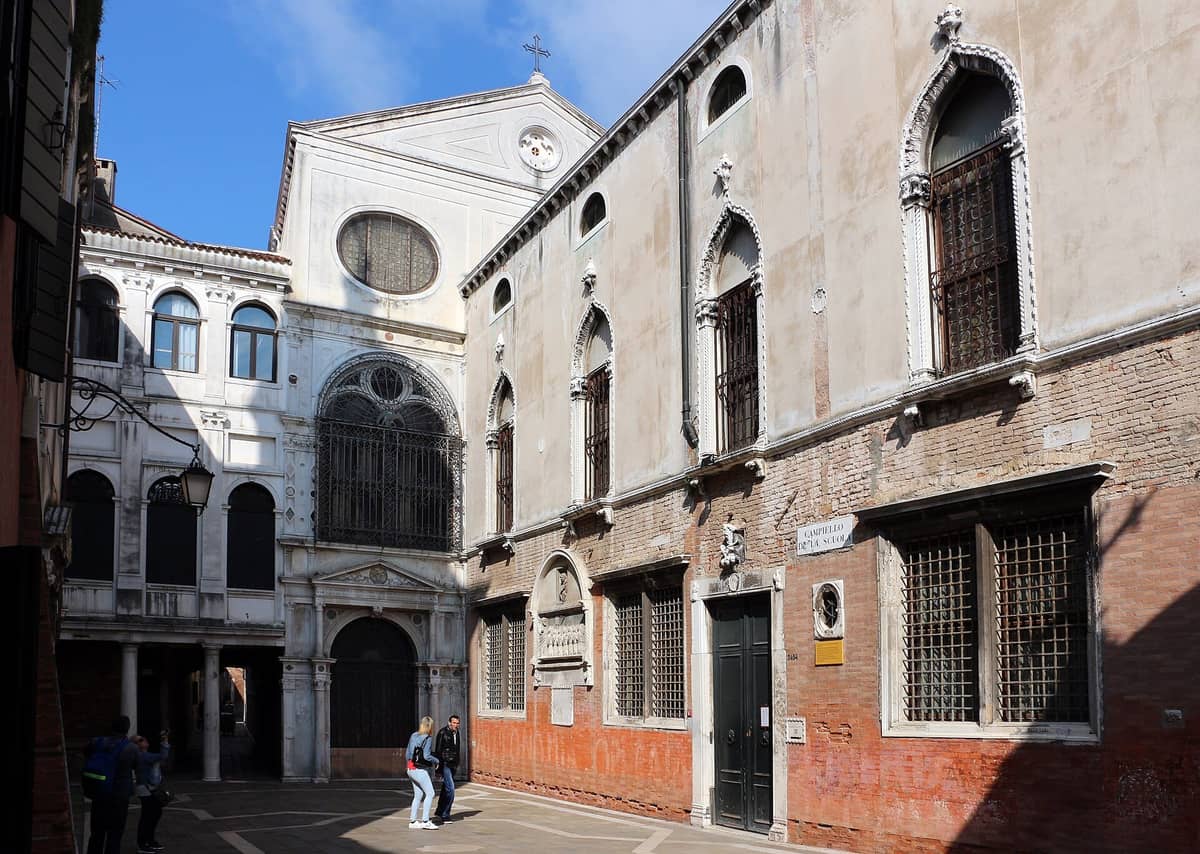
What Is the Scuola Grande di San Giovanni Evangelista?
The Scuola Grande di San Giovanni Evangelista is one of six institutions the Venetian Republic designated as Scuole Grandi, powerful lay confraternities that functioned as mutual aid societies, civic bodies, and patrons of the arts. This one was founded in 1261 by a group of flagellant penitents devoted to St John the Evangelist, making it the second oldest of the Scuole Grandi. Over the following six centuries, its wealthy membership poured resources into a complex of buildings on this small square in San Polo that grew to rival the decorative ambition of any church in the city.
Unlike the Scuola Grande di San Rocco, which draws long lines on the basis of its Tintoretto cycle, San Giovanni Evangelista remains largely off the main tourist circuit. That is partly a matter of location, tucked into a campiello you will not cross by accident, and partly a matter of programming: the building operates as a working conference and events venue, so visiting hours are more restricted than a conventional museum. For the traveler willing to plan ahead, the reward is one of Venice's densest concentrations of architectural layering, from late Gothic stonework to a Pietro Lombardo screen to a Mauro Codussi staircase, seen in near silence.
⚠️ What to skip
Opening hours change week to week depending on private events. Always check the official calendar at scuolasangiovanni.it/en/calendar-and-hours/ before visiting. Typical public hours when open: 09:30–13:00 and 14:00–17:15, with the ticket office closing shortly before closing time. Saturday and Sunday visits are most reliably available.
The Courtyard and the Lombardo Screen: Your First Impression
You enter the campiello through a narrow sotoportego and the change in atmosphere is immediate. The square is small, paved in grey Venetian stone, and flanked on one side by the church of San Giovanni Evangelista and on the other by the Scuola's own facade. What stops most visitors first is the white marble screen closing off the inner courtyard, designed by Pietro Lombardo and completed around 1485. It is a masterpiece of early Venetian Renaissance carving: an eagle, the symbol of St John the Evangelist, spreads its wings above the central arch, flanked by columns of Istrian stone so precisely worked they look almost too fine to have survived six centuries of lagoon air.
In the morning, when low sun catches the west-facing screen, the carved relief picks up strong shadows and the marble almost glows. By midday the courtyard falls into more even light, useful for photography but less dramatic. If the complex is open on a weekday morning and you arrive before 10:30, you may have the entire courtyard to yourself for fifteen or twenty minutes. There is a bench along one wall where you can sit quietly and look at Lombardo's screen without a crowd in the foreground — an experience that has no equivalent near the Rialto or Piazza San Marco.
Tickets & tours
Hand-picked options from our booking partner. Prices are indicative; availability and final rates are confirmed when you complete your booking.
Self-guided Discovery Walk in Venice's Cannaregio
From 28 €Instant confirmationFree cancellationGrand Canal by gondola with commentary
From 36 €Instant confirmationFree cancellationPrivate Gondola Ride on Grand Canal in Venice
From 149 €Instant confirmationFree cancellationVenice Boat Tour with Grand Canal and Tower Climb
From 119 €Instant confirmationFree cancellation
The Codussi Staircase and the Upper Hall
Inside the building, the ceremonial double-ramp staircase designed by Mauro Codussi in the late 15th century is the architectural centerpiece. Codussi was one of the most important architects working in Venice during the shift from Gothic to Renaissance forms, and this staircase shows why: it is wide enough to process in pairs, built from pale stone, and lit from above by a lantern that pulls cool daylight into the interior. The handrails have been worn smooth by centuries of use. The acoustics in this space reward a moment of stillness — conversations from below carry up in a particular way, and the building has a quality of resonant quiet you rarely find in Venice's busier interiors.
The Sala dell'Albergo and the main upper hall contain an important group of paintings commissioned over several centuries, including works by Palma il Giovane and Pietro Longhi. The ceilings are Venetian Baroque in character, heavy with gilt and painted panels, and the overall effect is of accumulated civic pride. This is not a minimalist museum experience. Every surface has a story, and a guided visit or a good audio guide is worth the investment if you want to make sense of the iconographic program.
Visitors who find the density of the Scuola Grande di San Rocco slightly overwhelming may actually prefer San Giovanni Evangelista's more intimate scale. For a sense of how these confraternity halls relate to one another, the Scuola Grande di San Rocco is a 10-minute walk south and worth comparing directly, though it requires a separate timed ticket and attracts far larger crowds.
The Relic Chapel and the Cross of the True Cross
The Scuola's most historically significant possession is a fragment of the True Cross, donated to the confraternity in 1369 by Philippe de Mézières, chancellor of Cyprus. The relic became the center of one of the great devotional cults in medieval and Renaissance Venice, and its miraculous reputation generated the commission for a famous cycle of paintings by Gentile Bellini and others — works now in the Gallerie dell'Accademia.
If you want to see the paintings that the relic originally inspired, the Gallerie dell'Accademia holds Gentile Bellini's large-scale canvases depicting miracle stories associated with this very cross. Visiting both in sequence gives a rare complete picture of how a single object could generate an entire tradition of Venetian civic and religious art.
Getting There: Practicalities and Orientation
The Scuola sits in the San Polo sestiere, close to the Santa Croce border. From the Riva de Biasio vaporetto stop on line 1, walk south along the rio, cross into Campo Nazario Sauro, and follow the signs for roughly 300 meters. The walk takes about five minutes at a normal pace and passes through quiet residential streets with almost no tourist infrastructure. From Santa Lucia train station the walk is around nine minutes; from Piazzale Roma, about ten. From the Rialto Bridge, allow 13 to 15 minutes.
The surrounding neighborhood rewards time before or after your visit. The Santa Croce sestiere immediately to the north and west is one of Venice's least-visited districts at street level, with working-class bars and bacari that serve proper cicchetti rather than tourist-priced approximations. If you are continuing to the Rialto area, the Rialto market is a reasonable next stop — arrive before 11:00 if you want to see it functioning as a market rather than a spectacle.
💡 Local tip
The Scuola doubles as a conference venue, and some events are open to the public or ticketed separately. Evening concerts held inside the upper hall benefit from the building's warm acoustics and candlelit atmosphere. Check the official website calendar for any upcoming public events.
Photography, Lighting, and What to Wear
Photography is generally permitted in the public areas, though flash use and tripods may be restricted. The interior spaces are relatively dim and rely on natural light filtered through high windows, so a camera or phone that performs reasonably in low light will serve you better than one that depends on bright conditions. The Codussi staircase photographs well from the base looking up, particularly if the lantern above is catching daylight.
As a religious and historic institution, modest dress is expected. Covered shoulders and knees are the standard requirement for most Venetian buildings of this type. The complex has steps throughout and no confirmed step-free route is publicly documented; travelers with mobility concerns should contact the Scuola directly at +39 041 718234 or info@scuolasangiovanni.it before visiting. Disabled visitors are admitted free of charge, which the institution states on its visitor information, but specifics about ramps or lift access are worth confirming in advance.
Who Will Appreciate This, and Who Might Not
The Scuola Grande di San Giovanni Evangelista is a specialist destination in the best sense. Travelers with an existing interest in Venetian Gothic and Renaissance architecture, the history of lay confraternities, or the relationship between civic wealth and artistic patronage will find it deeply satisfying. The combination of Lombardo, Codussi, and Massari in a single complex is genuinely rare, and the absence of large tour groups means you can examine the stonework and paintings at your own pace.
Travelers on a first visit to Venice who are working through the canonical list of sites may find the visit hard to justify against the time cost. If your schedule is tight, the Basilica dei Frari is a ten-minute walk away and offers a higher density of masterworks in a single space. San Giovanni Evangelista works best as a second or third day addition, or for anyone who has already seen the obvious landmarks and wants the experience of real depth rather than more surface coverage.
Visitors hoping for a conventional museum experience with didactic panels and a clear narrative flow should also temper expectations. The space is evocative but not heavily curated for general audiences. What it offers is architectural and historical authenticity: a building that has been continuously used and maintained since the Middle Ages, layered with five centuries of artistic decisions, and still functioning as a live institution rather than a preserved relic.
ℹ️ Good to know
The Scuola Grande di San Giovanni Evangelista does not appear on the Venice Museum Pass or most combined ticket schemes. Budget the admission separately. At around €10 full price, it remains one of the better value admissions in a city where major museum tickets routinely exceed €20–25.
Insider Tips
- Always check the monthly calendar on the official website before making this a fixed plan. The Scuola hosts private congresses and weddings that close it to public visitors without much advance notice. A Saturday or Sunday visit in mid-morning is the most reliable option.
- If you visit on a quiet weekday morning, ask at the ticket desk whether a staff member or guide is available to explain the relic chapel and the original context of the Bellini commission. The building is small enough that informal conversations with knowledgeable staff are genuinely possible.
- The campiello outside the entrance screen is worth photographing in its own right. The combination of the Lombardo marble, the Gothic church facade, and the low surrounding walls creates a composition that reads nothing like the tourist-facing Venice most visitors photograph.
- For acoustic experience, try to be on the Codussi staircase when the building is quiet. The stone carries sound in a way that is almost completely different from the noise of the street outside — the contrast arrives quickly and is worth pausing for.
- If you are also visiting the Gallerie dell'Accademia, do San Giovanni Evangelista first. Seeing the original setting for the Cross and its relic chapel makes Gentile Bellini's large canvases of the miracle processions considerably more legible and emotionally resonant when you encounter them later.
Who Is Scuola Grande di San Giovanni Evangelista For?
- Architecture specialists and students interested in the Venetian Gothic-to-Renaissance transition
- Art historians tracing the Bellini circle and Venetian narrative painting
- Repeat visitors to Venice looking for depth beyond the canonical itinerary
- Travelers who want a significant cultural experience without crowds or long waits
- Concert and classical music audiences: the Scuola hosts live events in its upper hall
Nearby Attractions
Other things to see while in Santa Croce:
- Museo di Storia Naturale di Venezia
Venice's Natural History Museum occupies the Fondaco dei Turchi, a 13th-century palazzo on the Grand Canal in Santa Croce. With nearly 2 million specimens spanning fossils, zoology, botany, and ethnography, it rewards visitors who want something beyond art and architecture. It is also one of the most family-friendly museums in the city.
- Palazzo Mocenigo Museum
Tucked into the Santa Croce sestiere near the Grand Canal, the Museo di Palazzo Mocenigo is one of Venice's most distinctive civic museums. A patrician palace of Gothic origin, rebuilt in the early 1600s, it holds centuries of Venetian textile history, sumptuous period costumes, and a one-of-a-kind study centre dedicated to the history of perfume.