Museo di Storia Naturale di Venezia: A Grand Canal Palace Full of Dinosaurs and Deep Time
Venice's Natural History Museum occupies the Fondaco dei Turchi, a 13th-century palazzo on the Grand Canal in Santa Croce. With nearly 2 million specimens spanning fossils, zoology, botany, and ethnography, it rewards visitors who want something beyond art and architecture. It is also one of the most family-friendly museums in the city.
Quick Facts
- Location
- Santa Croce 1730, Fondaco dei Turchi, Venice — on the Grand Canal, Santa Croce sestiere
- Getting There
- Vaporetto line 1 to San Stae (under 400 m) or Riva de Biasio (lines 1, 5.2); 15-min walk from Santa Lucia train station
- Time Needed
- 1.5 to 2.5 hours for most visitors; allow longer with children
- Cost
- Full €10 / Reduced €7.50 (ages 6–14, students 15–25, over 65, Rolling Venice Card holders) / School groups €4. Verify current rates before visiting.
- Best for
- Families with children, science enthusiasts, visitors seeking relief from art-museum overload, rainy-day plans
- Official website
- www.museivenezia.it/museo-di-storia-naturale
What Is the Museo di Storia Naturale di Venezia?
The Museo di Storia Naturale di Venezia — officially the Museo di Storia Naturale di Venezia Giancarlo Ligabue — is Venice's civic natural history museum, part of the Fondazione Musei Civici di Venezia network. It opened in its current home in 1923 and has grown into one of Italy's larger natural history collections, holding approximately 2 million specimens across zoology, entomology, botany, palaeontology, anatomy, and ethnography. The museum's library contains over 40,000 volumes.
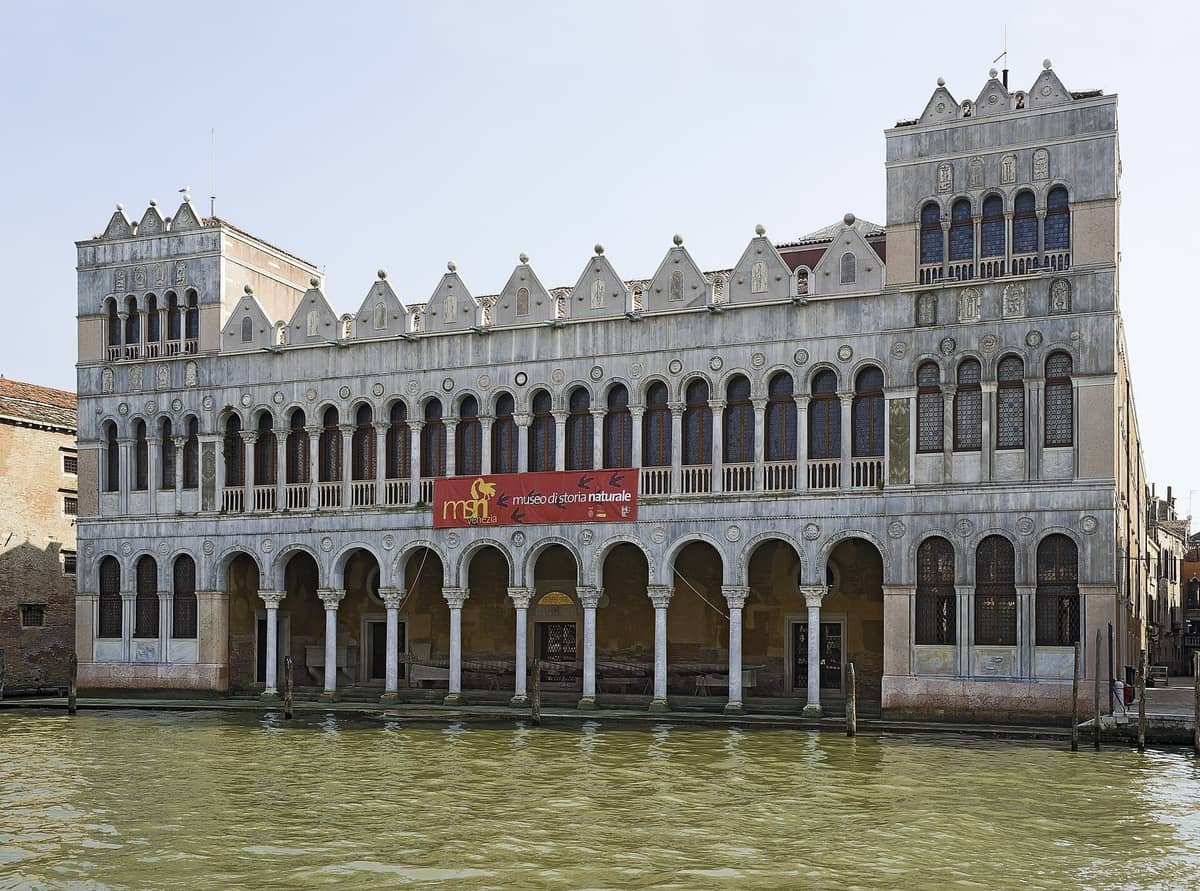
What immediately sets this museum apart from its counterparts in Rome or Milan is its setting. The building is the Fondaco dei Turchi, a palazzo erected by the Pesaro family in the first half of the 13th century, overlooking the Grand Canal. You arrive by water or on foot through the back streets of Santa Croce, step into a courtyard that smells of old stone and damp plaster, and walk past a skeleton of a Ouranosaurus nigeriensis — a dinosaur excavated in the Sahara — before you have even reached the main galleries. That juxtaposition of deep natural history inside living medieval architecture is the museum's defining quality.
💡 Local tip
Last admission is one hour before closing. In summer (June–September) the museum closes at 18:00 (opening at 10:00), and in the off-season it closes at 17:00 (opening at 9:00). Plan to arrive at least two hours before closing to see everything without rushing.
The Fondaco dei Turchi: Architecture Worth Noticing
Before you focus on the specimens inside, take a moment with the building itself. The Fondaco dei Turchi is one of the oldest surviving Byzantine-Veneto structures on the Grand Canal. Its name refers to its later use: from 1621 to 1838, the Republic of Venice leased the building to Ottoman merchants (turchi) as a combined trading post, warehouse, and residential compound. The arrangement was a pragmatic Venetian compromise — profitable commerce supervised under tight regulation.
The facade facing the Grand Canal retains its long arcade of round-headed arches, flanked by towers at each end, a form that would have been recognizable to a 13th-century merchant arriving by galley. The building underwent significant restoration in the 19th century, which smoothed some of its original roughness, but the basic mass and proportions remain intact. Seen from a vaporetto on the Grand Canal, especially in the flat morning light, it reads clearly against the more ornate Gothic and Renaissance buildings on either bank.
If architecture is your primary interest in Venice, the Grand Canal frontage of the Fondaco dei Turchi is worth seeing even if you do not enter. But most visitors who come for the facade end up staying for the collections.
Tickets & tours
Hand-picked options from our booking partner. Prices are indicative; availability and final rates are confirmed when you complete your booking.
Venice Legends, Anecdotes and Ghost Stories Tour
From 35 €Instant confirmationFree cancellationDoge's Palace skip-the-line tickets and guided tour with museums around St. Mark's Square
From 67 €Instant confirmationFree cancellationCa' Pesaro - International Gallery of Modern Art and Oriental Art Museum entrance ticket
From 8 €Instant confirmationCa' Rezzonico 18th century Venice Museum entrance tickets
From 8 €Instant confirmation
The Collections: What You Will Actually See
The museum is organized across multiple floors, and the pacing is different from a typical art museum. There are no masterpieces to queue in front of. Instead the experience is cumulative: case after case of pinned insects, drawers of shells arranged by family, mounted fish from the Adriatic and the lagoon, skeletal preparations of mammals, and glass jars of preserved marine life. The scale of the collections makes the point without any single object needing to carry the whole argument.
The palaeontology section is the most visually dramatic. The Ouranosaurus skeleton is the centrepiece, but the fossil fish collection from the Venetian region is scientifically significant in its own right. There are specimens here that document the geological history of the northern Adriatic basin in a way that connects directly to the lagoon outside the windows. If you have any interest in how the physical landscape of the Veneto formed, this floor is genuinely illuminating.
The zoological galleries include dioramas of African wildlife collected in the mid-20th century, ethnographic material gathered during scientific expeditions, and a substantial entomological collection. Some of the display cases and specimen mounts have a deliberately old-fashioned quality — glass-topped cabinets with handwritten labels — which some visitors find charming and others find dated. Either way, it is a different register from the sleek interactivity of newer science museums, and worth knowing before you go.
The aquarium wing, dedicated to the ecology of the Venice Lagoon and Adriatic, is particularly relevant to where you are. It contextualizes the living ecosystem underneath the city in a way that most Venice museums do not attempt. Watching the lagoon fish and crustaceans in tanks while boats pass on the Grand Canal visible through the windows produces an unexpectedly direct connection between the collection and the city.
Visiting with Children
This is, without much competition, one of the most child-friendly museums in Venice. The dinosaur skeleton alone makes the trip worthwhile for most children under twelve. The zoological dioramas hold attention in a way that Renaissance altarpieces rarely do. The aquarium section adds live animals to the mix. And the building has enough physical variety — courtyards, staircases, long corridors — to keep the experience from feeling static.
Admission for ages 6–14 is €7.50 (reduced rate). Children under 6 should be verified with the museum directly. For other family-friendly ideas across the city, the Venice with kids guide covers the full range of options, from lagoon islands to outdoor spaces.
ℹ️ Good to know
The museum is closed on Mondays and on 1 January, 1 May, and 25 December. Plan your visit accordingly — these closures catch more visitors than the ticket price.
When to Visit and What Affects the Experience
Mornings on weekdays are reliably quieter. School groups tend to arrive mid-morning, primarily on weekdays during the academic year, and they change the atmosphere of the children's sections noticeably. If you are visiting with your own children and prefer a calmer pace, arriving at opening time — 10:00 in summer and 9:00 in the off-season — gives you roughly an hour before the day gets busy.
Weather matters in a specific way here. This is a genuinely good rainy-day museum: the galleries are enclosed, the content rewards slow attention, and the building itself is interesting enough to justify being inside. On hot summer afternoons, the thick walls of the Fondaco dei Turchi keep the interior cooler than the streets outside — a practical advantage in July and August when outdoor Venice can feel relentless.
During acqua alta events, the low-lying streets around Santa Croce can flood. The museum entrance is elevated from street level, but the approach on foot may require elevated walkways. Check the tide forecast and consider waterproof footwear if visiting between October and February. The acqua alta guide explains what to expect and how to prepare.
Getting There: Practical Route Notes
The most straightforward approach is vaporetto line 1 to San Stae, which puts you less than 400 metres from the museum entrance on the Salizada del Fontego dei Turchi. From Santa Lucia railway station, the walk takes about 15 minutes: cross the Ponte degli Scalzi bridge over the Grand Canal, then follow the signs through the back streets of Santa Croce toward the Fondaco dei Turchi. The route is not complicated but the signage in this part of the city is sparse — keep the address (Santa Croce 1730) on your phone.
If you are staying near Piazza San Marco or Rialto, vaporetto line 1 along the Grand Canal drops you at San Stae or Riva de Biasio. The trip takes about 15–20 minutes from San Marco depending on stops, and the Grand Canal journey is worthwhile on its own. For a full orientation to vaporetto routes and ticketing, the getting around Venice guide covers all transport modes in detail.
Photography and Practical Notes
Photography policy should be verified at the entrance — policies in Italian civic museums can vary and change. In general, non-flash photography of displays is often permitted for personal use, but confirm before shooting. The Grand Canal facade is freely photographable from the water or from the fondamenta opposite, and is best lit in morning light facing southeast.
On accessibility: the museum is housed in a historic palazzo, and official documentation does not specify step-free access routes or lift availability in detail. Visitors with mobility requirements should contact the museum directly before visiting to confirm current access conditions.
The museum sits in the Santa Croce sestiere, which is one of the less-touristed districts of the historic city. After your visit, the streets immediately west toward Piazzale Roma and east toward San Polo offer a more local texture than the area around San Marco. The Rialto market is about 15 minutes' walk, worth combining if you arrive early.
Who Should Consider Skipping It
If your time in Venice is strictly limited to two days or fewer and you are focused on the canonical art and architecture — Doge's Palace, the Basilica, the Accademia, the Frari — this museum does not belong at the top of the list. Its significance is disciplinary rather than iconic: it holds scientific collections, not masterworks. It will not appear in most standard Venice itineraries for that reason.
Visitors who find natural history museums unengaging regardless of setting will not be converted here. The displays, while substantial, are not dramatically more interactive or immersive than other mid-sized European natural history collections. And visitors expecting a polished, contemporary museum experience with multimedia installations and bilingual digital guides may find the format more old-fashioned than they prefer. That old-fashioned quality is, for many visitors, exactly the appeal — but it is worth naming honestly.
Insider Tips
- The museum's Grand Canal facade is best seen from the water. If you are taking vaporetto line 1 from Santa Lucia to San Stae, sit on the right side of the boat (facing forward) to see the Fondaco dei Turchi as you approach — you will recognize the long arcade of arches immediately.
- The Rolling Venice Card (available to visitors aged 14–29) qualifies for the reduced admission rate of €7.50. If you are in that age range and plan to visit multiple civic museums, the card can significantly reduce costs across the Musei Civici network.
- The back-street approach to the museum from San Polo crosses some of the quietest calli in central Venice. Leave more time than the map suggests, particularly in the late afternoon when delivery trolleys and local foot traffic fill the narrower passages.
- The aquarium section focused on the Venice Lagoon is often overlooked by visitors who come primarily for the dinosaur skeleton. It is the one part of the museum that directly explains the living ecology beneath the city, and it takes about 20 minutes to see properly.
- Musei in Festa dates offer free entry for Venice residents. If you are not a resident, these dates can mean slightly higher visitor numbers from local families — worth knowing if you prefer a quieter visit.
Who Is Museo di Storia Naturale di Venezia For?
- Families with children aged 5 to 14 looking for an alternative to Venice's art-heavy museum circuit
- Science and natural history enthusiasts who want to see palaeontological and zoological collections in an unusual architectural setting
- Visitors with a second or third day in Venice seeking something off the standard itinerary
- Rainy-day visits when outdoor exploration is limited
- Travellers interested in the ecological and geological context of the Venice Lagoon
Nearby Attractions
Other things to see while in Santa Croce:
- Palazzo Mocenigo Museum
Tucked into the Santa Croce sestiere near the Grand Canal, the Museo di Palazzo Mocenigo is one of Venice's most distinctive civic museums. A patrician palace of Gothic origin, rebuilt in the early 1600s, it holds centuries of Venetian textile history, sumptuous period costumes, and a one-of-a-kind study centre dedicated to the history of perfume.
- Scuola Grande di San Giovanni Evangelista
Founded in 1261, the Scuola Grande di San Giovanni Evangelista is one of Venice's six historic confraternity halls, housing centuries of Gothic, Renaissance, and Baroque art and architecture. Tucked into a quiet San Polo campiello, it draws a fraction of the crowds that swamp more famous landmarks, yet its ceremonial staircase, ornate assembly hall, and storied relic chapel rank among the city's genuine architectural high points.