San Miniato al Monte: Florence's Hilltop Basilica Worth the Climb
Perched on Monte alle Croci above the Oltrarno, the Basilica of San Miniato al Monte is one of the finest surviving examples of Florentine Romanesque architecture. Entry is free, the views over Florence are exceptional, and the atmosphere inside is unlike anything in the city centre below.
Quick Facts
- Location
- Via delle Porte Sante 34, 50125 Florence (Oltrarno, above Piazzale Michelangelo)
- Getting There
- ATAF bus 12 or 13 from central Florence to the stop near the stairway; 5–10 min uphill walk from Piazzale Michelangelo
- Time Needed
- 45–90 minutes at the basilica, plus travel time up and down the hill
- Cost
- Free admission to the basilica
- Best for
- Architecture lovers, those seeking quiet reflection, panoramic city views, and travellers wanting to escape the centro storico crowds
- Official website
- http://www.sanminiatoalmonte.it
What San Miniato al Monte Actually Is
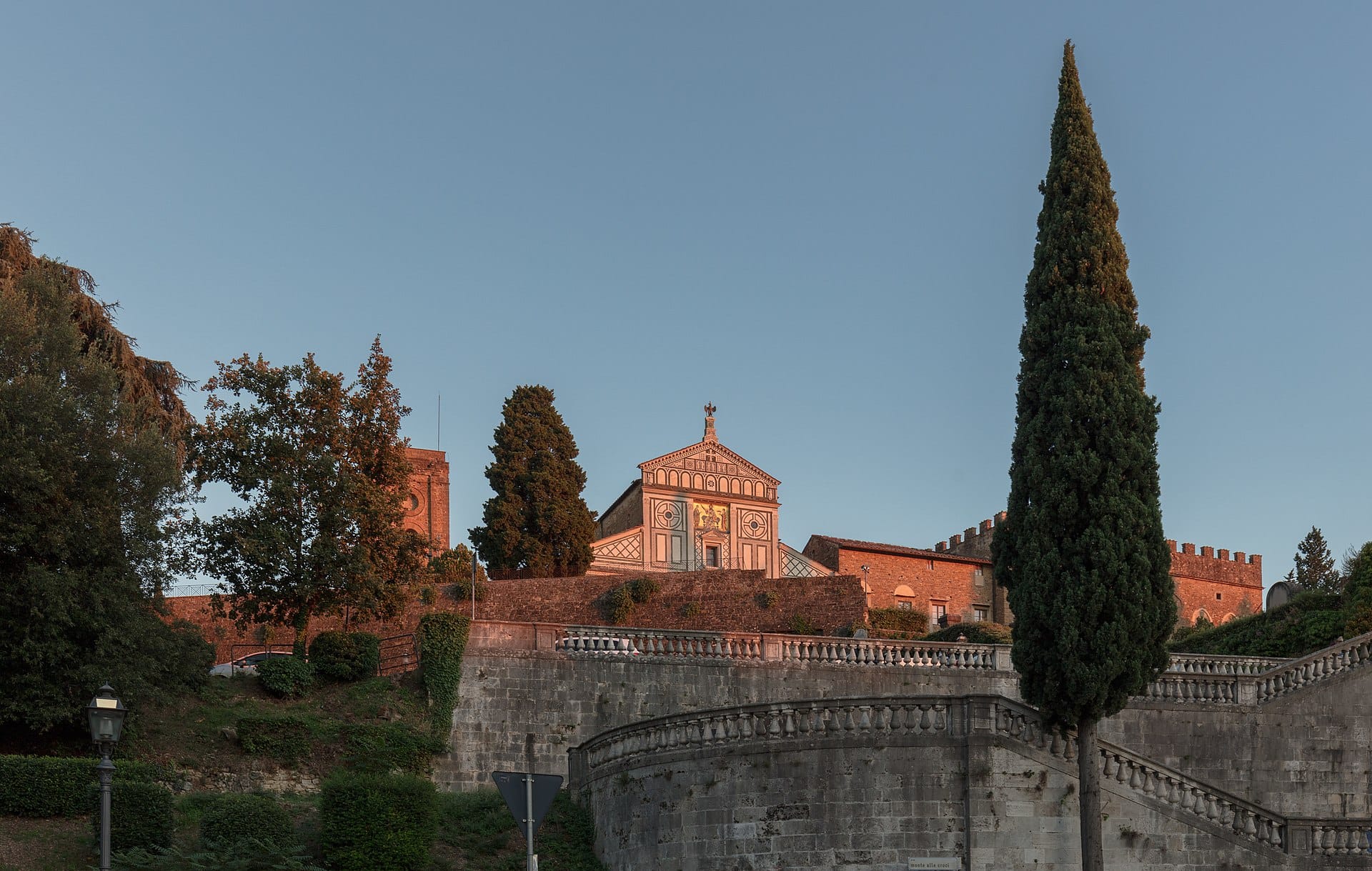
The Basilica of San Miniato al Monte is a Romanesque church completed in 1062, standing on one of the highest points in the Florentine hills. It predates the Duomo by centuries and has the quiet authority of a building that has never needed to compete for attention. Its white and green marble facade, geometric and precise, looks almost impossibly clean against the sky when you approach from the staircase below.
Construction began after 1018 under Bishop Hildebrand, with the facade completed during the 12th century. The church holds the title of basilica minor and stands within the UNESCO-designated Historic Centre of Florence. Today it is maintained by an active Benedictine monastic community, which gives it a quality that pure tourist monuments lack: it is still a working place of worship.
San Miniato sits a short but steep walk abovePiazzale Michelangelo, which most visitors know as Florence's main panoramic terrace. The two sites are often combined in a single afternoon, and rightly so, but San Miniato is the more architecturally significant of the pair and receives considerably fewer visitors.
💡 Local tip
Arrive before 11:00 on weekday mornings to have the interior largely to yourself. By early afternoon on weekends, group tours arrive and the contemplative atmosphere changes considerably.
The Approach and the View
The walk up from Piazzale Michelangelo takes five to ten minutes along a paved path with stone steps. It is a genuine incline, and in summer heat it demands water and comfortable shoes. The reward at the top is a terrace with an unobstructed panorama over the red rooftops of Florence: the dome of Santa Maria del Fiore in the middle distance, the hills of Fiesole behind it, and the Arno threading between the city's two halves.
In the late afternoon, when the sun drops toward the west and the city below shifts from white to amber, this terrace becomes one of the best vantage points in Florence. Unlike Piazzale Michelangelo, which faces directly west and is better for sunsets, the San Miniato terrace faces slightly north and gives a more layered view of the city's skyline. Both perspectives are worth experiencing.
If the climb is a concern, ATAF buses 12 and 13 stop close to the stairway. This reduces but does not eliminate all uphill walking. For context on how this fits into a broader afternoon south of the Arno, see the guide tothe Oltrarno neighbourhood.
Tickets & tours
Live prices and dates from our booking partner. If you book, we may earn a commission at no extra cost to you.
Siena, San Gimignano and Monteriggioni trip from Florence
From 189 €Instant confirmationFree cancellationMonteriggioni and Val d'Orcia Medieval Day Trip with Optional Tastings
From 55 €Instant confirmationFree cancellationSan Gimignano, Siena, Monteriggioni and Chianti with wine tasting
From 50 €Instant confirmationFree cancellationPerfume masterclass: a sensory experience in Florence
From 70 €Instant confirmationFree cancellation
Inside the Basilica: What You'll Find
The interior of San Miniato al Monte operates on a different register than most Florentine churches. There is no overwhelming fresco cycle, no crowd pressing toward a single famous painting. Instead, the space is structured and spare: a nave divided by columns, a raised choir, a crypt below, and a floor inlaid with green and white marble panels depicting zodiac signs and symbolic animals. The floor panels date to 1207 and are worth getting close to, particularly in the sections that have not been worn smooth by centuries of foot traffic.
The Chapel of the Cardinal of Portugal, off the left aisle, is a Renaissance work of considerable refinement: it contains glazed terracotta roundels by Luca della Robbia, frescoes by Alesso Baldovinetti, and an altarpiece originally by Antonio and Piero Pollaiuolo. The integration of colour and material in this small space is technically sophisticated and rarely gets the attention it deserves in standard Florence itineraries.
The crypt beneath the raised presbytery is cool and dim even in summer. Slender columns support low vaults, and light filters in at low angles. It has the atmosphere of a place in continuous use, because it is: the Benedictine monks who maintain the church use the space regularly.
ℹ️ Good to know
Gregorian chant is sung by the monks at vespers, typically in the late afternoon. The time varies by season; check the official website before visiting if this is a priority. Hearing it inside the Romanesque interior is an experience that has no equivalent elsewhere in Florence.
Opening Hours and Practical Details
The basilica is generally open Monday through Saturday from 09:30 to 13:00 and again from 15:00 to 19:00. On Sundays, opening begins earlier, around 08:15, with the same afternoon session. In the summer months of April through October, closing time sometimes extends slightly beyond the standard schedule, but not reliably to 19:30. Winter hours (November through March) are slightly reduced in the afternoon session. These hours are subject to change, particularly around religious feast days and monastic schedules, so confirm current times via the official website before making it the centrepiece of your day.
Admission is free. There is no ticket booth and no reservation required. Dress codes consistent with those at any active Florentine church apply: shoulders and knees should be covered. The church is not loud about enforcement, but it is a genuinely active religious site and the usual courtesies matter here more than in many museums.
⚠️ What to skip
No specific wheelchair-access information is publicly documented for San Miniato al Monte. The approach involves significant stairs and steep gradients. Visitors with limited mobility should plan accordingly and may wish to contact the church directly before visiting.
How the Experience Changes by Time of Day
Mornings, particularly weekday mornings between 09:30 and 11:00, offer the interior at its quietest. The light enters from the east-facing windows and picks out the geometry of the marble floor. The air inside stays cool, carrying a faint smell of stone and old wood. Sounds from the city below do not reach this far up the hill.
Midday brings more visitors, and in summer the terrace becomes crowded as tour groups from Piazzale Michelangelo continue up the stairs. The interior itself remains relatively calm since many visitors spend most of their time on the terrace and take only a quick look inside.
Late afternoon is arguably the best window, combining warm directional light on the marble facade, a clearing of the midday crowd, and the possibility of catching vespers if you time it correctly. The walk back down toward Piazzale Michelangelo in the early evening, with the city lit by low sun, is one of the more satisfying end-of-day walks Florence offers.
Who Should Think Twice
San Miniato is not the right choice for travellers whose primary interest is major Renaissance painting. The church's artistic content is excellent but focused: Romanesque architecture, medieval decorative arts, and one outstanding Renaissance chapel. Those who have already spent a full day in the Uffizi and the Accademia and are looking for a third major gallery experience will find this quieter and more monastic in character.
If you have very limited time in Florence, the question is whether the walk up the hill is the best use of half an afternoon. For many travellers, the answer is yes, particularly if combined withPiazzale Michelangelobelow. Those working through a tight one-day itinerary may find it difficult to include; theone-day Florence guidediscusses how to prioritise.
Travellers who struggle with steep walking routes should also factor in the approach seriously. The hill is genuinely steep, and while the bus reduces some of the climb, it does not eliminate it.
Combining San Miniato with the Surrounding Area
The most natural pairing is with Piazzale Michelangelo below, which requires no additional travel. From there, heading back down into the Oltrarno opens up the neighbourhood aroundBasilica di Santo Spiritoand the artisan streets of San Niccolò and San Frediano. TheBoboli Gardensat Palazzo Pitti are also on this side of the river, though they require a separate ticket and a different afternoon.
For those interested in Florence's other hilltop perspectives, thebest views in Florence guideputs San Miniato in context alongside the Campanile and Brunelleschi's dome.
Insider Tips
- The monks sell honey, herbal liqueurs, and other products from a small shop inside the complex. These make practical, non-kitschy souvenirs and help support the monastery's continued maintenance of the site.
- The cemetery beside the basilica, the Cimitero delle Porte Sante, contains the graves of several notable Florentines including Carlo Collodi, author of Pinocchio. It is open to visitors and worth a slow walk through if the gates are open.
- For photography, the facade is at its most striking in the morning when it is lit from the front. By afternoon the light comes from behind the church, which works better for wide shots including the city panorama beneath.
- Weekday afternoons between 15:00 and 17:00 tend to see a quieter interior crowd than equivalent times on weekends, when tour groups from Piazzale Michelangelo regularly continue up the stairs.
- The marble floor panels depicting zodiac signs are easy to walk over without noticing. Before you enter, ask yourself to look down rather than immediately up: the floor is one of the most distinctive medieval decorative schemes in Tuscany.
Who Is San Miniato al Monte For?
- Architecture enthusiasts who want to see Florentine Romanesque at its finest without a ticket queue
- Travellers seeking a genuine sense of quiet and contemplation away from the crowded centre
- Photographers wanting the best panoramic view of Florence that is less visited than Piazzale Michelangelo
- Anyone interested in monastic life, Gregorian chant, or early medieval religious art
- Families combining a meaningful cultural stop with a manageable walk and a sweeping view that rewards the effort
Nearby Attractions
Other things to see while in Oltrarno:
- Bardini Garden
Tucked into the hillside above the Oltrarno neighborhood, the Giardino Bardini is a 4-hectare historic garden offering panoramic views over Florence, a famous wisteria pergola, and a far more intimate atmosphere than its famous neighbor, the Boboli Gardens. Open daily (except the first and last Monday of each month) from April 1 through September 30, it rewards visitors who time their arrival carefully.
- Basilica di Santo Spirito
On the south side of the Arno, away from the crowds of the Duomo district, the Basilica di Santo Spirito stands as one of Florence's most complete Renaissance interiors. Designed by Filippo Brunelleschi in the late 1430s, it offers serene architecture, a Michelangelo crucifix, and a surrounding piazza that feels more Florentine than touristic.
- Boboli Gardens
Spread across 30 hectares behind Palazzo Pitti in the Oltrarno, the Boboli Gardens are one of Italy's finest examples of Italian Renaissance and Baroque garden design. Laid out from the mid-16th century as a private Medici retreat, the grounds combine terraced lawns, shaded groves, monumental fountains, and open-air sculpture across a hillside with sweeping views over Florence.
- Cappella Brancacci
The Brancacci Chapel inside Santa Maria del Carmine holds one of the most significant fresco cycles in Western art. Painted by Masolino, Masaccio, and Filippino Lippi between 1424 and 1481, these images of St Peter's life transformed how painters understood light, space, and the human figure. Visits are intimate by design, capped at 30 people for 30 minutes, making advance booking essential.
Planning a trip? Discover personalized activities with the Nomado app.