SALT Galata: Inside Istanbul's Most Beautiful Former Bank
Housed in the meticulously restored 1892 headquarters of the Imperial Ottoman Bank on Bankalar Caddesi, SALT Galata is a major contemporary arts and research institution in Istanbul. Admission is free, the permanent Ottoman Bank Museum collection is genuinely fascinating, and the research library draws scholars from across the region.
Quick Facts
- Location
- Bankalar Caddesi 11, Karaköy 34421, Istanbul
- Getting There
- Karaköy tram stop (T1 line) or Şişhane metro (M2 line), both within about 5–10 min walk
- Time Needed
- 1.5–3 hours depending on exhibitions and library use
- Cost
- Free entry (general admission and Ottoman Bank Museum; exhibitions and library)
- Best for
- Architecture lovers, contemporary art, Ottoman financial history, design research
- Official website
- saltonline.org/en/42/salt-galata
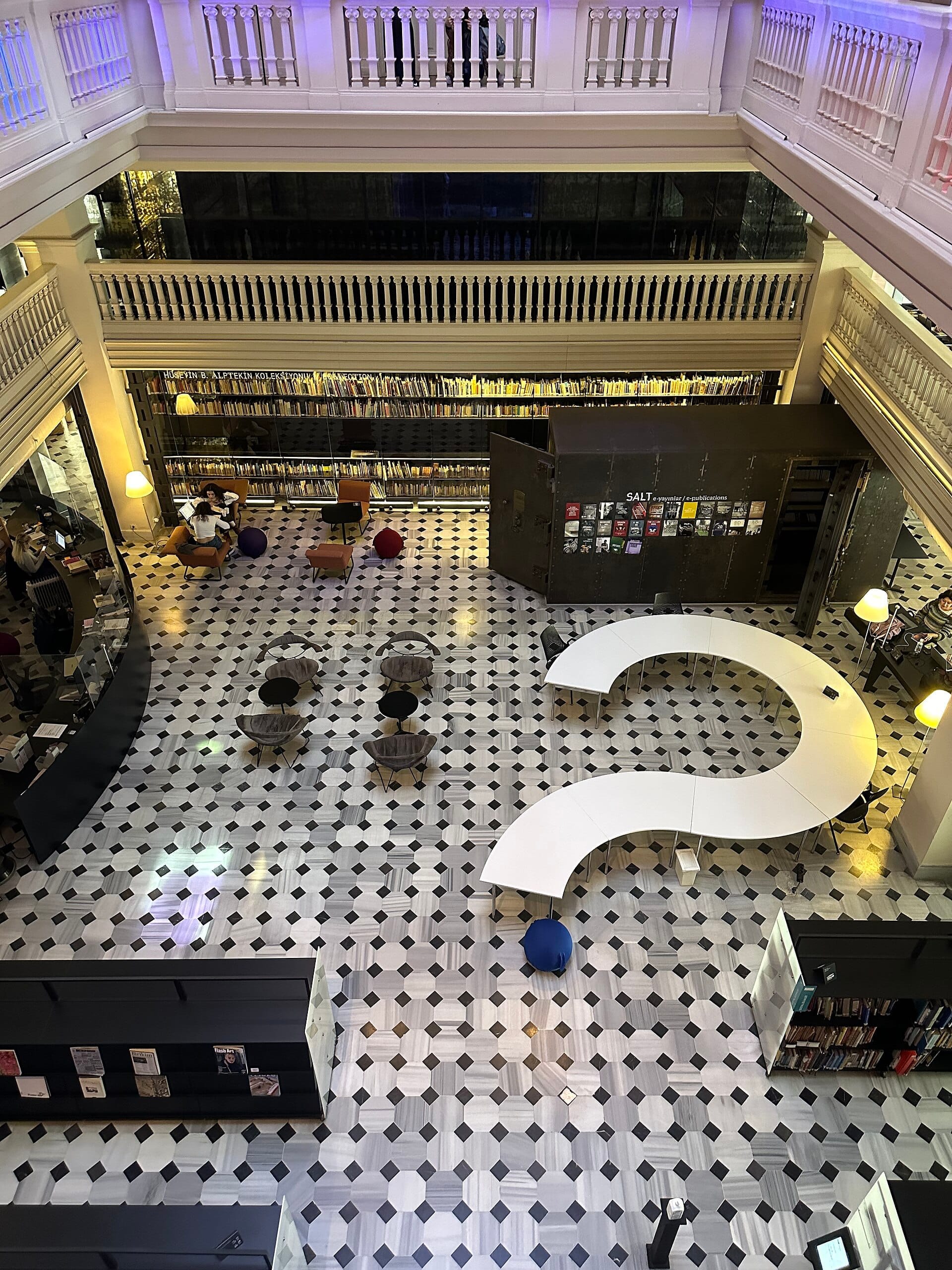
What SALT Galata Actually Is
SALT Galata is a contemporary arts and research institution that operates inside one of Istanbul's most significant 19th-century buildings. The address, Bankalar Caddesi 11 in Karaköy, puts it on what was once a major financial street of the late Ottoman era. Bankalar Caddesi translates simply as 'Banks Street', and for good reason: this short stretch of the Galata district once housed the headquarters of the empire's most powerful financial institutions. SALT Galata sits at its center.
The institution opened here in November 2011 after a careful restoration of the original structure. It is not a commercial gallery or a typical tourist attraction. It functions as a serious cultural organization combining contemporary exhibition spaces, a substantial research library, an auditorium for public programming, a bookstore, and a café. Entry to the building and its permanent museum collection is free, which makes it accessible in practice and not just technically so.
ℹ️ Good to know
SALT Galata is open Tuesday to Saturday 11:00–19:00 and Sunday 11:00–18:00. It is closed on Mondays and on New Year's Day, Labor Day, and the first and second days of Eid and Greater Eid. Verify current hours at saltonline.org before visiting, as special events occasionally affect access.
The Building: Alexandre Vallauri's 1892 Masterpiece
The structure dates to 1892, when French-Levantine architect Alexandre Vallauri (also known as Vallaury) designed it as the headquarters of the Imperial Ottoman Bank, the İmparatorluk Osmanlı Bankası. The bank operated from this building from 1892 until 1999. Vallauri was one of the most prolific architects working in late Ottoman Istanbul, and this building represents his work at its most assured: a neoclassical facade of ashlar stone, with arched ground-floor windows that give the exterior a solidity and permanence that still reads as institutional authority today.
Step inside and the banking hall reveals itself as a double-height space with ornate detailing that has survived restoration with its character intact. The original vault systems, counters, and circulation patterns have been thoughtfully adapted rather than erased. Natural light filters through the upper windows during the morning hours, casting long geometric shadows across the stone floors. By early afternoon, when direct sun shifts off the facade, the interior takes on a cooler, more contemplative quality that suits the kind of slow looking that good art and architecture demand.
The Karaköy and Galata area has always occupied a distinct place in Istanbul's geography, historically associated with Genoese traders, later with foreign banks and embassies, and now with a creative and culinary scene that has drawn cafés, galleries, and studios over the past two decades. Understanding this context matters when visiting SALT Galata: the building is not an isolated monument but part of a neighborhood that has repeatedly reinvented itself. For a broader sense of the area, the Karaköy and Galata neighborhood guide covers the surrounding streets in detail.
Tickets & tours
Hand-picked options from our booking partner. Prices are indicative; availability and final rates are confirmed when you complete your booking.
Galata Tower Skip-the-Line Ticket with Audio Guided Tour
From 47 €Instant confirmationFree cancellationBasilica Cistern, Galata Tower, Topkapi Palace, Hagia Sophia ticket
From 178 €Instant confirmationFree cancellationIstanbul Audio Guide Tour from Taksim Square Through Galata Tower
From 12 €Instant confirmationFree cancellationTopkapi Palace and Galata Tower Skip-the-Line Ticket
From 110 €Instant confirmationFree cancellation
The Ottoman Bank Museum: 145 Years of Financial History
The permanent exhibition based on the Ottoman Bank Museum collection is the anchor of SALT Galata's historical identity. The collection spans more than 130 years of the bank's operation, from its founding in the mid-19th century through the decline of the empire and into the Turkish Republican period. The materials include documents, currency, photographs, architectural drawings, correspondence, and objects that illuminate how a single financial institution navigated the collapse of one empire and the formation of another.
This is not a dry financial archive. The display is curated to show the human and political dimensions of money: how the bank financed public works, how its ledgers recorded the economic shocks of two world wars, how its architecture broadcast power to subjects and rivals alike. For visitors with an interest in Ottoman and early Republican history, this collection adds considerable depth to what is otherwise easily overlooked material.
If Ottoman history is a particular interest, combining SALT Galata with the nearby Galata Tower and the broader Ottoman history trail through Istanbul makes for a coherent half-day around the Galata district.
Contemporary Exhibitions and Public Programming
Beyond the permanent collection, SALT Galata runs a rotating program of contemporary art exhibitions, design shows, and research-led presentations. The scale of the exhibition spaces is suited to work that requires room to breathe: large prints, installations, archival presentations. The programming tends toward the intellectually serious rather than the crowd-pleasing, which is either a strength or a limitation depending on what you are looking for.
The auditorium hosts talks, film screenings, and symposia on topics ranging from urban planning to visual culture. Most public programming is listed on the SALT website and social channels in advance. If your visit coincides with an evening event, the building takes on a different atmosphere entirely: the stone corridors fill with students, academics, and practitioners, and the café does brisk business until closing.
💡 Local tip
Check the SALT website before visiting to see what exhibitions are currently running. The program changes regularly and the quality and relevance of temporary shows varies. The Ottoman Bank Museum and the building itself are worth the visit regardless, but active exhibitions improve the experience considerably.
The Research Library and Bookstore
SALT Research, the library housed within SALT Galata, is one of the more significant specialized collections in Istanbul for researchers working on art, architecture, and social sciences. The holdings include periodicals, monographs, and digitized archival materials. Access to the library is open to the public during institution hours, making it a useful resource for anyone doing serious research rather than casual browsing.
The bookstore near the entrance carries a curated selection of publications on architecture, contemporary art, urban history, and Turkish cultural studies. The stock is better than the average museum shop: less branded merchandise, more actual books worth reading. It is worth a few minutes even for visitors with no intention of buying.
Getting There and Practical Logistics
The building is straightforward to reach from two directions. From the Karaköy T1 tram stop, walk uphill along Bankalar Caddesi for roughly five minutes and the building is on your right. From Şişhane station on the M2 metro line, walk downhill via the same street for about eight to ten minutes. Both routes are manageable even with a light bag, though Bankalar Caddesi has a moderate gradient that can be felt on the uphill return.
SALT Galata sits within easy walking distance of the Galata Bridge to the south and Galata Mevlevi Museum a short distance to the north. Combining these into a single morning or afternoon is very achievable on foot.
For accessibility, the building is a multi-floor structure in a 19th-century shell. Visitors requiring step-free access or specific accommodations should contact SALT directly at +90 212 334 22 00 before visiting, as detailed accessibility information is not published on the main website. The café on the ground floor is accessible from the main entrance without major steps.
When to Visit and What to Expect at Different Times
Weekday mornings, particularly Tuesday through Thursday, are quietest. The library visitors arrive early and the exhibition spaces are rarely crowded before noon. This is the best time to experience the building as it was likely intended: as a place for sustained attention rather than fast consumption. The morning light through the upper windows of the banking hall is particularly good for photography.
Weekend afternoons bring a different crowd: students, couples, and the occasional tour group passing through Karaköy. The café fills up and the ground floor becomes livelier. This is not a problem for most visitors, but if you plan to spend time in the research library or want to spend longer in front of specific works, a weekday visit is a better choice.
Weather has little direct effect on the experience since SALT Galata is almost entirely indoors. The surrounding neighborhood of Karaköy is pleasant to walk in good weather, but rainy days can actually make the museum more enjoyable given reduced crowds. If you are visiting Istanbul during the wetter November-to-February period, SALT Galata is an excellent option to build into days when outdoor priorities are rained out.
⚠️ What to skip
SALT Galata closes on Mondays. It also closes for the first two days of both Eid al-Fitr and Eid al-Adha, and on New Year's Day and Labor Day (May 1). These closures can catch visitors off guard, particularly during religious holidays when the timing shifts year to year. Confirm before making a special trip.
Who Should Skip SALT Galata
Visitors focused exclusively on Istanbul's Ottoman monuments and Byzantine archaeology may find SALT Galata a detour that does not fit their itinerary. The institution is not a conventional sightseeing stop: there are no panoramic views, no grand religious spaces, and the contemporary art program is not universally accessible. If your priority list is already full of sites like Hagia Sophia, Topkapi Palace, and the Grand Bazaar, SALT Galata is a considered addition rather than an essential one.
Families traveling with young children may also find the exhibition spaces less engaging than purpose-built alternatives like Miniaturk or the Istanbul Toy Museum. SALT Galata rewards patience and interest in ideas, which is not always compatible with a visit that includes small children.
Insider Tips
- The rooftop terrace, when accessible during certain events and openings, offers an unusual angle on the Galata district and the waterfront below. Check the SALT events calendar for any open evening programming that includes rooftop access.
- The café on the ground floor uses the original bank's architectural shell in a way that makes it one of the more atmospheric spots in Karaköy for a coffee. You do not need to be visiting an exhibition to use it, and the prices are reasonable by Istanbul café standards.
- If you have a specific research interest in Ottoman financial, architectural, or urban history, contact SALT Research in advance of your visit. The library staff are specialized and can sometimes facilitate access to materials beyond the public reading room.
- Photography is generally permitted in the exhibition and permanent collection areas without flash. The interior architectural details, particularly the vaulted spaces and original ironwork, photograph well with natural light in the late morning.
- Bankalar Caddesi itself is worth walking slowly before or after your visit. Several other former bank buildings line the street in various states of adaptation, and the contrast between restored grandeur and neglected facades tells its own story about Istanbul's economic geography.
Who Is SALT Galata For?
- Travelers with a genuine interest in Ottoman economic and political history who want to go beyond the standard monuments
- Architecture enthusiasts drawn to late 19th-century neoclassical and Levantine building traditions
- Contemporary art visitors looking for serious, non-commercial programming in an exceptional building
- Researchers and academics needing access to a specialized library on Turkish visual and architectural culture
- Anyone caught in bad weather in Karaköy who wants several hours of quality indoor engagement at no cost
Nearby Attractions
Other things to see while in Karaköy & Galata:
- Galata Tower
Rising 66.9 meters above the Galata/Karaköy area, Galata Tower is one of Istanbul's most recognizable structures. Built by the Genoese in 1348, it now functions as a museum with an observation balcony offering uninterrupted views across the Bosphorus, the Golden Horn, and the rooftops of the historic peninsula.
- Galataport
Galataport Istanbul is a 400,000 m² mixed-use development stretching 1.2 km along the Karaköy-Tophane shoreline. The promenade is free to walk, the views across the Bosphorus are among the best in the city, and the complex houses Istanbul Modern along with dozens of restaurants and shops. It also functions as a fully operational cruise port, thanks to a world-first underground terminal.
- Istanbul Modern
Housed in a purpose-built Renzo Piano building on the Galataport waterfront, Istanbul Modern is Turkey's first museum of modern and contemporary art. The 2023 building brings together rotating exhibitions, a permanent collection of Turkish art, and some of the best Bosphorus views in the city.