Profitis Ilias Monastery: Santorini's Highest Point and Its Fortress Above the Clouds
Perched at roughly 565 metres above sea level on the summit of Mount Profitis Ilias, this 18th-century Orthodox monastery is the highest structure on Santorini. The monastery is not generally open to casual visitors, but the surrounding viewpoint is among the most complete panoramas on the island, taking in the caldera, the eastern beaches, and on clear days, neighbouring Cycladic islands.
Quick Facts
- Location
- Summit of Mount Profitis Ilias, near Pyrgos village, southeast Santorini
- Getting There
- Approx. 2.5 km marked hiking trail from Pyrgos main square, or by car/taxi via mountain road
- Time Needed
- 1–2 hours at the summit; allow extra time if hiking from Pyrgos (roughly 45–60 min each way)
- Cost
- Exterior and viewpoint access is free; interior and museum access are restricted and not offered on a regular ticketed basis
- Best for
- Panoramic views, hiking, history and architecture, photography, escape from coastal crowds
What the Profitis Ilias Monastery Actually Is
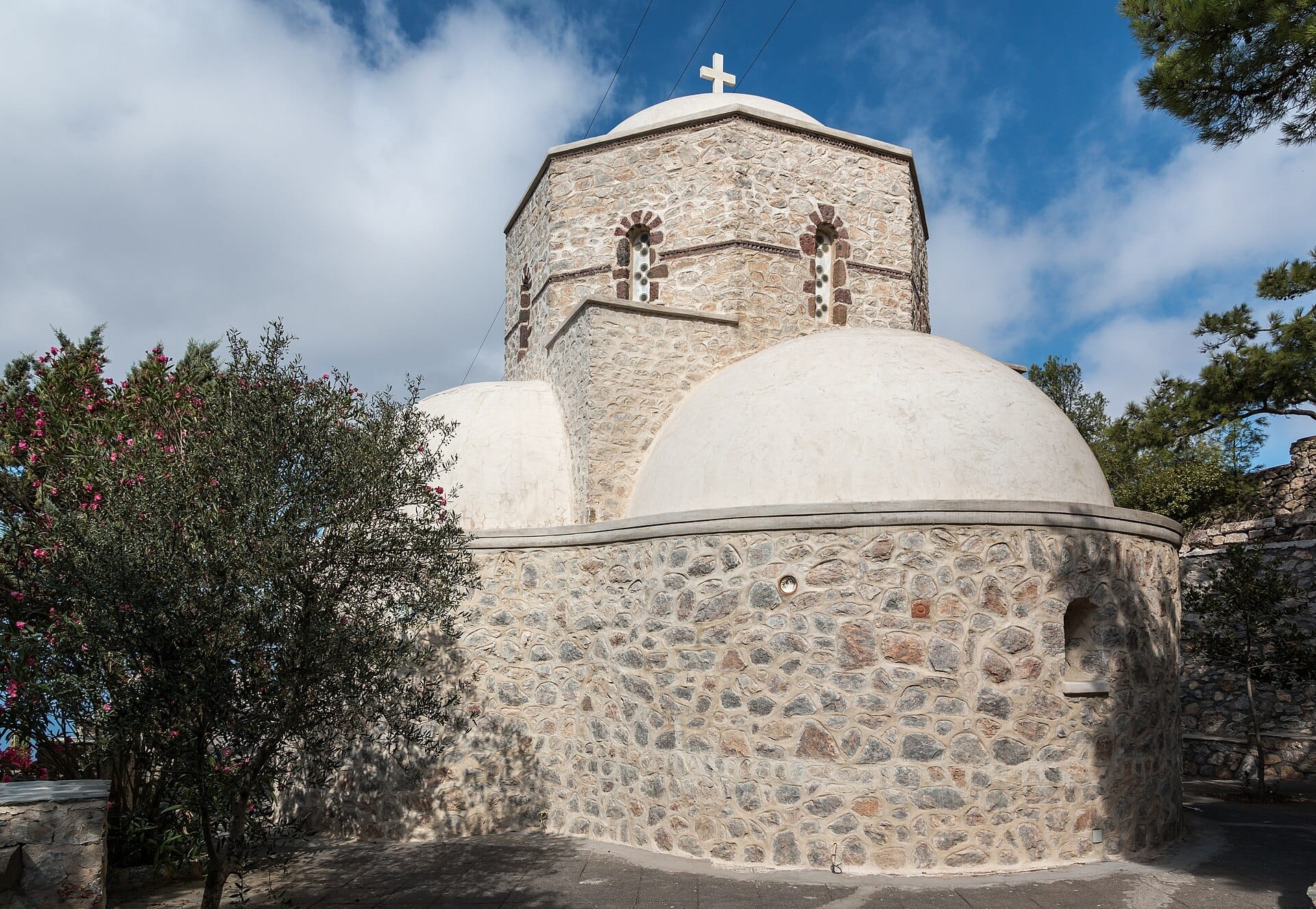
The Monastery of Profitis Ilias sits at the apex of Santorini, somewhere around 565 metres above sea level, depending on whose survey you trust. That makes it the single highest point on the island. The building itself dates to 1711 or 1712 (sources differ slightly), when two monks named Joachim and Gabriel received episcopal authorisation to establish a monastic community here. What they built was less a gentle retreat than a fortified compound, with thick stone walls designed to deter pirate raids on what was then an exposed hilltop.
For roughly 150 years after its founding, the monastery functioned as a cultural and economic centre. It ran a school teaching Greek language and literature, and its community even operated its own trading vessel. That combination of spiritual, educational, and commercial life made it unusually influential for an island monastery. The 1956 earthquake damaged parts of the structure significantly, and restoration work followed. Today the monastery is still active, home to a small number of monks, but tourist access to the interior is generally not offered. What draws visitors is the summit itself.
ℹ️ Good to know
Interior access may be granted on major religious occasions, particularly around the feast day of Prophet Elias on 20 July, but should not be assumed or relied upon. If you're visiting outside those dates, plan your trip around the viewpoint and exterior, not the church interior.
The View from the Top: What You Actually See
From the monastery terrace and the rocky ground around it, the panorama extends in every direction without interruption. To the west, the caldera opens up fully, its curved rim tracing Fira, Imerovigli, and the outline of Oia in the distance. You can see the dark mass of Nea Kameni sitting in the caldera water. To the east and southeast, the flat agricultural centre of the island spreads below you, and beyond it the black and dark-grey beaches of Perissa and Kamari are visible as thin strips along the coastline.
On clear mornings, particularly in spring and autumn, the views extend far beyond Santorini itself. The islands of Ios, Sikinos, Folegandros, and occasionally Crete's northern coast become visible. This is not the kind of view that's limited to one aesthetic direction, the way a caldera-edge terrace in Oia confines what you can see. Here the whole island is laid out below you like a map.
For photographers, the summit offers compositions that are nearly impossible elsewhere on the island. The caldera and the eastern coast in the same frame, the monastery walls against the sky, the agricultural terracing receding toward the coast. For context on how Santorini's viewpoints compare, the Santorini views and viewpoints guide gives a useful breakdown of what each vantage point actually delivers.
Tickets & tours
Hand-picked options from our booking partner. Prices are indicative; availability and final rates are confirmed when you complete your booking.
Luxury Sunset Cruise in Santorini
From 120 €Free cancellationCruise of the volcanic islands around Santorini
From 45 €Instant confirmationFree cancellationGuided e-bike tour in Santorini
From 90 €Instant confirmationFree cancellationSantorini audio guide with TravelMate app
From 5 €Instant confirmation
How the Experience Changes Through the Day
Early morning is the most rewarding time to be here. Before 9am, the hilltop is almost completely empty, the light is low and warm, and the air still carries the cool of the previous night at this altitude even in July and August. The silence is unusual for Santorini in peak season. You'll hear wind, occasionally bells, and sometimes the sound of the monks going about their morning. It feels genuinely removed from the tourist infrastructure below.
By late morning, particularly between May and October, tour groups begin arriving by car and minibus. The car park fills, and the atmosphere shifts. It's still not crowded in the way that Oia's sunset point becomes crowded, but the solitude dissolves. If your primary goal is the view rather than the walking, aim to arrive before 9am or after 5pm in summer.
Afternoon light hits the monastery walls from the west and is flattering for exterior photography. The caldera, however, goes into partial shadow by late afternoon when viewed from this height. Sunset from the summit is dramatic in theory, but access by road after dark on a narrow mountain route requires care. The monastery itself has no illuminated visitor facilities.
💡 Local tip
In July and August, temperatures at the summit can be 3–5°C cooler than the coast due to elevation, but there is almost no shade in the immediate viewpoint area. Bring water, sunscreen, and a hat even if it doesn't feel hot when you arrive.
Getting There: Hiking vs. Driving
The most satisfying approach is on foot from Pyrgos. A marked trail of approximately 2.5 km climbs from the main square of the village up through scrubby hillside vegetation to the summit. The path is clear and reasonably well-maintained, though it becomes steep in the final stretch. Allow 45 to 60 minutes going up at a comfortable pace. The descent takes slightly less. The trailhead in Pyrgos village is easy to locate; the path is signed.
Pyrgos itself is worth time before or after the hike. It is one of the most intact medieval settlements on the island, with a hilltop kastro and stone-paved lanes that see a fraction of the foot traffic that Oia and Fira absorb. The Pyrgos neighbourhood guide covers the village in more detail.
For those arriving by car or taxi, the mountain road winds steeply up from Pyrgos and is accessible but narrow in places. The car park at the summit is small. In high season, arriving by car between 10am and 4pm means competing for limited spaces. A taxi from Fira to the summit is a reasonable option; verify current fares locally as they vary by season. There is no regular KTEL bus service to the monastery summit.
The monastery can also be incorporated into a longer route: a trail links the summit area to Perissa on the coast and passes near the Ancient Thera archaeological site on the ridge. This makes for a half-day or full-day itinerary, though it requires fitness, good footwear, and carrying your own water. Check trail conditions locally before setting out.
⚠️ What to skip
The mountain road is a single-lane winding route with limited passing places. If you're renting a vehicle, drive slowly and use passing places courteously. In wet weather the road surface can become slippery.
The Architecture and What You Can See Externally
The monastery complex presents its original fortress character even from outside. The enclosing wall is solid and relatively high, built from the same volcanic stone that underlies the entire island. The main church dedicated to Prophet Elias is visible through the entrance when the gate is open, with characteristic Cycladic whitewash against the pale stone perimeter. The church roof and bell tower are the most photographed features from the exterior.
A small folk museum within the monastery complex reportedly holds ecclesiastical artefacts, tools, and historical objects connected to monastic life on the island. Access to this museum is tied to the same restricted schedule as any interior visit and is usually limited to specific religious occasions, particularly around the 20 July feast day. If you arrive on a regular visiting day, the museum will not be open.
Visitors with a deeper interest in Santorini's ecclesiastical architecture might also visit the Orthodox Metropolitan Cathedral in Fira, which is more consistently accessible and contains notable frescoes.
Practical Notes and Who Might Not Enjoy This
Dress modestly if you intend to enter the monastery grounds or interior on a feast day. Covered shoulders and knees are expected for both men and women. This is an active religious community, not a tourist site, and the monks have deliberately limited public access partly to preserve that character.
Accessibility is genuinely limited here. The hiking trail from Pyrgos is steep and unpaved in sections. The mountain road, while driveable, does not lead to a flat, step-free environment at the top. Visitors with significant mobility limitations will find this site challenging regardless of how they arrive.
Travellers whose primary interest is interior religious art, byzantine iconography, or museum displays should manage expectations carefully. Without timed access to coincide with the 20 July feast or specific religious occasions, the interior remains closed. The value of the visit is the summit, the views, the physical experience of the island's highest point, and the architectural character of the exterior. If those aren't enough justification for the journey, it may not be worth the effort.
If you're building an itinerary that combines viewpoints, beaches, and history in this part of the island, the 3-day Santorini itinerary includes practical routing suggestions for the southern and central parts of the island.
Photography and What to Frame
The summit offers some of Santorini's most technically interesting photography because the scale is different from caldera-edge shots. Wide-angle compositions capturing the island's full geography work well here. For detailed guidance on the island's best photographic locations and timing, the Santorini photography guide is a useful companion.
The monastery walls in morning light, the distant caldera with Thirassia beyond it, the agricultural plateau in the afternoon haze, and the descent path back toward Pyrgos are all worth framing. A standard zoom or wide-angle lens is more versatile here than a telephoto. Polarising filters help manage the intense Aegean light in midday.
Insider Tips
- The 20 July feast day of Prophet Elias brings a small but genuine local celebration to the summit, with monks, local families, and some visitors attending liturgy. Arriving early (before 8am) gives you the best chance to experience the atmosphere and any services that may be held.
- The hike from Pyrgos is unmarked on many standard tourist maps, but the trail is visible and signed on the ground. Ask at Pyrgos village for the trailhead if you can't locate it — locals point it out regularly.
- In spring (April and May), the hillside vegetation around the trail is green and intermittently flowering, which changes the character of the walk considerably compared to the dry brown scrub of summer. If you plan to hike rather than drive, spring is the most pleasant season to do so.
- The summit is significantly windier than the coast, particularly in spring and autumn. A light layer is worth packing even on a warm day, especially if you plan to sit and take in the views for any length of time.
- Combining the monastery visit with a walk down to Pyrgos for lunch makes for a natural half-day. Pyrgos has several good tavernas and far fewer tourists than Fira or Oia. Time your descent to arrive at the village around midday.
Who Is Profitis Ilias Monastery For?
- Hikers and walkers looking for a rewarding uphill trail with a clear destination and outstanding views
- Photographers who want island-wide panoramic compositions unavailable from the caldera rim
- Travellers seeking historical and religious context beyond Santorini's beach and sunset circuit
- Those visiting in shoulder season (April, May, September, October) who want uncrowded natural viewpoints
- Anyone staying near Pyrgos or Kamari who wants a half-day excursion without crossing the island
Nearby Attractions
Other things to see while in Pyrgos:
- Art Space Santorini
Art Space Santorini, formally known as Art Space Argyros Canava, is an unusual triple attraction in Exo Gonia near Pyrgos: a working winery housed in 19th-century pumice-carved cave cellars, a gallery showing contemporary paintings and sculptures, and a small museum of traditional winemaking. It rewards visitors who want something beyond the caldera views.
- Castle of Pyrgos (Kasteli)
Perched above the village of Pyrgos Kallistis, the Castle of Pyrgos — known locally as Kasteli — is a Venetian-era fortified ruin that rewards visitors with 360-degree views across the island. Free to visit and largely off the standard tourist circuit, it offers a quieter, more textured alternative to the caldera-edge crowds.
- Koutsoyannopoulos Wine Museum
Set 8 metres below the volcanic earth of Vothonas, the Koutsoyannopoulos Wine Museum traces three centuries of Santorini winemaking through a 300-metre cave corridor. It combines a self-guided audio tour with a structured wine tasting, making it one of the more substantive indoor experiences on the island.
- Santo Wines
Perched on the western cliffs near Pyrgos, Santo Wines is Santorini's largest wine cooperative, founded in 1911 and representing around 1,200 growers. The clifftop terrace delivers unobstructed caldera views, and the tasting flights introduce you to the island's distinctive Assyrtiko grape in a setting that few wineries anywhere can match.