Castle of Pyrgos (Kasteli): Santorini's Forgotten Hilltop Fortress
Perched above the village of Pyrgos Kallistis, the Castle of Pyrgos — known locally as Kasteli — is a Venetian-era fortified ruin that rewards visitors with 360-degree views across the island. Free to visit and largely off the standard tourist circuit, it offers a quieter, more textured alternative to the caldera-edge crowds.
Quick Facts
- Location
- Hilltop above Pyrgos Kallistis village, central Santorini, approx. 7 km from Fira
- Getting There
- KTEL bus to Pyrgos from Fira, then 10-15 min walk uphill via cobbled lanes; taxi or rental car also practical
- Time Needed
- 1 to 2 hours for the castle; allow extra time to explore Pyrgos village
- Cost
- Free — no ticket office or entrance gate
- Best for
- History enthusiasts, photographers, travelers avoiding crowds, and those combining with Profitis Ilias hike
What the Castle of Pyrgos Actually Is
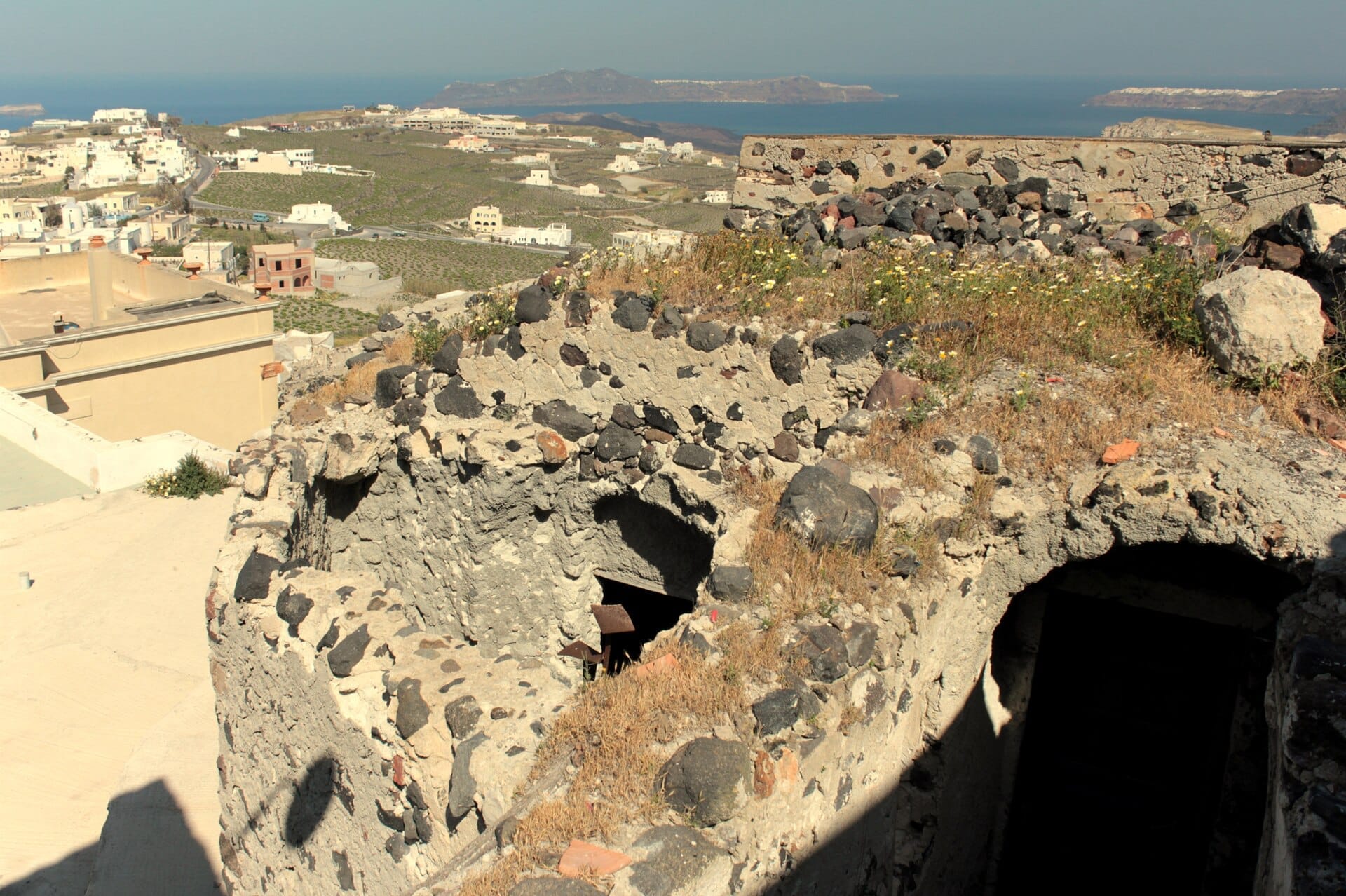
The Castle of Pyrgos — formally known as Kasteli — is the ruined shell of a Venetian fortified settlement built around 1580, making it the most recently constructed of Santorini's five medieval kastelia. It crowns the summit of Pyrgos Kallistis, one of the higher villages on the island, and sits at the foot of Mount Profitis Ilias. The 1956 earthquake that devastated much of Santorini left the castle in the partial ruin you see today: crumbling arched doorways, roofless stone chambers, and stairways that climb to remnant walls offering unobstructed views in every direction.
This is not a museum with interpretive panels or a polished heritage site. There are no ticket windows, no rope barriers, no guided audio tours. You walk up through the village on cobbled lanes, pass between whitewashed houses that lean close enough to touch on both sides, and eventually emerge onto the castle's exposed summit. The experience is roughly what it would have been for a traveler arriving here centuries ago, minus the threat of pirates.
ℹ️ Good to know
Access is free and unrestricted. The Kasteli sits within the living fabric of Pyrgos village — you reach it by walking uphill through residential lanes from the central square, not through any marked entrance.
The History Behind the Stone
Pyrgos Castle was constructed during Venetian rule of the Cyclades as part of a network of defensive settlements designed to protect the island's population from the frequent pirate raids that plagued the Aegean throughout the medieval period. The settlement was built on a concentric plan: the kasteli at the top, with residential buildings arranged in rings descending the hill, the outer walls of the houses themselves functioning as a defensive perimeter. This architectural logic meant that the village had no vulnerable open flanks — you had to pass through to get to the center.
Pyrgos is often described as having been the capital of Santorini in the 18th century, though some local historians dispute this, which explains why the village retains a density of churches disproportionate to its size — estimates put the number at around 20 within the settlement, a legacy of its former administrative importance. The castle itself took significant structural damage in the catastrophic 1956 earthquake that reshaped much of the island, and what remains today is an evocative but incomplete skeleton of the original fortification.
For deeper context on Santorini's layered past, the guide to Santorini's history and ancient ruins covers how the island's successive occupiers shaped its settlements from ancient Thera through Ottoman times.
Tickets & tours
Hand-picked options from our booking partner. Prices are indicative; availability and final rates are confirmed when you complete your booking.
Luxury Sunset Cruise in Santorini
From 120 €Free cancellationCruise of the volcanic islands around Santorini
From 45 €Instant confirmationFree cancellationGuided e-bike tour in Santorini
From 90 €Instant confirmationFree cancellationSantorini audio guide with TravelMate app
From 5 €Instant confirmation
The Walk Up: What You'll See, Hear, and Feel
The approach from Pyrgos village square is the real experience here. The lanes are narrow enough that two people walking side by side will brush the walls, and the stone underfoot transitions from rough-cut to worn-smooth as you gain elevation. Flowering plants spill from pots set on steps and windowsills. You'll hear the occasional door, the sound of a television from an open window, a cat asserting priority on a landing. In peak summer, the stone radiates stored heat well into evening, but at dawn it stays cool and slightly damp.
The castle walls open up in sections as you climb, giving compressed glimpses of landscape before the full panorama arrives at the top. From the summit, the view covers the caldera and the western cliffs, the central plateau of the island with its vineyards and farm tracks, the volcanic islets in the bay, and on clear days the outlines of neighboring islands across the Aegean. This is a 360-degree view, which is unusual for Santorini — most of the island's celebrated viewpoints face west toward the caldera and miss the eastern and inland landscape entirely.
For a focused assessment of Santorini's best panoramic positions, the complete guide to Santorini's viewpoints compares what you see from the caldera rim, the hilltop villages, and the island's elevated interior.
Best Time to Visit and How Light Changes Everything
Sunrise is the most rewarding time to visit the Kasteli, and for practical rather than purely aesthetic reasons. The castle faces east as well as west, so morning light catches the ruined stonework directly and illuminates the inland landscape in a way that the typical caldera-sunset visit misses. More importantly, arriving at sunrise means having the summit almost entirely to yourself. The village is quiet, the air is cooler, and the walk up feels contemplative rather than rushed.
Sunset draws more visitors, but Pyrgos remains far less crowded at dusk than Oia or even Imerovigli. The western aspect from the castle gives a clear view of the sun dropping toward the caldera horizon, and the light on the white church domes below the walls turns copper before fading. This is a legitimate alternative for travelers who want a sunset experience without the extreme density of people that forms at the Oia viewpoint each evening.
Midday in high summer is the least comfortable time to visit. The stone paths reflect heat, there is no shade on the upper section of the approach, and the summit itself is fully exposed. If midday is your only option, carry water and expect to move slowly. In spring and autumn, midday visits are entirely pleasant and the light on the ruins is strong and direct.
💡 Local tip
Photography tip: The castle's arched doorways and broken window frames work as natural compositional frames for the caldera or the volcanic islets. Arrive at golden hour (roughly 30 minutes after sunrise or before sunset) to get warm directional light on the stone texture. A wide-angle lens handles the narrow lanes; a standard focal length suits the summit panoramas.
Practical Logistics: Getting There and Getting Around
Pyrgos sits roughly in the geographic center of the island, about 7 kilometers from Fira by road. The KTEL bus network connects Fira with Pyrgos, though schedules vary by season and should be confirmed in advance at the Fira bus terminal or via the KTEL Santorini website. Taxis from Fira take around 10 to 15 minutes depending on traffic, which in July and August can be significant on the main island road. Many visitors combine Pyrgos with a rental car day exploring the island's interior villages, wineries, and the southern coastline.
Once in Pyrgos, parking is limited near the central square. The walk from the square to the castle summit takes around 10 to 15 minutes at a moderate pace, though the gradient and the cobblestone surface make it feel longer if you are not accustomed to hillside walking. Wear shoes with grip — the stones are polished by foot traffic and can be slippery when damp. There are no handrails on most of the approach and almost none on the castle walls themselves.
⚠️ What to skip
Accessibility: The route to the Kasteli involves sustained steep climbing on uneven cobblestones. There are no step-free alternatives and no vehicle access to the summit. Visitors with mobility limitations will find the upper section of the village and the castle itself very difficult to reach.
If you are planning a full day in this part of the island, the Profitis Ilias Monastery sits directly above Pyrgos on the island's highest peak and can be reached on foot or by road as a natural extension of the same visit.
Pyrgos Village: Worth Time Beyond the Castle
The village surrounding the Kasteli earns time in its own right. Pyrgos is widely regarded in local tradition as a former administrative center, and its street plan — concentric alleys spiraling up to the fortress — is better preserved than almost anywhere else on Santorini. Walking through the lower sections reveals clusters of churches, small family-run cafes, and workshops that have been in the same buildings for generations. The village has developed a modest wine tourism infrastructure, with the nearby estates reflecting the island's designation for Assyrtiko production.
For those interested in pairing the castle visit with wine, the Venetsanos Winery and other producers are accessible within a short drive of Pyrgos. The Santorini wine guide explains the island's distinctive volcanic viticulture in detail.
Who should skip the Kasteli? Travelers with limited mobility will find the approach genuinely difficult. Those primarily focused on the caldera experience and Cycladic blue-dome photography may find that Pyrgos, pointing inland as much as outward, does not deliver the images they came for. And visitors on very tight itineraries who have not yet seen the archaeological site at Akrotiri or Ancient Thera may find those sites offer more structured historical depth for the time invested.
Insider Tips
- Some village churches may be open during the day — the small chapel just below the castle summit, with its dome visible from the top, is sometimes open and worth stepping into for a moment of quiet and a look at its interior iconography.
- If you are visiting in the shoulder season (April, May, or October), Pyrgos sees noticeably fewer visitors than the caldera villages. You may have the castle summit entirely to yourself even at midday.
- The view east from the castle summit reveals the full agricultural interior of the island — the patchwork of vineyards, the road to Kamari, the salt flats near Monolithos. This perspective is almost never photographed and gives a more honest picture of what Santorini actually looks like beyond its famous western cliffs.
- Several of the small kafeneia (traditional coffee houses) in the village square open early and serve Greek coffee and local pastries before the tourist cafes further down the hill are running. Arriving before 8 AM for a coffee before the climb is a reliable way to start the visit at the right pace.
- Combining the Kasteli with the hiking trail to Profitis Ilias Monastery above it makes for a half-day walk that covers the highest points on the island with minimal backtracking. Wear proper footwear and bring more water than you think you need.
Who Is Castle of Pyrgos (Kasteli) For?
- History-minded travelers who want Santorini's medieval layer without the museum format
- Photographers seeking textured stone, arched doorways, and a viewpoint that covers the full island rather than just the caldera
- Visitors combining a wine and village loop through the island's interior
- Early risers who want a sunrise viewpoint without competing for space
- Hikers using Pyrgos as a base for the ascent to Profitis Ilias
Nearby Attractions
Other things to see while in Pyrgos:
- Art Space Santorini
Art Space Santorini, formally known as Art Space Argyros Canava, is an unusual triple attraction in Exo Gonia near Pyrgos: a working winery housed in 19th-century pumice-carved cave cellars, a gallery showing contemporary paintings and sculptures, and a small museum of traditional winemaking. It rewards visitors who want something beyond the caldera views.
- Koutsoyannopoulos Wine Museum
Set 8 metres below the volcanic earth of Vothonas, the Koutsoyannopoulos Wine Museum traces three centuries of Santorini winemaking through a 300-metre cave corridor. It combines a self-guided audio tour with a structured wine tasting, making it one of the more substantive indoor experiences on the island.
- Profitis Ilias Monastery
Perched at roughly 565 metres above sea level on the summit of Mount Profitis Ilias, this 18th-century Orthodox monastery is the highest structure on Santorini. The monastery is not generally open to casual visitors, but the surrounding viewpoint is among the most complete panoramas on the island, taking in the caldera, the eastern beaches, and on clear days, neighbouring Cycladic islands.
- Santo Wines
Perched on the western cliffs near Pyrgos, Santo Wines is Santorini's largest wine cooperative, founded in 1911 and representing around 1,200 growers. The clifftop terrace delivers unobstructed caldera views, and the tasting flights introduce you to the island's distinctive Assyrtiko grape in a setting that few wineries anywhere can match.