Pozalagua Cave: The Extraordinary Underground Cathedral Near Bilbao
Hidden beneath the limestone hills of the Karrantza Valley, Pozalagua Cave contains one of the largest concentrations of eccentric stalactites on the planet. Discovered by accident in 1957, this vast chamber draws geology enthusiasts, families, and curious travelers making a day trip from Bilbao into the quieter corners of Biscay.
Quick Facts
- Location
- Peñas de Ranero, Karrantza Harana (Valle de Carranza), Bizkaia – approx. 60 km southwest of Bilbao
- Getting There
- Car recommended via road BI-630 toward Karrantza; FEVE trains and buses run from Bilbao to Karrantza, but you will need a taxi or long walk from the station to reach the cave.
- Time Needed
- 2–3 hours including travel from Bilbao; guided tour inside the cave lasts roughly 45–60 minutes
- Cost
- General €10, reduced €6 (children 6–12, seniors, students), under 6 free. Verify current rates before visiting.
- Best for
- Geology enthusiasts, families with children, day-trippers wanting something different from Bilbao's urban scene
- Official website
- www.visitbiscay.eus/en/pozalagua
What Pozalagua Cave Actually Is
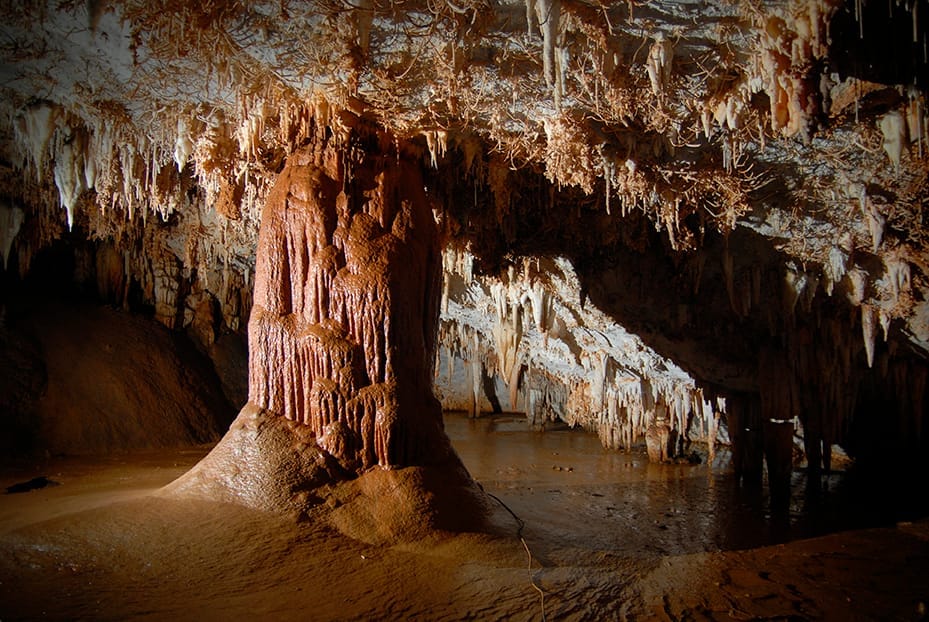
Pozalagua Cave is not a winding tunnel system that takes hours to explore. It is, essentially, one enormous underground chamber: roughly 125 metres long, 70 metres wide, and with a ceiling vaulting up to 17 metres above your head. That scale alone is enough to silence a group of visitors the moment they step inside. But the real reason people travel here is what clings to that ceiling and erupts from the walls: eccentric stalactites.
Eccentric stalactites, known to geologists as helictites, are formations that defy gravity. Instead of hanging straight down like conventional stalactites, they grow sideways, curve back on themselves, spiral outward in delicate corkscrews, and branch in directions that seem to have nothing to do with physics. The scientific consensus is that they form through capillary forces, hydrostatic pressure, and air currents rather than simple gravity-driven drip. The result looks surreal, almost botanical, like coral frozen mid-growth. Pozalagua has one of the largest known concentrations of these formations anywhere in the world, which is what places it in a genuinely rare category of natural sites.
ℹ️ Good to know
The cave maintains a constant temperature of around 13–14°C year-round regardless of outside conditions. Even in August, bring a light jacket or layer.
Discovery by Accident: The Cave's Unusual History
Pozalagua was not found by cavers or explorers. It was revealed on 28 December 1957 by workers blasting at the adjacent dolomite quarry. A single detonation broke through the rock wall and opened a passage into a cavity that had been sealed for millennia. The fact that the cave had never been exposed to the outside world is part of what preserved its formations in such exceptional condition. There was no tourist foot traffic to erode the floors, no centuries of candle soot, no vandalism. The helictites grew undisturbed.
The quarry still operates nearby, which creates a slightly strange juxtaposition: industrial machinery working the hillside above, while below, one of Spain's most remarkable geological treasures is carefully lit and guided for visitors. The interpretation centre at the entrance covers the cave's geology and discovery history before you descend, and it is worth taking ten minutes with it before the tour begins.
Tickets & tours
Live prices and dates from our booking partner. If you book, we may earn a commission at no extra cost to you.
Self-guided e-Scavenger Hunt in Bilbao
From 31 €Instant confirmationFree cancellationSan Juan de Gaztelugatxe guided tour from Bilbao
From 65 €Instant confirmationFree cancellationSan Sebastian, Hondarribia, Hendaye, and Getaria from Bilbao
From 54 €Instant confirmationFree cancellationGaztelugatxe and Mundaka small group guided tour from Bilbao
From 50 €Instant confirmationFree cancellation
The Experience Inside: What to Expect
All visits are guided, which means you move through the cave as a group on a fixed schedule. The route is approximately 400 metres long and has been adapted with walkways and platforms, making it accessible for visitors with reduced mobility. Provincial tourism authorities actively promote Pozalagua as an accessible attraction, which is unusual among cave sites and worth noting for families with pushchairs or visitors who find uneven terrain difficult.
Inside, the lighting is deliberate and theatrical. Spotlights pick out individual clusters of helictites in warm amber and cool white, casting long shadows that make the formations appear even more complex than they are in flat light. The guide will stop at several key points in the main chamber, explaining the geology and the conditions that produced these formations. Tours are typically available in Spanish and Basque, with some English-language options depending on demand; confirm when booking if English is essential to your experience.
The air inside is still and cool. You will hear nothing from the quarry once you are in the main chamber. The dominant sounds are your own footsteps on the walkway, the occasional drip of water from the ceiling, and the guide's voice. It is strikingly quiet in a way that underground spaces rarely are, and that stillness adds considerably to the atmosphere.
💡 Local tip
Photography is generally permitted inside the cave, but tripods and flash photography may be restricted. A smartphone with a good low-light camera will produce better results than a compact camera with aggressive flash, which tends to flatten the formations and wash out the dramatic shadows.
Getting There from Bilbao
Pozalagua Cave sits in the Karrantza Valley (Karrantza Harana), around an hour’s drive southwest of Bilbao. The drive via road BI-630 (reached from the A-8 and BI-636) takes approximately 60–70 minutes under normal conditions. The route passes through the hills of western Biscay and, from Cantabria, via the CA-151 through Trucios at Guriezo. Signage for the cave is clear once you are in the valley. There is a dedicated car park and interpretation centre at the entrance.
There is no public transport that takes you directly to the cave entrance. FEVE trains and two bus lines connect Bilbao with Karrantza, from where you can take a taxi or, if you are prepared for a long hike, walk to the cave. If you do not have access to a car, a taxi or private transfer from Bilbao would be expensive given the distance, and neither Uber nor Cabify are realistic options for a round trip this far from the city. Car hire from Bilbao remains the most straightforward option for independent travelers. If you are coming from Cantabria, the cave is more straightforward to reach by road.
For travelers planning a broader day out in western Biscay, the Karrantza Valley pairs naturally with a drive through the forested hills of the Encartaciones region. You might also combine it with the Gorbea Natural Park or, if you are willing to extend your itinerary, include a stop at Guernica on the return toward Bilbao.
Opening Hours, Tickets, and Practical Planning
The cave operates on a seasonal schedule. During high season, from 24 June to 7 September, it is open Tuesday through Sunday and on bank holidays from 11:00 to 19:00, with the last tour at 18:00. During the rest of the year, opening is typically limited to weekends, long weekends and bank holidays, generally from 11:00 to 18:00 with last tours at 17:00 or 18:00 depending on the period. The cave is closed on Mondays (except public holidays and long weekends), and also closes on 18 September, 24 and 25 December, 31 December, and 1 and 6 January.
Current ticket pricing is General €10 and reduced €6 (children aged 6 to 12, seniors, students, and organised groups), with free entry for children under 6. These prices and schedules do change; confirm directly with the cave before you go.
⚠️ What to skip
The cave closes on Mondays and on specific holiday dates. A number of visitors make the 60-kilometre drive from Bilbao only to find the entrance closed. Always verify the schedule online or by phone before setting out, especially on long weekends and in shoulder season.
When to Visit and Who This Suits
Because the cave temperature stays constant at around 13–14°C throughout the year, the season outside has no effect on the experience inside. This makes Pozalagua a particularly compelling option on days when Bilbao's Atlantic weather turns grey or rainy. The Karrantza Valley is lush and green in any season, and a wet day in the hills of western Biscay has its own particular atmosphere.
Weekend mornings in summer attract the largest crowds, with tour groups from the Basque Country and Cantabria filling the car park by midday. If you want a quieter experience, aim for a weekday morning in June or September, when the cave is open but visitor numbers are noticeably lower. The guided format does naturally cap group sizes, but arriving just before a busy tour slot means you will feel more compressed in the chamber.
Families with children typically get a lot from this visit. The formations are visually striking and the guided format gives children a structure that keeps the experience focused. The accessible walkways also make it viable for a wider range of visitors than most cave attractions. If you are building a family day out around Bilbao, see our guide to things to do in Bilbao with kids for complementary ideas.
Who might not find this worthwhile: travelers with very limited time who want to concentrate on Bilbao's urban highlights will find the two-hour round trip a significant commitment for a single attraction. If your schedule is tight and you have not yet seen the city's main draws, prioritise those first. Pozalagua rewards travelers who are seriously interested in geology or natural phenomena, not those ticking a list.
Combining Pozalagua with the Wider Basque Country
Pozalagua fits naturally into a broader itinerary across Biscay's natural landscapes. The province has a remarkable concentration of outdoor attractions within two hours of the city, from the coastal drama of Gaztelugatxe on the northeast coast to the forests of the Urdaibai Biosphere Reserve. The cave works best as a western counterpoint to those more visited eastern destinations, ideal for travelers spending at least two full days based in Bilbao.
If you are planning a broader trip through the region, the Basque Country itinerary guide outlines how to structure multiple days across Bilbao and beyond, including how to sequence natural and urban attractions without unnecessary backtracking.
Insider Tips
- Tours fill up during summer weekends. Arriving at opening time (11:00) means you will join the first tour of the day with a smaller group and have the chamber lit up fresh before the crowds arrive.
- The interpretation centre at the entrance is useful and clear and takes around ten minutes. Reading the panels before descending means you will understand what you are looking at when the guide points to specific helictite formations.
- The cave is 13–14°C year-round. In summer, the temperature contrast from a warm car or a sunny day outside is sharper than visitors expect. A thin fleece or windproof layer in your bag solves this without adding bulk.
- If you are driving from Bilbao, the BI-630 route through the hills is attractive but takes longer than a map app suggests on first glance. Allow at least 70 minutes from central Bilbao to account for the winding road through the valley.
- Photography works best in the main chamber without flash. The cave lighting is designed to create depth and shadow; flash photography eliminates exactly the visual drama that makes the helictites look extraordinary.
Who Is Pozalagua Cave For?
- Geology and natural science enthusiasts who want to see eccentric stalactites in one of the world's most significant concentrations
- Families with children aged 6 and older looking for an educational and visually striking day trip from Bilbao
- Travelers visiting Bilbao in autumn or winter who want a weather-proof attraction that delivers regardless of rain
- Visitors with reduced mobility, thanks to the accessible 400-metre adapted route through the main chamber
- Road-trippers combining western Biscay with a drive through the Encartaciones region or crossing into Cantabria
Nearby Attractions
Combine your visit with:
- Bakio Beach
Stretching nearly a kilometre along the Bizkaia coast, Bakio Beach is the largest and most complete sandy beach within easy reach of Bilbao. With reliable surf, a long promenade, full facilities, and Blue Flag certification, it draws everyone from families to serious wave riders.
- Bermeo
Perched on the rugged Biscay coast about 35 kilometres northeast of Bilbao, Bermeo is one of the Basque Country's oldest and most significant fishing towns. With a harbour still piled with nets, a medieval old quarter dating to 1236, and a front-row seat to one of northern Spain's most dramatic coastlines, it rewards travellers who venture beyond the city.
- Castillo de Butrón
Rising from dense Biscayan woodland just over 20 km from Bilbao, Castillo de Butrón is one of the most visually striking pieces of architecture in the Basque Country. Originally a medieval tower-house, it was radically rebuilt in neo-Gothic style in 1878 and today stands as a classified Historic Monument. Interior access is currently not available to the general public, but the exterior alone makes the short drive worthwhile.
- San Juan de Gaztelugatxe
A 10th-century hermitage perched on a jagged sea islet connected to the mainland by a cobbled stone bridge and 241 steps. San Juan de Gaztelugatxe sits roughly 45 minutes by car from Bilbao and delivers one of the most visually striking landscapes on the entire Atlantic coast of Spain. Free to enter, but requiring advance reservation in peak season.
Planning a trip? Discover personalized activities with the Nomado app.