Guernica (Gernika-Lumo): The Basque Sacred Town That Changed History
Gernika-Lumo is a small Basque town northeast of Bilbao carrying an outsized weight of history. It is the traditional seat of Basque self-governance, the site of a devastating 1937 Nazi bombing that inspired Picasso's most famous painting, and today a living town of roughly 17,000 people that has rebuilt itself around memory, identity, and resilience.
Quick Facts
- Location
- Gernika-Lumo, Biscay (Bizkaia), Basque Country — approx. 33 km northeast of Bilbao via the Oka valley
- Getting There
- Euskotren from Bilbao's Zazpi Kaleak (Casco Viejo) station (approx. 55–70 min); regional bus also available. By car: roughly 35–45 min via BI-635
- Time Needed
- 3–5 hours for a comfortable day trip covering the Peace Museum, Assembly House, Oak Tree, and town centre
- Cost
- Free to walk the town; individual attractions (Peace Museum, Assembly House) charge separate entry fees — verify current prices before visiting
- Best for
- History travellers, Basque culture enthusiasts, those interested in 20th-century political history and art
- Official website
- www.gernika-lumo.eus
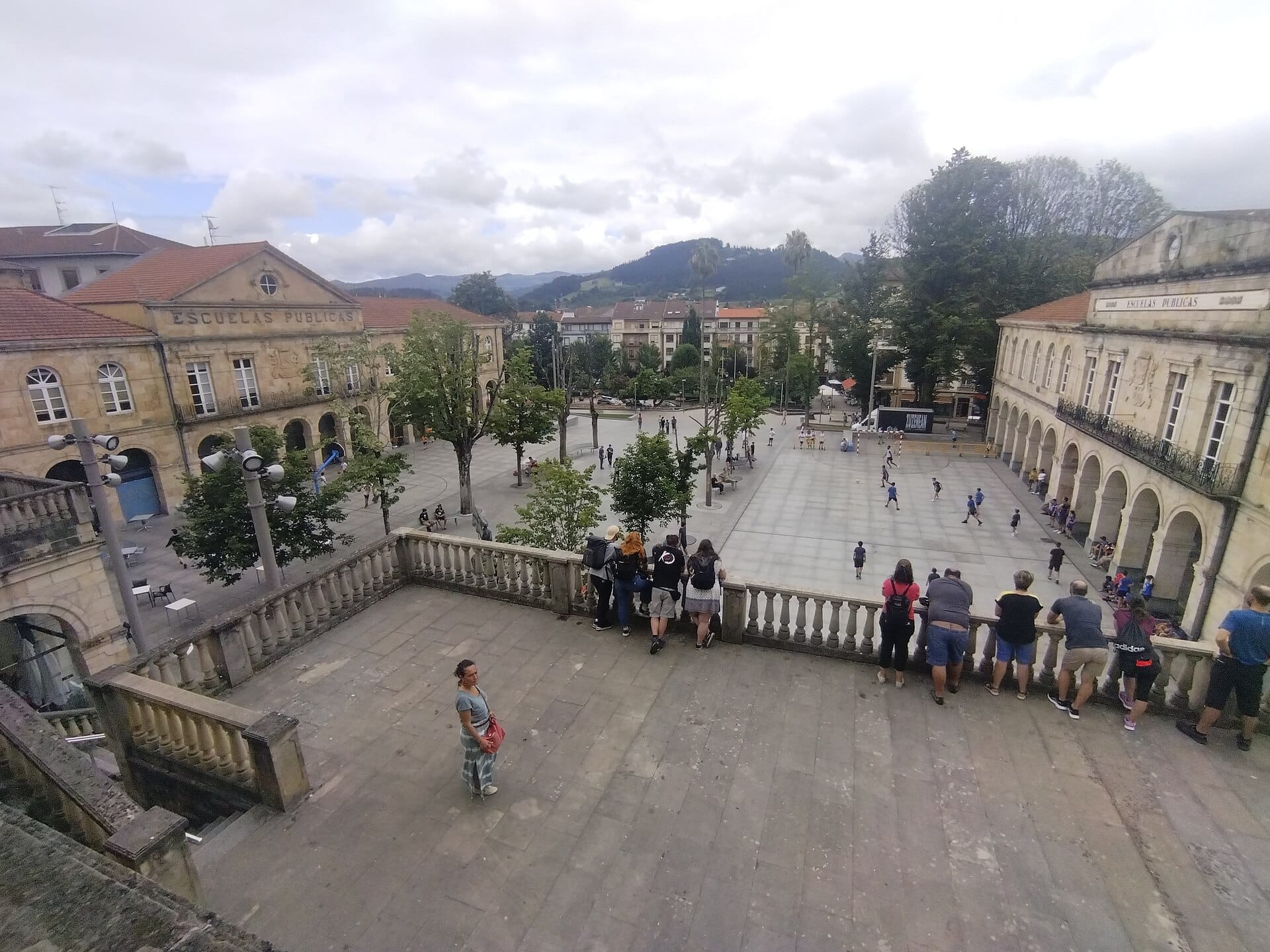
Why Gernika-Lumo Matters
The name Guernica — as the world knows it — belongs first to Picasso's monumental canvas, a roar of fractured bodies and screaming horses that has hung in museums from Madrid to New York. But before the painting, and after it, there is the actual place: Gernika-Lumo, a working Basque town in the Oka river valley that has been carrying this history for nearly nine centuries.
Founded on 28 April 1366 by Tello Alfonso, Lord of Biscay, Gernika served for centuries as the symbolic capital of Basque self-governance. The Lords of Biscay, and later the Spanish crown, swore to uphold Basque laws (the Fueros) beneath a sacred oak tree here. That tradition predates the Spanish state itself, which is why the town occupies a place in Basque identity that no other location quite matches.
Then came 26 April 1937. During the Spanish Civil War, aircraft of Nazi Germany's Condor Legion and Fascist Italy's Aviazione Legionaria bombed the town on a market day, killing hundreds of civilians in what became one of the first deliberate aerial bombardments of a civilian population in modern history. The event shocked the world, prompted Picasso to begin painting his response later that spring, and transformed Gernika into an international symbol of anti-war resistance. Today, anyone with a serious interest in 20th-century history, Basque identity, or the relationship between art and politics will find this a more rewarding stop than almost anywhere else in the Basque Country itinerary.
ℹ️ Good to know
Gernika-Lumo is a living town, not an open-air museum. Locals go about daily life here. The town rewards respectful, unhurried visitors far more than those rushing through for a quick photo.
Getting There from Bilbao
The most atmospheric way to arrive is by Euskotren from Bilbao's Zazpi Kaleak (Casco Viejo) station, a compact terminus in the Casco Viejo district on the right bank of the Nervión. The journey winds northeast through the hills and valleys of Biscay, following the Oka river corridor into Gernika. Travel time is typically 55 to 70 minutes. The train deposits you within easy walking distance of the town centre, which makes a car unnecessary for most visitors.
Driving takes around 35 to 45 minutes via the BI-635, though parking in the town centre can be limited on market days (Monday is Gernika's traditional market day, when the streets fill with produce stalls and the town is at its most local and energetic). If you are planning a broader trip through Biscay's coast — perhaps continuing to Mundaka or the Urdaibai Biosphere Reserve — a car gives you more flexibility.
💡 Local tip
Time your visit for a Monday if possible. Gernika's weekly market (one of the oldest in the Basque Country) fills the central streets with food, crafts, and a genuinely local crowd. It transforms the atmosphere entirely.
Tickets & tours
Hand-picked options from our booking partner. Prices are indicative; availability and final rates are confirmed when you complete your booking.
San Juan de Gaztelugatxe guided tour from Bilbao
From 65 €Instant confirmationFree cancellationSan Sebastian, Hondarribia, Hendaye, and Getaria from Bilbao
From 54 €Instant confirmationFree cancellationGaztelugatxe and Mundaka small group guided tour from Bilbao
From 50 €Instant confirmationFree cancellationBilbao walking tour
From 16 €Instant confirmationFree cancellation
What to See: The Core Circuit
Gernika Peace Museum (Museo de la Paz de Gernika)
This is the essential first stop. The Peace Museum sits near the town centre and is dedicated to the 1937 bombing and its global consequences. The permanent collection moves carefully through the lead-up to the attack, the bombing itself, survivor testimonies, and the international aftermath including Picasso's painting and its long political journey. The museum does not sensationalise. It gives testimony space: recorded voices, photographs, objects recovered from the rubble, and careful historical context.
Allow at least 90 minutes here. The exhibition is well-curated and genuinely affecting rather than performatively mournful. Signage is in Basque, Spanish, and English. Admission fees apply — check the official museum site or gernikainfo.eus for current prices and hours before visiting, as both are subject to seasonal changes.
Casa de Juntas (Assembly House of the Basque Country)
A short walk from the museum brings you to the Casa de Juntas, the Assembly House where the representatives of Biscay have historically gathered to govern under the Basque Fueros. The building itself is neoclassical in style, constructed in the early 19th century, but it stands on ground of far older political significance. Inside, the circular chamber with its wooden galleries and stained-glass ceiling is a formally beautiful space — and one that remains in active ceremonial use.
Entry to the Casa de Juntas is typically free or low-cost, though this can change. Guided visits may be available. Outside the main building, the garden houses both the old stump of the original Oak Tree of Gernika and a younger successor oak planted in its place. These trees are not decorative. They are the physical embodiment of a constitutional tradition stretching back centuries, and Basque leaders still gather here for formal oath-taking.
The Tree of Gernika
The Oak of Gernika (Gernikako Arbola in Basque) is the most potent symbol in Basque political culture. The tree under which medieval lords swore to respect Basque rights no longer stands in its original form, but the old stump is preserved under a classical pavilion in the Casa de Juntas garden. Beside it, a younger oak planted in the 19th century carries the living tradition forward. A third, even younger tree was planted in the 20th century to continue the lineage.
The oak has inspired poetry, the Basque anthem (Gernikako Arbola, written by José María Iparraguirre in 1853), and remains a living reference point in Basque political discourse. Standing beside it, even knowing the full context, still carries a particular kind of quiet weight.
How the Town Feels at Different Times of Day
Gernika in the morning is calm and domestic. Locals queue at bakeries on the side streets near the central square; the smell of fresh bread and strong coffee drifts out of bar doorways. The light is soft in the Oka valley, often with a thin mist clinging to the surrounding hills in cooler months. This is the quietest time to visit the Casa de Juntas and the oak garden before tour groups arrive.
By late morning, the Peace Museum fills with school groups and visitors arriving on day trips from Bilbao and San Sebastián. The central area around the market square becomes considerably busier — particularly on Mondays. If you are sensitive to crowds inside exhibition spaces, arriving right at opening time makes a notable difference.
Early afternoon is when the town settles into a distinctly Basque rhythm: the streets quiet between roughly 2pm and 4pm as locals eat. Several bars and restaurants around Calle Artekalea serve pintxos and set lunches that are priced for the local market rather than tourists. The fish dishes, particularly bacalao preparations, reflect the Basque interior's relationship with the sea via trade routes that have centuries of history behind them.
If you want a detailed sense of how Basque food culture plays out beyond Bilbao's pintxo bars, the Basque food guide provides useful context — but eating in Gernika's unpretentious local bars is itself a practical extension of that culture.
Weather, Seasons, and When to Go
The Oka valley shares the humid oceanic climate of the wider Basque Country: mild winters, warm summers, and rainfall distributed across the year with the heaviest periods typically in autumn and winter. Unlike coastal visits where weather affects swimming or beach conditions, Gernika's major attractions are all accessible regardless of rain. The town's narrow streets and bar terraces provide shelter, and the museums are fully indoor experiences.
Spring (April to June) and early autumn (September to October) are the most comfortable periods for walking the town. Summer brings more visitors but also longer daylight hours if you want to explore the Oka valley surroundings. Visiting in April — particularly around the 26th — adds historical resonance, as the anniversary of the 1937 bombing is marked in the town each year.
⚠️ What to skip
The Peace Museum and Casa de Juntas are closed on certain public holidays. Always check opening hours directly before making the trip from Bilbao, especially if your visit falls on a national or local holiday.
Extending Your Day: The Urdaibai Biosphere Reserve
Gernika-Lumo sits at the heart of the Urdaibai Biosphere Reserve, a UNESCO-designated estuary ecosystem of exceptional ecological value. The Oka river mouth, with its wetlands, dunes, and migratory bird populations, is visible from the edges of the town itself. Combining a visit to Gernika with a walk along the Urdaibai estuary adds a completely different dimension to the day.
From Gernika, the Euskotren continues along the coast to Mundaka, one of Europe's most celebrated surf breaks, just 8 km away. The combination of Gernika's historical weight and Mundaka's dramatically beautiful river mouth makes for one of the most complete day trips available from Bilbao — covering history, ecology, and landscape in a single route.
Practical Notes for Your Visit
- Wear comfortable walking shoes: the town centre is compact and flat, but the streets around the Casa de Juntas involve some uneven paving.
- Spanish and English are both usable in tourist-facing contexts; Basque signage is everywhere but staff at museums generally speak Spanish and often English.
- Photography is permitted in public spaces and generally in the Casa de Juntas garden; the Peace Museum has its own photography policy inside exhibitions — check at the entrance.
- There is no need to book ahead for most visits unless you want a guided tour of the Assembly House; the Peace Museum can get crowded on summer weekends but does not require advance tickets as standard.
- ATMs are available in the town centre. Most restaurants and museums accept cards, but smaller bars may prefer cash.
Who Should Skip This
Visitors expecting a polished, heavily touristic experience will find Gernika straightforward but understated. The town does not perform its history for visitors — it lives alongside it. Those looking for a scenic coastal town with restaurants and beaches should continue directly to Mundaka or the Basque coast. If you have only one day in the Bilbao area and are primarily interested in contemporary architecture and gastronomy, the time might be better spent in the city itself.
Gernika also requires some historical curiosity to be genuinely rewarding. Without basic awareness of the Spanish Civil War or Basque political history, the Casa de Juntas and the oak garden can seem modest. The Peace Museum provides the necessary context independently, but visitors should be prepared to engage rather than simply observe. For those building a broader itinerary, the 2 days in Bilbao guide helps position Gernika within a realistic schedule.
Insider Tips
- The Euskotren journey from Bilbao's Casco Viejo (Zazpikaleak) station is itself worth the trip: the train passes through hills, small villages, and river valleys that are almost entirely off the standard tourist map. Sit on the right side of the train heading toward Gernika for the best valley views.
- The Monday market extends well beyond the central square into side streets — follow the noise rather than the maps, and you will find the most interesting stalls (local cheese, wild mushrooms in season, cider) tucked away from the main pedestrian area.
- The stained-glass ceiling of the Casa de Juntas assembly chamber is lit from above and changes character depending on the time of day and cloud cover. Morning light on a partially overcast day tends to produce the richest colour effects.
- Gernika's bars around Calle Industria serve txakoli (the local slightly sparkling Basque white wine) poured from a height in the traditional manner. Ordering a glass here costs considerably less than in Bilbao's tourist-facing pintxo bars.
- The old oak stump is more moving than photographs suggest. It is ancient, hollowed, and protected under a classical stone rotunda that frames it like a relic. Give it more than a passing glance.
Who Is Guernica (Gernika-Lumo) For?
- History and political culture travellers with an interest in 20th-century European conflicts
- Basque Country first-timers wanting to understand Basque identity beyond the Guggenheim
- Those extending a Bilbao trip toward the Urdaibai coast and Mundaka
- Visitors who prefer authentic, locally-oriented towns over heavily touristic destinations
- Travellers interested in the intersection of art, memory, and place
Nearby Attractions
Combine your visit with:
- Bakio Beach
Stretching nearly a kilometre along the Bizkaia coast, Bakio Beach is the largest and most complete sandy beach within easy reach of Bilbao. With reliable surf, a long promenade, full facilities, and Blue Flag certification, it draws everyone from families to serious wave riders.
- Bermeo
Perched on the rugged Biscay coast about 35 kilometres northeast of Bilbao, Bermeo is one of the Basque Country's oldest and most significant fishing towns. With a harbour still piled with nets, a medieval old quarter dating to 1236, and a front-row seat to one of northern Spain's most dramatic coastlines, it rewards travellers who venture beyond the city.
- Castillo de Butrón
Rising from dense Biscayan woodland just over 20 km from Bilbao, Castillo de Butrón is one of the most visually striking pieces of architecture in the Basque Country. Originally a medieval tower-house, it was radically rebuilt in neo-Gothic style in 1878 and today stands as a classified Historic Monument. Interior access is currently not available to the general public, but the exterior alone makes the short drive worthwhile.
- San Juan de Gaztelugatxe
A 10th-century hermitage perched on a jagged sea islet connected to the mainland by a cobbled stone bridge and 241 steps. San Juan de Gaztelugatxe sits roughly 45 minutes by car from Bilbao and delivers one of the most visually striking landscapes on the entire Atlantic coast of Spain. Free to enter, but requiring advance reservation in peak season.