Porta Capuana: Naples' Forgotten Renaissance Masterpiece
Built in 1484 on the orders of King Ferrante I d'Aragona, Porta Capuana is one of the finest Renaissance city gates in Italy. Flanked by two marble towers and bearing the coat of arms of Charles V, this free-standing arch near Piazza Garibaldi rewards visitors who seek it out with extraordinary architecture and almost no crowds.
Quick Facts
- Location
- Piazza Capuana, 80139 Naples (Porta Capuana district)
- Getting There
- Naples Centrale (Piazza Garibaldi) – 10-minute walk; served by metro Line 1 and 2, plus regional rail
- Time Needed
- 20–40 minutes to observe and photograph; longer if exploring the surrounding piazza
- Cost
- Free – exterior monument with no admission charge
- Best for
- Architecture lovers, Renaissance history, photography, unhurried sightseeing
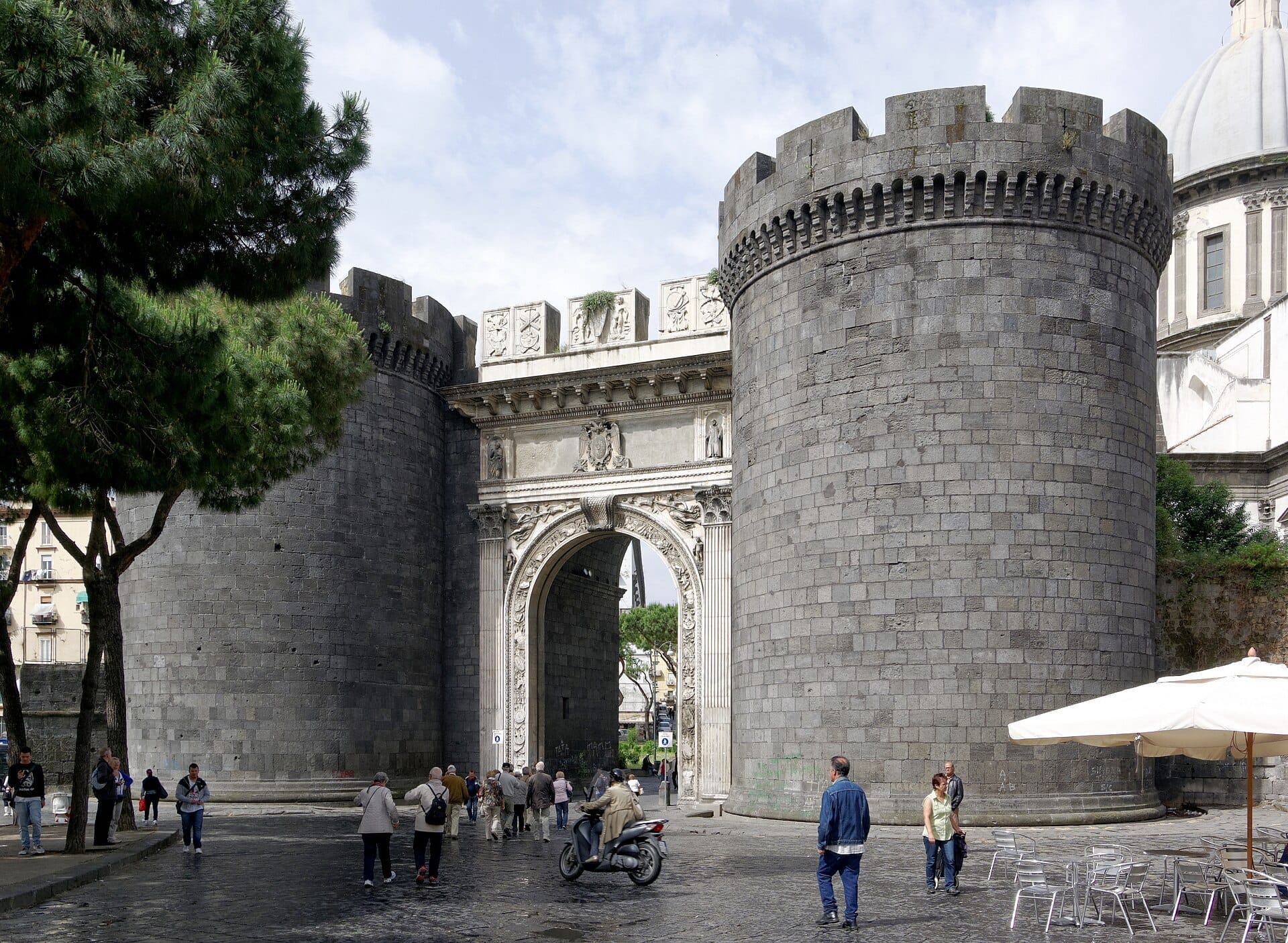
What Porta Capuana Actually Is
Porta Capuana is a triumphal city gate built in 1484 on the command of King Ferrante I d'Aragona (Ferdinand I of Aragon), ruler of the Kingdom of Naples. It formed part of the Aragonese city walls that once encircled the city, and it served as the principal gateway to the ancient road running northeast toward the city of Capua and, beyond that, into the Puglia region. Today, those walls are long gone, leaving the gate free-standing like a Roman triumphal arch dropped into the dense urban fabric of eastern Naples.
The architecture is the work of Giuliano da Maiano, a Florentine sculptor and architect who brought the full refinement of early Renaissance classicism to what was then a formidable military structure. The white marble arch is delicate and precisely cut, a striking contrast to the two massive cylindrical towers flanking it. Those towers were given names: the one on the left is called Onore (Honor) and the one on the right is Virtù (Virtue). The symbolism was deliberate. Passing through the gate, whether a king or a common traveler, was understood as a passage between moral qualities.
ℹ️ Good to know
Look for the carved coat of arms of Holy Roman Emperor Charles V in the center of the door. It was added after his visit to Naples in 1535 and remains one of the clearest indicators of the gate's continued political importance well after its construction.
The Architecture Up Close
Standing directly in front of the gate, the contrast between its two building traditions is impossible to miss. The arch itself is carved from white marble with fine classical detailing: pilasters, entablature, and carved friezes that reflect the Florentine Renaissance vocabulary Giuliano da Maiano brought from Tuscany. The overall composition is graceful and measured, closer in spirit to the great Florentine buildings of the 1470s than to anything built locally in Naples at that time.
The two towers are a different story. They are built from grey volcanic stone in a cylindrical drum form, solid and undecorated. Their function was primarily defensive: they provided flanking fire along the wall line and housed the garrison that controlled passage through the gate. The combination of these two registers, delicate marble arch between two heavy military drums, gives Porta Capuana its unique and slightly paradoxical character. It reads simultaneously as a monument to power and a gesture toward civic refinement.
The gate stands close to Castel Capuano, a 12th-century Norman castle that the Aragonese kings used as a royal residence before converting it into the city's Court of Justice in the 16th century. The two structures once anchored this entire section of the city walls together, and seeing them in proximity helps reconstruct the now-invisible defensive system that once defined Naples' eastern edge.
Tickets & tours
Live prices and dates from our booking partner. If you book, we may earn a commission at no extra cost to you.
Pompeii and Mount Vesuvius tour with transportation
From 110 €Instant confirmationFree cancellationMount Vesuvius and Herculaneum tour with transportation
From 100 €Instant confirmationFree cancellationPompeii Small Group Tour with transportation from Naples
From 65 €Instant confirmationFree cancellationHerculaneum ruins tour with transportation
From 60 €Instant confirmationFree cancellation
How the Experience Changes by Time of Day
Early morning, before 9:00 AM, Porta Capuana is remarkably quiet given its proximity to the chaos of Piazza Garibaldi, one of Naples' main transport hubs roughly ten minutes' walk to the west. The light is clean and low in the warmer months, raking across the marble surface and making the carved details of the arch particularly legible. The surrounding piazza, Piazza Enrico de Nicola, holds a market in the mornings, and the smell of fresh produce, coffee from nearby bars, and occasional diesel from delivery scooters creates an immediately local atmosphere.
By mid-morning the market is in full operation and the square becomes considerably livelier. Street vendors, local residents, and the occasional tourist mix freely. This is when the gate functions as a backdrop to everyday Neapolitan life rather than a formal monument, which is arguably its most authentic state. Afternoon light hits the facade from the west, washing out some of the detail but making the white marble glow. The area quiets again in the early evening, making sunset one of the better photography windows if you are after an atmospheric shot without too many distractions in the foreground.
💡 Local tip
For photography, a mid-morning visit (9:30–11:00 AM) gives you good light on the facade without the full shadow contrast of midday. Shooting from slightly south of the gate's central axis reveals the depth of the arch and both towers in a single frame.
Getting There and the Surrounding Area
The gate is a 10-minute walk from Naples Centrale at Piazza Garibaldi, the city's main rail terminus served by metro Lines 1 and 2, regional trains, and the Circumvesuviana railway that runs to Pompeii and Herculaneum. From the station, head northeast along Corso Umberto I and turn left onto Via dei Tribunali before cutting up through the streets toward Piazza Enrico de Nicola. The walk itself passes through the eastern edge of the historic centre and gives a useful orientation to this less-visited part of the city.
The neighborhood around Porta Capuana is working-class and noticeably less polished than the tourist corridors of Spaccanapoli or Via Toledo. This is part of its interest. The streets around the gate contain food stalls, repair shops, and market traders dealing in everything from vegetables to mobile phone accessories. Visitors who expect the curated atmosphere of central Naples may find it jarring; visitors who want to understand how the city actually operates day-to-day will find it instructive.
From Porta Capuana, the Naples National Archaeological Museum is roughly 20 minutes on foot heading northwest, making a logical pairing for anyone building a morning around the city's ancient and Renaissance layers.
⚠️ What to skip
The piazza around Porta Capuana has uneven paving stones and low kerbs with no consistent ramp access. Visitors using wheelchairs or pushchairs should plan for terrain that is manageable but not well-maintained. The gate itself has no interior to enter.
Historical Context: Why This Gate Matters
In 1484, when construction began, Naples was one of the largest and wealthiest cities in Europe, the capital of a powerful kingdom that controlled most of southern Italy and had deep dynastic ties to the Spanish Crown of Aragon. Ferrante I was a shrewd and often ruthless ruler, but he was also a patron of Renaissance culture who understood that architecture communicated political authority as effectively as military force. Commissioning a Florentine architect to design the gate was a deliberate signal: Naples was not a provincial backwater but a city capable of absorbing and displaying the most sophisticated architectural ideas of the era.
The gate predates the Spanish Viceroyalty of Naples, which began in 1503, but it anticipated the city's transformation into one of the most important cities of the Spanish Empire. That transformation is visible across the historic centre, from the Palazzo Reale to the fortifications of Castel Nuovo. Porta Capuana belongs to the generation just before that shift, a product of the Aragonese moment that the Spanish would inherit and amplify.
The addition of Charles V's coat of arms in 1535 tells its own story. The Emperor's visit to Naples was a triumphal procession through a city that had been under Spanish control for over three decades. Inserting his emblem into an existing Aragonese monument was an act of dynastic continuity, connecting Habsburg authority to its Aragonese predecessors through a single piece of carved stone.
Honest Assessment: Is It Worth the Detour?
Porta Capuana is not a spectacle. It does not have the sheer visual drama of Castel Sant'Elmo on the hilltop or the overwhelming scale of Piazza del Plebiscito. What it offers is something more specific: an exceptionally well-preserved piece of 15th-century civic architecture that most visitors to Naples walk past on their way to the train station without registering. For travelers with a genuine interest in Renaissance history or Italian architecture, it is a clear priority. For those on a short itinerary looking primarily for marquee sights, it makes most sense as a brief stop en route between Piazza Garibaldi and the historic centre.
If you are building an itinerary around Naples' architectural layers, consider pairing Porta Capuana with the Cappella Sansevero and the Cathedral of Naples for a coherent half-day through the city's historic centre. The gate sits at the natural eastern anchor of that walk.
Travelers who are primarily interested in beach days, food markets, or contemporary Naples will find little to hold their attention here beyond a quick photograph. The surrounding area is lively but not particularly scenic, and without architectural context the gate can read as just another old structure in a city full of old structures.
Insider Tips
- Walk through the arch itself and look back at the inner face. The detailing on the city-facing side differs subtly from the exterior, and you get a cleaner view of the towers from this angle without market stalls or parked scooters in the frame.
- The morning market in Piazza Enrico de Nicola typically runs until around noon on weekdays. It sells local produce, cheese, and street food at prices well below what you'll find in the tourist corridors of the historic centre.
- Castel Capuano, the Norman castle visible from the gate, now functions as a courthouse and is not regularly open for tourism, but its exterior is worth a close look as you leave Porta Capuana heading back toward the centro storico.
- The gate faces roughly west, so late afternoon sun hits the marble facade directly. If you want the white marble to appear warm rather than bleached, revisit around 4:00–5:00 PM in summer.
- Combine this stop with the Porta Nolana market area, about 15 minutes southeast near the waterfront, for a fuller picture of Naples' eastern districts and their very different character from the tourist-heavy historic core.
Who Is Porta Capuana For?
- Architecture and Renaissance history enthusiasts who want depth beyond the headline sights
- Photographers looking for an iconic structure with no entrance queues and good natural light
- Travelers arriving or departing from Naples Centrale who have 30 minutes to spare between trains
- Walkers building a self-guided tour of the historic centre's eastern edge
- Budget travelers: completely free, with no booking required
Nearby Attractions
Other things to see while in Piazza Garibaldi & Forcella:
- Porta Nolana Fish Market
The Mercato di Porta Nolana is Naples at its most uncut: vendors shouting over slabs of glistening tuna, octopus coiled in blue plastic trays, and clams raked into neat piles under the shadow of a medieval gate. Free to enter and operating since the 15th century, it's one of the most authentic food markets in southern Italy.
Planning a trip? Discover personalized activities with the Nomado app.