Pollença Old Town: Mallorca's Most Quietly Rewarding Town
Pollença Old Town sits inland from the Bay of Pollença, a compact medieval settlement of limestone streets, a 13th-century parish church, and a staircase of 365 cypress-lined steps. It rewards slow walkers, early risers, and anyone who prefers genuine Mallorcan life over resort noise.
Quick Facts
- Location
- Pollença, northern Mallorca, approx. 6 km inland from Port de Pollença
- Getting There
- Bus line from Port de Pollença and Alcúdia; limited central parking — arrive early or use edge-of-town lots
- Time Needed
- 2–4 hours for a thorough visit; half a day if combining with the Sunday market
- Cost
- Free — public streets, squares, and landmarks; church entry typically free or nominal donation
- Best for
- History lovers, photographers, slow travellers, Sunday market browsers
- Official website
- www.pollensa.com/en/
What Pollença Old Town Actually Is
Pollença is not a resort town. That distinction matters more than it might seem. Where Port de Pollença, just 6 km to the northeast, fills each summer with sun-seekers and yacht traffic, the old town of Pollença remains largely the province of locals going about ordinary life: picking up bread from the baker near Plaça Major, walking dogs through the shaded lanes behind the Convent de Sant Domingo, or nursing a coffee at the same table they've occupied for years.
The town was founded in the 13th century by Catalan settlers who deliberately chose an inland position to reduce exposure to the pirate raids that made coastal life dangerous throughout the medieval Mediterranean. That decision shaped everything: the tight, interlocking street plan, the thick stone walls, the elevated Calvari chapel watching over the rooftops. Pollença was built to be defensible, and it still carries that compact, inward quality today.
Its name echoes the Roman settlement of Pollentia, which actually stood further south near present-day Alcúdia. Pollença inherited the name and some of the historical identity but is a distinct medieval foundation, not a continuation of the Roman site.
The Calvari Staircase: The Climb Worth Every Step
The single most distinctive feature of Pollença Old Town is the Via Crucis: a straight, steep staircase of 365 stone steps flanked by ancient cypress trees that leads from the edge of town up to the Oratori del Calvari chapel. Each step is said to represent one day of the year. The climb takes around ten to fifteen minutes at a relaxed pace, and the reward at the top is a panorama that sweeps across the terracotta rooftops of the town, the agricultural plain to the south, and on clear days, the Serra de Tramuntana mountains to the west.
💡 Local tip
Climb the Calvari steps early in the morning, ideally before 9 AM in summer. The cypress trees provide some shade, but by mid-morning the stone radiates heat. The light on the town rooftops is also significantly better before 10 AM for photography.
The chapel at the top is small and simple, with a revered Black Madonna (Mare de Déu del Peu de la Creu) inside. The atmosphere is genuinely devotional rather than theatrical. Every Good Friday, the town enacts a procession along these steps after dark, carrying a figure of Christ downhill by torchlight — one of the most atmospheric religious observances in Mallorca, though it draws large crowds.
Visitors with mobility limitations should know that the staircase is steep and entirely uneven. There is no lift or alternative accessible route to the chapel. The view from the base of the steps, looking upward through the corridor of cypresses, is itself striking and worth seeing even if the climb is not possible.
Tickets & tours
Hand-picked options from our booking partner. Prices are indicative; availability and final rates are confirmed when you complete your booking.
Small group guided snorkelling tour in the Bay of Pollenca
From 55 €Instant confirmationFree cancellationScuba programme first-time diving experience in the Bay of Pollenca
From 110 €Instant confirmationFree cancellationDinosaurland and Caves of Hams combined ticket
From 25 €Instant confirmationFree cancellationShuttle Boat from Cala Millor to Cala Ratjada
From 26 €Instant confirmationFree cancellation
Plaça Major and the Parish Church
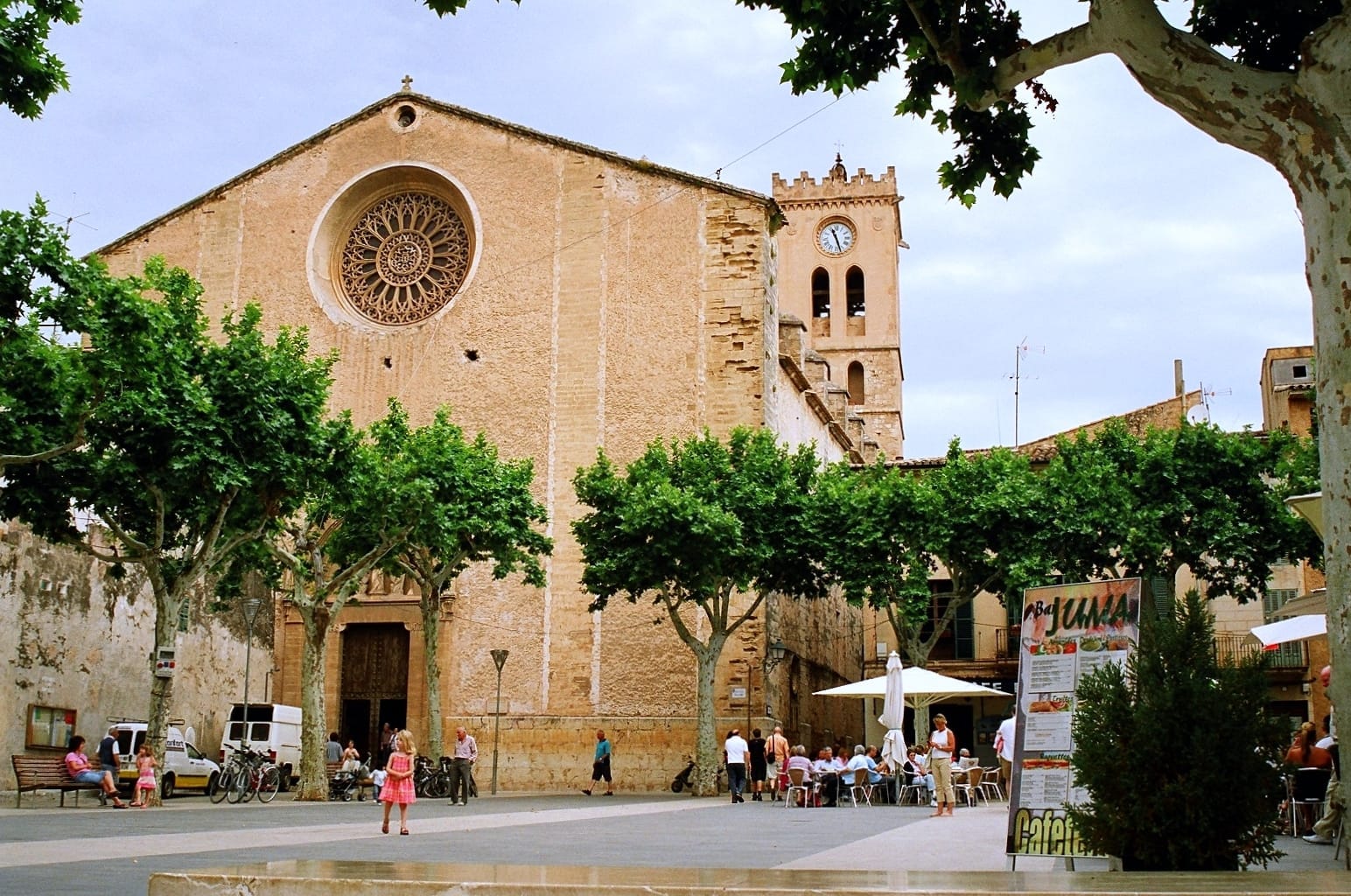
The social heart of Pollença is Plaça Major, a sun-washed square framed by café terraces, the town hall, and the imposing bulk of the Església de Mare de Déu dels Àngels. This parish church was founded in 1236, shortly after the Christian conquest of Mallorca, and gifted to the Knights Templar in 1240 by King Jaume I. What stands today is largely an 18th-century reconstruction, but it incorporates elements of much earlier fabric. The rose window above the main entrance is the detail most photographers focus on, and rightly so — it catches the afternoon light with particular intensity.
The square itself shifts character throughout the day. At 8 AM on a weekday, it belongs to retirees with newspapers and delivery vehicles making their rounds. By mid-morning, café tables fill with visitors. On Sunday mornings from around 8:30 AM to early afternoon, the square and surrounding streets become the site of Pollença's weekly market, one of the better produce and craft markets in northern Mallorca. Vendors sell local olive oil, almonds, pottery, leather goods, and seasonal produce alongside the inevitable tourist handicrafts.
The Sunday market is worth pairing with a broader exploration of northern Mallorca's market towns, though Pollença's version has a more local character than some of the larger tourist-oriented markets elsewhere on the island.
The Pont Romà and the Town's Edges
Despite its name, the Pont Romà (Roman Bridge) at the edge of Pollença dates to the 15th century, built on the site of an earlier structure that may have been associated with a Roman aqueduct. It spans a small stream and is best appreciated in late afternoon when the stone turns amber. The surrounding area is quieter than the town center and gives a sense of how Pollença sits within its agricultural landscape, surrounded by low hills and almond and olive groves.
Walking outward from the center in any direction takes you quickly into narrow lanes where residential Pollença becomes apparent: cats on doorsteps, washing hung across alleys, the occasional sound of a radio from an open window. These peripheral streets are less photographed and more honest about what the town actually is.
The Convent de Sant Domingo and Cultural Life
The former Dominican convent of Sant Domingo, founded in the 16th century, now houses the Museu de Pollença and serves as the venue for the Pollença Music Festival, held each July and August in its open cloister. The festival has run since 1962 and brings international classical musicians to perform in one of the more atmospheric outdoor settings in the Mediterranean. If your visit coincides with the festival season, checking the program is strongly recommended.
The museum inside the convent holds a permanent collection of local archaeology, religious art, and the works of Anglada Camarasa, a Catalan painter who spent decades in Pollença. It is compact but thoughtfully arranged. For context on how this region of Mallorca fits into a broader itinerary, the one-week Mallorca itinerary covers northern stops including Pollença alongside the coast and mountains.
Practical Walkthrough: How to Spend Your Time
The logical sequence for most visitors is to park or alight at the edge of town (the streets leading into the center become very narrow and parking disappears quickly after 10 AM in summer), walk to Plaça Major first to orient yourself, then follow the signs to the Calvari staircase. After descending, the Pont Romà is a ten-minute walk from the square. The convent and museum can fill another hour. The entire circuit covers under 2 km.
⚠️ What to skip
Pollença's cobblestone streets are genuinely uneven throughout the historic center. Sandals with thin soles or heels are uncomfortable for extended walking. Lightweight shoes with good grip are the practical choice, especially for the Calvari steps.
For photography, the Calvari cypress corridor photographs well in both early morning and late afternoon. The church rose window is best shot in afternoon sun. The Plaça Major is shadier in the morning and brighter after midday. The Pont Romà benefits from golden hour light.
Drivers combining Pollença with the wider north should note it pairs naturally with Alcúdia Old Town (20 minutes by road to the east) and with the coastal scenery of the Formentor Peninsula, which begins about 15 km to the northeast.
Honesty Check: What Pollença Is Not
Pollença will disappoint visitors expecting a polished heritage experience with interpretive panels, multilingual audio guides, and a curated tourist circuit. Most of what makes it worthwhile is ambient rather than programmatic: the quality of the light, the texture of the stone, the pace of ordinary life. If you need structured activities and clear entry points, the town may feel underwhelming after an hour.
Similarly, anyone with significant mobility limitations will find the Calvari inaccessible and the streets tiring. The town is not wheelchair-friendly. Families with young children can enjoy Plaça Major and the market but will find the Calvari steps a negotiation with small legs.
Visitors who want to understand how Pollença fits into Mallorca's broader cultural geography might first read through the most beautiful villages in Mallorca guide, which places the town in context alongside Deià, Fornalutx, and others.
Insider Tips
- The Calvari steps are also accessible by a narrow road that loops around the back of the hill — useful if you want to drive up, see the view, and walk down the steps rather than climbing them.
- On Sunday market mornings, parking becomes genuinely difficult by 9:30 AM. Arrive before 9 AM or take the bus from Port de Pollença, which runs regularly in summer.
- The café at the northeast corner of Plaça Major (nearest the church) has the best sightline of the rose window from a seated position. Order coffee early before tables fill.
- The Pollença Music Festival (July and August) offers evening concerts in the Sant Domingo cloister — check pollensaclassica.com for the season program, as tickets sell out for headline concerts.
- Almond trees in the agricultural land around Pollença bloom in late January and February, turning the surrounding countryside white. This is one of the quieter times to visit and arguably one of the most photogenic.
Who Is Pollença Old Town For?
- Travellers who want authentic Mallorcan town life rather than resort infrastructure
- History and architecture enthusiasts interested in medieval Catalan settlement patterns
- Photographers working in the early morning or late afternoon golden hour
- Visitors combining northern Mallorca sites over a full-day drive or road trip
- Anyone visiting during the Pollença Music Festival in July or August
Nearby Attractions
Other things to see while in Alcúdia:
- Alcúdia Old Town
Alcúdia Old Town is the most historically layered settlement in Mallorca, with Talaiotic origins, Roman ruins, and intact 14th-century walls enclosing narrow cobbled streets, a neo-Gothic church, and a twice-weekly market. Entry is free, and the atmosphere shifts dramatically between early morning calm and midday tour-group activity.
- Cala Molins
Cala Molins is one of four sandy coves that make up the Cala Sant Vicenç resort, 7 km from Pollença in northern Mallorca. Backed by pine-covered cliffs and residential houses, it offers fine sand, unusually clear water, and a calmer atmosphere than the island's more famous southern beaches. Entry is free.
- Formentor Peninsula
The Formentor Peninsula stretches 20 kilometres into the Mediterranean from northern Mallorca, combining sheer limestone cliffs, a pine-fringed beach, and a historic lighthouse at its northernmost tip. Access is by mandatory shuttle bus during peak summer hours, so planning matters. Here is what you need to know before you go.
- Playa de Muro
Stretching 6 kilometres along the Bay of Alcúdia, Playa de Muro combines Blue Flag facilities with untouched dune corridors and pine-backed shore. It is one of the longest and most ecologically significant beaches in Mallorca, sitting directly beside S'Albufera Natural Park.