Plaza de las Tres Culturas: Aztec Ruins, Colonial Legacy, and Mexico's Most Significant Protest Site
Plaza de las Tres Culturas in Tlatelolco compresses 700 years of Mexican history into a single city block. Pre-Hispanic pyramidal platforms, a 16th-century Spanish church, and a modernist government complex stand side by side — and the ground beneath carries the memory of the 1968 student massacre that changed the country.
Quick Facts
- Location
- Eje Central Lázaro Cárdenas s/n, Colonia Tlatelolco, Alcaldía Cuauhtémoc, Mexico City
- Getting There
- Metro Line 3 — Tlatelolco station (short walk to plaza)
- Time Needed
- 1 to 2 hours
- Cost
- Plaza free; archaeological zone may charge a small fee — verify on site
- Best for
- History enthusiasts, architecture, photography, students of Mexican politics
- Official website
- mexicocity.cdmx.gob.mx/venues/plaza-de-las-tres-culturas
What Is Plaza de las Tres Culturas?
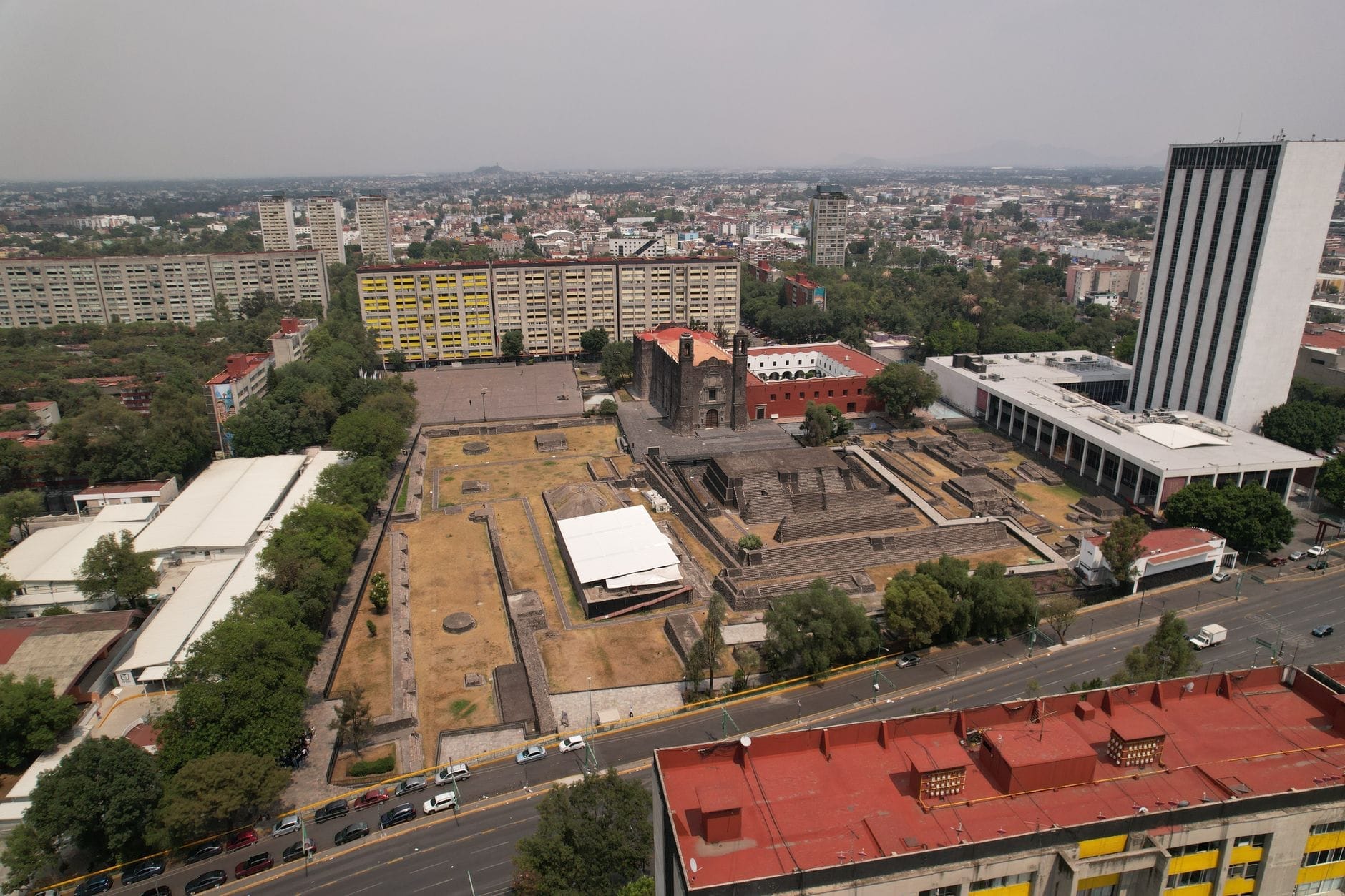
The Plaza de las Tres Culturas — Plaza of the Three Cultures — is one of the most layered public spaces in the Americas. It sits in the Tlatelolco district, north of Mexico City's Historic Center, on the former site of a major Aztec trading city. The name describes what you see when you stand in the middle: the stone ruins of Tlatelolco's pre-Hispanic temples occupy the lower level; the 16th-century Church of Santiago Tlatelolco rises from the middle ground; and the modernist towers of the Conjunto Urbano Nonoalco Tlatelolco form the backdrop. Three eras of Mexican civilization coexisting in uncomfortable, extraordinary proximity.
The plaza was inaugurated in 1964, as a deliberate urban statement. Architect Pedro Ramírez Vázquez, who also designed the Museo Nacional de Antropología, shaped the Secretariat of Foreign Relations building that anchors the complex. The intent was civic pride: a unified Mexico that had absorbed, survived, and synthesized conquest and colonialism. Four years later, the same square became the site of one of the most traumatic events in modern Mexican history.
ℹ️ Good to know
The plaza is open as a public space at all hours. The archaeological zone within it has reported visiting hours of 08:00–18:00 daily, and a small entrance fee may apply to that specific area. Confirm current fees on arrival, as prices are not fixed in advance.
The Three Layers of History
The Pre-Hispanic Level: Tlatelolco's Aztec Ruins
The archaeological remains that form the base of the plaza belonged to Tlatelolco, a city founded around 1337 CE on a separate island in Lake Texcoco from the better-known Tenochtitlan. Tlatelolco was renowned throughout Mesoamerica for its massive tianguis (marketplace), which Hernán Cortés's companion Bernal Díaz del Castillo described as far exceeding any market in Spain. The platforms, staircases, and truncated pyramid visible today represent the civic-ceremonial core of that city.
Walking along the raised pathways around the ruins, you can read the architectural grammar of Aztec construction: stacked platforms indicating successive building phases, each new ruler adding a layer over the previous structure. The stone is porous grey tezontle and limestone, and in the morning light the textures are sharply defined. These are not reconstructed ruins — they are original fabric, exposed and stabilized, and they reward close inspection.
For context on the broader pre-Hispanic world that produced Tlatelolco, the Museo Nacional de Antropología in Chapultepec holds the most comprehensive collection in the country and pairs well with a visit here.
The Colonial Level: Church of Santiago Tlatelolco
The Church of Santiago Tlatelolco was built by Franciscan friars in the 16th century, largely using stone quarried and hauled from the Aztec structures that once surrounded it. The building is severe and fortress-like, its facade worn smooth by centuries of weather and city smog. It is one of the oldest churches in Mexico City still standing on or near its original site.
Inside, the walls carry traces of earlier frescoes, and the space has the cool, dim quality common to colonial-era churches: thick stone walls, high ceilings, the faint smell of melted wax and old wood. The church also holds historical significance as the site where indigenous nobles received education from Franciscan missionaries at the Colegio de Santa Cruz de Tlatelolco, an early colonial institution where Nahuatl texts and histories were preserved. Without this school, much of what we know about Aztec cosmology and poetry would have been lost.
The Modern Level: Ramírez Vázquez's Modernist Complex
The third layer is the concrete and glass Mexico of the mid-20th century. The former Secretariat of Foreign Relations building, known as the Tlatelolco Tower, is a clean International Style structure that represented Mexico's aspirations as a modern nation-state. The broader Conjunto Urbano Nonoalco Tlatelolco housing complex, built in the 1960s under urban planner Mario Pani, was one of the largest social housing projects in Latin American history, designed to rehouse tens of thousands of residents.
Some of those towers were damaged in the catastrophic 1985 earthquake, and the complex today shows its age. It is not a manicured heritage site. It is a living neighborhood where real people have lived for 60 years, and that unglamorous authenticity is part of what makes the place feel authentic.
Tickets & tours
Live prices and dates from our booking partner. If you book, we may earn a commission at no extra cost to you.
A mariachi night in Plaza Garibaldi and dinner at Bellini restaurant
From 143 €Instant confirmationFree cancellationMexico City tour with cooking class and Frida Kahlo Museum visit
From 94 €Instant confirmationFree cancellationPrivate Mariachi night in Plaza Garibaldi and dinner at Bellini
From 207 €Instant confirmationFree cancellationMexico City market secrets guided tour and cooking class
From 42 €Instant confirmationFree cancellation
October 2, 1968: The Massacre That Cannot Be Forgotten
No visit to this plaza is complete without confronting October 2, 1968. Ten days before Mexico City was to host the Olympic Games, the government of President Gustavo Díaz Ordaz ordered security forces to move against a large student demonstration in the plaza. Dozens of students and civilians were killed; the exact death toll remains disputed and was systematically obscured for decades by the Mexican government.
A stone memorial plaque in the plaza reads: 'El 2 de octubre de 1968 no se olvida' — October 2, 1968 is not forgotten. Every year on that date, student marches and commemorative gatherings take place here, drawing crowds from across Mexico City. The memorial is not theatrical or elaborate; it is just text on stone, embedded in the pavement. The understatement is its own kind of force.
The Centro Cultural Universitario Tlatelolco, housed in the former Foreign Relations building, maintains a permanent exhibition — Memorial del 68 — documenting the student movement and the massacre with photographs, documents, and testimonies. This exhibition is serious, carefully curated, and moving. Opening hours and entry conditions for the Centro Cultural should be confirmed directly, as they may vary.
⚠️ What to skip
If you visit on or near October 2, expect large organized marches converging on the plaza. The atmosphere is politically charged and crowds can be dense. This is a meaningful cultural event, but plan your visit accordingly if you are seeking a quieter experience of the archaeological site.
What It Feels Like to Visit
Early morning visits, before 10:00, offer the clearest sense of the ruins and the church. The surrounding streets are quiet, the smog has not yet thickened, and the stone catches low directional light that emphasizes relief and texture. A few locals cut through on their way to work; pigeons cluster around the base of the pyramid. The scale of the ruins is modest compared to sites like Teotihuacan, but the context — the church looming directly over them, the apartment towers beyond — is unlike anything else in the city.
By midday the plaza fills with students from nearby schools, office workers eating lunch on the low walls surrounding the ruins, and occasional tour groups. The sound of traffic on Eje Central Lázaro Cárdenas is constant. This is an urban archaeological site, not a quiet sanctuary, and the noise is part of the experience. You are standing in the middle of a working city with deep historical roots.
Photography works best from the elevated walkway that runs along the perimeter of the ruins, allowing a clean sight line across the stone platforms toward the church facade. In the afternoon, when the sun moves behind the church tower, you lose contrast on the ruins. Overcast days are actually good for even, shadowless detail shots of the stone surfaces.
The Tlatelolco area is a distinct part of the city with its own character. For a broader sense of the neighborhood and nearby sites, see the Tlatelolco-Tepito neighborhood guide.
Getting There and Practical Notes
The most straightforward route is Metro Line 3 (Olive/Green line) to Tlatelolco station. From the station exit, walk north a few minutes along Eje Central Lázaro Cárdenas. The ruins and church are visible from the street. Multiple RTP bus routes also serve the surrounding avenues if you are coming from neighborhoods not served by Line 3.
The area around the plaza is a practical urban neighborhood, not a polished tourist zone. There are street food vendors nearby selling tacos and tortas, small tiendas, and few if any tourist-oriented shops or cafes directly adjacent to the site. Bring water, particularly if you are visiting in the warmer months of March through May when temperatures regularly exceed 25°C.
For practical guidance on navigating Mexico City's public transport network, the getting around Mexico City guide covers the Metro, Metrobús, and ride-hailing apps in detail.
Accessibility across the plaza is limited in some sections. The archaeological zone has uneven stone surfaces and steps, and the surrounding plaza has standard urban paving. Visitors with mobility considerations should note that there is no guarantee of step-free access to all parts of the ruins. The outer plaza and church area are more navigable.
Is This Worth Your Time?
Honestly: this is not an attraction that everyone will find rewarding. The ruins are relatively small compared to what first-time visitors expect from 'Aztec remains.' If you arrive hoping for Teotihuacan-scale grandeur, you will be underwhelmed. The power of the place is conceptual and historical — the collision of three eras, the weight of 1968, the fact that people still live and work in the apartment blocks visible from the ruins.
Travelers seeking the large-scale archaeological experience should prioritize the day trip to Teotihuacan, which is an hour outside the city and offers a completely different scale of pre-Hispanic architecture.
But for anyone seriously interested in Mexico City's history — particularly the 20th century, the student movement, and how the country grapples with political violence — this plaza is essential. The Memorial del 68 exhibition alone justifies the trip. Combine it with a walk through the surrounding streets and the experience becomes a genuine window into how Mexico City contains its own contradictions.
If you're building a multi-day itinerary that includes key historical and cultural sites, the 3-day Mexico City itinerary can help you sequence this alongside the Historic Center and Chapultepec.
Insider Tips
- The Memorial del 68 exhibition inside the former Foreign Relations building is frequently overlooked by visitors who explore only the outdoor ruins. Allow 30–60 minutes for this exhibition — it is one of the most substantive and first-hand accounts of 20th-century Mexican political history available to the general public.
- For the cleanest photographs of the ruins with the church in the background, arrive before 10:00 and position yourself on the northern elevated walkway. By mid-morning the site fills with students on school visits who tend to cluster near the main platform.
- The neighborhood around the plaza has excellent, unpretentious street food. Walk half a block east toward the residential streets of the Tlatelolco housing complex for taco stands and juice carts that cater to local residents rather than visitors — prices reflect it.
- The 1968 memorial plaque set into the paving is easy to walk past without noticing. It is located in the open section of the plaza, not immediately adjacent to the ruins. Look for it deliberately — standing at it for a moment changes how the whole space feels.
- If you are visiting with a Spanish-language guide or reading material, the inscriptions on the church exterior and the informational panels around the ruins reward careful attention. Much of the most significant contextual information is only in Spanish.
Who Is Plaza de las Tres Culturas For?
- History enthusiasts who want to understand Mexico beyond the colonial and pre-Hispanic surfaces
- Architecture and urban design observers interested in mid-20th-century Mexican modernism
- Photographers looking for layered, visually complex compositions that do not appear on every travel feed
- Students and researchers of Latin American political history, particularly the 1968 student movement
- Repeat visitors to Mexico City who have already covered the major tourist circuits and want more depth
Nearby Attractions
Other things to see while in Tlatelolco, Tepito & Santa María la Ribera:
- Santa María la Ribera Moorish Kiosk
An octagonal iron kiosk with a glass dome and Moorish arched columns, the Kiosco Morisco has represented Mexico at three international expositions before finding its permanent home in a leafy neighborhood park. Entry is free, the architecture is extraordinary, and almost no tourists know it exists.
Planning a trip? Discover personalized activities with the Nomado app.