Kiosco Morisco de Santa María la Ribera: Mexico City's Forgotten World's Fair Pavilion
An octagonal iron kiosk with a glass dome and Moorish arched columns, the Kiosco Morisco has represented Mexico at three international expositions before finding its permanent home in a leafy neighborhood park. Entry is free, the architecture is extraordinary, and almost no tourists know it exists.
Quick Facts
- Location
- Alameda de Santa María la Ribera, Cuauhtémoc, Mexico City (corner of Dr. Atl and Salvador Díaz Mirón)
- Getting There
- Buenavista station (Metro Line B, Metrobús Line 3, suburban train) — approx. 8-minute walk
- Time Needed
- 30–60 minutes for the kiosk; 1.5–2 hours if you explore the full neighborhood
- Cost
- Free — the park and kiosk are an open public space with no ticketed entry
- Best for
- Architecture lovers, photographers, and anyone wanting an authentic local park experience away from tourist crowds
What You're Looking At — and Why It Matters
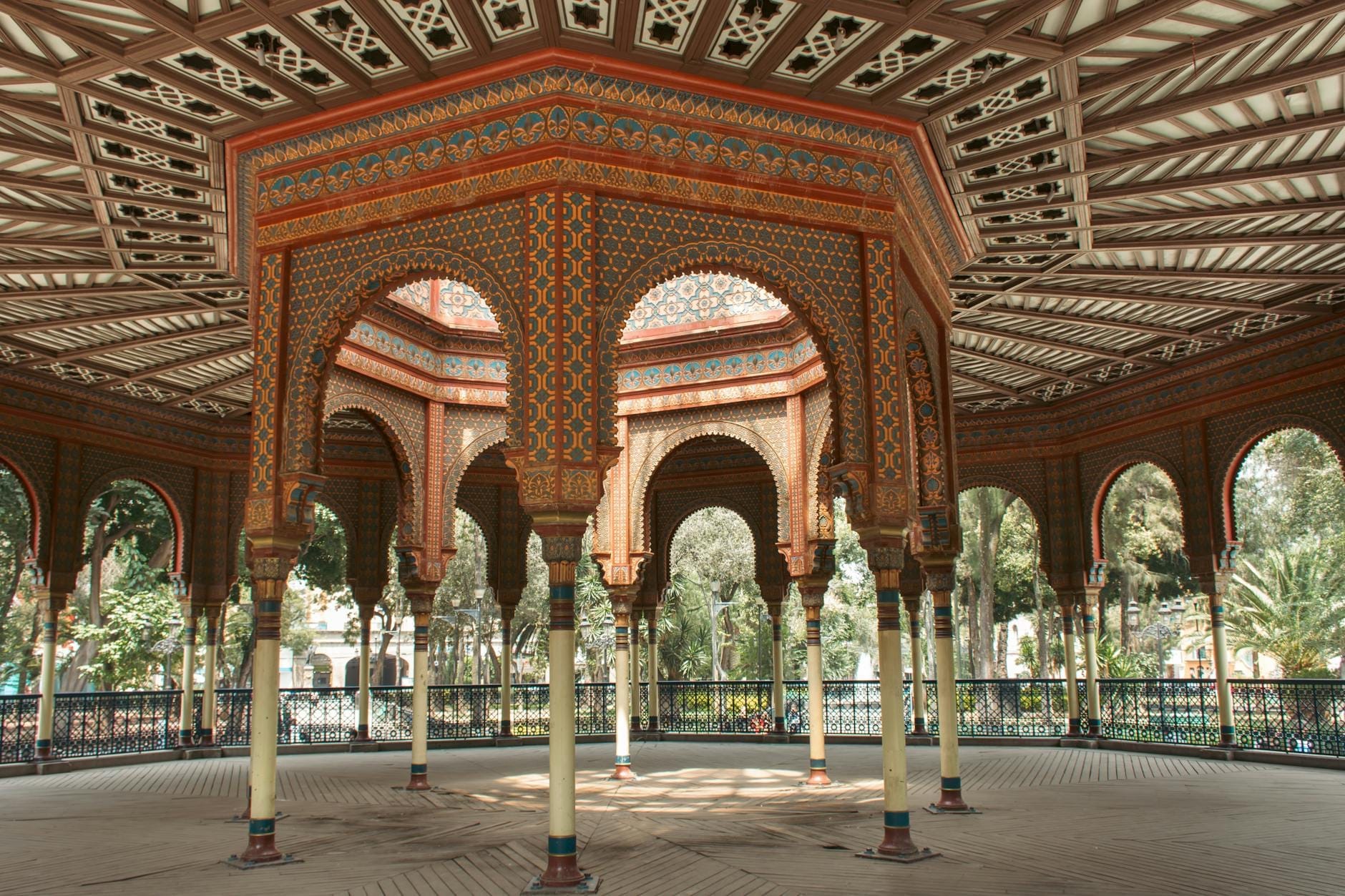
The Kiosco Morisco de Santa María la Ribera is one of the most architecturally singular objects in Mexico City, yet it sits in a residential park that most visitors never find. The structure is an octagonal iron pavilion in the Neo-Mudéjar style — sometimes called Moorish Revival — characterized by slender columns, horseshoe arches, elaborate latticework, and a central dome of iron and glass that catches light differently at every hour of the day. The craftsmanship reads as ornate even by the standards of 19th-century exhibition architecture.
What makes the kiosk exceptional is not just its appearance but its biography. This structure has literally traveled the world. It was designed by engineer José Ramón Ibarrola as Mexico's representative pavilion for the World's Industrial and Cotton Centennial Exposition held in New Orleans in 1884–1885. It then appeared at the 1889 Paris Exposition and is also associated in some accounts with later international expositions before returning permanently to Mexico City. After each international appearance, it was dismantled, shipped, and reassembled. Most World's Fair pavilions are gone. This one is still standing in a Mexico City park, and you can walk up to it for free.
ℹ️ Good to know
The kiosk was declared a National Monument by presidential decree in 1972, and underwent a complete structural and cosmetic restoration in 2003. The ironwork you see today reflects that restoration.
The Setting: Alameda de Santa María la Ribera
The kiosk stands at the center of the Alameda de Santa María la Ribera, a rectangular park shaded by mature trees in the Santa María la Ribera neighborhood, Cuauhtémoc borough. The neighborhood itself developed in the mid-19th century as one of Mexico City's first planned residential expansions beyond the colonial core, and it retains a calm, lived-in quality that contrasts sharply with the density of the Centro Histórico a few kilometers to the east.
The park is local. On weekday mornings, older residents take slow laps along its shaded paths, children from nearby schools cut across on their way home at midday, and vendors sell fruit and snacks from carts near the benches. The air carries the smell of cut grass and roasted corn depending on the time of day. On weekend evenings, the park fills with families, and the kiosk sometimes hosts informal live music or cultural performances organized by the borough. None of this is curated for tourists.
The neighborhood surrounding the park is worth knowing before you arrive. Santa María la Ribera sits just north of the Centro Histórico corridor, close to the Tlatelolco and Tepito area, but with a distinctly quieter, middle-class residential character. The Museo del Chopo, a Gothic iron building that now functions as a contemporary arts venue, is a short walk away and makes a natural pairing with the kiosk if you have extra time.
Tickets & tours
Live prices and dates from our booking partner. If you book, we may earn a commission at no extra cost to you.
A mariachi night in Plaza Garibaldi and dinner at Bellini restaurant
From 143 €Instant confirmationFree cancellationPrivate Mariachi night in Plaza Garibaldi and dinner at Bellini
From 207 €Instant confirmationFree cancellationMexico City night tour with taqueria visit and mariachi performance
From 90 €Instant confirmationFree cancellationPuebla and Cholula guided tour from Mexico City with optional lunch
From 43 €Instant confirmationFree cancellation
The Architecture Up Close
When you approach the kiosk along any of the park's main paths, the structure emerges gradually through the tree canopy. Its iron frame has been painted in deep greens and reds that emphasize the ornamental detailing without overwhelming it. The eight sides of the octagon each feature a set of horseshoe arches — the defining motif of Moorish Revival design — supported by columns with elaborately cast capitals. The visual effect borrows from Spanish-Moorish architecture, the Alhambra tradition filtered through 19th-century European eclecticism and exported to Latin America.
At the center of the structure, the dome rises above you in a pattern of glass panels and iron ribs. On a clear afternoon, sunlight comes through the dome and scatters across the interior floor in a way that rewards standing still for a few moments. The platform of the kiosk is elevated slightly above the surrounding park surface, and you can walk up onto it and look outward through the arches toward the tree canopy. The scale is human — intimate rather than monumental, which makes it feel accessible in a way that larger heritage structures do not.
💡 Local tip
For photography, late morning (around 10–11 am) gives you soft directional light on the ironwork without the harsh shadows of midday. Overcast days are ideal for capturing the dome's interior detail without lens flare.
A World's Fair Pavilion with an Unlikely Journey
The context for the kiosk's creation matters. Mexico in the 1880s was under the government of Porfirio Díaz, a period known as the Porfiriato, characterized by aggressive modernization, foreign investment, and a desire to project Mexico as a modern nation on the world stage. World's Fair participation was central to that project. The choice of a Neo-Mudéjar style for Mexico's pavilion was deliberate — it referenced the pre-colonial civilizations of Spain while simultaneously signaling cosmopolitan cultural sophistication. It was Mexico presenting itself to Europe on European aesthetic terms.
After its international career, the kiosk was reassembled in Mexico City's Alameda Central, the historic park in the Centro Histórico. In 1910, the centennial year of Mexico's War of Independence, it was relocated to its current site in Santa María la Ribera — a move that coincided with the neighborhood's prestige as a desirable residential area. For decades, the kiosk served as the venue for public events including, notably, drawings for the National Lottery, and it has continued to appear in commemorative materials in recent years.
If you want to see where the kiosk originally stood before its 1910 move, the Alameda Central is about 2 kilometers southeast and makes a natural complement to this visit — though the two parks feel very different in character and crowd level.
When to Visit and What to Expect at Different Times
The park is accessible at any hour as an open public space, though the kiosk is most rewarding to visit during the day when the dome is lit from above and the ironwork detail is fully visible. Early weekday mornings, roughly 8–10 am, offer the quietest conditions, with few visitors and favorable soft light before the sun climbs too high. This is the time to photograph the structure without other people in frame.
Weekend afternoons shift the atmosphere considerably. Families occupy the park benches, vendors are more active, and the kiosk itself becomes a backdrop for photographs, quinceañera shoots, and casual gatherings. If the borough has scheduled a weekend event or musical performance at the kiosk, the area can become quite lively. This version of the experience is arguably more interesting for understanding how the structure functions as a living part of the neighborhood rather than a monument.
Rainy season afternoons (roughly May through October) can produce dramatic overcast skies that give the ironwork a saturated, almost theatrical appearance, but heavy afternoon downpours are common in this period. If you are visiting during the rainy season, plan to arrive in the late morning and leave before 3 pm to avoid the daily storm cycle typical of Mexico City's subtropical highland climate.
⚠️ What to skip
Mexico City sits at approximately 2,240–2,250 meters above sea level. If you are new to the altitude, take the walk from Buenavista station slowly and carry water. The park has no official drinking water facilities documented at the kiosk itself.
Getting There and Practical Logistics
The most straightforward approach is from Buenavista station, a major transport interchange roughly an 8-minute walk from the park. Buenavista connects Metro Line B, Metrobús Line 3, and the Suburban Train (Tren Suburbano) that runs north toward Cuautitlán. From the station, head west along Mosqueta or use any cross street toward Dr. Atl. The park occupies the block bounded by Dr. Atl and Salvador Díaz Mirón, and the kiosk is visible from the park's perimeter through the trees.
Ride-hailing apps including Uber and Didi operate throughout Mexico City and can drop you directly at the park entrance. If you are building a half-day around this area, consider combining it with the Plaza de las Tres Culturas in nearby Tlatelolco, which is a short ride northeast and offers an entirely different kind of historical experience.
The park surface and the paths leading to the kiosk are paved and generally flat. The kiosk platform is elevated slightly, but the steps are shallow. Detailed official accessibility information (ramps, accessible restrooms) is not documented in published sources; visitors with specific mobility requirements should verify conditions on arrival. Public restrooms in the park are reported by visitors to exist, though their condition and availability vary.
Worth Your Time?: Is It Worth Your Time?
If you are primarily interested in the kiosk as a structure, the visit takes 30–45 minutes at most. The park itself is pleasant but not large, and there are no adjacent cafes or restaurants directly on the alameda, though the surrounding streets of Santa María la Ribera have a growing number of local spots worth exploring afterward.
Visitors whose priority is major collections or landmark monuments may find this detour unnecessary. But for anyone interested in 19th-century architecture, the Porfiriato period, or Mexico City's less-trafficked neighborhoods, the Kiosco Morisco delivers something genuine: a technically accomplished, historically layered object that sits in an ordinary park being used by ordinary people. It is the kind of thing you will not see reproduced on postcards. For a broader picture of the city's architectural heritage, the guide to Mexico City's lesser-known attractions covers similar territory worth pairing with this visit.
Travelers who dislike destinations without nearby infrastructure (restaurants, cafes, large museums) immediately adjacent may find the neighborhood feels too residential and quiet for a standalone trip. From a pure sightseeing efficiency standpoint, this is a destination that rewards those who enjoy slow, exploratory visits over those running a tight itinerary of major attractions.
Insider Tips
- Walk the full perimeter of the kiosk before stepping onto the platform. The proportions and decorative details change significantly depending on which angle you approach from — the dome reads very differently from directly below versus from the park paths at mid-distance.
- The surrounding Santa María la Ribera neighborhood has a concentration of early 20th-century mansions in various states of preservation. The blocks immediately around the park, particularly along Dr. Atl and Eligio Ancona, are worth a slow walk for anyone interested in Porfiriato-era residential architecture.
- Weekend mornings between 9 and 11 am tend to attract local photographers using the kiosk as a backdrop for portrait sessions, particularly quinceañera and engagement photos. If you want the structure to yourself, early weekday visits are significantly quieter.
- The Museo del Chopo, a contemporary arts museum housed in a Gothic iron structure also dating from the Porfiriato era, is a 10-minute walk from the kiosk and makes a strong architectural pairing for the same visit.
- The kiosk's dome panels have a green tint that casts the interior light in a subtle, cool hue on bright days. This effect is most pronounced between 11 am and 1 pm when the sun is nearly overhead — worth timing if you are visiting specifically for the interior light.
Who Is Santa María la Ribera Moorish Kiosk For?
- Architecture and design enthusiasts interested in 19th-century iron construction and Moorish Revival style
- Photographers seeking an ornate, photogenic structure without the crowds found at more prominent landmarks
- History travelers tracing Mexico's Porfiriato period and World's Fair participation
- Visitors wanting to experience a working-class neighborhood park used by actual residents rather than a tourist-facing attraction
- Anyone building a half-day itinerary in northern Cuauhtémoc who wants a free, unhurried stop
Nearby Attractions
Other things to see while in Tlatelolco, Tepito & Santa María la Ribera:
- Plaza de las Tres Culturas
Plaza de las Tres Culturas in Tlatelolco compresses 700 years of Mexican history into a single city block. Pre-Hispanic pyramidal platforms, a 16th-century Spanish church, and a modernist government complex stand side by side — and the ground beneath carries the memory of the 1968 student massacre that changed the country.
Planning a trip? Discover personalized activities with the Nomado app.