Pera Museum: Istanbul's Most Rewarding Private Art Space
Set inside a restored 19th-century hotel on Meşrutiyet Caddesi, Pera Museum blends Ottoman cultural artifacts with ambitious international loan exhibitions. It's compact enough to explore in two hours but rich enough to reward a longer stay.
Quick Facts
- Location
- Meşrutiyet Caddesi No. 65, Tepebaşı, Beyoğlu, Istanbul
- Getting There
- M2 metro to Şişhane, then 5–10 min uphill walk; or T1 tram to Karaköy then uphill on foot
- Time Needed
- 1.5 to 2.5 hours for permanent collection; add 45–60 min for major temporary shows
- Cost
- Full 300 TL, Concession 150 TL, Groups (10+) 200 TL/person. Students free on Wednesdays.
- Best for
- Art lovers, Ottoman history enthusiasts, travelers seeking serious culture near İstiklal Avenue
- Official website
- www.peramuseum.org
What Is Pera Museum and Why Does It Matter?
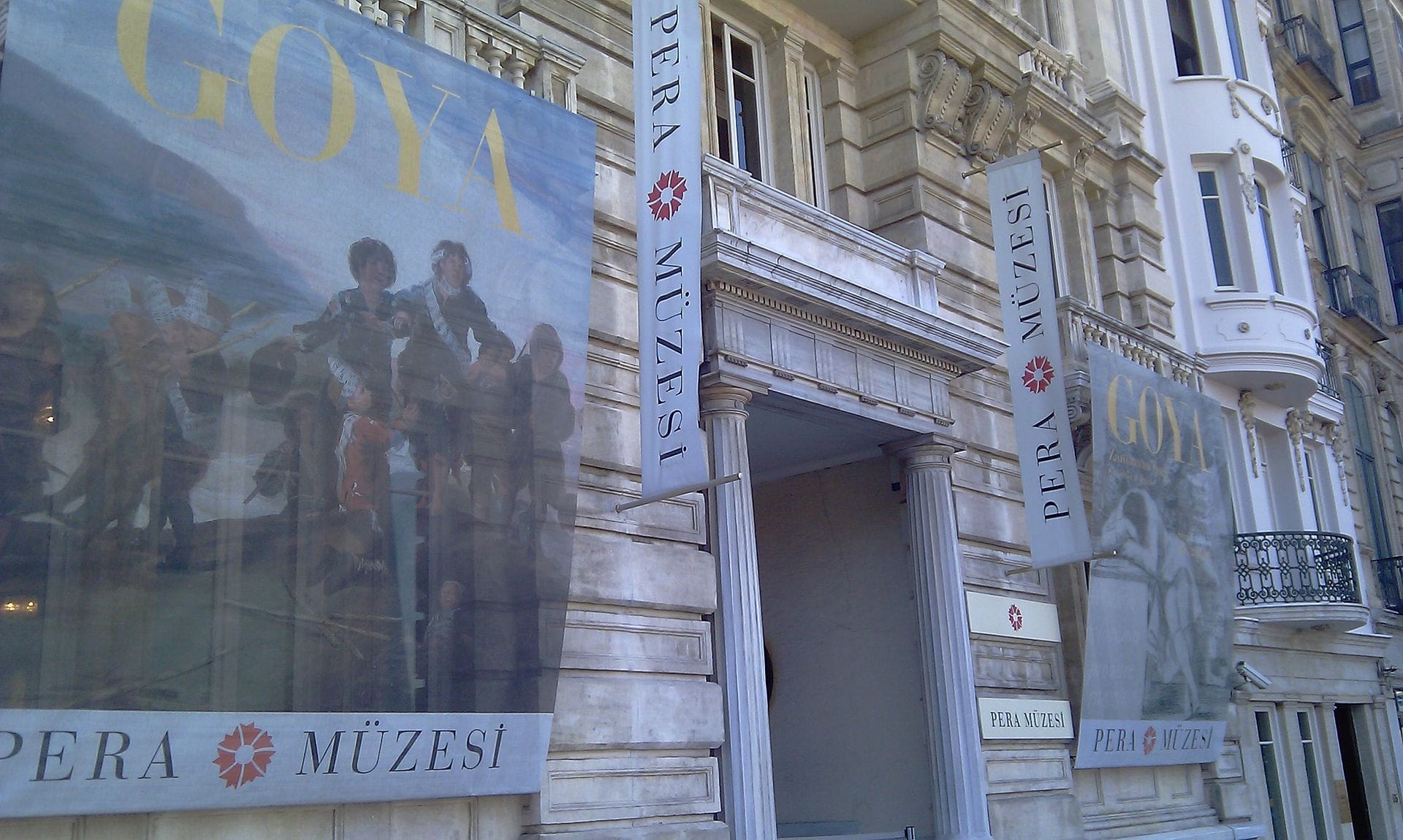
Pera Museum (Pera Müzesi) opened on 8 June 2005 as a private institution funded by the Suna and İnan Kıraç Foundation, one of Turkey's most significant cultural philanthropies. It occupies the former Bristol Hotel, a late 19th-century building designed by architect Achille Manoussos in the Tepebaşı quarter of Beyoğlu. The restoration kept the building's ornate facade while converting its interior into six floors of modern gallery space with proper climate control, freight elevators, and the infrastructure needed to host international touring exhibitions.
What separates Pera from the large state museums clustered around Sultanahmet is its curatorial ambition. The permanent collection holds three distinct pillars: Orientalist paintings depicting the Ottoman world through 18th and 19th-century European eyes, a rare assembly of Anatolian weights and measures spanning centuries of commercial history, and Kütahya tiles and ceramics tracing the evolution of one of Turkey's most distinctive ceramic traditions. Temporary exhibitions, often loaned from major European institutions, run alongside the permanent galleries and have brought works by Picasso, Frida Kahlo, and Goya to Istanbul.
💡 Local tip
Students with valid ID can enter free every Wednesday. For everyone else, Friday evenings from 18:00 to 22:00 are free admission and usually quieter: the museum stays open until 22:00, crowds thin dramatically after 18:00, and the galleries feel contemplative.
The Permanent Collection: Three Floors Worth Knowing
Orientalist Paintings
The Orientalist painting collection is the museum's most visually immediate floor. These are large-format canvases by European artists who traveled to the Ottoman Empire between roughly 1750 and 1900, documenting bazaars, hammams, Bosphorus shores, and court life with a mixture of ethnographic curiosity and Romantic idealization. The collection includes works by Jean-Léon Gérôme, Fausto Zonaro (official painter to Sultan Abdülhamid II), and other artists whose names are less familiar in Western museums but whose works carry real historical weight here, on the ground where they were made.
Osman Hamdi Bey's 'The Tortoise Trainer' is the painting most visitors come to see. Hamdi Bey was one of the first major Ottoman painters trained in the Western academic tradition, and this 1906 canvas, showing a robed figure coaxing tortoises with a reed flute, operates on multiple levels: as genre painting, as subtle cultural commentary, and as a technically accomplished work that holds its own against contemporaneous European canvases. The original is held by the Pera Museum and reproductions appear across Istanbul, but seeing the actual scale and surface texture of the painting is a different experience from any reproduction.
Anatolian Weights and Measures
This collection is less immediately glamorous than the paintings but arguably more historically specific. Weights and measures were the infrastructure of Ottoman commerce: standardized, regulated, and distributed across the empire's trade networks. The Kıraç Foundation assembled an exceptional range of these objects, from delicate balance weights to large grain measures, covering Byzantine, Seljuk, and Ottoman periods. For visitors with an interest in economic history or material culture, this floor rewards close attention. For others, it reads as a curiosity best seen quickly.
Kütahya Tiles and Ceramics
Kütahya, a city in western Anatolia, developed a ceramic tradition running parallel to the better-known İznik style. Where İznik pieces tend toward formal court production, Kütahya wares were often made for export, for the Armenian Christian community, and for everyday Ottoman urban use, which gives them a more eclectic visual range. The museum's collection spans wall tiles, coffee cups, figurative plates, and large decorative panels, with examples dating from the 17th century through to the 20th century.
Tickets & tours
Hand-picked options from our booking partner. Prices are indicative; availability and final rates are confirmed when you complete your booking.
Bosphorus sunset cruise on luxury yacht with guide
From 55 €Free cancellationIstanbul and Bosphorus cruise on private boat - half day afternoon tour
From 40 €Instant confirmationFree cancellationWhirling Dervishes live show and exhibition
From 29 €Instant confirmationBasilica Cistern fast-track entry ticket and optional audio guide
From 34 €Instant confirmation
How the Museum Feels at Different Hours
Arriving at 10:00 on a weekday puts you in the museum before the guided tour groups, which typically arrive between 10:30 and 11:30. The light in the Orientalist galleries in the morning is controlled and artificial, so time of day does not affect the viewing experience inside, but the entrance hall and the small museum café at the ground level catch early morning quiet before the street outside on Meşrutiyet Caddesi fills with the traffic and noise of a full Beyoğlu workday.
Midday on weekends brings the heaviest crowds, particularly when a major temporary exhibition is running. The stairwells narrow, and the Tortoise Trainer gallery can become congested enough to make close looking difficult. If you arrive between 14:00 and 16:00 on a Saturday during a popular loan show, factor in that other visitors will be sharing the gallery with you.
Friday evenings after 18:00 are the best-kept practical secret of the museum. The extended hours until 22:00 draw a younger local crowd, often couples and small groups who visit after dinner in the Asmalımescit neighborhood immediately below. The atmosphere shifts from formal museum visit to something more relaxed, the café at the ground floor sees more traffic, and the upper galleries are genuinely uncrowded.
ℹ️ Good to know
The museum is closed on Mondays. Opening hours: Tuesday to Saturday 10:00–19:00, Friday 10:00–22:00, Sunday 12:00–18:00. Check the official site for holiday closures before visiting.
Getting There: The Practical Reality
Pera Museum sits on Meşrutiyet Caddesi in Tepebaşı, a few minutes' walk from the upper end of İstiklal Avenue. The M2 metro line's Şişhane station is the most direct public transport option: exit toward Tepebaşı, walk uphill on Yüksek Kaldırım or Galip Dede Caddesi for roughly five to ten minutes, and Meşrutiyet Caddesi will be ahead of you. The museum entrance is clearly marked at No. 65.
Alternatively, the T1 tram to Karaköy deposits you at the bottom of the Galata hill. From Karaköy, it is a 15-minute uphill walk past the Galata Tower and through the neighborhood of Galata into Tepebaşı. This walk is worth doing if you have time: the streets between Karaköy and Tepebaşı are full of instrument workshops, independent bookshops, and old apartment facades that give a clear sense of what this part of Beyoğlu looked like before the main shopping strips took over.
Taxis and ride-hailing apps (Uber, BiTaksi) can drop you directly at the entrance. Traffic in Beyoğlu during peak hours can be slow, but the distances from Taksim Square or Karaköy are short enough that a taxi is rarely worth it over walking.
Temporary Exhibitions: The Real Draw for Repeat Visitors
Pera's temporary exhibition programme is where the museum's ambition becomes most visible. The foundation has the resources and institutional relationships to borrow significant works from European and American museums, and the resulting shows have brought Goya prints, a Frida Kahlo retrospective, and works from the collections of the Hermitage and the Prado to Istanbul. These exhibitions run for several months each and are heavily promoted, so checking the current programme before planning a visit is worth the two minutes it takes.
Temporary exhibitions occupy the lower floors and often have their own ticketing or supplement structure; the standard admission price typically covers both permanent and temporary galleries, but this should be confirmed at the box office or on the official Pera Museum website before your visit. For travelers with a broader museum itinerary, it is also worth reviewing the Istanbul Museum Pass to see whether it applies here — the Pera Museum operates independently as a private institution and may not be included.
The Building and Its Neighborhood Context
The former Bristol Hotel dates from the late 19th century, a period when Pera (the European name for Beyoğlu during the Ottoman era) was the diplomatic and commercial quarter of the city, home to European embassies, Levantine merchants, and the grande hotels that served them. Walking along Meşrutiyet Caddesi today still gives a sense of that layer of Istanbul: the Pera Palace Hotel is a few hundred meters away on the same street, the French consulate is nearby, and the facades of late Ottoman apartment buildings survive between newer commercial insertions.
Immediately downhill from the museum, the Asmalımescit neighborhood offers some of the best meyhane dining in Istanbul, traditional taverns serving raki and meze in a format unchanged for generations. Visiting Pera Museum in the late afternoon and continuing into Asmalımescit for dinner makes for a coherent and satisfying half-day. For a wider view of what Beyoğlu offers beyond the museum, İstiklal Avenue is a five-minute walk uphill and connects the museum to Taksim Square and the full range of the district's restaurants, music venues, and shops.
Practical Notes: What to Bring and What to Expect
Photography without flash is permitted in the permanent collection galleries; some temporary exhibitions restrict photography entirely, so check the signage when you enter each floor. The museum has a coat and bag check at the entrance, which is worth using if you are carrying a heavy bag: the stairwells are narrow in sections and large backpacks become inconvenient.
The building has elevator access to the main gallery floors, which makes the visit navigable for visitors with mobility limitations. However, some transition areas between floors involve short flights of steps, and the entrance itself has a small step. Anyone with specific accessibility requirements should contact the museum directly at +90 (212) 334 99 00 or info@peramuzesi.org.tr before visiting.
The ground floor café is small but competent: espresso drinks, tea, and light snacks. It is more of a pause point than a destination in itself. For a proper meal, the streets immediately around the museum have far better options at comparable prices.
⚠️ What to skip
Ticket prices are listed in Turkish lira and can change. The figures given here (Full 300 TRY, Concession 150 TRY, Groups 200 TRY) were current at the time of writing. Verify current prices at peramuseum.org before your visit, especially if you are budgeting for a group.
Insider Tips
- The museum's Friday evening extension to 22:00, with free admission from 18:00 to 22:00, is not well promoted outside Turkish cultural listings. Arrive at 18:30 and you will have the Orientalist galleries largely to yourself while most of the day's tourists have moved on.
- Students with a valid ID enter free every Wednesday — not just discounted, but free. This applies regardless of nationality, so carry proof of enrollment.
- The Tortoise Trainer hangs in the Orientalist collection on an upper floor. Go there first before any temporary exhibition crowds build, then work your way downward through the building.
- Meşrutiyet Caddesi has limited parking and the side streets in Tepebaşı fill quickly on weekends. Coming by metro (Şişhane) takes any transport stress out of the visit entirely.
- The museum shop on the ground floor stocks a small but well-chosen selection of art books, including catalogues from past temporary exhibitions. These are not available elsewhere in Istanbul and make a more specific souvenir than the generic items sold near the major monuments.
Who Is Pera Museum For?
- Art lovers wanting to see Orientalist painting in its geographic and historical context
- Travelers interested in Ottoman material culture who have already covered the major state museums
- Anyone whose visit coincides with one of the museum's major international loan exhibitions
- Students and younger visitors who can take advantage of free Wednesday entry
- Visitors combining a museum afternoon with an evening in the Asmalımescit meyhane district
Nearby Attractions
Other things to see while in Beyoğlu:
- Çukurcuma Antique Quarter
Tucked between Cihangir and Galatasaray in Beyoğlu, the Çukurcuma Antique Quarter is a steep tangle of cobbled streets lined with over 150 antique and second-hand shops. Free to explore and steps from İstiklal Avenue, it rewards slow walkers with Ottoman brass, Soviet cameras, and vintage curiosities spilling out of storefronts onto the pavement.
- Galata Mevlevi Museum
Tucked along Galip Dede Street in Beyoğlu, the Galata Mevlevi Museum occupies a 15th-century dervish lodge that once formed the spiritual heart of Istanbul's Mevlevi Sufi order. Today it houses rotating collections of calligraphy, musical instruments, and ceremonial objects, arranged around a serene courtyard that feels worlds away from the crowds of nearby İstiklal Avenue.
- İstiklal Avenue
İstiklal Caddesi stretches 1.4 km through the heart of Beyoğlu, connecting Tünel Square to Taksim Square along a corridor of Belle Époque apartment buildings, independent bookshops, historic churches, and the iconic nostalgic tram. Free to walk at any hour, the avenue rewards visitors who go beyond the obvious and turn into its side streets.
- Museum of Innocence
Housed in a 19th-century wooden house in Çukurcuma, the Museum of Innocence transforms Orhan Pamuk's celebrated novel into a physical collection of over a thousand objects from everyday Istanbul life. Winner of the European Museum of the Year Award 2014, it is one of the most original museum experiences in Turkey.