Parque de la Memoria: Buenos Aires' Memorial to the Disappeared
Parque de la Memoria is a 14-hectare open-air memorial on the northern riverfront of Buenos Aires, dedicated to the victims of state terrorism between 1976 and 1983. Free to visit and open daily, it combines a monumental wall of names, international sculpture, and exhibition space into one of South America's most thoughtfully designed sites of remembrance.
Quick Facts
- Location
- Av. Costanera Norte Rafael Obligado 6745, beside Ciudad Universitaria, Buenos Aires
- Getting There
- No Subte line reaches directly; several bus lines (colectivos) serve Costanera Norte. Check the official site for current route numbers.
- Time Needed
- 1.5 to 3 hours, depending on whether you visit the Sala PAyS exhibition
- Cost
- Free (entrada libre y gratuita)
- Best for
- History, reflection, contemporary sculpture, riverside walks, education
- Official website
- parquedelamemoria.org.ar/en
What Parque de la Memoria Actually Is
Parque de la Memoria, whose full official name is Parque de la Memoria – Monument to the Victims of State Terrorism, is not a conventional park and it is not a conventional museum. It is a purpose-built memorial landscape covering roughly 14 hectares on the western bank of the Río de la Plata, created in 1998 by the Legislature of the City of Buenos Aires to honor those who were killed or forcibly disappeared during the period of state terrorism between 1969 and 1983. The figure most associated with that era is 30,000 disappeared, though the monument itself records the names of those whose cases have been officially documented and verified.
The site sits immediately north of Ciudad Universitaria, the main campus of the University of Buenos Aires, in a part of the riverfront that feels genuinely removed from the city center. There are no souvenir stalls, no concession stands visible from the monument itself, and almost no noise apart from wind off the river and the occasional plane descending toward Aeroparque. That physical separation, deliberate or not, gives the place a quality of stillness that is rare in Buenos Aires.
ℹ️ Good to know
Opening hours differ slightly between weekdays and weekends. The park is open Monday to Sunday including holidays; on weekdays it closes at 18:00, while on Saturdays, Sundays and holidays it stays open until 19:00. The Sala PAyS indoor exhibition closes earlier: Tuesday to Friday until 17:00, and Saturday, Sunday and holidays until 18:00. Verify current hours at parquedelamemoria.org.ar before visiting. Verify current hours at parquedelamemoria.org.ar before visiting.
The Monument: A Wall of Names Along the River
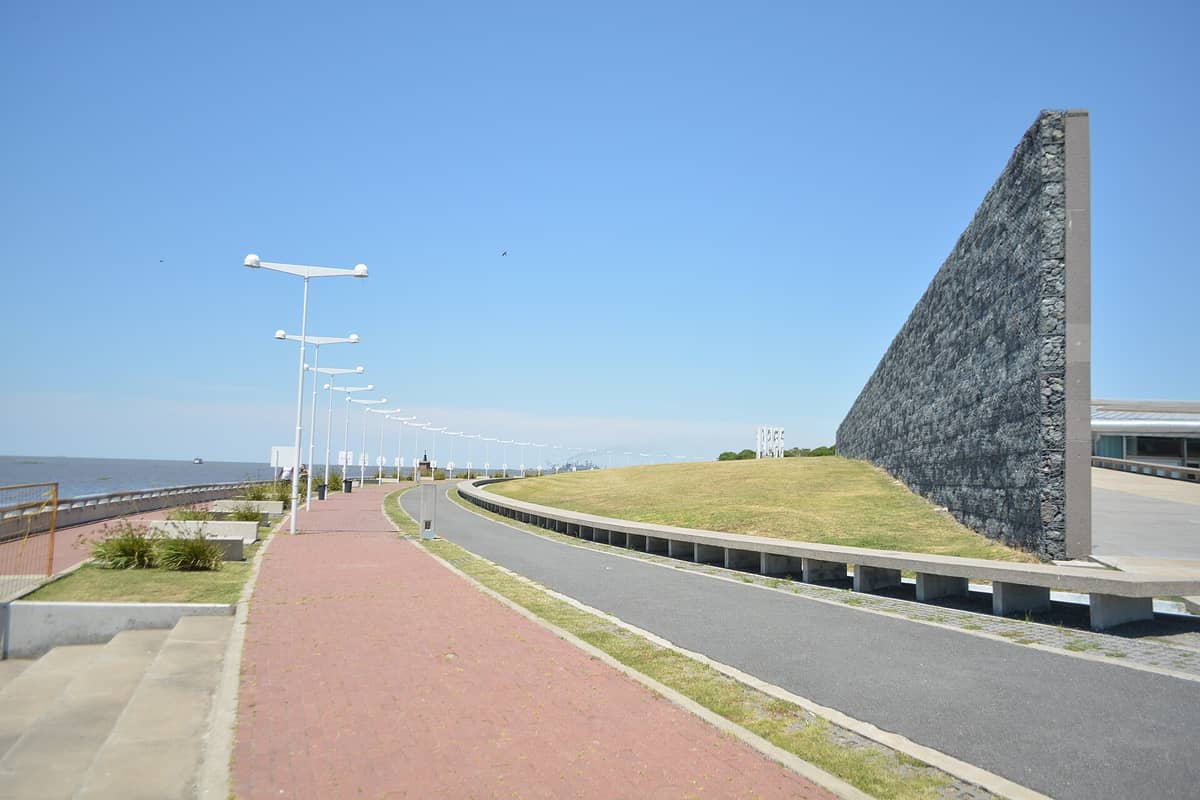
The central structure is a long, zigzagging wall of pink granite panels that winds along the riverbank. Engraved on those panels are the names, ages, and professions of the victims: students, workers, teachers, journalists, lawyers, pregnant women, children. The demographic range is striking. The panels are organized by year, and you move through the memorial chronologically, the names becoming denser in the peak years of the military dictatorship between 1976 and 1983.
The wall is not tall. It sits low enough that you are looking at names at roughly eye level or slightly below, which creates a different physical relationship than, say, a towering cenotaph. You find yourself leaning in, reading individual entries. Some panels have flowers laid against them. The pink granite turns a deep rose color in afternoon light, particularly in the hour before the park closes, which makes late-afternoon one of the more visually affecting times to visit.
There are gaps in the wall, narrow passages that cut through it toward the river. These are architectural devices that function as pauses in the reading of the monument, moments where the Río de la Plata appears directly in front of you. The river is not incidental to the site's meaning: during the dictatorship, many victims were thrown from aircraft into the Río de la Plata and the Atlantic Ocean in what became known as the death flights. The river view is not scenic in the conventional sense; it is part of the memorial itself.
Tickets & tours
Live prices and dates from our booking partner. If you book, we may earn a commission at no extra cost to you.
Parque de la Costa amusement park tickets with transfer
From 79 €Instant confirmationFree cancellationMadero Tango Show tickets with optional dinner
From 32 €Instant confirmationFree cancellationBuenos Aires small-group city tour with optional lunch and cruise
From 25 €Instant confirmationFree cancellationPiazzolla Tango Show VIP tickets with transfer and optional dinner
From 112 €Instant confirmationFree cancellation
The Sculpture Park: International Art in a Charged Landscape
Distributed across the 14 hectares are more than a dozen large-scale sculptures by Argentine and international artists, selected through an open competition and installed progressively from the early 2000s onward. The works range in style from figurative to abstract, and they are integrated into the landscape rather than displayed on pedestals. You encounter them while walking between sections of the monument, often when you are not expecting them.
Several pieces deal directly with themes of absence, memory, and the body. Others are less explicitly referential but take on weight from their setting. Walking between sculptures in this context is not the same as walking through a conventional sculpture garden: the works activate differently here. Artists including William Tucker, Dennis Oppenheim, and Roberto Aizenberg contributed pieces, alongside Argentine sculptors whose work is less known internationally.
Photography is permitted throughout the outdoor areas, and the sculptures offer interesting compositional opportunities against the flat expanse of the river. Early morning light from the east hits the river-facing sections well, though the park does not open until 10:00, which limits the golden-hour window considerably in summer months.
Sala PAyS: The Indoor Exhibition Space
The Sala PAyS (which stands for Presentes, Ahora y Siempre, a phrase from Argentine human rights protest culture meaning Present, Now and Always) is a contemporary art and memory exhibition space within the park. It hosts rotating exhibitions, generally with a focus on art that engages with recent history, human rights, and political memory. The programming changes, so it is worth checking the official site before your visit to see what is currently showing.
The space itself is modest in scale compared to major Buenos Aires museums, but the exhibitions are consistently serious and well-curated. It functions as a complement to the outdoor monument rather than a separate attraction, and most visitors move between the two in the same visit. Allow at least 30 to 45 minutes for the Sala PAyS if it has an active exhibition.
💡 Local tip
Guided visits and educational group visits can be arranged in advance through the park's education program. Individual visitors can also join free guided tours on certain days; check the official website for the current schedule. A guide changes the experience significantly, particularly for non-Argentine visitors unfamiliar with the specific history.
Historical Context: Why This Memorial Exists
The military junta that took power in Argentina in March 1976 implemented a systematic program of abduction, torture, and killing that targeted political opponents, activists, intellectuals, and perceived dissidents. The period of organized state violence that the memorial addresses spans from 1969 to 1983, encompassing the pre-coup period as well as the military government years. Argentina's official truth commission, the CONADEP, documented thousands of cases and produced the landmark report Nunca Más (Never Again) in 1984. For deeper context on this history as it intersects with Buenos Aires, the site at Espacio Memoria (the former ESMA detention center) offers a more forensic engagement with the physical infrastructure of the repression, while Parque de la Memoria focuses on commemoration and the names of the victims.
The park was created by a law passed by the Buenos Aires City Legislature in 1998, driven in part by human rights organizations, particularly the Madres and Abuelas de Plaza de Mayo, whose decades of activism kept the issue in public consciousness through the post-dictatorship years. The project involved extensive public debate about how to memorialize mass atrocity in urban space, and its design reflects that process: it is neither triumphalist nor purely mournful, but insistently specific, insisting on individual names over abstracted numbers.
Understanding the Buenos Aires that exists around this memorial requires some sense of the political and social history that shaped the city's identity since the return to democracy in 1983. The Plaza de Mayo in the city center is directly connected to this history: it was and remains the site of weekly marches by the Madres de Plaza de Mayo, and visiting both locations in a single day gives a more complete picture of how Buenos Aires has processed and continues to process its recent past.
How the Experience Changes by Time of Day and Season
On weekday mornings, particularly Tuesday to Thursday, the park tends to be quiet. Occasional school groups arrive for organized educational visits, and their presence, students moving in clusters with a guide, is a reminder of the site's ongoing pedagogical function. Weekends bring more independent visitors, including international tourists, and the atmosphere is slightly more populated without ever becoming crowded in the way that central Buenos Aires attractions can.
Weather affects the experience considerably. In summer (December to February), temperatures regularly exceed 30°C, and the park has almost no shade. The open riverside setting means sun exposure is constant, and the granite surfaces of the monument retain heat. Bring water, wear a hat, and consider arriving close to opening time at 10:00 before the heat builds. In winter (June to August), the riverfront can be cold and windy even when temperatures are mild by European standards, around 8 to 15°C. A windproof layer makes the difference between a reflective visit and an uncomfortable one.
Spring (September to November) and autumn (March to May) are the most comfortable seasons for a sustained visit. Temperatures are moderate, the riverside light is often clear and low-angled, and the park's landscaping, which includes grass slopes and planted areas, looks its best in spring growth.
⚠️ What to skip
The park is located on the northern Costanera, which is not served directly by the Subte. Getting here without a car requires a bus (colectivo) or a taxi or ride-hailing service. Do not underestimate transit time when planning around the closing hour.
Practical Walkthrough: What to Expect When You Arrive
Entry is through a gate off Avenida Costanera Norte Rafael Obligado, adjacent to the university campus. There is no admission fee and no ticket queue. The site is broadly flat and the main paths are paved, making it accessible for wheelchairs and strollers, though some of the sloped grass areas between sculptures are less easily navigated.
Most visitors walk the monument wall first, then move through the sculpture park, then check the Sala PAyS before leaving. This circuit takes between 90 minutes and two and a half hours at a reflective pace. There are benches along the riverside sections where visitors frequently sit and look out over the water. There is no cafe or restaurant inside the park, and no vending machines visible from the main visitor areas. Eat or drink before you arrive, particularly in warmer months.
If you are combining this visit with other sites related to human rights history and memory, the nearby Espacio Memoria at the former ESMA is a short distance away and can be visited in the same day. For a broader cultural day in Buenos Aires, the best museums in Buenos Aires guide covers a range of options across different neighborhoods.
Who Might Not Find This Worthwhile
Visitors with no prior knowledge of Argentine history and no interest in acquiring it during the visit will find the monument difficult to engage with. The names on the wall are the primary content, and without some sense of who those people were and the context of their deaths and disappearances, the experience risks becoming purely visual. It is not an attraction that explains itself through spectacle.
Families with very young children may find the mood and content challenging to manage. The site is not designed for children to run around, and the subject matter requires explanation that is not always easy to provide on the spot. The Sala PAyS sometimes contains graphic or disturbing imagery in its exhibitions. None of this is a reason to avoid the park with older children, but younger visitors need preparation.
Travelers who are short on time and trying to cover Buenos Aires' central neighborhoods will find the location logistically awkward. The northern Costanera sits away from the standard tourist circuit, and getting here and back consumes at least an hour of transit. For visitors on a strict two or three day itinerary, other sites in the city center may be more efficiently reached.
Insider Tips
- The monument wall faces east toward the river. In the late afternoon, as the sun moves west, the pink granite shifts to a deeper rose tone and the shadows cast by the engraved letters become more pronounced and legible in photographs. If you want to photograph the wall, late afternoon visits on weekdays are better than midday.
- The park hosts occasional evening events, including commemorations on significant dates such as March 24 (the anniversary of the 1976 coup, now a national public holiday called Día Nacional de la Memoria por la Verdad y la Justicia). These gatherings draw large crowds and give a completely different sense of the site's living function in Argentine society.
- Guided visits in English can be arranged in advance through the education department. The standard walk-in experience provides minimal interpretive signage in English, so requesting a guide or downloading the Spanish-language park map and using a translation tool before visiting improves comprehension significantly.
- The sculptures are spread across the full 14 hectares, and some are positioned away from the main monument circuit. If you only follow the paved path near the wall, you will miss several works. Pick up the site map at the entrance and use it to locate the outlying pieces.
- The stretch of Costanera Norte immediately outside the park has food trucks and casual restaurants that are popular on weekends. They are a practical option for lunch before or after your visit, particularly on warm days when you will want to sit outside.
Who Is Parque de la Memoria For?
- Travelers with an interest in 20th-century Latin American history, human rights, and political memory
- Contemporary art visitors who want to see sculpture in a context that goes beyond gallery aesthetics
- Educators and students doing research or structured learning visits to Buenos Aires
- Visitors seeking a quieter, reflective counterpoint to the density and noise of central Buenos Aires
- Photographers interested in the combination of architectural memorial forms, riverscape, and outdoor sculpture
Nearby Attractions
Combine your visit with:
- Cementerio de la Chacarita
Larger and less visited than its famous counterpart in Recoleta, Cementerio de la Chacarita is a vast urban cemetery spanning multiple city blocks in the Chacarita neighborhood. Free to enter, it holds the tombs of cultural icons including tango legend Carlos Gardel, and its monumental mausoleums, wide internal avenues, and layers of Argentine social history make it one of the most atmospheric and underappreciated sites in the city.
- Colonia del Sacramento (Uruguay)
Colonia del Sacramento, Uruguay's oldest city and a UNESCO World Heritage Site, sits just across the Río de la Plata from Buenos Aires. Its Barrio Histórico packs cobblestone lanes, Portuguese-era walls, and a working lighthouse into a compact quarter that most visitors can absorb in a single afternoon.
- Espacio Memoria y Derechos Humanos (ex-ESMA)
Built on the grounds of one of Argentina's most notorious clandestine detention centers, Espacio Memoria y Derechos Humanos (ex-ESMA) is a 17-hectare memorial complex in northern Buenos Aires dedicated to human rights and collective memory. Entry is free, the site has regular daily opening hours, and a visit here is one of the most sobering and important experiences the city offers.
- Estadio Monumental (River Plate)
The Estadio Más Monumental Antonio Vespucio Liberti is more than a football ground. Home to Club Atlético River Plate and the largest stadium in South America, it holds around 85,000 spectators and carries decades of Argentine football history. Whether you visit on a quiet Tuesday morning or a roaring match day, the scale and atmosphere of El Monumental is unlike anything else in Buenos Aires.
Planning a trip? Discover personalized activities with the Nomado app.