Palmitos Park: Gran Canaria's Subtropical Wildlife Park in a Ravine
Palmitos Park is a botanical and zoological park set inside a dramatic mountain ravine about 10 km from Maspalomas. It combines tropical bird collections, a dolphinarium, an aquarium, an orchid house, and a butterfly house in a single sprawling site. It is one of the south's most enduring family attractions, though the terrain demands comfortable shoes and realistic expectations.
Quick Facts
- Location
- Barranco de Los Palmitos S/N, 35109 Maspalomas, San Bartolomé de Tirajana, Gran Canaria
- Getting There
- Best reached by taxi or rental car from Maspalomas or Playa del Inglés; organized transfers with tickets available through local agencies
- Time Needed
- 3 to 5 hours to see the main areas; a full day if you attend all shows
- Cost
- Adults (11+) approx. €39, Children (5–10) approx. €29, Mini (3–4) approx. €15, Under 3 free. Verify current prices at the official site before visiting.
- Best for
- Families with children, wildlife and bird enthusiasts, botanical garden lovers, overcast days when the beach loses its appeal
- Official website
- palmitospark.es/en
What Palmitos Park Actually Is
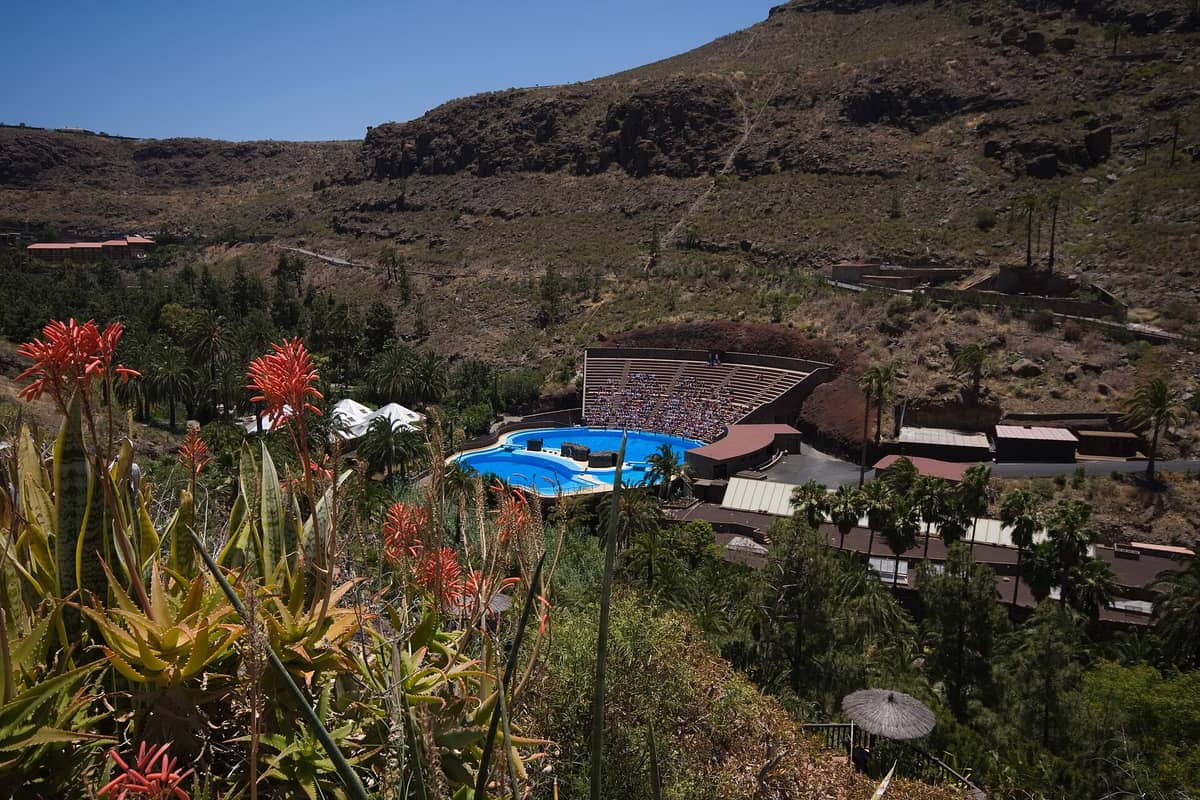
Palmitos Park is a botanical zoo set inside the Barranco de Los Palmitos, a narrow ravine carved into the dry hills above Maspalomas. The location is the first surprise. You approach through a parched, ochre landscape typical of the south, and then the road drops into a pocket of green so dense it feels deliberate, because it largely is. Thousands of palm trees line the valley floor, joined by tropical plantings that have been cultivated over decades to create a genuine microclimate within the ravine.
The park operates as a hybrid: part wildlife park, part botanical garden, part live entertainment venue. It houses one of the Canary Islands' most significant tropical bird collections, a working dolphinarium, a freshwater and marine aquarium, an orchid greenhouse with hundreds of species, a butterfly house, and an area dedicated to reptiles including alligators. No single section dominates. The layout asks you to move between them across sloping paths, which is part of what makes the visit feel more like exploration than a queue-to-exhibit experience.
ℹ️ Good to know
Opening hours: open every day 10:00 to 18:00, last admission at 17:00. Confirm current hours at palmitospark.es before your visit, as seasonal adjustments have been noted by some third-party sources.
The Setting: A Ravine That Works in the Park's Favour
The barranco setting is not just scenery. It provides meaningful shade throughout the day, which matters enormously in the south of Gran Canaria where summer temperatures along the coast regularly reach 27 to 28 °C and the sun is relentless between noon and 4pm. Inside the ravine, the canopy of palms and tropical vegetation filters the light, and the stone walls of the valley retain cool air in the morning. Arriving at opening time (10:00) gives you the most comfortable walking conditions and the best chance of seeing animals at their most active before the midday heat sets in.
The soundscape shifts as you move deeper into the park. Near the entrance, you hear the standard background noise of any visitor attraction. Within a few minutes on the main path, birdsong starts to dominate: the dry chatter of parrots, the shriek of macaws from their open perches, and the occasional low note from birds you cannot immediately identify. The smell is botanical rather than zoo-like for most of the visit, a mix of damp soil, tropical flowers, and the faintly sweet air of the orchid house.
The Birds: The Core of the Collection
Tropical and exotic birds are what Palmitos Park has built its reputation on, and the collection is genuinely extensive. Free-flying macaws and parrots are stationed at various points along the main paths, trained to perch close to visitors, which makes for vivid photographs but also means you should watch your belongings and food. Children find these encounters memorable. The bird of prey shows, scheduled throughout the day, demonstrate flight behaviours from eagles, owls, and falcons in an outdoor amphitheatre, with commentary explaining ecological context and conservation.
The show schedule matters for how you plan your visit. Check the day's programme at the entrance on arrival and work backwards: if you want to catch both the bird of prey show and the dolphin show, you will need to map the timing before you start wandering. Trying to improvise a route that fits all shows usually results in missing at least one.
💡 Local tip
Pick up the daily show schedule at the entrance and plan your route around it. The bird of prey show is worth prioritising — it takes place in an open-air arena and the flying demonstrations cover a wide section of the ravine airspace.
The Dolphinarium, Aquarium, and Other Exhibits
The dolphin show is the headline entertainment for many families and draws the largest crowds. The performance takes place in a covered pool arena with tiered seating. Arrive five to ten minutes early for a reasonable seat with a clear sightline. The show itself focuses on behaviour demonstrations alongside conservation messaging, which is broadly in line with current zoo and marine park standards, though visitors with concerns about cetaceans in captivity should factor that into their decision before booking.
The aquarium covers both freshwater tropical species and marine exhibits. It is not the largest aquarium in the Canary Islands; that distinction belongs to the purpose-built facility in Las Palmas, but it provides a useful context for the marine ecosystems of the Atlantic and tropics. For a comparison of what a dedicated aquarium experience looks like,
Visitors interested in marine life might also consider Poema del Mar Aquarium in Las Palmas, which offers a very different and more immersive ocean-focused experience.
The orchid house is easy to underestimate on paper and easy to linger in once you are inside. The greenhouse maintains the humidity and temperature required for hundreds of orchid varieties, and the density of colour in a relatively small space is striking. The butterfly house operates on a similar principle: a sealed tropical enclosure where species from different continents fly freely around visitors. Both are worth more time than most visitors give them.
How the Visit Changes by Time of Day
The 10:00 opening slot is the most rewarding. Crowds are thinnest, animals are active, and the light in the ravine is soft and angled rather than overhead and flat. The bird collection is most vocal in the first two hours. If you are interested in photography, morning is when you will get the clearest shots without other visitors in the frame.
By early afternoon, the park reaches its busiest point. Coach transfers from the resort hotels typically arrive in the mid-morning, meaning 11:30 to 14:00 sees the highest concentration of visitors, particularly around the dolphin show arena and the main bird perch areas. If your schedule forces an afternoon arrival, use the first hour to see the quieter sections: the orchid house, the butterfly house, and the upper botanical paths, and save the main shows for when you have warmed up to the pace of the place.
The final hour before 17:00 last admission is again relatively calm. The coach parties have largely departed, children are tired, and the light in the ravine takes on a warmer tone. This is a good time to revisit any section you felt rushed through earlier.
Getting There and Practical Logistics
Palmitos Park sits approximately 10 km inland from the Maspalomas lighthouse (Faro de Maspalomas), up a road that winds into the hills above the resort corridor. There is no direct public bus route to the park entrance. The practical options are a taxi from Maspalomas or Playa del Inglés, a rental car, or a transfer-inclusive ticket package offered by local excursion agencies and hotels in the south. Taxi fares from the resort area are typically modest given the short distance, though the return journey requires either pre-arranging a pickup or calling for a cab from the park, as passing taxis at the site are not guaranteed.
If you are staying in Playa del Inglés or Maspalomas, Palmitos Park makes a logical half-day or full-day excursion from your base, leaving time for the beach in the evening.
The terrain inside the park involves slopes and uneven surfaces throughout. The ravine is not flat, and moving between sections requires climbing and descending paths. Trainers or walking shoes with grip are significantly more comfortable than sandals or flip-flops. Pushchairs and wheelchairs can navigate parts of the park but will encounter difficulty on some inclines. Contact the park directly before visiting if accessibility is a concern, as they can advise on the current state of routes.
⚠️ What to skip
Wheelchair users and visitors with limited mobility should contact the park in advance. Palmitos Park is set in a mountain ravine with notable slopes and some uneven paths. Not all sections are fully accessible.
Honest Assessment: Is It Worth the Price?
At current adult prices of around €39, Palmitos Park sits at the upper end of the south Gran Canaria family attraction market. Whether it justifies that depends on what you bring to it. Visitors who engage with the show schedule, spend time in the botanical sections, and allow three to four hours will generally leave satisfied. Visitors who walk through quickly, skip the shows, and treat it as a casual stroll will likely feel the price is steep for what they experienced.
The park is not attempting to be a world-class zoo. The animal collection is focused rather than comprehensive, and the enclosures reflect a park that has evolved over decades rather than been built to contemporary zoo design standards. What it does offer is a genuinely pleasant environment in a unique natural setting, well-maintained botanical sections, and entertainment shows that are competently produced. For families with children aged four to twelve, it tends to land well. Adults visiting without children may find the experience pleasant but not compelling enough to warrant the full ticket price.
For those weighing options on a budget, the free things to do in Gran Canaria guide covers alternatives that might complement or replace a park visit depending on your priorities.
Photography Tips
The free-flying macaws at the main path stations are cooperative subjects for close-up shots, though the backgrounds are often cluttered with visitor infrastructure. The orchid house offers the most controlled photography conditions: consistent soft light, vivid colour, and subjects that stay still. A macro lens or a phone with portrait mode will produce the strongest results there. The bird of prey show is challenging to photograph well because the birds move fast against a bright sky, but the amphitheatre positions mean you can usually get a clear shot during stationary perching moments.
Avoid flash photography in the butterfly house and near the bird enclosures. It disturbs the animals and will produce worse results than ambient light anyway in those environments.
Insider Tips
- Check the day's show schedule the moment you arrive and plan your walking route around it. There is no single logical loop through the park, so knowing what time the dolphin show and bird of prey show start lets you structure the visit and avoid missing either.
- The orchid house is air-conditioned and a legitimate refuge during the hottest part of the afternoon. Plan to visit it between 13:00 and 15:00 when exterior paths are least comfortable.
- Transfer-inclusive ticket packages from hotels and excursion desks in Playa del Inglés and Maspalomas sometimes work out cheaper than booking separately and solve the return taxi problem in one step. Compare prices before buying direct at the gate.
- Food and drink at the park is available but expensive, as is standard for attractions of this type. Packing snacks and a water bottle will reduce costs and keep energy levels up on a long visit.
- The upper botanical paths, which many visitors skip in favour of heading straight to the shows, offer the most peaceful experience in the park and some of the best views down into the ravine. Allow at least 20 minutes for these if crowds elsewhere are building.
Who Is Palmitos Park For?
- Families with children aged 4 to 12 who want a structured, full-day activity away from the beach
- Wildlife and tropical bird enthusiasts looking for a focused collection in a natural ravine setting
- Botanical garden visitors interested in orchids, palms, and curated subtropical plantings
- Overcast or partially cloudy days when beach conditions are less appealing and an inland activity makes sense
- Visitors on a Gran Canaria week who want one dedicated wildlife and nature day in the south
Nearby Attractions
Other things to see while in Playa del Inglés:
- Aqualand Maspalomas
Aqualand Maspalomas is the south of Gran Canaria's largest water park, sitting 3 km inland from Maspalomas on the road toward Palmitos Park. With slides ranging from gentle lazy rivers to near-vertical drops, it draws families, groups, and thrill-seekers across the island's long sunny season. Here's what to expect, what to bring, and how to get the most out of your visit.
- Playa del Inglés Beach
Playa del Inglés stretches for 3 kilometres along Gran Canaria's south coast, connecting the Maspalomas dunes to San Agustín with wide golden sand, a flat promenade, and facilities suited to families, solo travellers, and the LGBTQ+ community. Access is free, the sun almost always shines, and the surrounding resort has everything you need within walking distance.