Palacio Postal: Mexico City's Most Extravagant Working Post Office
Inaugurated in 1907, the Palacio Postal (Palacio de Correos de México) is one of the most architecturally ambitious buildings in Centro Histórico. Admission is free, it still functions as an active post office, and its gilded interior stops visitors in their tracks. Few places in the city deliver this much visual reward for zero cost.
Quick Facts
- Location
- Tacuba 1, Centro Histórico, corner of Eje Central, Mexico City
- Getting There
- Bellas Artes (Line 2/8, ~3 min walk) or Allende (Line 2, ~5 min walk)
- Time Needed
- 20–45 minutes for a thorough visit
- Cost
- Free entry to public areas; Museo Postal inside (verify locally)
- Best for
- Architecture lovers, photographers, history enthusiasts, budget travelers
- Official website
- mexicocity.cdmx.gob.mx/venues/postal-palace/?lang=en
What Is the Palacio Postal?
The Palacio Postal, formally known as the Palacio de Correos de México or Quinta Casa de Correos, is the central post office of Mexico City and one of the most ornate public buildings in the entire country. It sits at the corner of Calle Tacuba and Eje Central in the heart of Centro Histórico, directly across from the Palacio de Bellas Artes. The building has been in continuous postal operation since its inauguration on February 17, 1907, which makes it one of the rare architectural landmarks in the world that still performs its original civic function.
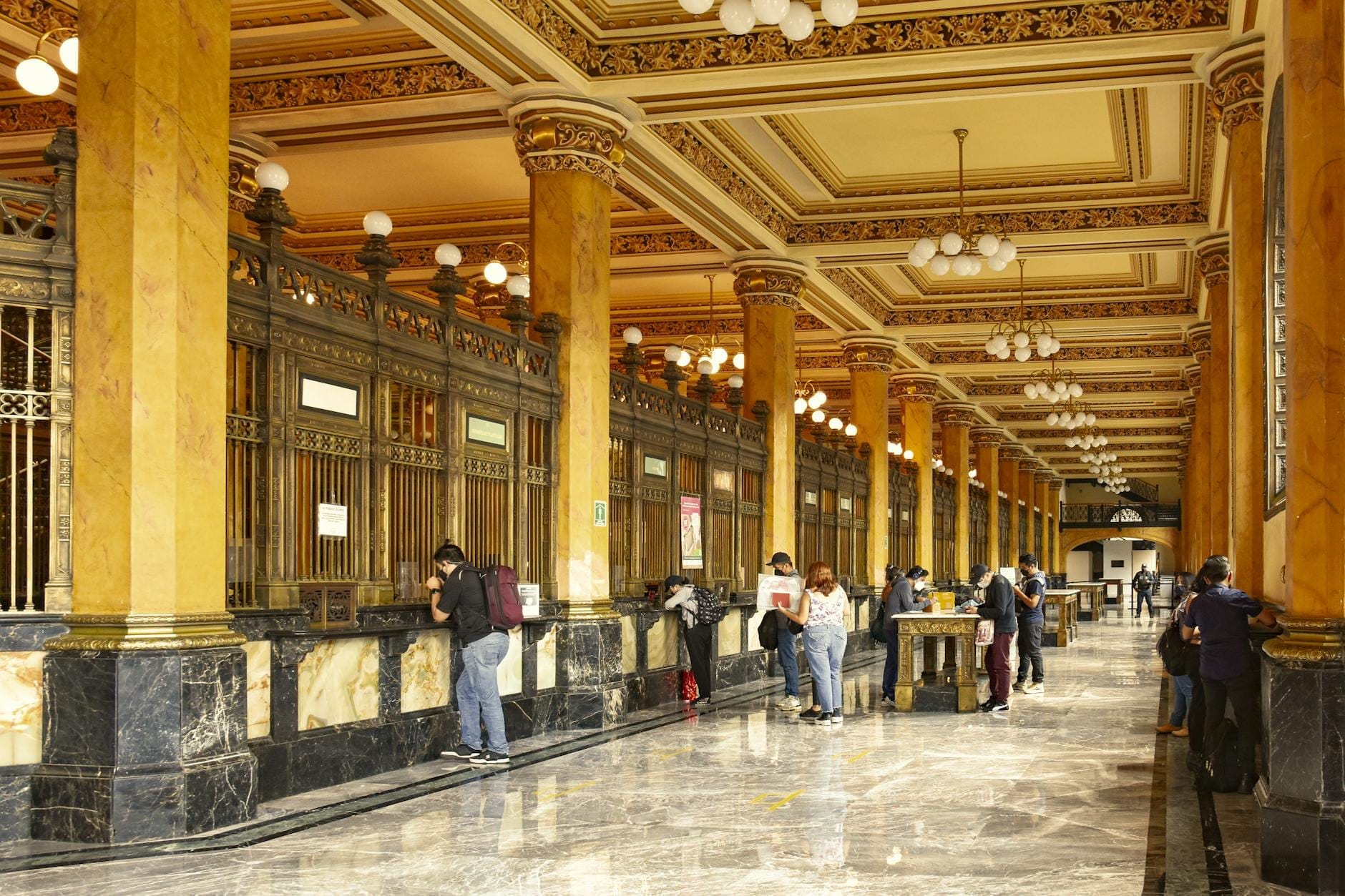
That combination, free to enter, still working, and visually overwhelming, makes the Palacio Postal unlike most historic buildings in the city. You are not walking through a museum reconstruction or a converted heritage site. Clerks process packages behind the counters, customers fill out forms at the brass-fitted writing desks, and, according to official listings, the building generally operates on weekdays and limited weekend hours (verify the current schedule before visiting). The everyday bureaucratic life of the city unfolds beneath one of the most intricate ceilings you will find anywhere in Latin America.
💡 Local tip
Opening hours vary by source: one listing shows Mon–Fri 08:00–20:00, Sat 08:00–15:30, Sun 09:00–13:00, while the official Mexico City tourism page lists Mon–Fri 08:00–16:00, Sat 08:00–12:00 with no Sunday hours. Verify the current schedule before visiting, particularly on weekends, by checking the official venue page or calling ahead.
The Architecture: What You Are Actually Looking At
Construction of the Palacio Postal began in 1902 under the commission of President Porfirio Díaz, who wanted to signal Mexico's modernization to the world. The project was assigned to Italian architect Adamo Boari, who was simultaneously designing the Palacio de Bellas Artes across the street. Boari collaborated with Mexican engineer Gonzalo Garita y Frontera, and together they produced a building that defies easy categorization.
The facade is a dense layering of eclectic styles: Art Nouveau detailing in the ironwork, Spanish Renaissance Revival stone carving on the exterior, Plateresque ornamentation across the window surrounds, and traces of Venetian Gothic and Elizabethan Gothic in the arched galleries. The exterior stone is a pale cream-gray, quarried from regional Mexican stone, and it weathers the afternoon light differently depending on the hour. At midday the facade looks almost bleached; in the late afternoon, the carved surfaces catch warm directional light and the relief work reads with much greater clarity.
Inside, the main hall is the visual centerpiece. A soaring interior atrium rises through multiple levels of open galleries, all wrapped in gilded bronze balustrades and ironwork that was manufactured in Florence and shipped to Mexico. The natural light filtering through the upper windows gives the space a quality that shifts perceptibly across the day. Early morning visitors find a quieter, cooler atmosphere with softer light; by late morning the hall fills with both natural illumination and the low hum of postal activity.
Tickets & tours
Live prices and dates from our booking partner. If you book, we may earn a commission at no extra cost to you.
Puebla and Cholula guided tour from Mexico City with optional lunch
From 43 €Instant confirmationFree cancellationXochimilco, Coyoacan and Frida Kahlo Museum with skip-the-line tickets
From 63 €Instant confirmationFree cancellationMexico City exploration game and tour in Chimalistac
From 10 €Instant confirmationFree cancellationCuernavaca and Taxco Guided Tour with Optional Lunch
From 40 €Instant confirmationFree cancellation
Visiting the Interior: A Practical Walkthrough
Entry is through the main ground-floor doors on Tacuba. There is no ticket booth, no queue, and no formal admission process for the public areas. You walk in the same way postal customers do. The ground floor is fully operational, with service windows along the perimeter and writing stations in the central space. The smell is a combination of old stone, wood countertops, and the faint chemical scent of packaging materials, which is oddly appealing given the grandeur of the setting.
The most rewarding thing to do is to look up. The central atrium, visible from the ground floor, rewards sustained observation. The gilded ironwork galleries stack upward on multiple levels, and the structural confidence of the interior, all that ornamental metalwork bearing real load, is immediately apparent. Visitors are generally free to walk the perimeter of the ground floor. Access to upper floors or specific areas may be restricted depending on the day and the operational needs of the building; this is worth clarifying with staff if you want to explore the Museo Postal, which houses postal artifacts and historical documents relating to Mexico's communications history.
Photography is widely practiced inside the building and generally tolerated in public areas. A wide-angle lens captures the full scale of the atrium; a longer focal length pulls in the ornamental detail on individual balustrades. Shooting upward from near the center of the ground floor gives the most dramatic result. Avoid flash, as the ambient light from the upper windows is usually sufficient and flash tends to flatten the metalwork.
When to Visit and How the Experience Changes
The Palacio Postal is rarely crowded in the way that major museums get crowded. It functions as a working building, and most visitors passing through are on postal business rather than sightseeing. Weekday mornings between opening time and around 10:30 offer the calmest environment, with natural light improving steadily and relatively few tourists present. By midday on weekdays, the queues at postal windows lengthen and the ground floor has more foot traffic, though it never becomes unmanageable.
Saturday mornings can be pleasant for a visit if you arrive before 10:00, when the building still has the unhurried quality of an early weekend. Sunday hours are limited and inconsistent across sources, so weekday visits are the more reliable choice. Weather matters less here than at outdoor attractions because the main draw is the interior. Even during the rainy season, when afternoon downpours are common from May through October, a visit to the Palacio Postal fits naturally into a morning itinerary.
The building sits in immediate proximity to several other major attractions in Centro Histórico. The Palacio de Bellas Artes is literally across the street, and Alameda Central is a two-minute walk west. Combining the Palacio Postal with a morning walk along Calle Madero toward the Zócalo makes for a focused half-day route through the historic core.
Historical and Cultural Context
The Porfiriato, the long presidency of Porfirio Díaz from 1876 to 1911, was defined in part by a state-directed program of public works intended to announce Mexico's arrival as a modern nation. The Palacio Postal was one of several major construction projects of that era in the capital, along with the Palacio de Bellas Artes and the restructuring of Paseo de la Reforma. Boari's brief was to produce something that could hold its own against the great public buildings of Europe, and his response was this aggressively ornate structure that pulled from multiple European architectural traditions simultaneously.
The building was completed just four years before the Mexican Revolution began, which gives it a particular historical resonance. It represents the full ambition of the Díaz administration at the very moment that ambition was about to collapse. That the building survived intact, and continues to function as intended, is itself an unusual historical outcome. Many comparable Porfirian-era projects were interrupted by the Revolution or repurposed afterward.
The Palacio Postal shares its architect with the nearby Palacio de Bellas Artes, though the two buildings have very different characters. The Bellas Artes is monumental and somewhat austere from the exterior, while the Postal Palace is dense with applied ornamentation. Seeing both in a single morning provides a useful comparative understanding of Boari's range. For a deeper dive into the art and muralism of the Porfiriato and post-revolutionary period, the Museo Mural Diego Rivera is a short walk away on the western edge of Alameda Central.
Who Should Visit and Who Might Not
This is one of the most rewarding free attractions in the city for anyone interested in architecture, decorative arts, or the political history of late 19th-century Mexico. The combination of zero cost, genuine operational status, and extraordinary visual quality is hard to beat on a time-value basis. Even visitors who give it only twenty minutes while walking between the Metro and the Zócalo tend to leave impressed.
However, visitors seeking an immersive museum experience with extensive interpretive content may find the Palacio Postal limited. The Museo Postal inside the building is modest in scope, and the main draw is the architecture of the space itself rather than a curated narrative. If you have already spent time at the Museo Nacional de Antropología or similar institutions and are looking for comparable depth of content, this building will feel more like a visual stop than a full attraction. It suits an itinerary best when treated as a thirty-to-forty-minute pause rather than a destination in its own right.
Visitors with significant mobility limitations should note that specific information on step-free access, ramps, and elevator availability is not clearly documented in official sources. The building is large and built to early 20th-century standards; it is worth contacting the building or consulting the official venue page directly if this is a concern before visiting.
Getting There
The Palacio Postal is one of the most accessible attractions in the city by public transit. The Bellas Artes Metro station (Lines 2 and 8) is approximately a three-minute walk. Allende station (Line 2) is about five minutes away. The Metro is reliable, inexpensive, and the standard way to reach Centro Histórico from most parts of the city. For guidance on navigating the network, the getting around Mexico City guide covers options in detail.
Ride-hailing apps including Uber and Didi both operate in this area. Traffic in Centro Histórico can be slow during weekday rush hours, so the Metro is generally faster if you are coming from Polanco, Roma, or Condesa. On foot, the building is recognizable from a distance by its pale ornate facade; the Palacio de Bellas Artes across the street is an unmissable reference point.
Insider Tips
- Stand in the center of the ground floor and look straight up toward the atrium ceiling. This is the single best vantage point in the building, and most visitors miss it because they are focused on the perimeter galleries at eye level.
- If you want to actually send a letter or postcard from one of the most architecturally significant post offices in the world, you can do it here. Buying stamps and mailing something from the Palacio Postal is a low-cost, high-memory experience that takes about ten minutes.
- The exterior facade photographs best in the late afternoon when directional light catches the carved stone relief work on the upper levels. Morning light is flatter and less revealing of the texture.
- The building is directly across from the Palacio de Bellas Artes. Stand on the steps of the Postal Palace and you have an unobstructed straight-on view of the Bellas Artes facade, which is one of the better informal photography angles for that building without needing to enter it.
- Weekday mornings before 10:00 are the calmest time to visit. The ground floor has a different, more contemplative quality when the postal queues are short and the light is still low and directional through the upper windows.
Who Is Palacio de Correos de México For?
- Architecture and design enthusiasts who want to see Porfirian-era eclecticism at its most concentrated
- Photographers looking for a free, visually dense interior that rewards both wide-angle and detail shots
- Budget travelers building a free walking itinerary through Centro Histórico
- History-focused visitors interested in the Porfiriato and the political use of monumental architecture
- Anyone combining it with the nearby Palacio de Bellas Artes and Alameda Central as part of a half-day historic center circuit
Nearby Attractions
Other things to see while in Centro Histórico:
- Alameda Central
Founded in 1592, Alameda Central is the oldest public park in the Americas and the green centerpiece of Mexico City's historic center. Flanked by the Palacio de Bellas Artes and a ring of colonial-era institutions, it offers free entry, shaded walkways, and a front-row seat to everyday city life.
- Calle Madero
Avenida Francisco I. Madero connects the Zócalo to the Torre Latinoamericana along one of the oldest streets in the Americas. Free to walk at any hour, it layers colonial architecture, street performance, and everyday city life into a single corridor that doubles as an open-air history lesson.
- Casa de los Azulejos
Casa de los Azulejos is one of the most photographed facades in Mexico City, its exterior wrapped in blue-and-white Talavera tiles from Puebla. With documented origins in the 16th century and operating as a Sanborns restaurant since 1919, it offers free entry and a rare chance to step inside a baroque palace that has survived centuries of history.
- La Ciudadela Artisan Market
The Mercado de Artesanías de La Ciudadela is one of Mexico City's largest and best-known handicraft markets, with more than 350 vendors selling handmade goods from across 22 states. Entry is free, quality ranges from tourist trinkets to serious collector pieces, and knowing how to navigate the stalls makes all the difference.
Planning a trip? Discover personalized activities with the Nomado app.