Oslo Cathedral (Oslo Domkirke): What to Know Before You Visit
Oslo Cathedral, known locally as Oslo Domkirke, is the main church of the Diocese of Oslo and sits at the civic heart of Norway's capital. Entry is free, the interior is rich with detail, and it remains an active place of worship alongside a significant cultural landmark.
Quick Facts
- Location
- Karl Johans gate 11, Stortorvet, Sentrum, Oslo
- Getting There
- Stortorvet tram stop (lines 11, 12, 13, 17); 5–8-min walk from Oslo Central Station (Oslo S)
- Time Needed
- 30–60 minutes for a relaxed visit
- Cost
- Free entry; special concerts and events may be separately ticketed
- Best for
- Architecture lovers, pilgrimage walkers, quiet reflection mid-city
- Official website
- http://www.oslodomkirke.no
What Oslo Cathedral Actually Is
Oslo Domkirke is not a relic kept alive for tourists. It is the cathedral church of the Diocese of Oslo and an active parish of the Church of Norway, which means services, baptisms, and confirmations happen here continuously. That living quality sets it apart from many European cathedrals that feel more like museums than places of faith.
The building stands at Stortorvet, the old market square at the eastern end of Karl Johans gate, Oslo's ceremonial main street. Physically, it anchors one of the most traversed corners of the Norwegian capital. You pass through its shadow whether you are heading toward the Royal Palace, the Storting (parliament building), or Oslo Central Station. Its position is not accidental: the cathedral has served as the spiritual counterpoint to Norway's political institutions for centuries.
The cathedral also marks one of the staging points on the Pilegrimsleden, Norway's network of pilgrimage routes that historically connected Oslo to Nidarosdomen in Trondheim. If you are exploring Oslo's deeper historical layers, Oslo's Viking and medieval history adds useful context for understanding why this location carries so much civic and religious weight.
ℹ️ Good to know
Opening hours: Monday–Thursday and Saturday 10:00–16:00, Friday 16:00–24:00; Sunday service at 11:00 with visiting hours varying. Services (including Sunday high mass at 11:00) may restrict access to parts of the nave during those times. Confirm hours on the official website before your visit, especially around Norwegian public holidays.
Inside the Cathedral: What You Will See
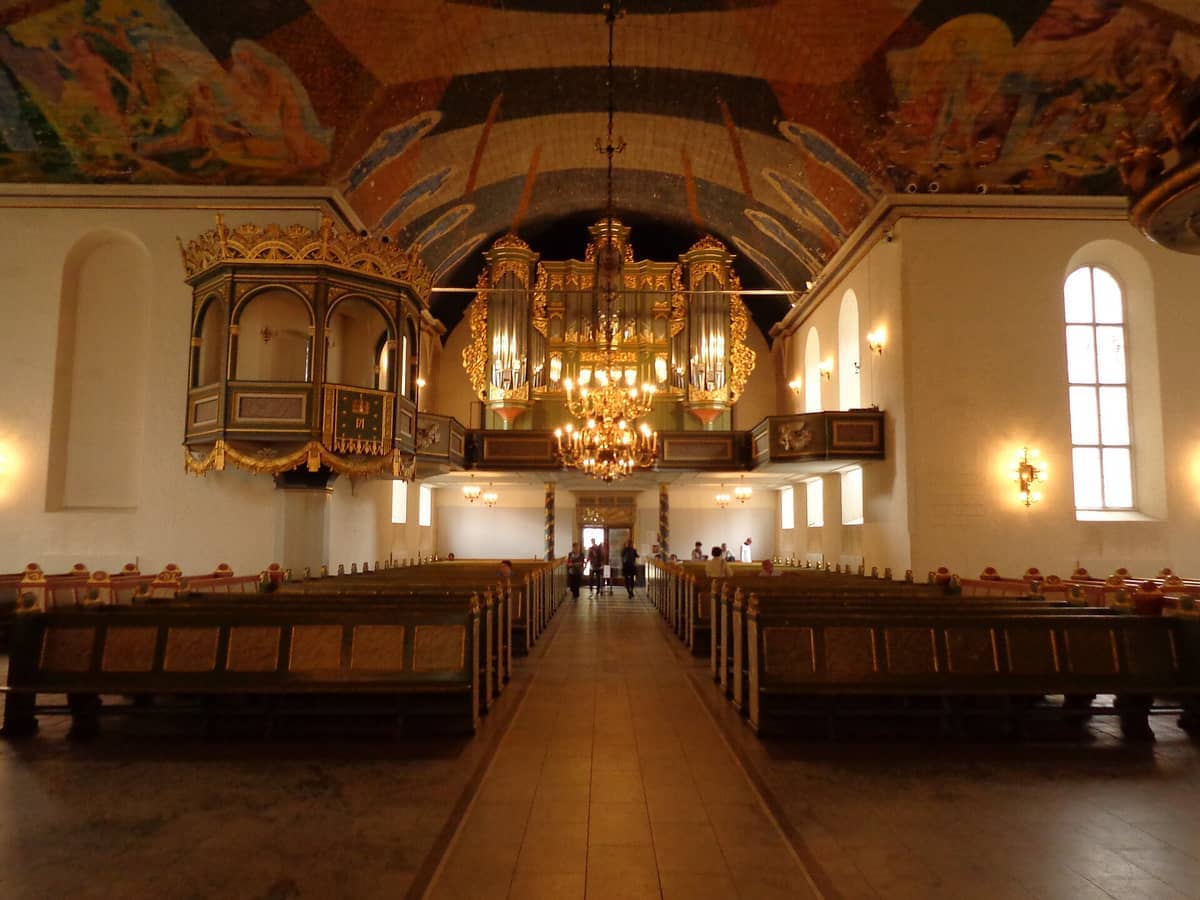
Step through the main doors from Stortorvet and the transition from Oslo's outdoor noise to the cathedral's interior is immediate and pronounced. The nave is wide, the ceilings are high, and the acoustics amplify even quiet footsteps. Natural light falls differently depending on the time of day: morning visits catch the light filtering through the stained glass windows at a low angle that makes the colors in the glass saturate considerably more than they do at midday.
The ceiling paintings are among the most discussed features of the interior. Hugo Louis Mohr painted the ceiling decorations in the 20th century, completing a scheme that uses deep blues and golds to create an effect closer to a Byzantine interior than the sparse Lutheranism typical of Scandinavian churches. Visitors often stop mid-nave and look up before doing anything else. It is worth doing deliberately rather than noticing halfway through.
The altarpiece dates to the late 17th century. The carved and gilded wooden altar is one of the richest pieces of ecclesiastical furniture in Oslo, contrasting with the relatively understated stone of the walls around it. Look also at the pulpit and the detailed ironwork on the cathedral doors, which were designed by the sculptor Dagfin Werenskiold in the 20th century and depict scenes from the New Testament with a bold, graphic quality that reads clearly even from a distance.
Tickets & tours
Live prices and dates from our booking partner. If you book, we may earn a commission at no extra cost to you.
Oslo Fjord sightseeing audio-guided electrical boat tour
From 35 €Instant confirmationFree cancellationFjord cruise with live jazz music
From 64 €Instant confirmationFree cancellationLuggage Storage in Oslo
From 6 €Instant confirmationFree cancellationPicturesque dinner cruise in Oslo
From 137 €Instant confirmationFree cancellation
How the Experience Changes by Time of Day
Weekday mornings between 10:00 and noon are consistently the quietest period. The square outside is active with commuters and shoppers, but the cathedral interior holds only a handful of visitors at most. This is when you can take time with individual details, sit in the pews without feeling self-conscious, and hear the building's own sounds: the low creak of old wood, the distant hum of the city filtered through thick stone walls.
Friday evenings are a different proposition entirely. The cathedral stays open until late on Fridays as part of its 'open church' programme, and the atmosphere shifts. Candlelight replaces the cooler daytime lighting, small musical performances sometimes take place, and the space draws people who want something quieter than Oslo's bars but more atmospheric than an empty hotel room. It is one of the more unusual ways to spend a Friday evening in central Oslo.
Sunday mornings, predictably, are busiest. The high mass at 11:00 fills a significant portion of the nave with regular congregation members, and casual visitors are welcome to observe, but navigating the space freely is not possible during the service. If you prefer exploring without disrupting worship, arrive before 10:30 or after 12:30.
💡 Local tip
Best photography window: arrive at 10:00 on a clear day. The stained glass on the east-facing windows catches direct morning light for roughly 45 minutes, producing the most vivid colour saturation you will find at any point in the day. Bring a camera with decent low-light capability; a tripod is impractical and unnecessary if you can stabilise against a pew.
The Building's History and Place in Oslo
The current structure dates primarily from 1697, though it has been substantially renovated and altered several times since. Oslo itself has existed under various names (Christiania, Kristiania) across the centuries, and the cathedral's history mirrors the city's: construction, fire damage, rebuilding, and gradual accumulation of artistic additions spanning three centuries.
Its role has extended beyond regular worship at key moments in Norwegian national life. State ceremonies, royal events, and national memorials have been held here, reinforcing its function as a place where Norwegian civic identity and religious practice intersect. When Norway's constitution was signed in 1814 at Eidsvoll and the country established its independent institutions in Oslo, the cathedral was already the established focal point for those institutional ceremonies.
The surrounding Sentrum district gives useful context for the cathedral's position. Oslo's city centre was reorganised around Karl Johans gate during the 19th century, and the street's progression from Oslo Central Station westward to the Royal Palace was deliberately designed as a ceremonial axis. The cathedral, the Storting, and the National Theatre all sit along or just off this line, forming a coherent architectural and civic statement.
Getting There and Practical Walkthrough
The cathedral is straightforward to reach. From Oslo Central Station, walk west along Karl Johans gate for approximately eight minutes and Stortorvet opens out on your right. The cathedral faces the square directly. Tram lines 11, 12, 13, and 19 stop at Stortorvet, making it reachable from Grünerløkka, Aker Brygge, and other central areas without changing lines.
Entry is free. There is no ticket desk, no timed entry, and no queue system. You walk in from the square-facing entrance. The main doors feature Werenskiold's ironwork panels, which are worth examining before you enter rather than after. A donation box is positioned inside, and the usual expected contribution is modest.
For accessibility: the primary entrance involves some steps up from the square. Staff can direct visitors to an alternative entrance with a gentler approach. The main nave aisles are wide and level, making wheelchair navigation through the principal space manageable. Some secondary areas of the building involve steps that are harder to avoid. If mobility is a concern, contacting the cathedral in advance is worth doing.
💡 Local tip
The Oslo Pass covers free entry to many museums but is not relevant here since entry is already free. If you are budgeting a full day in the city centre, the cathedral pairs well with a walk along Karl Johans gate toward the Royal Palace or a visit to the nearby National Theatre.
Weather, Seasons, and When to Visit
Because the cathedral is an indoor attraction, seasonal weather affects the experience less than it would an outdoor site. That said, the approach across Stortorvet square is exposed, and Oslo winters (December through February) are cold, often sitting below freezing. Wear warm layers and waterproof footwear if you are visiting in autumn or winter.
The most atmospheric outdoor moments around the cathedral come in early December, when the Christmas market at Stortorvet fills the square with wooden stalls, the smell of cinnamon and warm drinks, and lights that reflect off the cathedral's stone facade after dark. The contrast between the market noise outside and the silence inside the cathedral during that period is striking.
On Constitution Day (17 May), the area around the cathedral and Karl Johans gate becomes the centre of Oslo's national celebrations. The scale of the crowds makes quiet cathedral visits difficult that day, but the energy of the occasion is something else entirely. See the Oslo Constitution Day guide for how to navigate 17 May in the city.
Who Should Manage Their Expectations
Oslo Cathedral is not a grand Gothic cathedral in the manner of Cologne or Notre-Dame. Visitors expecting soaring medieval vaulting or a vast complex of chapels and cloisters will find the scale more modest than anticipated. The building's power lies in its interior decoration and its civic role, not in architectural monumentality.
If you have limited time and are choosing between major Oslo attractions, the cathedral is best treated as a 30-minute stop woven into a broader walk through Sentrum rather than as a standalone destination requiring dedicated planning. It fits naturally into a three-day Oslo itinerary as one element of a central-city morning, not as the headline act.
Those who appreciate Lutheran ecclesiastical art, Scandinavian religious history, or simply want a few minutes of genuine quiet in the middle of a capital city will find it rewarding. Families with young children can visit comfortably; there is no pressure to maintain silence during open-church hours, and the ceiling paintings tend to hold children's attention.
Insider Tips
- The Friday late opening (into the night) is largely unknown to tourists. If you are in central Oslo on a Friday evening, stepping in after 20:00 offers a candlelit, nearly empty interior that feels completely different from the daytime experience.
- Examine the main entrance doors before going inside. Dagfin Werenskiold's cast bronze panels are a significant work of 20th-century Norwegian religious art and easy to walk straight past if you are focused on getting in.
- The square outside, Stortorvet, has a flower market on weekday mornings. Arriving via the market adds a pleasant approach to the visit and gives you something to browse if the cathedral doors have not yet opened.
- If you want the ceiling paintings to yourself, visit on a Tuesday or Wednesday morning between 10:00 and 11:00. Tour groups, when they do appear, tend to arrive mid-morning on weekends.
- Midday prayers and brief weekday services happen regularly. Check the parish website schedule before arriving if you want to observe a short service rather than a full Sunday mass. These shorter gatherings give a more intimate sense of the cathedral as a living church.
Who Is Oslo Cathedral (Domkirken) For?
- Architecture and ecclesiastical art enthusiasts interested in Baroque and 20th-century Norwegian decoration
- Travellers seeking a short, free, weather-proof stop in central Oslo
- Anyone walking the Karl Johans gate corridor between Oslo S and the Royal Palace
- Visitors wanting quiet reflection or a brief escape from the city's outdoor pace
- Families who want to introduce children to a working historic church without a ticket barrier
Nearby Attractions
Other things to see while in Sentrum (City Centre):
- Akershus Castle and Fortress
Akershus Fortress (Akershus slott og festning) is a medieval royal stronghold that has guarded Oslo's harbour since around 1299. The fortress grounds are free to enter year-round, offering sweeping Oslofjord views, cobblestone courtyards, and a castle interior that spans seven centuries of Norwegian history.
- Damstredet & Telthusbakken
Two short streets in central Oslo preserve what the rest of the city lost to fire and modernisation: timber houses from the late 1700s and early 1800s, still inhabited, still cobbled. Free to walk at any hour, Damstredet and Telthusbakken offer a rare glimpse of pre-industrial Oslo just minutes from the parliament building.
- Historical Museum (Historisk Museum)
Housed in a grand early 20th-century building on Tullinløkka in central Oslo, the Historical Museum holds some of Norway's most remarkable ancient objects, from Viking gold jewelry to Egyptian mummies and Arctic indigenous artifacts. It is one of the most substantive indoor experiences the city offers, and it rewards visitors who take their time.
- National Museum (Nasjonalmuseet)
The National Museum (Nasjonalmuseet) is Norway's largest museum for art, architecture, and design, housed in a landmark building on the Oslo waterfront. From Edvard Munch's original Scream to Norwegian design and painting and centuries of decorative arts, it holds the country's most significant cultural collections under one roof.
Planning a trip? Discover personalized activities with the Nomado app.