National Hellenic Museum: Chicago's Window into Greek History and Diaspora Life
Anchored in Chicago's historic Greektown, the National Hellenic Museum brings Greek civilization and the Greek-American immigrant experience to life through rotating exhibitions, archival collections, and cultural programming. It's a compact but meaningful stop for anyone curious about the ancient world or the story of one of Chicago's most enduring ethnic communities.
Quick Facts
- Location
- 333 S. Halsted Street, Greektown, Chicago, IL 60661
- Getting There
- CTA Blue Line to UIC–Halsted; Bus Route 8 (Halsted) stops nearby on Halsted
- Time Needed
- 1.5 to 2.5 hours
- Cost
- Adults $10 | Seniors & Students $8 | Children 3–12 $7 | Under 3 free | Members free | AAM/AASLH members free with card and ID
- Best for
- History enthusiasts, Greek heritage travelers, families, architecture fans
- Official website
- nationalhellenicmuseum.org
What the National Hellenic Museum Actually Is
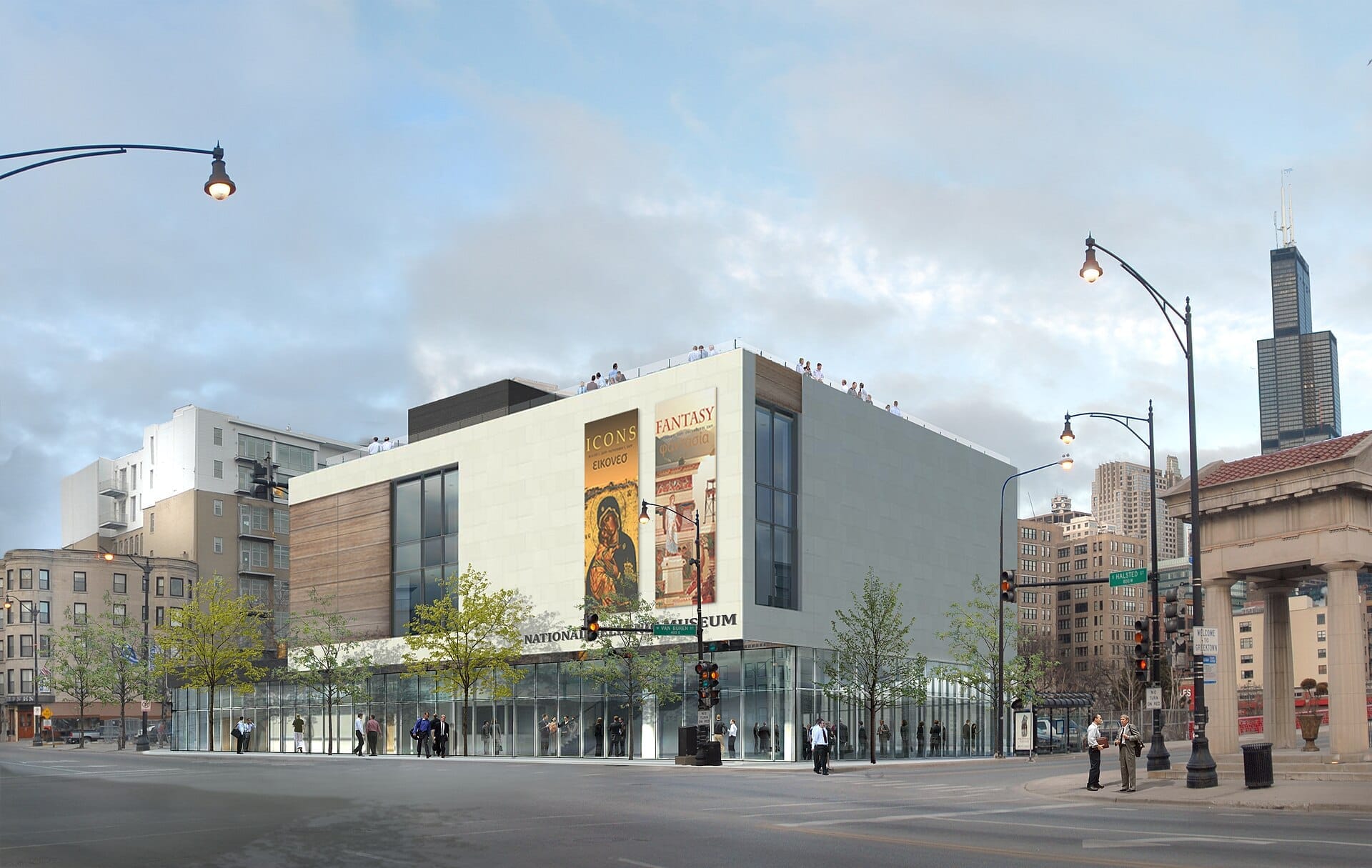
The National Hellenic Museum sits at 333 South Halsted Street in Chicago's Greektown, right in the heart of Chicago's Greektown. The building itself is a statement: a modern glass-and-steel structure that contrasts sharply with the older commercial facades lining Halsted. It was originally known as the Hellenic Museum and Cultural Center before adopting its current name.
The museum occupies a dual role. On one hand, it covers the long arc of Greek civilization, from ancient history through Byzantium and the modern Greek state. On the other, it documents the Greek diaspora's story in America, with particular focus on the waves of immigration that shaped neighborhoods like this one. Oral histories, photographs, documents, and artifacts sit side by side, making the collection feel personal rather than purely academic.
ℹ️ Good to know
The museum is closed Monday through Wednesday. Thursday through Sunday it opens at 10:00 and closes at 16:00. It also closes on a long list of holidays including both Western and Eastern Orthodox Easter, so check the official website before you go.
The Greektown Setting and Arriving at the Museum
Getting here by CTA is straightforward. Take the Blue Line to UIC–Halsted and the museum is a short walk north of the station exit. Bus Route 8 on Halsted also drops you at the intersection directly outside. If you're driving, the proximity to Interstates 90, 94, and 290 makes it accessible from most parts of the city, though street parking on Halsted can be competitive during lunch hours on weekends. The museum recommends nearby parking options in Greektown.
The Greektown neighborhood around the museum rewards a bit of wandering before or after your visit. The stretch of Halsted between Adams and Monroe is lined with Greek restaurants and bakeries, and the smell of roasting lamb and fresh phyllo dough in the late morning is hard to ignore. If you arrive at opening time on a Thursday or Friday, the block tends to be quiet, the sidewalks nearly empty, which makes the contrast between the sleek museum exterior and the old-school restaurant signage all the more interesting.
Greektown is part of Chicago's broader Near West Side, a district covered in detail in the West Loop and Fulton Market neighborhood guide. If you're combining the museum with a meal or an afternoon exploring the city's immigrant heritage corridors, that guide has practical orientation information.
Tickets & tours
Hand-picked options from our booking partner. Prices are indicative; availability and final rates are confirmed when you complete your booking.
Go City | Chicago All-Inclusive Pass
From 127 €Instant confirmationFree cancellationiFLY Chicago Lincoln Park indoor skydiving experience
From 126 €Instant confirmationFree cancellationiFLY Chicago Rosemont indoor skydiving tickets
From 117 €Instant confirmationFree cancellationChicago lakefront neighbourhood bike tour
From 18 €Instant confirmationFree cancellation
Inside the Museum: What You'll Actually See
The interior is well-lit and unhurried. Visitor numbers are modest compared to Chicago's major institutions, which means you rarely have to compete for space in front of a display case or wait for someone to step aside for a photograph. The galleries rotate with some regularity, so what's on display in a given season may differ from a previous visit, but the permanent collection thread runs consistently through every iteration: who were the Greeks, how did they build their civilization, and how did they carry that identity to America?
The archival holdings are one of the museum's most distinctive assets. Oral history recordings, immigration documents, family photographs, and letters chart the experience of Greek immigrants who arrived in Chicago in the late nineteenth and early twentieth centuries. These aren't sanitized triumph narratives. The materials also capture the difficulties: language barriers, economic hardship, and the long process of carving out community in an unfamiliar city. Listening stations at some exhibits let you hear voices directly, which adds texture that wall text alone can't provide.
Objects connected to ancient and Byzantine Greek culture appear throughout, from ceramic reproductions and coins to textiles and religious artifacts. The curation is careful to place these objects in historical context rather than letting them float free as decorative curiosities. Labels are informative without being dense, making the collection genuinely accessible to visitors who don't arrive with prior knowledge.
💡 Local tip
Thursday visits tend to be the quietest. Weekend afternoons, especially Saturdays, can see school groups and organized tours moving through. If you prefer a contemplative pace, aim for opening time on a Thursday or Friday.
Historical and Cultural Context
Chicago's Greek community has deep roots in the city. Greek immigrants began settling in significant numbers in the late 1800s, initially clustering in an area further east that became known as the Delta. As urban renewal projects displaced that original community in the 1960s, the neighborhood shifted to its current location on South Halsted Street. Greektown today is smaller and more commercially oriented than it once was, but it retains a recognizable identity, and the National Hellenic Museum functions as its institutional memory.
The Greek immigrant story in Chicago is one chapter in a much larger American narrative of diaspora communities building cultural infrastructure in their adopted city. The museum places that story in dialogue with the broader sweep of Greek history, which gives visits a layered quality: you're simultaneously looking at Athenian pottery and reading letters from someone who arrived at Ellis Island with a few dollars and an address in Chicago scrawled on a piece of paper.
Chicago has a remarkable concentration of ethnic cultural museums. If you're building an itinerary around them, the National Museum of Mexican Art in Pilsen and the DuSable Black History Museum offer similarly focused, community-rooted perspectives on American immigration and identity.
Photography, Accessibility, and Practical Logistics
Photography is generally permitted in the galleries for personal use, though you should verify any restrictions for specific temporary exhibitions when you arrive. The building's glass-and-steel architecture makes for interesting exterior shots, particularly in morning light when the facade catches the early sun at an angle. Interior lighting is warm and consistent, suitable for phone photography without flash.
Visitors with specific accessibility needs should contact the museum directly before visiting, as detailed accessibility information is not fully specified on the general visit page. The building is a modern construction, so structural accommodations are likely built in, but it's worth confirming elevator access and other specifics in advance.
Admission is $10 for adults, with discounts for seniors and students ($8 each) and children aged three to twelve ($7). Children under three enter free, and museum members pay nothing. Members of the American Alliance of Museums or the American Association for State and Local History receive one complimentary admission with a current member card and photo ID. At these prices, the museum represents good value for a couple of hours of focused engagement.
⚠️ What to skip
The museum closes on major holidays, including Thanksgiving, Christmas Eve, Christmas Day, and New Year's Eve. Don't assume standard weekday rules apply around these dates.
Honest Assessment: Who Will Get the Most from This Museum
The National Hellenic Museum is not a large institution, and visitors who arrive expecting the scale of the Art Institute or the Field Museum will find something quite different: focused, quieter, and deliberately communal in spirit. That restraint is part of its appeal for the right visitor. If you have a connection to Greek heritage, or if you're genuinely curious about the mechanics of how an immigrant community builds and sustains cultural identity across generations, you'll find the visit rewarding.
Travelers who prefer wall-to-wall artifact density or broad historical sweep across multiple civilizations may find the scope limiting. The museum is honest about what it is: a dedicated institution for a specific community's history, not a comprehensive survey of world cultures. For a broader cultural itinerary in Chicago, the museum works best as a complement to a Greektown meal and a visit to one of the city's larger institutions rather than as a standalone half-day anchor.
If you're planning a fuller day in Chicago's cultural landscape, the guide to Chicago's best museums helps you sequence visits by geography and interest, which is particularly useful if you're combining the National Hellenic Museum with stops on the Museum Campus or in the Loop.
Combining Your Visit with the Surrounding Area
The museum's location on Halsted puts it within easy reach of several other worthwhile stops. The restaurants on the Greektown strip are the obvious draw: Santorini, Greek Islands, and similar long-running establishments serve lunch and dinner throughout the week. A midday visit to the museum followed by a late lunch on Halsted is a natural pairing.
The Museum of Science and Industry is a longer trip south, but if you're traveling with children, it's worth factoring into the day. Closer by, the West Loop's restaurant and market scene along Randolph Street is a short cab or rideshare ride away and offers one of the city's most concentrated stretches of serious dining.
For a broader sense of how to fit the National Hellenic Museum into a Chicago trip, the Chicago neighborhoods guide provides context on the Near West Side and the city's ethnic cultural geography more generally.
Insider Tips
- Check the museum's current exhibitions page before visiting. Temporary shows rotate with some frequency and occasionally include programming like lectures, film screenings, and cultural events that coincide with Greek national holidays or diaspora anniversaries.
- If you're driving and plan to eat in Greektown afterward, ask the restaurant about their parking validation before committing to the Arkadia Tower garage. Several Halsted restaurants have parking arrangements that could save you the separate fee.
- The museum's gift shop carries a small selection of books on Greek history, Greek-American immigration, and Byzantine art that are genuinely harder to find in general bookstores. If you have specific reading interests in this area, it's worth browsing.
- Eastern Orthodox holidays follow a different calendar from Western Christian holidays, which means the museum's closure dates for Greek Easter may fall on different days than you'd expect. Always check the specific year's dates on the official website.
- Arrive at or just after 10:00 on a Thursday or Friday for the most unhurried experience. Weekend afternoons tend to see the most visitor traffic, including occasional tour groups.
Who Is National Hellenic Museum For?
- Travelers with Greek or Greek-American heritage looking to connect with the diaspora story
- History enthusiasts interested in ancient Greek and Byzantine civilization in an accessible, focused format
- Families with children aged eight and up who can engage with immigration narratives and archival materials
- Visitors building a day around Chicago's ethnic cultural institutions and neighborhood dining
- Architecture-minded travelers who appreciate modern institutional buildings in urban heritage contexts
Nearby Attractions
Combine your visit with:
- Bahá'í House of Worship
The Bahá'í House of Worship in Wilmette, Illinois, is one of the most architecturally singular buildings in North America. Free to enter, open daily, and reachable by CTA from downtown Chicago, it rewards visitors with a 135-foot lace-like dome, meditative silence, and an unusual kind of spiritual calm that transcends denomination.
- Brookfield Zoo Chicago
Brookfield Zoo Chicago is one of the largest and most historically significant zoos in the United States, covering 216 acres about 14 miles west of downtown. With more than 511 species, landmark indoor exhibits, and a genuine conservation mission, it rewards a full day of exploration. But it takes planning to get the most out of it.
- Chicago Air and Water Show
Every August, the Chicago Air and Water Show transforms the lakefront into a grandstand for one of the most spectacular free public events in the United States. Fighter jets, military demonstrations, and precision flying teams perform over Lake Michigan while hundreds of thousands of spectators line the shore from Fullerton to Oak Street.
- Chicago Botanic Garden
A living museum spread across 385 acres and nine islands north of Chicago, the Chicago Botanic Garden offers 27 gardens, four natural areas, and six miles of lake shoreline in Glencoe, Illinois. Whether you visit for a single seasonal bloom or spend a full day exploring Japanese landscapes and native prairies, this guide covers everything you need to plan a worthwhile trip.