The Nashville Arcade: A 120-Year-Old Downtown Passageway Worth Slowing Down For
Built in 1902 and opened in 1903 and modeled after Milan's Galleria Vittorio Emanuele II, the Nashville Arcade is often described as the city's first shopping center and one of its most distinctive architectural spaces. Free to enter, it runs between 4th and 5th Avenues North in downtown Nashville, housing local businesses, artist studios, and galleries beneath a soaring glass-and-iron roof.
Quick Facts
- Location
- Between 4th and 5th Avenues North, Downtown Nashville, TN 37219
- Getting There
- WeGo Public Transit buses stop within a short walk on 4th or 5th Ave N; walkable from most downtown hotels
- Time Needed
- 20-45 minutes to walk through; longer if you browse galleries or grab a bite
- Cost
- Free to enter; individual shops, galleries, and events set their own prices
- Best for
- Architecture lovers, local art browsers, rainy-day walkers, history enthusiasts
- Official website
- thearcadenashville.com
What the Nashville Arcade Actually Is
The Nashville Arcade is a covered pedestrian passage running through the heart of downtown Nashville, connecting 4th and 5th Avenues North. Built in 1902 and opened in 1903 on what was formerly called Overton Alley, it became the city's first shopping center and has operated continuously in some form ever since. That kind of uninterrupted urban life, over 120 years in a city that tears things down and rebuilds with notable regularity, makes it genuinely unusual.
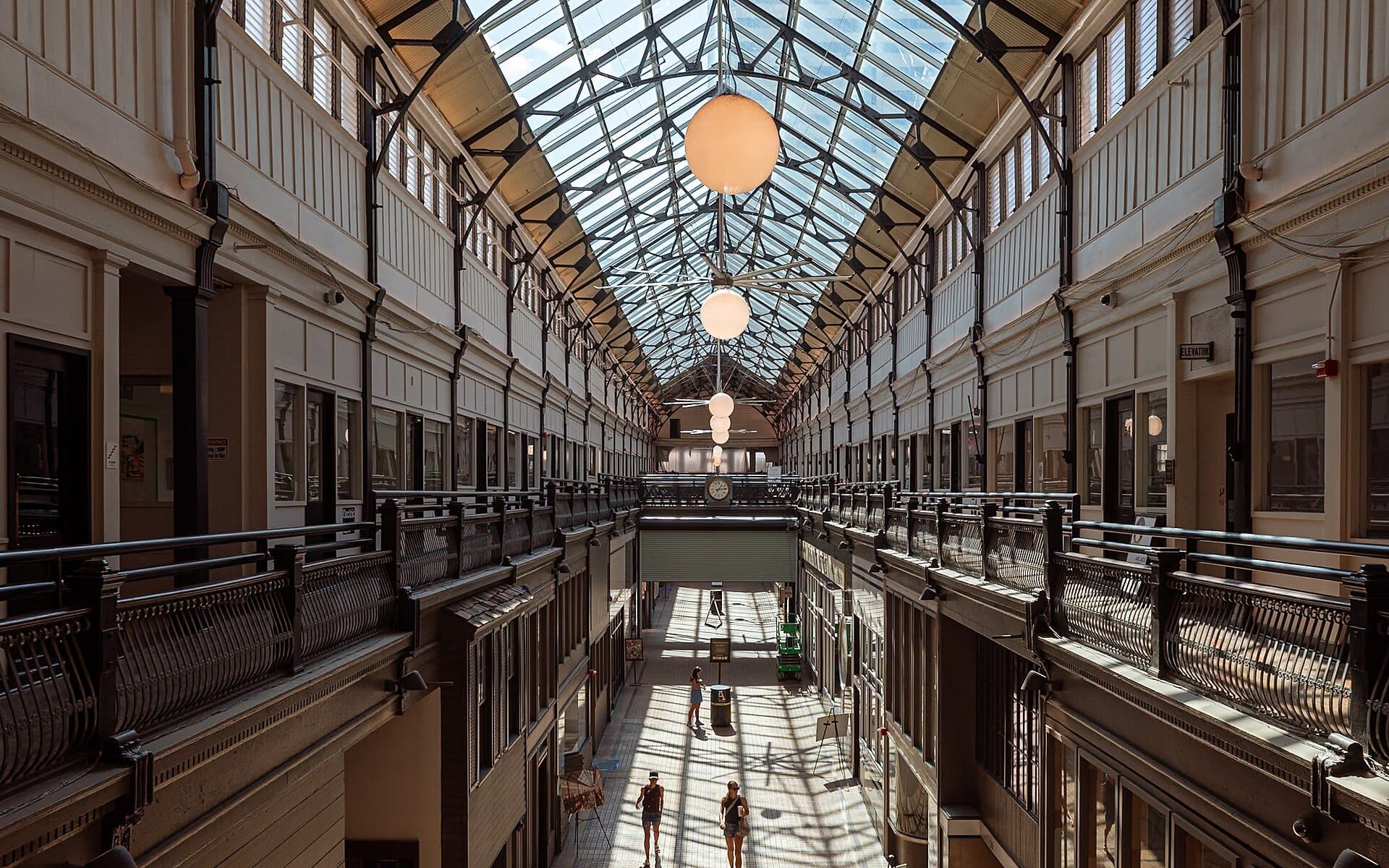
The building was deliberately modeled after the Galleria Vittorio Emanuele II in Milan, the grand 19th-century arcade that became a template for covered shopping passages across Europe and the Americas. Nashville's version is more modest, but the architectural ambition is readable: the glass-and-iron barrel roof lets natural light pour onto two floors of small commercial storefronts, giving the space a warmth and proportion that no modern construction in the area comes close to matching. It is promoted as covering nearly five acres and spanning two city blocks.
The Arcade was added to the National Register of Historic Places on May 10, 1973, recognizing both its architectural significance and its role as a piece of Nashville's commercial and social history.
💡 Local tip
Entry is completely free. You walk in from either avenue, look around, and leave whenever you like. There are no gates, no security line, and no ticket booth. Individual businesses inside set their own hours and prices.
What You See When You Walk In
The first thing you notice is the ceiling. The glass-paneled roof runs the full length of the building, and depending on the weather and time of day, the light inside shifts from a flat midday brightness to something warmer and more atmospheric in the late afternoon. On overcast days, the diffused glow through the glass gives the arcade an almost studio-like quality, which likely explains why it attracts photographers and artists.
The ground floor runs along a straight corridor lined with small storefronts. The scale is human, with narrow shopfronts, a tile floor underfoot, and the faint background noise of the city filtered down to something almost quiet. You can hear footsteps echoing slightly. The smell depends on what is open that day, but there is usually the presence of food, from a lunch counter or a small restaurant, mixed with the faint cool smell of old masonry.
A second floor runs above both sides of the corridor, accessible by stairs. This is where Arcade Arts Nashville operates, a community of working artists with studios and gallery spaces. The organization operates independently within the building, and while studio access varies, the upper level gives a clear view down the length of the arcade and a stronger sense of the building's proportions.
Tickets & tours
Live prices and dates from our booking partner. If you book, we may earn a commission at no extra cost to you.
Old Town trolley tour of Nashville
From 54 €Instant confirmationFree cancellationDowntown walking tour of Nashville
From 21 €Instant confirmationFree cancellationNashville Downtown Underground Donut Tour
From 46 €Instant confirmationFree cancellationNashville City Center audio-guided walking tour
From 9 €Instant confirmation
How the Space Changes Through the Day
Mornings in the arcade are quiet. Foot traffic from commuters and delivery people moves through the passage as a shortcut between avenues, which is still one of its primary functions. A few lunch-counter-style spots begin their prep; the tile surfaces amplify small sounds. If you want to appreciate the architecture without distraction, a weekday morning is the right time.
Midday on a weekday is when the arcade feels most alive. Office workers from nearby buildings use it as a lunch destination, and the corridor takes on a steady but unhurried pace. Light through the roof is at its fullest, which helps when you want to photograph the ironwork or the two-story storefronts without fighting shadows.
Weekend afternoons attract a different crowd: tourists walking between downtown landmarks, people who stumbled in from 5th Avenue and found themselves surprised by the interior. The arcade is not heavily promoted by tour companies, so there is rarely the same concentration of visitors you find two blocks away on Broadway. That absence of crowds is, for many people, the whole point.
ℹ️ Good to know
Because each tenant sets their own hours, some storefronts may be closed even when the arcade itself is open and passable. Check individual business hours before making a special trip for a specific shop or gallery.
The Architecture and Its Historical Context
When the Nashville Arcade officially opened in 1903, it represented a genuine ambition for the city. Nashville was already positioning itself as a commercial and educational center in the American South, and a covered arcade modeled on Milan's Galleria was the kind of civic gesture that communicated serious intent. The original development replaced Overton Alley, an older pedestrian lane, with a purpose-built retail passage designed to draw shoppers in from two parallel streets.
The building's design, with its iron framework supporting a continuous glass roof over a two-story interior passage, placed it firmly in the tradition of 19th-century European arcades. These structures appeared throughout American cities in the late 1800s and early 1900s as developers tried to replicate the commercial success of their European counterparts. Most did not survive the 20th century intact. The Nashville Arcade did, partly because of its solid construction and partly because its location in downtown Nashville kept it commercially relevant even as retail patterns shifted.
The Arcade sits within a broader downtown area that rewards architecture-focused walking. The Tennessee State Capitol is a short walk north, and the War Memorial Auditorium anchors the civic precinct nearby. Together, these buildings illustrate how Nashville's downtown core developed between the 1840s and early 1900s as a series of deliberate, architecturally serious public and commercial investments.
Art Spaces Inside: Arcade Arts Nashville
The second floor of the building is home to Arcade Arts Nashville, a collective of working artists who maintain studios and gallery spaces within the historic structure. The organization operates at 65 Arcade, Second Floor, and functions as an independent arts community rather than a single curated gallery. Individual studios may be open during events, open studio days, or by appointment, and the programming changes seasonally.
For visitors interested in Nashville's working art community rather than its commercial gallery scene, this is a worthwhile stop. The studios here reflect the kind of sustained creative practice that does not require a Lower Broadway address or a social-media following to sustain itself. That said, if you are arriving specifically to see the art spaces, check the Arcade Arts Nashville website before visiting, since studio access is not guaranteed on every day.
⚠️ What to skip
Visitors with mobility limitations should note that the Arcade Arts gallery spaces are located on the second floor. Detailed accessibility information, including elevator or lift access, is not published on the official site. Contact individual venues directly before visiting if step-free access is a requirement.
Practical Walkthrough: How to Visit
The arcade is located in downtown Nashville, between 4th and 5th Avenues North. If you are arriving from Broadway and walking north toward the Capitol precinct, you will pass the 5th Avenue entrance roughly two blocks north of the main honky-tonk strip. The entrance is marked but not dramatic, a standard commercial doorway that opens into the covered interior.
WeGo Public Transit buses run along nearby streets, and the arcade is easily walkable from most downtown hotels, the Country Music Hall of Fame area, and the Ryman Auditorium. There is no dedicated parking for the arcade itself; street parking and downtown garages are the practical options for those arriving by car.
Because the arcade is free and typically takes only 20-30 minutes to walk through thoroughly, it pairs naturally with adjacent downtown stops. The Hatch Show Print letterpress shop is a short walk south, and the Nashville Farmers Market is accessible a few blocks north. If you are building a full downtown walking day, the arcade works well as a mid-route stop rather than a primary destination.
Photography works best in the middle section of the arcade, where you can frame the full length of the glass roof. A wide-angle lens or smartphone's wide mode gives a better sense of the barrel-vaulted ceiling than a standard shot. The light is most attractive in the mid-to-late morning before direct overhead sun flattens the ironwork.
Honest Assessment: Who This Is and Is Not For
The Nashville Arcade is not a major attraction in the way the Country Music Hall of Fame or the Ryman Auditorium are. It does not have a single compelling exhibition, a performance, or a narrative that carries you through for two hours. What it has is space, history, and the kind of architectural quality that has mostly disappeared from American commercial streets.
If your Nashville trip is tightly scheduled around music venues, hot chicken, and Broadway, the arcade is easy to skip without regret. It rewards curiosity and a slower pace, not a checklist approach. Travelers who derive genuine pleasure from old buildings, street-level commerce, and the texture of a city's daily life will find it satisfying. Those expecting a curated experience with exhibits, guides, or guaranteed entertainment are better served elsewhere.
It also functions extremely well as a practical shelter. Nashville summers are hot and humid, with temperatures regularly reaching the high 80s Fahrenheit, and the covered arcade offers a cool, shaded route between 4th and 5th Avenues that requires no outdoor exposure at all.
Insider Tips
- Walk the full length of the arcade and then look back from the far entrance before you leave. The perspective down the barrel-vaulted corridor, framed by the two-story storefronts and the glass roof, is the single best view in the building and is only apparent once you have cleared the crowd near the entrance.
- Arcade Arts Nashville holds periodic open studio events that allow public access to working artist spaces on the second floor. These are not heavily advertised outside the organization's own channels, so check their website directly before your visit if you want more than a walk-through.
- The arcade functions as a genuine pedestrian shortcut for downtown office workers, which means it is most useful and most populated at weekday lunch hours. If you prefer fewer people, early weekday mornings are noticeably quieter.
- Tenant mix changes over time. Some storefronts have been continuously occupied for decades; others turn over. Do not rely on older travel articles for specific shop recommendations, since a listing that was accurate two years ago may no longer be open.
- If you are shooting architecture, position yourself at either entrance and shoot toward the far end during mid-morning. The combination of the glass roof overhead and the two-story facades on either side makes for a compelling composition without requiring special equipment.
Who Is Nashville Arcade For?
- Architecture and history travelers who want to see a rare surviving American example of the European covered arcade typology
- Visitors on a rainy or very hot day who want a walkable indoor route through part of downtown Nashville
- Anyone interested in Nashville's working arts community, particularly if Arcade Arts has an open studio event scheduled
- Walkers building a downtown Nashville itinerary who want to connect 4th and 5th Avenues in a more interesting way than the sidewalk
- Photographers looking for strong natural light and historic ironwork without the crowds of Broadway
Nearby Attractions
Other things to see while in Downtown Nashville:
- 3rd & Lindsley
Since 1991, 3rd & Lindsley has been the venue where Nashville musicians play when they want to be heard, not just seen. Located half a mile south of Broadway in the SoBro district, it is an intimate, no-frills room that draws touring acts, local legends, and serious audiences in equal measure.
- Acme Feed & Seed
Housed in a landmark 1943 building at the corner of 1st Avenue and Broadway, Acme Feed & Seed is a multi-level bar, restaurant, and music venue with a rooftop overlooking the Cumberland River. It offers a more layered experience than the typical honky-tonk strip, with a rooftop that earns its reputation for views and a ground floor that still delivers the Broadway energy.
- Adventure Science Center
Adventure Science Center is Nashville's premier interactive science museum, offering 44,000 square feet of hands-on exhibits, a 75-foot adventure tower, and a 63-foot dome planetarium. It has served the city since 1945 and remains one of the most engaging family destinations near downtown Nashville.
- Bicentennial Capitol Mall State Park
Bicentennial Capitol Mall State Park is a free, 19-acre outdoor park in downtown Nashville built to commemorate Tennessee's 200th anniversary of statehood. Anchored by a 200-foot granite map of the state, a 95-bell carillon, and the Rivers of Tennessee Fountains, it doubles as one of the most informative and peaceful green spaces in the city center.
Planning a trip? Discover personalized activities with the Nomado app.