Music City Walk of Fame Park: Nashville's Open-Air Tribute to Music Legends
Set in the heart of downtown Nashville, the Music City Walk of Fame Park honors the artists, songwriters, and industry figures who shaped the city's musical identity. Free, open daily and accessible year-round, and surrounded by the city's most iconic music institutions, it makes a natural stop on any Nashville itinerary.
Quick Facts
- Location
- 121 4th Avenue South, Downtown Nashville, TN — Demonbreun Street between 4th and 5th Avenues South
- Getting There
- Walkable from Broadway and lower downtown. Paid parking in the Gateway Commons garage beneath the park. WeGo bus routes serve the area.
- Time Needed
- 20–45 minutes for a self-guided stroll; longer if you combine it with nearby attractions
- Cost
- Free. No tickets, no reservations required.
- Best for
- Music fans, first-time visitors, families, budget travelers, and anyone combining a downtown walking loop
- Official website
- www.visitmusiccity.com/walk-of-fame
What Is the Music City Walk of Fame?
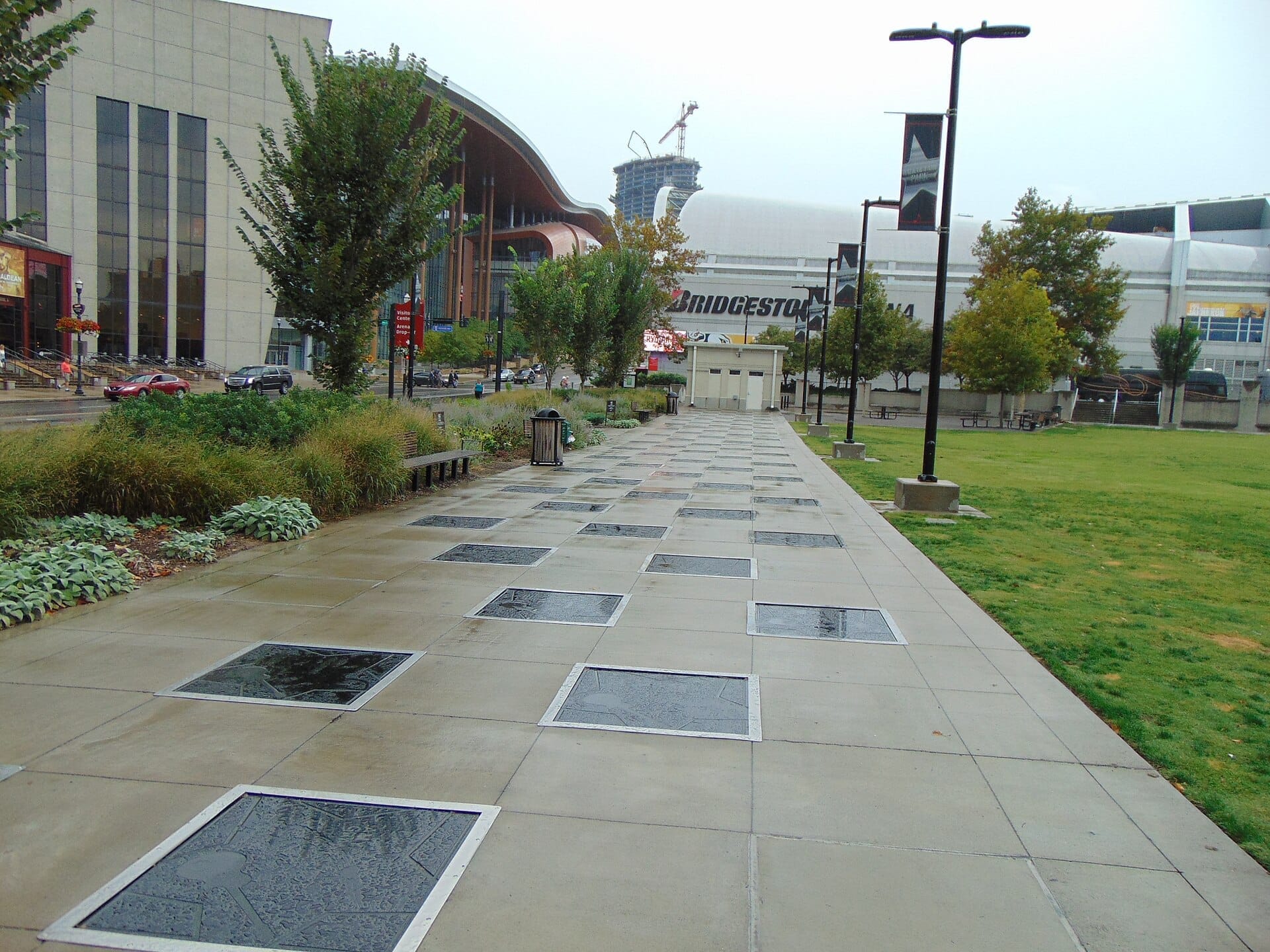
The Music City Walk of Fame is an outdoor public monument located in Walk of Fame Park on Demonbreun Street in downtown Nashville. Established in 2006 by the Nashville Convention and Visitors Bureau, it was created to honor artists, musicians, songwriters, and music industry figures who have made significant contributions to Nashville's musical legacy, regardless of genre. The honorees are not limited to country music: rock, blues, gospel, pop, and classical artists all appear in the constellation of stainless steel stars embedded in the park's terrazzo walkways.
Each star is large and boldly inlaid in the pavement, engraved with the honoree's name and a short descriptor of their contribution to Music City. With around 60 inductees recognized, the park reads like a compressed encyclopedia of American popular music, laid out underfoot at a scale that's easy to absorb in a single visit.
The park sits directly across Demonbreun Street from the Country Music Hall of Fame and Museum, and is flanked by Bridgestone Arena and Schermerhorn Symphony Center. This positioning is no accident: Walk of Fame Park occupies the physical and symbolic center of Nashville's institutional music district.
The Experience on the Ground
Walking into the park from the Demonbreun Street side, the first thing you notice is how clean and legible the design is. The stars aren't clustered randomly; they line the paths in a way that invites slow movement and reading. The stainless steel catches light differently depending on the angle and time of day, giving the stars a reflective quality that photographs well in morning and late afternoon sun.
💡 Local tip
Visit in the early morning before 9am for the best light on the stars and the quietest atmosphere. The park opens onto Demonbreun Street, which sees heavy foot traffic from mid-morning onward on weekends.
The terrazzo surrounding each star is smooth underfoot and the paths are flat throughout, making the park genuinely comfortable for strollers and wheelchairs. Shaded bench seating is scattered through the space, which matters considerably during Nashville's humid summers when the temperature routinely climbs above 87°F (31°C). The park is open to the public daily, and it looks striking at night when the surrounding venue lighting casts a warm glow across the walkways, though reading the star inscriptions after dark requires the torch on your phone.
Street noise from Demonbreun filters in continuously, a low-grade mix of vehicle traffic, delivery trucks early in the morning, and the distant thump of live music venues as the day wears on. It's urban, not serene, but that energy fits the subject matter.
Tickets & tours
Live prices and dates from our booking partner. If you book, we may earn a commission at no extra cost to you.
Old Town trolley tour of Nashville
From 54 €Instant confirmationFree cancellationNashville Soul of Music City night tour
From 40 €Instant confirmationFree cancellationCountry Hall of Fame, RCA studio B and Hatch Show Print tour
From 41 €Instant confirmationFree cancellationSelf-Guided Audio Tour in the Heart of Downtown Nashville
From 6 €Instant confirmationFree cancellation
Historical and Cultural Context
Nashville's identity as a music capital runs deeper than its modern tourism infrastructure. The city has been a center of the American recording industry since the 1950s, when the so-called Nashville Sound transformed country music into a polished, commercially viable format and made Music Row one of the most important addresses in the music business. The Walk of Fame was conceived as a way to make that legacy visible and publicly accessible at street level, rather than confined behind museum doors.
The honorees inducted into the Walk of Fame range from foundational figures in country and bluegrass to internationally recognized names in rock and pop. The range makes the park a genuinely broad statement about Nashville's musical influence rather than a narrowly genre-specific monument. For a deeper look at the city's recording history, the Country Music Hall of Fame and Museum directly across the street provides the archival depth and artifact collections that the park itself cannot.
The park's location in what locals call the SoBro (South of Broadway) district reflects Nashville's deliberate investment in creating a walkable cultural corridor between the entertainment strip on Broadway and the performing arts venues to the south. The Schermerhorn Symphony Center and Bridgestone Arena, both immediately adjacent, reinforce the Walk of Fame's role as a connective tissue between different expressions of Nashville's musical identity.
How the Experience Changes by Time of Day
Early morning, between 7am and 9am, the park belongs to dog walkers, joggers, and the occasional hotel guest who has wandered down from one of the nearby properties. The light at this hour is the most flattering for photography: low-angle sun catches the stainless steel stars with sharp definition, and the surrounding city is quiet enough that you can move through the space without navigating foot traffic.
By midday the character shifts. Tour groups arrive, often as part of downtown walking tours or as overflow from the Country Music Hall of Fame. The volume of visitors isn't overwhelming by any standard, but the park loses its contemplative quality. This is also when the heat becomes a genuine consideration in summer. The park has limited shade; a wide-brimmed hat and water bottle are practical rather than precautionary choices from June through August.
Evening visits, particularly on weekends, draw a different crowd: people on their way to or from shows at Bridgestone Arena or the Symphony. The park glows softly under venue and streetlighting, and the inscriptions on the stars are still legible if you crouch slightly. It's a pleasant five-minute detour rather than a destination at this hour, but worth noting for visitors whose days are oriented around evening concerts.
⚠️ What to skip
Nashville summers are genuinely hot and humid. The park is largely exposed with minimal shade. If you visit between late June and August, plan for either early morning or evening to avoid the worst of the heat. Carry water.
Practical Walkthrough: How to Get the Most Out of Your Visit
Walk of Fame Park is best treated as part of a broader downtown loop rather than a standalone destination. A natural circuit starts at the park, crosses Demonbreun to spend time at the Country Music Hall of Fame and Museum, then heads north toward Broadway for a look at the honky-tonk corridor before looping back. This circuit takes a half-day at a relaxed pace and covers the core of Nashville's music heritage district without requiring a car.
If you're arriving by car, the Gateway Commons parking garage sits directly beneath the park and provides some of the most convenient access to the Demonbreun Street corridor. Parking fees apply; rates vary. For visitors using WeGo Public Transit, multiple bus routes connect downtown Nashville's central transit hub at Music City Central with this part of Demonbreun Street. For full transit planning, the guide to getting around Nashville covers options in detail.
Photography is unrestricted and the park is designed for it. The stars photograph best when you position yourself low, using the perspective of the path to show multiple stars receding into the distance. The stainless steel surfaces reflect sky and surrounding buildings, which adds interest to close-up shots. Morning and late afternoon both produce more texture than the flat midday light.
Accessibility throughout the park is strong: flat, paved surfaces, no stairs on the main paths, and an entrance directly off Demonbreun Street at street level. The Gateway Commons garage below also has elevator access to the park level.
Honest Assessment: Is It Worth Your Time?
The Music City Walk of Fame is not a destination that will anchor an entire afternoon on its own. It is a small urban park with inscribed stars. If you arrive expecting spectacle, you will find a well-maintained but modest public space. That is not a criticism: the park does exactly what it sets out to do. It gives visitors a free, accessible, physical connection to the names and legacies that define Nashville's musical reputation, in a location that makes it easy to combine with several major nearby attractions.
Visitors who come prepared to spend 20 to 40 minutes reading the stars and absorbing the context of the surrounding cultural institutions will leave with a genuine sense of Nashville's musical geography. Visitors who are not interested in music history, or who are looking for interactive or immersive experiences, will find more substance at the National Museum of African American Music a short walk away, or at the Musicians Hall of Fame nearby.
Families with children can visit without concern: the open layout, flat ground, and zero admission cost make it a low-pressure stop. There is nothing age-restricted or fragile here. Younger children may not engage deeply with the inscriptions, but the open space is comfortable and the visit is brief.
Insider Tips
- The Gateway Commons garage beneath the park is often overlooked by first-time visitors who circle the surrounding blocks. Access it directly from 4th Avenue South for the most convenient downtown parking.
- Look for the stars that list 'songwriter' or 'producer' alongside performer names. These honorees often surprise visitors unfamiliar with the behind-the-scenes figures who shaped Nashville's sound as much as the artists who performed it.
- The park connects naturally to a self-guided walking tour of the SoBro music district. Download the official Visit Music City walking tour map before you arrive to make the most of the surrounding half-mile radius.
- If you visit during CMA Fest or other major music events, the park fills with fans and the surrounding streets are closed to vehicles. Plan for more time and come early in the day to avoid the densest crowds.
- Combine the Walk of Fame with a stop at Hatch Show Print, a short walk away, for context on how Nashville's visual music culture developed alongside its sonic one.
Who Is Music City Walk of Fame Park For?
- First-time visitors to Nashville who want a quick, free orientation to the city's musical legacy
- Music history enthusiasts building a themed itinerary around the Country Music Hall of Fame and nearby institutions
- Budget travelers looking for substantive free attractions in the downtown core
- Families with children who need an outdoor, low-pressure stop between indoor museum visits
- Photographers interested in street-level urban detail and reflective surface textures
Nearby Attractions
Other things to see while in Downtown Nashville:
- 3rd & Lindsley
Since 1991, 3rd & Lindsley has been the venue where Nashville musicians play when they want to be heard, not just seen. Located half a mile south of Broadway in the SoBro district, it is an intimate, no-frills room that draws touring acts, local legends, and serious audiences in equal measure.
- Acme Feed & Seed
Housed in a landmark 1943 building at the corner of 1st Avenue and Broadway, Acme Feed & Seed is a multi-level bar, restaurant, and music venue with a rooftop overlooking the Cumberland River. It offers a more layered experience than the typical honky-tonk strip, with a rooftop that earns its reputation for views and a ground floor that still delivers the Broadway energy.
- Adventure Science Center
Adventure Science Center is Nashville's premier interactive science museum, offering 44,000 square feet of hands-on exhibits, a 75-foot adventure tower, and a 63-foot dome planetarium. It has served the city since 1945 and remains one of the most engaging family destinations near downtown Nashville.
- Bicentennial Capitol Mall State Park
Bicentennial Capitol Mall State Park is a free, 19-acre outdoor park in downtown Nashville built to commemorate Tennessee's 200th anniversary of statehood. Anchored by a 200-foot granite map of the state, a 95-bell carillon, and the Rivers of Tennessee Fountains, it doubles as one of the most informative and peaceful green spaces in the city center.
Planning a trip? Discover personalized activities with the Nomado app.