The Museum of Modern Art (MoMA): What to Know Before You Go
The Museum of Modern Art is one of the world's most influential art institutions, holding works by Picasso, Warhol, Monet, and Frida Kahlo across 170,000 square feet of gallery space in Midtown Manhattan. Whether you have two hours or a full day, understanding how MoMA is organized, when to go, and what to prioritize makes the difference between a meaningful visit and an overwhelming one.
Quick Facts
- Location
- 11 West 53rd Street, Midtown Manhattan, New York, NY 10019
- Getting There
- E/M train to 5 Av/53 St (nearby); F train to 57 St (nearby)
- Time Needed
- 2–4 hours (full visit); 1 hour for highlights only
- Cost
- Adults $30 | Seniors $22 | Students $17 | Under 16 Free | NY State residents free Friday evenings 5:30–8:30 p.m.
- Best for
- Art enthusiasts, design lovers, architecture admirers, rainy-day culture seekers
- Official website
- www.moma.org
What MoMA Actually Is (and Why It Matters)
The Museum of Modern Art, better known as MoMA, opened in 1929 and has spent nearly a century shaping how the world understands modern and contemporary art. It was not simply built to house art: it was founded to argue that modern art deserved serious institutional attention at a time when that was still a contested idea. That founding tension gives MoMA a particular energy that older encyclopedic museums do not have. This is a place with a point of view.
The collection spans painting, sculpture, photography, film, architecture, design, and performance. Works range from late 19th-century post-Impressionism through the present day, with particular strength in early 20th-century European modernism and postwar American art. The permanent collection holds over 200,000 objects, though only a fraction are on display at any time across the museum's galleries, distributed across a multi-level building that was significantly expanded and reopened in 2019.
If you are building an itinerary around Manhattan's art institutions, our guide to the best museums in New York City can help you decide how MoMA fits alongside the Met, the Whitney, and the Guggenheim.
The Building and the Arrival Experience
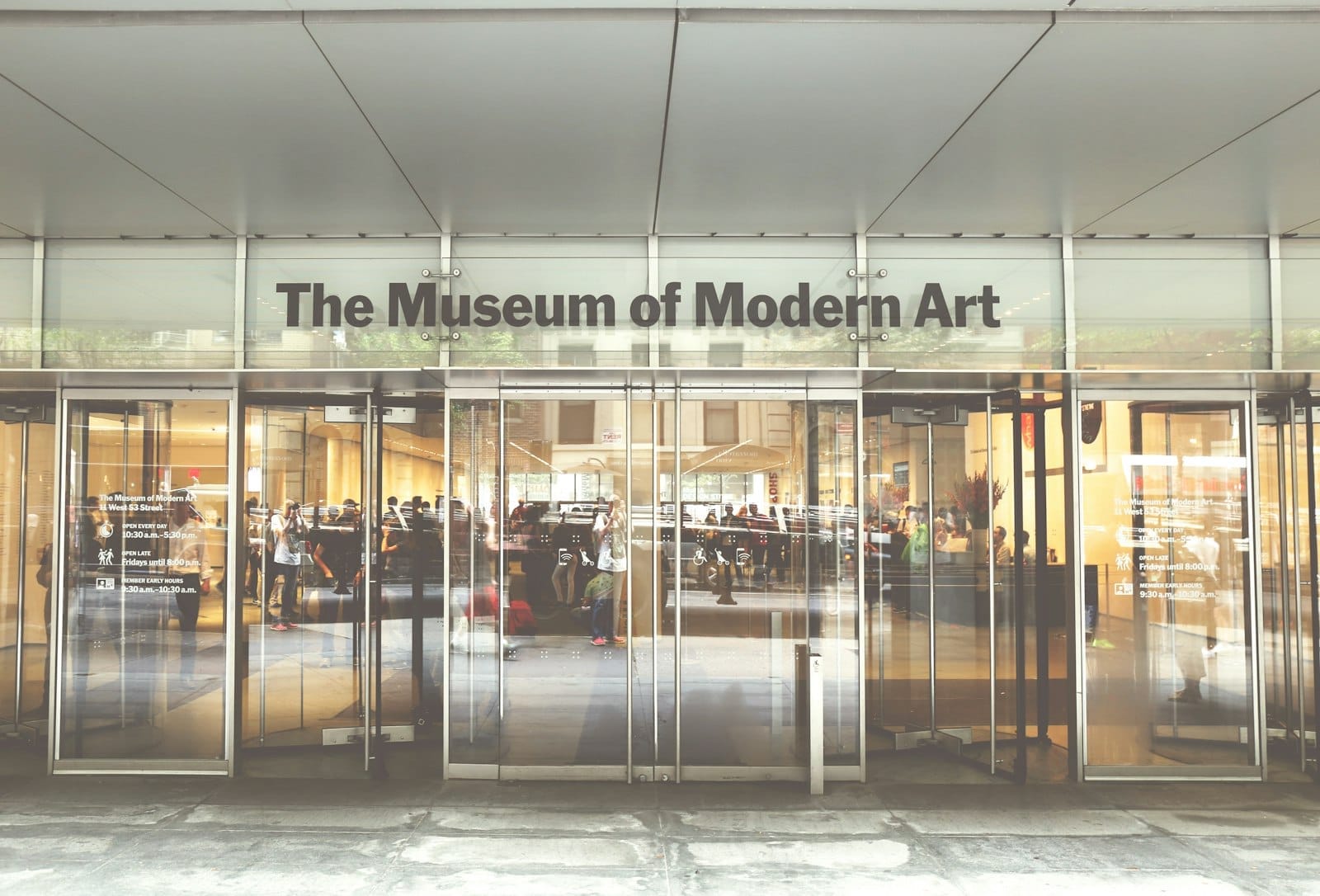
MoMA's current building is a study in considered restraint. The facade on West 53rd Street is glass and pale stone, designed to read as calm and permeable rather than monumental. Walking in from Midtown, surrounded by office towers and hotels, the entrance feels deliberately understated for an institution of this stature. That contrast is intentional.
Once inside, the scale opens up. The central atrium brings natural light deep into the building, and the sightlines from the lobby already give you glimpses into galleries above. The ticketing area can back up during busy periods, particularly on weekend mornings and during special exhibitions. Buying tickets online in advance is the single most effective way to save time on arrival.
💡 Local tip
Buy tickets at moma.org before you arrive. Walk-up queues at the ticket desk can add 20-30 minutes during peak hours, especially on Saturday mornings and during major special exhibitions.
The museum coat check is located near the entrance and is worth using. Gallery security staff will ask you to remove backpacks and large bags before entering certain areas, so checking your bag early avoids repeated interruptions.
Tickets & tours
Hand-picked options from our booking partner. Prices are indicative; availability and final rates are confirmed when you complete your booking.
The Edge Observation Deck, St Patrick's Cathedral and MoMA admission tickets
From 88 €Instant confirmationFree cancellationMuseum of Modern Art (MoMA) skip-the-line tickets
From 26 €Instant confirmationFree cancellationFamous artists of Manhattan exploration game and tour
From 10 €Instant confirmationFree cancellationPrivate Metropolitan Museum of Art skip-the-line guided tour
From 131 €Instant confirmationFree cancellation
Navigating the Collection: What You Will Encounter
MoMA's galleries are organized thematically and by medium rather than strictly chronologically, which is a deliberate curatorial choice and can feel disorienting on a first visit. The 2019 expansion reshuffled the collection significantly, placing works by women artists and artists from outside Europe and North America in genuine dialogue with the canonical names, rather than as footnotes. The result is a richer collection hang, though visitors expecting a linear art-history walkthrough may need to recalibrate their expectations.
Certain works are so well-known they have become pilgrimage objects. Vincent van Gogh's The Starry Night, Pablo Picasso's Les Demoiselles d'Avignon, Claude Monet's Water Lilies triptych, Andy Warhol's Campbell's Soup Cans, Salvador Dali's The Persistence of Memory, and Frida Kahlo's Self-Portrait with Cropped Hair are all in the permanent collection. Crowds tend to cluster around these works, especially Starry Night, which sits in a gallery that can feel genuinely packed on a busy afternoon. The Monet Water Lilies room, by contrast, is large enough that it rarely feels congested and rewards slow time.
The design and architecture galleries on the lower levels are among the most undervisited parts of the museum relative to their quality. Chairs, typefaces, appliances, posters, and industrial objects are displayed with the same curatorial seriousness as paintings, and these rooms tend to be quieter. If you find the painting galleries crowded, the design collection offers both relief and genuine substance.
ℹ️ Good to know
MoMA also maintains a film program with regular screenings of repertory and contemporary cinema. Tickets are separate from general museum admission. Check the film schedule on moma.org before your visit if this interests you.
How the Experience Changes by Time of Day
Morning visits, particularly on weekdays, offer the closest thing to a quiet museum experience. The galleries open at 10:30 a.m. on weekdays and weekends, and the first hour tends to be calm: footsteps echo, the light through the atrium is softer, and the most popular works are approachable without crowds pressing in around you. This is the window to spend time with Starry Night or the Monets without jostling.
By midday on weekends, the museum reaches its most crowded state. School groups, tour groups, and independent visitors converge, and the audio guide narration from multiple nearby visitors creates a low-level noise floor throughout the galleries. This is not a reason to avoid visiting, but it is a reason to arrive early or to head to the less-trafficked floors first.
Friday evenings are a different experience entirely. MoMA stays open until 8:30 p.m. on Fridays, and from 5:30 p.m., New York State residents can enter free of charge (advance ticket reservation is required). The evening crowd skews younger and more local. The galleries thin out in ways they do not during the day, and the museum's restaurant and cafe take on a social atmosphere. Even for out-of-state visitors paying full admission, Friday evening is among the most pleasant times to visit.
Practical Details: Getting There, Hours, and Accessibility
MoMA is located at 11 West 53rd Street in Midtown Manhattan, between Fifth and Sixth Avenues. The E and M subway trains stop at 5 Av/53 St, roughly a four-minute walk. The F train stops at 57 St, similarly close. The museum is also walkable from Rockefeller Center and Fifth Avenue shopping, making it easy to combine with other Midtown stops.
The surrounding area of Midtown Manhattan is dense with other sights. The New York Public Library is about a ten-minute walk south, and Rockefeller Center is just two blocks east.
- Monday–Thursday: 10:30 a.m.–5:30 p.m.
- Friday: 10:30 a.m.–8:30 p.m.
- Saturday–Sunday: 10:30 a.m.–5:30 p.m.
- Members-only early access: Saturday & Sunday 9:30–10:30 a.m. in select galleries
- Closed Thanksgiving Day and Christmas Day
Accessibility at MoMA is well-considered. Visitors with disabilities pay $22, and one accompanying care partner enters free. The building is wheelchair accessible throughout, with elevators serving all gallery levels. Specific accessibility information, including details on sensory-friendly programming and audio descriptions, is available on the museum's visit page.
⚠️ What to skip
MoMA does not publish a permanent floor-by-floor map online, as gallery configurations can change with new installations. Collect a printed map at the information desk on arrival, or ask staff for the current gallery layout for specific works you want to find.
Photography, the Garden, and What People Miss
Photography without flash is permitted throughout most of MoMA's permanent collection galleries. Tripods and selfie sticks are not allowed. Some special exhibitions restrict photography entirely; signage at the gallery entrance will indicate this. The museum's architecture, particularly the atrium stairwells and the long gallery corridors, photographs well and gives a sense of the building's scale.
The Abby Aldrich Rockefeller Sculpture Garden, accessible from the ground floor, is one of the genuinely underappreciated spaces in Midtown. Designed by Philip Johnson and opened in 1953, the garden hosts large-scale sculptures against the backdrop of the surrounding towers. On a clear day, particularly in spring or early autumn, it provides a rare moment of open sky and quiet in the middle of Midtown. The garden has limited seasonal hours and may close during private events; check on arrival.
MoMA's location makes it a natural anchor for a broader art-focused day in Manhattan. For context on where it fits within the city's wider art landscape, the New York City art guide covers galleries, institutions, and neighborhoods worth pairing with a museum visit.
Is MoMA Worth It? An Honest Assessment
At $30 for adult admission, MoMA is not cheap, and the question of value depends significantly on what you bring to it. Visitors who arrive with specific works in mind, some familiarity with 20th-century art movements, or a genuine curiosity about design and visual culture tend to leave feeling the price was justified. The quality of the collection is not in question: this is one of the great modern art museums on earth, and the 2019 rehang improved how the collection reads considerably.
Visitors who arrive expecting a single overwhelming masterpiece experience may find MoMA diffuse. Unlike a cathedral or a landmark building, it does not resolve into a single defining moment. The reward here is cumulative: the quality of looking across many rooms and many types of objects. If that is not your preference, the $30 is better spent elsewhere. Two hours is enough to cover the highlights without fatigue; four hours allows for depth.
Travelers on a budget who are New York State residents should note that Friday evening free admission (5:30–8:30 p.m.) is a genuine offer, not a catch. Advance ticket reservation is required even for free entry, but the museum does not charge residents during this window. Non-residents should also be aware that MoMA is included in the New York City Pass and similar attraction bundles if you are planning multiple paid admissions.
For budget-conscious travelers, our guide to free things to do in New York City includes other cultural institutions with no admission cost.
Insider Tips
- The Monet Water Lilies room (usually on the fifth floor) is large enough to absorb crowds better than the Starry Night gallery. If you want a contemplative experience with a major work, spend time there rather than fighting for space in front of Van Gogh.
- Friday evening free admission for New York State residents requires advance ticket reservation at moma.org even though there is no charge. Failing to reserve means you may be turned away at the door.
- The museum's cafe on the second floor offers a calmer midday break than the main restaurant. It is less crowded and the food quality is similar.
- If you are a serious visitor, check MoMA's website before arriving to see which special exhibitions are currently installed. Special exhibitions often occupy large gallery sections and require navigating around them to reach the permanent collection.
- The design and architecture galleries on the lower levels see a fraction of the foot traffic of the painting floors. If crowds upstairs become tiresome, head down: the chairs, posters, and industrial design objects are genuinely worth your time and the galleries are often near-empty.
Who Is Museum of Modern Art (MoMA) For?
- Art enthusiasts who want direct access to canonical works of 20th-century painting and sculpture
- Design and architecture lovers, particularly for the lower-level design collection and the Sculpture Garden
- Rainy-day culture seekers who need a full-day indoor itinerary in Midtown
- New York State residents taking advantage of Friday evening free admission
- Travelers combining a Midtown art day with nearby institutions or Fifth Avenue
Nearby Attractions
Other things to see while in Midtown Manhattan:
- Broadway Theater District
The Broadway Theater District in Midtown Manhattan is the center of American live theater, home to 41 official Broadway houses spanning nearly a century of performance history. Whether you're booking months in advance or hunting same-day discount tickets, this guide covers everything from curtain times to architectural details.
- Bryant Park
Tucked behind the New York Public Library on Sixth Avenue, Bryant Park is an 8-acre public park that holds its own against the surrounding skyscrapers. Free to enter year-round, it shifts character dramatically by season, from a winter ice rink to a summer outdoor cinema — and remains one of the most functional and well-managed public spaces in New York City.
- Carnegie Hall
Carnegie Hall has anchored Midtown Manhattan's cultural life since 1891. With three auditoriums ranging from 268 to 2,790 seats, it hosts everything from orchestral premieres to intimate recitals. This guide covers the halls, the history, and exactly how to make the most of a visit.
- Chrysler Building
Completed in 1930 and briefly the tallest building on earth, the Chrysler Building remains the finest example of Art Deco architecture in New York City. Visitors generally can't go inside beyond the main lobby, but the experience of standing beneath its gleaming stainless steel crown is genuinely unforgettable.