Mount Takao (Takao-san): The Mountain That Earns Its Place on Every Tokyo Itinerary
Rising 599 meters on the western edge of Tokyo's urban sprawl, Mount Takao (高尾山) offers something genuinely rare in a megacity: a forest that smells like forest, trails that reward effort, and a centuries-old Buddhist temple halfway up the slope. It is reachable in under an hour from central Tokyo and free to enter, which helps explain why it is one of Japan’s most visited mountains.
Quick Facts
- Location
- Takaomachi, Hachioji City, Tokyo 193-0844
- Getting There
- Takaosanguchi Station (Keio Takao Line), 5-minute walk to cable car and trailheads
- Time Needed
- 3–5 hours for a full round trip including the summit; half-day if you linger at Yakuo-in
- Cost
- Free to hike; cable car approx. ¥480 one way / ¥930–950 round trip (adult); chairlift similar pricing
- Best for
- Families, solo walkers, photographers, anyone wanting greenery without leaving Tokyo
- Official website
- www.takaotozan.co.jp
What Mount Takao Actually Is (and Why That Matters)
Mount Takao, known in Japanese as Takao-san (高尾山), sits at 599 meters above sea level in Hachioji City, at the western fringe of Tokyo Metropolis. That relatively modest elevation is part of the appeal: the mountain is genuinely manageable for most fitness levels, yet the forested slopes feel nothing like the concrete districts 50 kilometers to the east. The surrounding area forms part of the Mt. Takao Recreation Forest within Meiji no Mori Takao Quasi-National Park, a status that has protected its old-growth cedar and broadleaf woodland from development.
What sets Takao-san apart from other urban-fringe green spaces is the combination of factors converging in one place: multiple marked hiking trails of varying difficulty, a cable car and chairlift for those who want to ease into it, a working Buddhist temple complex with genuine historical weight, and views that on clear winter days extend all the way to Mount Fuji. No single element would be enough on its own, but together they create a day out with real substance.
💡 Local tip
For Mount Fuji views, aim for a weekday in late November through February. The air is driest and clearest in winter, and the crowds thin considerably after autumn leaf season ends.
Getting There: Simpler Than You Think
The most straightforward route from central Tokyo is the Keio Takao Line directly to Takaosanguchi Station. From Shinjuku, the journey takes roughly 50 minutes on a limited express service. If you are coming from elsewhere in the city, take the JR Chuo Line to Takao Station, then transfer to the Keio Line for one stop to Takaosanguchi. The station itself sits at the base of the mountain, with the cable car station and chairlift terminal a 5-minute walk away. There is no need to plan intricate connections.
Takaosanguchi Station is small but has luggage coin lockers near the exit, which is worth knowing if you are continuing to Kyoto or elsewhere after your hike and need to travel light. The path from the station to the trailheads and mechanical transport is well-signed in English, so first-time visitors rarely get confused in this stretch.
Tickets & tours
Hand-picked options from our booking partner. Prices are indicative; availability and final rates are confirmed when you complete your booking.
Tsukiji Fish Market Walking Food Tour
From 40 €Instant confirmationFree cancellationMt.Fuji,Owakudani, Hakone Cruise & Ropeway, Oshino Hakkai 1-Day Trip
From 54 €Instant confirmationFree cancellationTour to Mt. Fuji Area, Oshino Hakkai and Kawaguchi Lake from Tokyo
From 57 €Instant confirmationFree cancellationNikko UNESCO Shrine and Nature View 1-Day Tour from Tokyo
From 78 €Instant confirmationFree cancellation
Choosing Your Route Up: Six Options, One Summit
Mount Takao has six numbered trails, each with a distinct character. Trail 1, the Omotesando Course, is the most popular: it follows the cable car line up through the forest and passes directly through the Yakuo-in temple complex before reaching the summit. It is well-paved in the lower sections, which makes it accessible for children and those with limited hiking experience, though the upper portion becomes uneven stone steps near the temple.
Trail 6, the Biwa-daira Course, runs along a stream through a narrow valley and feels markedly wilder than Trail 1. The path crosses the stream several times on wooden bridges, and in wet seasons you can hear water on both sides for much of the ascent. It is the trail most likely to feel like a genuine forest walk rather than a crowd procession. Trail 4 is a loop option that connects to Trail 1 near the summit and passes a suspension bridge worth stopping on for views down into the canopy. All trails converge at the summit, which means you can mix and match your up and down routes.
If hiking is not the goal, the cable car starts operating at 8:00, with last rides varying by season (typically between about 17:15 and 18:30). The chairlift operates from 9:00 to 16:30 between May and November, and 9:00 to 16:00 from December through April. Both arrive at Kiyotaki Station, about halfway up the mountain, cutting the ascent to a 40-minute walk instead of 90 minutes from the base. The cable car is the better choice in rain; the chairlift offers better views when skies are clear.
ℹ️ Good to know
Cable car: approx. ¥490 one way / ¥950–980 round trip (adults). Children (over 3, under junior high school age): approx. ¥250 one way / ¥470–500 round trip. Prices verified against 2025–2026 sources but check the official Takao Tozan Railway site before visiting.
Yakuo-in Temple: The Cultural Core of the Mountain
Halfway up Trail 1, the forest opens into the complex of Takao-san Yakuo-in, a Buddhist temple that has occupied this slope since 744 in the 8th century. The head temple belongs to the Chizan branch of Shingon Buddhism, a sect associated with esoteric practices and mountain worship. The atmosphere shifts noticeably when you enter the temple precinct: incense drifts across the courtyard, the sound of chanting occasionally carries from interior halls, and the architectural density of the complex, with its tiered gates, carved wooden reliefs, and layered roof lines, reads as genuinely different from the more touristic temple experiences in central Tokyo.
The temple is particularly associated with the Tengu, long-nosed mountain spirits of Japanese folklore. Carved Tengu figures appear throughout the complex, and the main deity enshrined here, Izuna Daigongen, is depicted riding one. This connection to mountain asceticism makes Yakuo-in more than a scenic stop: it is an active center of practice, and visitors often encounter pilgrims completing the climb as a devotional act. For context on how Yakuo-in fits into Tokyo's broader temple landscape, the guide to Tokyo's best temples and shrines offers useful comparison points.
The Summit and What You See From It
The summit at 599 meters is a broad, relatively flat area with a viewing platform and a small shrine. On clear days between late autumn and late winter, Mount Fuji appears to the southwest with startling clarity, its cone rising above the lower ridge lines. This is not a guaranteed sighting: cloud cover, humidity, and haze reduce the probability considerably between May and September. The summit also looks back east toward the Tokyo skyline, though the view in that direction is less dramatic.
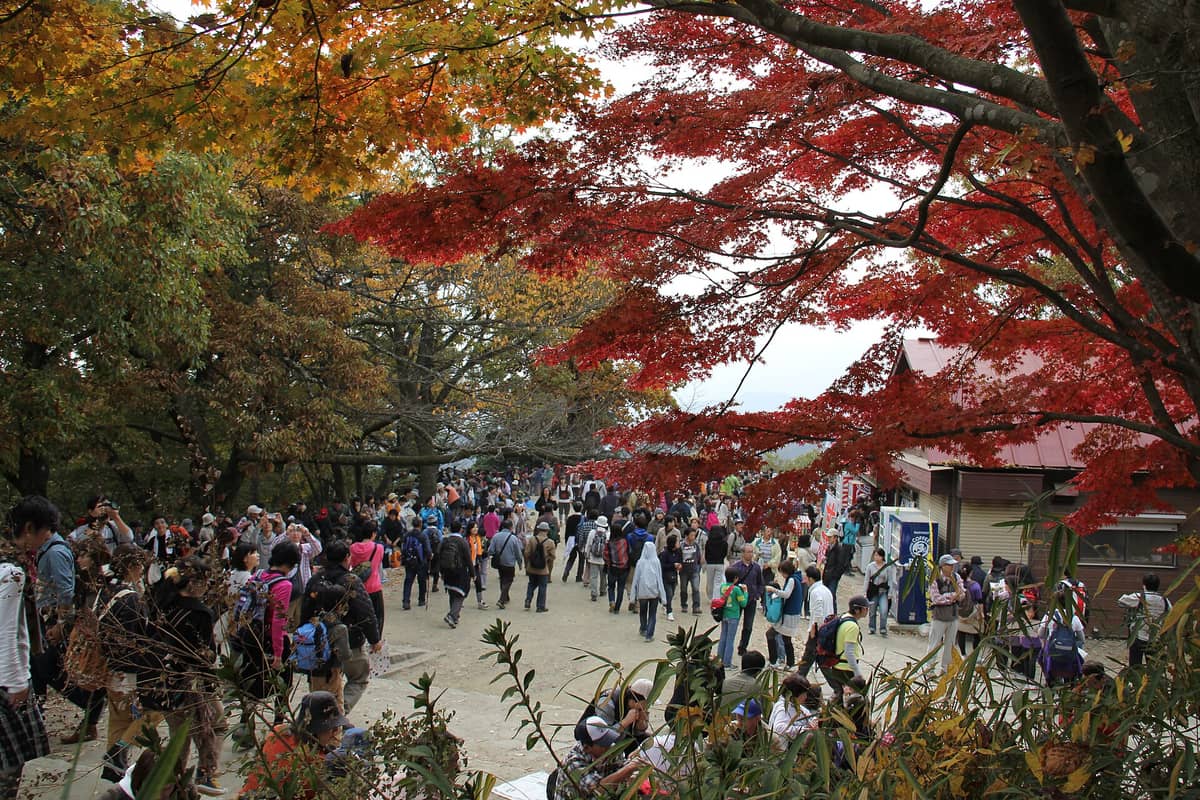
In autumn, specifically late November to early December, the slopes below the summit hold some of the finest foliage in the Tokyo area. The mix of Japanese maple, ginkgo, and zelkova turns the hillside orange, red, and yellow in layers visible from the summit viewing platform. This is when Takao-san reaches peak crowds: weekend visitor numbers during prime autumn leaf season are substantial, and the trail can feel more like a slow queue than a hike. If you visit during this period, arrive before 9:00 or come on a weekday.
⚠️ What to skip
Autumn weekends (late November to early December) draw enormous crowds. The cable car can have waits of 30 minutes or more. Hike up Trail 6 and take the cable car down, or start before 9:00 to stay ahead of the main rush.
How the Experience Changes by Time of Day and Season
Early morning on any weekday, the base of the mountain feels almost private. The souvenir stalls are still shuttered, the air carries the smell of damp cedar and earth, and the only sounds on the lower trails are birds and the occasional crow. By 10:00 on weekends the atmosphere has shifted entirely: groups of school children, family clusters with strollers, and hiking clubs in matching jackets fill the main trail. Neither version is wrong, but they are genuinely different experiences.
Spring brings cherry blossoms to the lower slopes in late March and early April, which overlap with the general Tokyo cherry blossom season. Summer is lush but humid, and the shade of the forest canopy on Trail 6 makes the ascent more bearable than open slopes would be. Winter is the underrated season: fewer visitors, dry air, and the highest chance of seeing Mount Fuji clearly. If a clear winter day is what you are after, cross-reference it with the best time to visit Tokyo for broader seasonal context before planning.
Practical Details: What to Bring, What to Expect
The mountain trails are well-maintained but not entirely paved. Trail-running shoes or light hiking shoes are adequate for Trails 1 and 4. Trail 6 involves stream crossings on narrow bridges and some scrambling near the top, so waterproof footwear is worthwhile in wet weather. Trekking poles are not necessary but are used by many older visitors on the steeper sections near the temple.
Water is available at vending machines near the cable car base and at the Yakuo-in area, but not reliably on the trails themselves. Carry at least a liter if you plan to hike both ways. The summit has a small shop and a restaurant serving soba noodles, a local specialty tied to Hachioji's food culture. Several stalls along Trail 1 sell grilled mochi skewers and roasted corn, and the smell of both tends to drift across the path in the mid-morning hours.
Accessibility on the mountain is partial. The cable car and chairlift make the midpoint reachable without hiking, and the paved lower section of Trail 1 is manageable for mobility-limited visitors. The upper sections involve uneven stone stairs and are not suitable for wheelchairs. The Tokyo Metropolitan Government's accessibility guide notes barrier-free information for the Takaosanguchi area; discounts may be available for cable car and chairlift users with disabilities on inquiry at the ticket counter.
Mount Takao is commonly included in day trips from Tokyo itineraries, and it pairs naturally with a visit to Kawagoe or Kawaguchiko if you are traveling by rail through the western Tokyo area. It also fits well into a Tokyo itinerary with children, particularly for families who want outdoor time after days of urban sightseeing.
Who Should Consider Skipping It
Travelers on a short Tokyo trip who have already visited several parks and gardens may find that the hour-long train journey each way does not justify the marginal difference in scenery. If you have already walked Shinjuku Gyoen and Yoyogi Park and are short on time, Takao-san is best saved for a return visit. Similarly, visitors seeking serious mountain hiking will find the crowds and infrastructure of Trail 1 disappointing: for genuine wilderness, the Japan Alps or even nearby Okutama are more appropriate.
The mountain also does not perform well in heavy rain or thick cloud cover. The forest trails become slippery, the views disappear, and the cable car queues grow long with people retreating early. Check the weather the night before: a clear-sky weekday is the single biggest factor in getting value from this trip.
Insider Tips
- Take Trail 6 up (stream-side, quieter, more atmospheric) and Trail 1 down past the temple. This route gives you the best of both paths without retracing steps.
- The cable car base area has coin lockers near the station exit, useful if you are connecting to a night train or continuing westward toward Kyoto after the hike.
- For Mount Fuji visibility, check the Japan Meteorological Agency's daily visibility forecast for the Kanto region. If the weather in central Tokyo is crisp and northwest winds are forecast, Fuji sightings from the summit are likely.
- The soba restaurants near the summit and at the base along Trail 1 are genuinely good, not tourist-trap food. Yamabushi Soba, flavored with mountain vegetables, is a regional specialty worth ordering if it is on the menu.
- Weekday mornings in winter offer the rarest combination on Takao-san: solitude, frost on the upper trail, and clear Fuji views. If your schedule allows any flexibility, this is the configuration worth holding out for.
Who Is Mount Takao (Takao-san) For?
- Families with children who need a physical outdoor day between city sightseeing
- Solo hikers wanting a well-marked half-day trail close to Tokyo
- Photographers chasing autumn foliage or winter Fuji views
- Anyone interested in active Shingon Buddhist temple culture outside the main tourist circuit
- Travelers on a budget: the mountain is free, and the total trip cost including train and cable car can often be kept around ¥3,000
Nearby Attractions
Combine your visit with:
- Akasaka Palace (State Guest House)
The State Guest House, Akasaka Palace is Japan's principal diplomatic residence and one of the few Western-style palaces in Asia open to the public. Built in neo-baroque style for the Crown Prince in the early 20th century, it now receives heads of state and, on select days, ordinary visitors. The combination of ornate gilded interiors, formal French gardens, and a Japanese-style annex makes it one of the most architecturally unusual stops in Tokyo.
- Edo-Tokyo Open Air Architectural Museum
Spread across the grounds of Koganei Park, the Edo-Tokyo Open-Air Architectural Museum rescues and reassembles more than 30 historic structures spanning the Edo period through the early 20th century. From a dismantled farmhouse to a reconstruction of a Showa-era Tokyo streetscape, it is one of the most thoughtful and undervisited cultural sites in the metropolitan area.
- Enoshima
A small island off the Shonan coast of Kanagawa Prefecture, Enoshima packs a surprising amount into a short walk: a three-part Shinto shrine, ancient sea caves, a hilltop botanical garden, a lighthouse observation tower, and seafood stalls lining a stone-paved shopping street. It works as a half-day excursion or a full day if you combine it with nearby Kamakura.
- Gotokuji Temple
Gotokuji Temple in Setagaya is a working Soto Zen Buddhist temple that happens to be one of the claimed birthplaces of the maneki-neko, Japan's iconic beckoning cat. Hundreds of white ceramic cats line the shelves of a dedicated shrine, creating one of Tokyo's most quietly striking visual spectacles. Entry is free, crowds are manageable, and the surrounding grounds offer genuine calm.