Monumento a la Independencia: Mexico City's Angel of Independence
Standing approximately 36 meters tall on Paseo de la Reforma, the Monumento a la Independencia (El Ángel) is one of Mexico City's most recognizable landmarks. A gilded bronze angel crowns a neoclassical column holding the remains of 14 independence heroes, and the roundabout below becomes the city's default gathering point for celebrations, protests, and everyday life.
Quick Facts
- Location
- Paseo de la Reforma s/n, Colonia Juárez, Alcaldía Cuauhtémoc, Mexico City
- Getting There
- Turibús and Capital Bus stop at the roundabout; no direct Metro station, but Zona Rosa and Reforma are walkable from Insurgentes (Line 1)
- Time Needed
- 20–40 minutes for the exterior and plaza; allow extra time if joining weekend guided climbs (10:00–13:00, limited availability)
- Cost
- Free (exterior and plaza). Interior staircase/viewpoint access: verify locally, as pricing is not consistently published
- Best for
- Architecture fans, history seekers, photographers, and anyone walking Paseo de la Reforma
- Official website
- mexicocity.cdmx.gob.mx/venues/el-angel-independencia
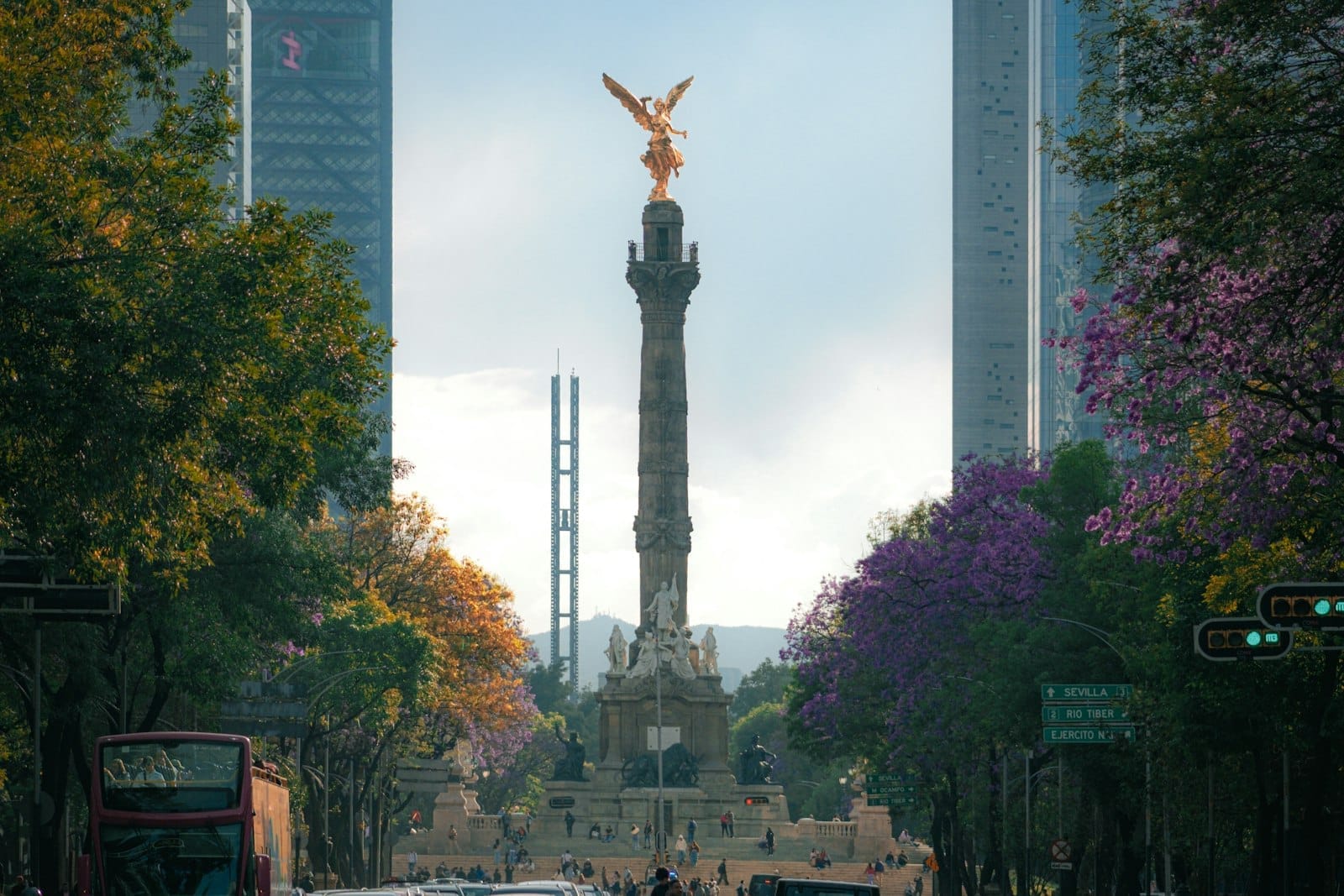
What You Are Looking At
The Monumento a la Independencia is an approximately 36-meter Corinthian column rising from a broad neoclassical base in the center of one of Paseo de la Reforma's signature roundabouts. At the top, a gilded bronze angel — Victoria, the goddess of victory — stands with her arms spread wide, a laurel wreath in one hand and a broken chain in the other. The symbolism is deliberate: Mexico breaking free from Spanish colonial rule. The monument is known colloquially as El Ángel, and that name has stuck across everyday conversation, news coverage, and street directions throughout the city.
Up close, the column is far more detailed than it looks from a passing car window. The base contains four bronze statues representing Law, War, Justice, and Peace, and additional relief sculptures recount episodes from the independence struggle. Four eagles flank the column's plinth, their spread wings echoing the national symbol. The stone is a warm honey-cream color that absorbs afternoon light differently than the cooler morning hours, which matters if you are deciding when to photograph it.
ℹ️ Good to know
Inside the base rest the remains of 14 heroes of Mexico's War of Independence, including Miguel Hidalgo, José María Morelos, and Josefa Ortiz de Domínguez. This is not just a decorative column — it functions as a mausoleum.
History and Context
The project was commissioned under President Porfirio Díaz as part of a broader modernization campaign that reshaped Paseo de la Reforma into a European-style boulevard lined with monuments and statues. The first stone was laid in 1902, and construction ran to 1910, with the inauguration on September 16, 1910 — the exact centennial of the beginning of Mexico's War of Independence. The timing was not accidental; Díaz was projecting national confidence on a world stage.
The monument did not survive the 20th century untouched. The 1957 earthquake shook the angel figure from the column's peak and shattered it on the roadway below. The figure was painstakingly restored, and the monument was re-inaugurated on September 16, 1958. The repair work is close to invisible today, though the story circulates widely among locals and is worth knowing before you visit.
The broader Paseo de la Reforma corridor, where El Ángel stands, has its own layered history as a showcase of Mexican national identity. To understand the monument's place in the city, it helps to read about the Paseo de la Reforma itself, which connects El Ángel to Chapultepec Park at one end and the historic center at the other.
Tickets & tours
Live prices and dates from our booking partner. If you book, we may earn a commission at no extra cost to you.
Puebla and Cholula guided tour from Mexico City with optional lunch
From 43 €Instant confirmationFree cancellationXochimilco, Coyoacan and Frida Kahlo Museum with skip-the-line tickets
From 63 €Instant confirmationFree cancellationMexico City exploration game and tour in Chimalistac
From 10 €Instant confirmationFree cancellationCuernavaca and Taxco Guided Tour with Optional Lunch
From 40 €Instant confirmationFree cancellation
How the Experience Changes by Time of Day
Early morning, before 8:00, the roundabout is calm enough to notice details you would miss later. Joggers circle Reforma, vendors begin setting up on nearby corners, and the column catches low golden light from the east. This is the window photographers prefer: soft light, no crowds, and the angel's gilt surface glowing without the harsh midday bleaching. Bring a wide-angle lens or position yourself from the pedestrian crossing on Reforma heading toward Chapultepec for a clean frontal shot.
By late morning and midday, foot traffic increases steadily. Tour buses from Turibús and Capital Bus stop at the roundabout quadrants, and groups gather around the base. Midday in full sun makes the column look washed out in photographs, and the heat radiating from the roadway is noticeable at the city's altitude. The plaza surface is mostly exposed concrete and stone, so shade is limited.
Evenings produce the most dramatic atmosphere. The monument is illuminated after dark, and the golden angel against a deep blue or black sky draws a different crowd: couples, street vendors, and visitors using the surrounding pedestrian esplanade as a gathering point. Night photography here is especially rewarding, particularly on clear nights when the illuminated column contrasts with the modern office towers behind it.
💡 Local tip
On September 15–16 (Mexican Independence) and after major sports events, the roundabout becomes the city's impromptu gathering place for tens of thousands of people. It is an extraordinary spectacle, but expect no quiet observation — and plan your transport accordingly.
Getting There and Getting Around
The monument sits on a traffic roundabout, which means pedestrian access requires crossing Reforma at designated crossings. The plaza around the base is accessible from all four sides of the roundabout, and the surfaces are step-free at street level, making the exterior fully accessible. Tourist buses are the most convenient public option if you are following a Reforma route; Turibús Circuito Centro Histórico and Capital Bus Ruta Centro-Polanco both stop at the roundabout quadrants.
There is no Metro station directly at El Ángel. The nearest Metro is Insurgentes on Line 1, which requires a walk of roughly 10–15 minutes through Zona Rosa. Ride-hailing apps (Uber, DiDi, Cabify) are straightforward to use on Reforma, though drop-off and pick-up on the roundabout itself can be awkward during peak traffic. Ask your driver to stop on one of the lateral streets feeding into the roundabout.
El Ángel sits roughly midpoint on a logical walking route between the Chapultepec Park end of Reforma and the historic center. Planning it as a stop in a longer walk, rather than a standalone destination, generally makes the most of the visit.
The Interior and Viewing Platform
On some weekends between approximately 10:00 and 13:00, guided climbs to the interior viewing platform are offered. The staircase is steep and narrow, and the climb is not wheelchair accessible. Availability is limited and subject to change without much notice, so treat this as a bonus rather than a given. The views from the top look directly down Reforma in both directions, which is well worth the climb if you catch an available slot.
If reaching the viewing platform is a priority, check the Mexico City government tourism site or call ahead to confirm current weekend availability before building your itinerary around it. Do not assume it will be open simply because it was open on a previous visit.
⚠️ What to skip
The interior staircase is steep and not suitable for travelers with mobility limitations, vertigo, or young children who are not steady climbers. The exterior plaza, however, is fully accessible at ground level.
Photography and Practical Details
The most useful photography tip for El Ángel is patience with the traffic light cycles. The roundabout is active throughout the day, and getting a clean shot of the column without vehicles requires timing your exposure to moments when the flow pauses. Standing on the Reforma esplanade rather than the roadside sidewalk gives you distance and a cleaner frame. The angel's gilded surface reflects warm light at golden hour and glows under the artificial illumination at night.
For context shots that show the monument within its Reforma setting, the pedestrian bridges and elevated viewpoints along the boulevard give a broader perspective. The surrounding office towers provide useful modern contrast against the neoclassical column, which some photographers find compelling and others find distracting. Neither approach is wrong; they tell different stories about the city.
If you are building a photography-focused itinerary along Reforma and through the city, the Mexico City viewpoints guide covers additional vantage points that pair well with El Ángel, including the Torre Latinoamericana observation deck.
Is It Worth Your Time?
Yes — but with realistic expectations. El Ángel is not an attraction you enter, explore, and spend an hour inside. It is a landmark you observe, photograph, and absorb as part of a broader walk along Reforma. The 20–40 minutes you allocate should feel like exactly enough. Visitors who build a full half-day excursion around the monument alone often come away feeling underwhelmed; those who fold it into a Reforma walk between Chapultepec and the historic center consistently find it satisfying.
Travelers who prefer indoor, climate-controlled experiences, or who are primarily interested in interactive exhibits and collections, may find the open-air roundabout visit too brief to justify the journey. The surrounding Colonia Juárez and Zona Rosa neighborhoods offer plenty of cafes and restaurants within walking distance, which helps extend the visit naturally.
For a fuller picture of how El Ángel fits into a broader Mexico City itinerary, the 3-day Mexico City itinerary places it alongside other Reforma-area landmarks in a logical sequence.
Insider Tips
- Sunday mornings are the quietest time to visit. Reforma closes to vehicles on Sundays for the weekly ciclovía (cycling and walking event), which transforms the normally traffic-heavy boulevard into a peaceful pedestrian space — the perfect conditions for unhurried photography around the base.
- The monument is visible from both directions along Reforma for several blocks, so you do not need to stand at the base to appreciate the scale. The view from the Chapultepec side, with the column framed against the skyline, gives better compositional depth than the close-up base shots most visitors take.
- If you visit during a major football (soccer) victory or a national holiday, the roundabout fills quickly and spontaneously. This can be spectacular to witness, but the crowds are dense and movement is restricted — not ideal for first-time visitors with a tight schedule.
- The colonia Juárez neighborhood immediately south of the roundabout has a strong cafe and restaurant scene that many visitors overlook in favor of the more tourist-trafficked Zona Rosa. If you want a post-visit meal or coffee without the tour-group density, walk one block south of Reforma.
- Check the Mexico City government tourism site before visiting on a weekend if you want to attempt the interior staircase climb. The guided access schedule shifts without much public notice, and showing up on the wrong weekend means exterior-only access.
Who Is Monumento a la Independencia (Angel of Independence) For?
- Architecture and history enthusiasts who want to understand Mexico's independence narrative in physical form
- Photographers working the golden-hour light on Reforma, particularly at sunrise or after dark
- Walkers building a Reforma corridor route between Chapultepec and the historic center
- Visitors in the city during national holidays or major events who want to witness where Mexico City celebrates
- Travelers following a broader Mexico City orientation itinerary who want to see the city's symbolic landmarks
Nearby Attractions
Combine your visit with:
- Acuario Inbursa
Built beneath Plaza Carso in the Nuevo Polanco district, Acuario Inbursa holds 1.6 million litres of seawater and roughly 14,000 specimens across more than 230 species. It opened in 2014 and remains one of the most technically ambitious aquariums in Latin America. Here is what the visit actually involves, and whether it is worth your time.
- Arena México
Inaugurated in 1956 and holding up to roughly 16,800 spectators, Arena México is the home of CMLL and the most storied lucha libre venue in the world. Matches run on Tuesday, Friday, and Sunday evenings in Colonia Doctores, making it one of the most accessible live spectacles in Mexico City.
- Basilica of Our Lady of Guadalupe
The Basilica of Our Lady of Guadalupe is one of the most visited Catholic shrines on earth, receiving over 20 million pilgrims and visitors each year. Built around the 1531 apparition site on Tepeyac Hill, it holds the venerated tilma of Juan Diego and offers a rare encounter with living Mexican faith at its most intense.
- Cineteca Nacional
The Cineteca Nacional de México is the country's national film archive and its most important arthouse cinema complex. Rebuilt after a devastating 1982 fire and transformed in 2012 into a world-class cultural campus, it combines 10 indoor screens, a large open-air screening forum, galleries, a bookshop, and restaurants in a single destination that attracts cinephiles, students, and casual visitors alike.
Planning a trip? Discover personalized activities with the Nomado app.