Monastery of Serra do Pilar: Porto's Best View from the Gaia Side
Perched on a hilltop above Vila Nova de Gaia directly opposite Porto's historic centre, the Monastery of Serra do Pilar is one of the most architecturally unusual religious buildings in Portugal. Founded in 1537 and part of Porto's UNESCO World Heritage designation, it also commands what many consider the finest panoramic view of the Douro River and Porto's skyline. The crowds that pack the Porto-side miradouros rarely make it across the bridge.
Quick Facts
- Location
- Largo de Avis - Santa Marinha, 4430-329 Vila Nova de Gaia, Portugal
- Getting There
- Jardim do Morro Station (Metro Line D) or Gaia Cable Car from the riverside
- Time Needed
- 45–90 minutes for the terrace, exterior, and interior if open
- Cost
- Terrace access may carry a small fee; verify current prices before visiting
- Best for
- Panoramic photography, history, architecture, and escaping Porto-side crowds
- Official website
- www.visitportugal.com/en/content/mosteiro-da-serra-do-pilar
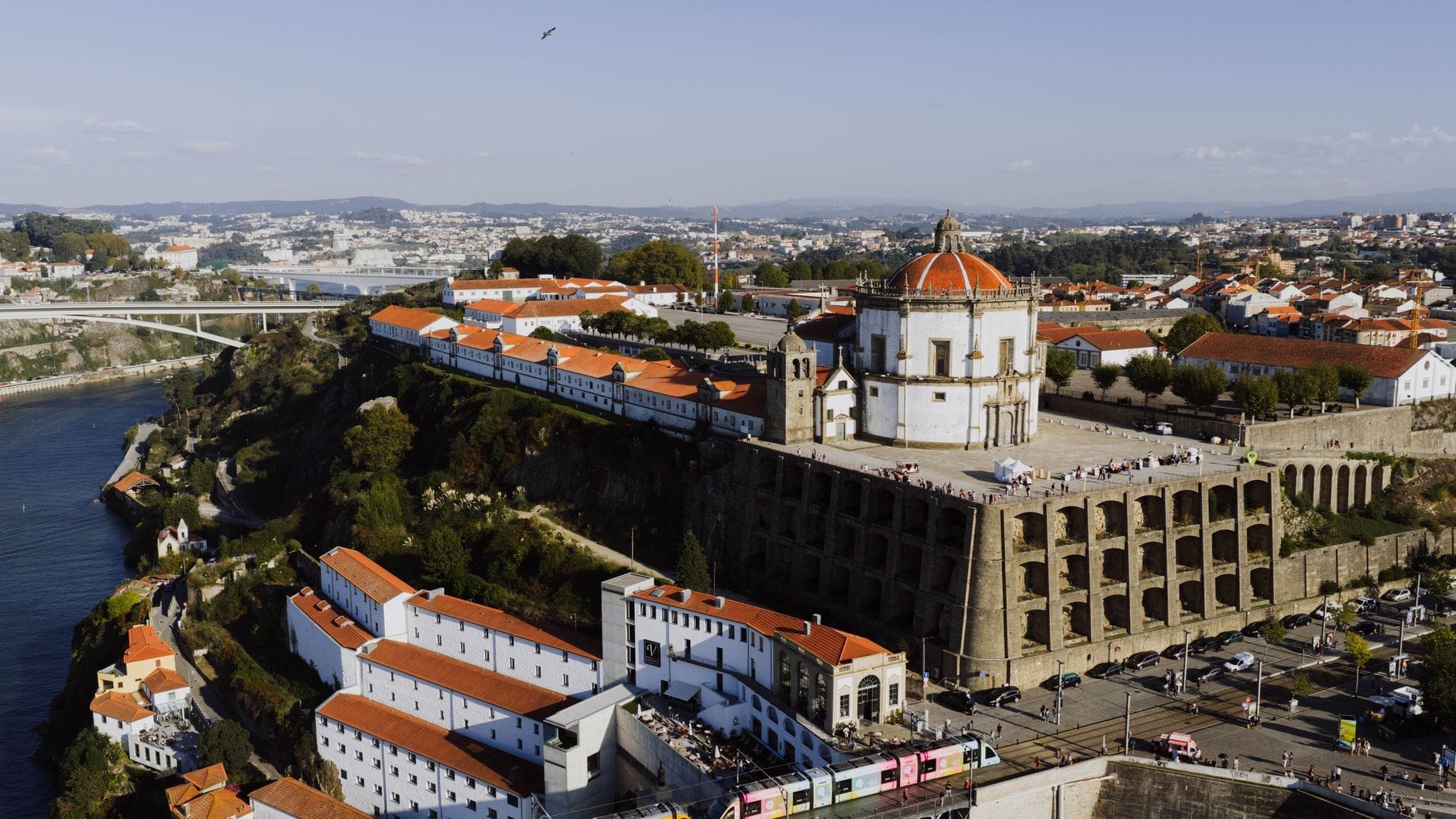
What the Monastery of Serra do Pilar Actually Is
The Mosteiro da Serra do Pilar sits at the crown of the hill on the Vila Nova de Gaia bank of the Douro, directly across the river from Porto's historic Ribeira quarter. From down at the waterfront it reads as a white dome and bell tower against the sky. Up close, it is something far more interesting: one of only two circular monastic churches in Portugal, topped by a domed rotunda and encircled by a round cloister of the same unusual form. Both the church and the cloister follow a circular plan, which was extraordinarily rare for Iberian religious architecture when construction began in 1538. The project took 72 years to complete.
The monastery belonged to the Augustinian order and functioned as an active religious community for centuries. In the 19th century it was militarised, used as a garrison and fortification, which is part of why its interior fabric is less ornate than comparable Portuguese monasteries. The military presence also meant the public had limited access for generations. Since the late 20th century the grounds have been progressively opened, and the site was included within Porto's UNESCO World Heritage designation in 1996, as part of the Historic Centre of Porto.
ℹ️ Good to know
The monastery's interior access is subject to opening hours and ticket availability, so confirm in advance, particularly if you are visiting on a Monday or outside summer months. The terrace and immediate surrounds are generally accessible during daylight hours, but confirm interior access in advance, particularly if you are visiting on a Monday or outside summer months.
The View: Why This Terrace Outperforms Porto's Miradouros
The hilltop terrace at Serra do Pilar gives you the single most complete panorama of Porto available from any publicly accessible point. From here the entire arc of the city stacks up in front of you: the terracotta rooftops of Ribeira at river level, the towers of the Sé Cathedral and Igreja dos Clérigos climbing the ridge behind, and the Dom Luís I Bridge stretching across the gorge at your feet. You are looking at the scene that appears on every Porto postcard, but from the position that produces it.
What makes the vantage point distinctive is the elevation and the angle. The terrace sits roughly level with the upper deck of the Dom Luís I Bridge, which means you see the bridge in profile rather than looking up at it from the waterfront. The Douro bends slightly here, so the river appears to curve away in both directions. On clear mornings, the light hits Porto's facade directly and the city reads in sharp relief. At dusk, the stone buildings turn amber and the whole skyline softens. Both moments are worth experiencing if your schedule allows.
The Porto-side miradouros, particularly the Vitória viewpoint, are well known and attract large groups throughout the day. Serra do Pilar draws visitors too, but the extra effort of crossing to Gaia keeps the numbers manageable. On a weekday morning in shoulder season you may find the terrace almost empty, which is a genuinely different experience from elbowing for a clear shot on the Porto side.
Tickets & tours
Hand-picked options from our booking partner. Prices are indicative; availability and final rates are confirmed when you complete your booking.
Serralves All-Access Pass
From 24 €Instant confirmationFree cancellationSao Bento da Vitoria Monastery Tour with Fado Concert
From 24 €Instant confirmationFree cancellationEntrance tickets to Serralves Park in Porto
From 15 €Instant confirmationFree cancellationSantiago de Compostela Full-Day Tour
From 79 €Instant confirmationFree cancellation
The Architecture: Circular Geometry in Stone
The circular cloister is the element that stops architects and close observers in their tracks. Portuguese religious architecture of the 16th century favoured rectangular cloisters, so the decision to build a round one here, with a colonnade of paired columns running the full circumference, was a deliberate statement. The proportions are precise and the stonework is restrained, closer to Italian Renaissance clarity than to the Manueline exuberance common in Portugal at the time construction began.
The church rotunda above echoes the same circular logic. The dome is relatively modest from the outside, but the interior, when accessible, demonstrates how carefully the geometry was controlled. Light enters through the drum and falls evenly around the space. The military occupation from the 19th century stripped much of the decorative programme, so visitors expecting gilded altars and azulejo-covered walls in the manner of other Porto churches will find the interior comparatively plain. That austerity is, arguably, what lets the architecture speak.
If you want to understand the broader context of Porto's religious architecture, the contrast is instructive: Serra do Pilar's restraint sits at one end of a spectrum, while the baroque intensity of Igreja de São Francisco in the city centre sits at the other. Visiting both in the same day gives you a clear sense of the range of ecclesiastical ambition at work across different centuries and orders.
Getting There: Metro, Cable Car, or on Foot
The most direct public transport option is Metro Line D, which stops at Jardim do Morro Station in Vila Nova de Gaia. From the station exit it is a short uphill walk to the monastery. The walk is steep in places and involves stone steps, so anyone with mobility limitations should factor that in. Comfortable, flat-soled footwear is strongly recommended regardless of your fitness level; the granite cobbles around the site can be slippery when wet.
Alternatively, the Gaia Cable Car runs from the riverside promenade in Gaia up to the hilltop area near the monastery. It is a pleasant and practical option, particularly if you are combining the monastery visit with time at the Cais de Gaia waterfront or one of the port wine lodges below. The cable car does not run continuously throughout the year, so check current operating status before planning your route around it.
You can also walk up from the Dom Luís I Bridge. If you cross on the upper deck, you emerge almost directly at the monastery's level and the walk from the bridge is only a few minutes. This is the approach most visitors who are already exploring the city on foot will find natural. Coming from Porto's Ribeira, crossing on foot and continuing up to Serra do Pilar makes a coherent half-day circuit.
💡 Local tip
Cross via the upper deck of the Dom Luís I Bridge on foot, visit Serra do Pilar, then descend to the Gaia cable car for the ride down to the waterfront. From there you can visit a port wine lodge before taking the metro back from Jardim do Morro. This loop takes roughly 3 hours and covers some of the best of Gaia without doubling back.
When to Visit: Light, Crowds, and Seasons
Morning visits, roughly between 9:00 and 11:00, offer the cleanest light for photographing Porto across the river. The sun rises behind you and illuminates the city facade directly, which is the condition that produces the sharpest and most saturated images of the skyline. Midday light is flatter and less interesting photographically, though the terrace itself is still worth the trip. Sunset is dramatic and popular: the sky behind Porto turns colour and the city lights begin to come on, but the terrace will be busier.
Seasonally, May, June, and September offer the most reliable combination of dry weather, comfortable temperatures, and reasonable crowd levels. July and August are warmer and clearer but bring more visitors. Winter visits are possible and sometimes rewarding, particularly on sharp clear days when the air is clean and the city reads with unusual definition, but rain is frequent from November through February and the terrace can be exposed and cold. Check the best time to visit Porto for a fuller breakdown of seasonal conditions across the city.
Historical Depth: Wellington, the Peninsular War, and UNESCO
The site's military significance is not only modern. During the Peninsular War in the early 19th century, the monastery was used as a command post. It was from this elevated position, with its clear sightlines across the Douro, that British forces under Arthur Wellesley, later the Duke of Wellington, coordinated the crossing of the Douro in May 1809 to retake Porto from French forces. That crossing is considered one of the more daring river crossings in Napoleonic-era warfare. Standing on the terrace and looking at the width of the river, the tactical logic becomes immediately clear.
The UNESCO designation in 1996 recognised The UNESCO designation in 1996 recognised the Historic Centre of Porto, Luiz I Bridge and Monastery of Serra do Pilar as an outstanding urban ensemble, with Serra do Pilar identified as a defining visual and spatial anchor of the group. The monastery's hilltop position is not incidental to its heritage value: the building and its setting are understood as inseparable. The monastery's hilltop position is not incidental to its heritage value: the building and its setting are understood as inseparable.
Who Should Consider Skipping It
If your primary interest is elaborate church interiors, gilded woodwork, or azulejo panels, Serra do Pilar will likely disappoint. The military history of the building stripped away most of the decorative richness you find in comparable Porto churches, and interior access is not always available. Visitors with significant mobility impairments will also find the approach challenging, since the route from the metro involves uneven stone steps and a gradient that is difficult to navigate without assistance. If the view is your only goal, note that the Jardim do Morro itself, reachable by metro, offers a similar panorama with far easier access and no interior-access uncertainty.
⚠️ What to skip
Opening hours for the church interior and cloister are subject to change and have historically varied by season and ticketing arrangements. Do not assume the interior will be open on arrival. Check with the local tourist office or Visit Portugal before making the monastery's interior the centrepiece of your day. Do not assume the interior will be open on arrival. Check with the local tourist office or Visit Portugal before making the monastery's interior the centrepiece of your day.
Insider Tips
- Cross the Dom Luís I Bridge on its upper deck rather than lower. You arrive almost at monastery level and avoid the steep cobbled climb from the riverside.
- The terrace faces northwest toward Porto. For the best photography light, come in the morning when the sun is behind you and the city facade is fully lit. At sunset the sky behind Porto is colourful but the city itself falls into partial shadow.
- The round cloister, when accessible on guided tours, is best appreciated by walking slowly around the full circumference rather than cutting across the centre. The proportional consistency of the colonnade only becomes apparent in motion.
- Combine Serra do Pilar with a port wine lodge visit on the same half-day. Several major lodges including Graham's and Sandeman are within a 10-minute walk downhill toward the river, and the contrast between two very different expressions of Gaia's heritage is worth the effort.
- On busy summer weekends, the terrace can fill with tour groups between 10:30 and 13:00. Arriving before 10:00 or after 16:00 significantly improves both the experience and your chances of a clear photograph.
Who Is Monastery of Serra do Pilar For?
- Photographers who want Porto's skyline from the definitive angle without crowds
- Architecture enthusiasts interested in rare circular Renaissance monastic design
- History-minded travellers curious about the Peninsular War and Wellington's Douro crossing
- Visitors combining a Gaia half-day with port wine lodge tours
- Travellers who want a less-packaged alternative to the standard Porto-side viewpoints
Nearby Attractions
Other things to see while in Vila Nova de Gaia:
- Cais de Gaia Waterfront
Cais de Gaia is the riverside promenade of Vila Nova de Gaia, stretching along the south bank of the Douro directly opposite Porto's UNESCO-listed Ribeira quarter. Free to walk at any hour, it offers some of the most photogenic views of Porto's skyline, the Dom Luís I Bridge, and the traditional Rabelo boats. For first-time visitors and returning travelers alike, this waterfront rewards those who cross the river.
- Cálem Port Wine Cellars
Founded in 1859 and set directly on the Douro waterfront in Vila Nova de Gaia, Cálem is one of Porto's most recognizable port wine cellars. Guided tours take visitors through atmospheric barrel-lined galleries, covering the history and craft of port production, and end with a tasting. Here is what to expect before you go.
- Gaia Cable Car (Teleférico de Gaia)
The Teleférico de Gaia is a 562-metre cable car linking the Vila Nova de Gaia riverfront to the upper deck of the Dom Luís I Bridge. The ride lasts under four minutes, but the panoramic views across the Douro to Porto's old city make it one of the most photogenic short journeys in northern Portugal.
- Graham's Port Lodge
Graham's Port Lodge sits on a hill above the Douro in Vila Nova de Gaia, offering guided cellar tours through a beautifully restored 1890 lodge and tasting experiences that range from a straightforward introductory pour to a luxury vintage flight. It is one of the more polished port wine experiences on the Gaia side of the river, with serious production credentials to back it up.